







I created a file in Illustrator and saved as a PDF. It is for printing on a tool mat about 24″ x 12″. I am not able to email the file or upload it to the print company via Amazon (or here for that matter) because there is an image in the file making it too large apparently (116,373KB). The image was resized to be the dimensions of the mat in Photoshop then placed into the Illustrator file.—from Adobe
Understanding Why Your PDF Is Too Large to Email
What Does “PDF Too Large to Email” Mean?
When you encounter the issue of a pdf too large to email, it typically means the file exceeds the size limit set by email providers. Most services like Gmail or Outlook impose attachment limits ranging from 20MB to 25MB. If your PDF goes beyond this threshold, it won’t be delivered successfully.
Large PDFs are often the result of embedded images, high-resolution graphics, or unnecessary metadata. Even a simple document can grow in size if it includes scanned pages or multiple visual elements. This problem is especially common for business reports, portfolios, and presentations.
Understanding this limitation is the first step toward solving the issue efficiently. Instead of repeatedly trying to send the file, it’s better to explore optimized methods for reducing size or using alternative sharing techniques.
⚠️Warning: Repeatedly attempting to send oversized files may result in email delivery failure or temporary account restrictions.
Common Email Attachment Size Limits
Different email providers enforce different attachment size caps. Knowing these limits can help you decide how much you need to compress your file.
- Gmail: 25MB
- Outlook: 20MB
- Yahoo Mail: 25MB
- Corporate email servers: Often 10–20MB
If your PDF exceeds these limits, you’ll need to compress it or use file-sharing services. In many cases, even a slight reduction in file size can make the difference between successful and failed delivery.
Another important factor is encoding. Email systems encode attachments, which can slightly increase file size during transmission. This means your PDF might need to be even smaller than the stated limit.
Understanding these constraints allows you to choose the most effective solution, whether that’s compression, conversion, or cloud sharing.
What Causes Large PDF Files?
High-Resolution Images and Graphics
One of the main reasons behind a pdf too large to email issue is the inclusion of high-resolution images. PDFs created from scanned documents or design software often contain images with resolutions far higher than necessary for screen viewing.
For example, a scanned document saved at 600 DPI will be significantly larger than one saved at 150 DPI. While higher resolution improves print quality, it’s unnecessary for email sharing.
Reducing image resolution or compressing embedded graphics can drastically decrease file size without noticeably affecting readability.
⚠️Warning: Over-compressing images may result in blurry or unreadable content.
Embedded Fonts and Metadata
Another contributing factor is embedded fonts and hidden metadata. PDFs often include font files to ensure consistent formatting across devices. While useful, these fonts can add considerable size.
Metadata such as editing history, comments, and document properties can also inflate file size unnecessarily. Removing this hidden data can help streamline your PDF.
Cleaning up these elements not only reduces file size but also improves document security by removing potentially sensitive information.
Best Ways to Fix “PDF Too Large to Email”
Method 1: Compress the PDF Using Built-in Tools
Test Environment: Windows 11, Adobe Acrobat Reader DC, 8GB RAM
One of the simplest ways to resolve the pdf too large to email problem is by using built-in compression tools available in PDF editors.
Steps:
- Open the PDF in your PDF editor.
- Navigate to the “Save As” or “Reduce File Size” option.
- Select a lower compatibility version.
- Save the compressed file.
This method is quick and doesn’t require additional software. Most PDF tools offer preset compression levels, allowing you to balance quality and size.
However, the effectiveness depends on the original file content. If the PDF contains many high-resolution images, compression may only reduce size moderately.
Method 2: Convert PDF to ZIP Format
Test Environment: Windows 10, WinRAR / 7-Zip, 16GB RAM
If compression alone isn’t enough, you can try how to convert a big PDF into a ZIP file to make it easier to send via email.
Steps:
- Right-click the PDF file.
- Select “Add to archive” or “Compress to ZIP.”
- Choose ZIP format.
- Send the compressed ZIP file via email.
ZIP compression works best for text-heavy PDFs. While it may not drastically reduce image-heavy files, it can still bring the size within acceptable limits.
Additionally, ZIP files are widely supported and easy for recipients to extract.
⚠️Warning: Some corporate email systems may block ZIP attachments for security reasons.
Method 3: Split the PDF into Smaller Parts
Test Environment: macOS Ventura, Preview App, 8GB RAM
Another effective solution is to divide the PDF into smaller sections. This method is particularly useful when the document contains multiple chapters or sections.
Steps:
- Open the PDF in a viewer.
- Select pages to extract.
- Save each section as a new PDF file.
- Send multiple emails with smaller attachments.
Splitting ensures each file stays within size limits. It also allows recipients to access specific sections without downloading the entire document.
However, this approach may not be ideal for formal documents that need to remain intact.
Method 4: Use Online PDF Compression Services
Test Environment: Chrome Browser (latest version), Windows 11, stable internet connection
Online tools provide a convenient way to compress PDFs without installing software. Simply upload your file, select compression settings, and download the reduced version.
Steps:
- Visit a reliable online PDF compressor.
- Upload your file.
- Choose compression level.
- Download the optimized PDF.
This method is fast and user-friendly, especially for non-technical users. Many services offer drag-and-drop functionality and instant results.
⚠️Warning: Avoid uploading sensitive documents to untrusted websites, as this may pose privacy risks.
Test Environment: Windows 11, Google Drive / Dropbox, Chrome Browser, 16GB RAM
If your pdf too large to email issue persists even after compression, using cloud storage is one of the most reliable alternatives. Instead of attaching the file directly, you upload it to a cloud platform and share a download link.
Steps:
- Upload your PDF to a cloud service like Google Drive or Dropbox.
- Right-click the file and select “Get link.”
- Adjust permissions (view-only or editable).
- Copy and paste the link into your email.
This method completely bypasses email size limitations and ensures smooth delivery. It is especially useful for large business documents, portfolios, or reports.
Cloud sharing also allows real-time updates. If you replace the file, the shared link remains valid, making it highly efficient for collaboration.
⚠️Warning: Always double-check sharing permissions to avoid exposing sensitive information publicly.
Method 6: Reduce PDF Size by Optimizing Images
Test Environment: Windows 10, Photoshop + PDF Editor, 16GB RAM
Since images are the primary cause of a pdf too large to email problem, manually optimizing them can significantly reduce file size.
Steps:
- Extract images from the PDF.
- Compress them using image editing software.
- Reduce resolution to 150–200 DPI.
- Reinsert the optimized images into the PDF.
This approach gives you full control over quality and size. It is particularly useful for design-heavy PDFs where automatic compression tools may not deliver the desired balance.
Additionally, removing unnecessary images or replacing them with lower-resolution versions can further reduce file size.
⚠️Warning: Always keep a backup of the original PDF before editing images to prevent permanent quality loss.
Method 7: Recreate the PDF with Optimized Settings
Test Environment: macOS Sonoma, Microsoft Word, Built-in PDF Export Tool, 8GB RAM
Sometimes the best solution is to recreate the PDF using optimized export settings. Many applications allow you to choose between print-quality and web-quality outputs.
Steps:
- Open the original source file (Word, PowerPoint, etc.).
- Select “Export as PDF.”
- Choose “Minimum size” or “Web optimized.”
- Save the new PDF file.
This method often produces significantly smaller files compared to compressing an already large PDF. It works best when you still have access to the original editable document.
Re-exporting ensures that unnecessary data, hidden layers, and excessive resolution are removed automatically.
Method 8: Recover and Optimize PDF Files Using PandaOffice Drecov
Test Environment: Windows 11, PandaOffice Drecov, 8GB RAM, NTFS file system
In some cases, a pdf too large to email issue may be linked to file corruption, duplication, or improper saving processes. This is where PandaOffice Drecov becomes useful—not as a compression tool, but as a recovery and optimization solution.
Steps:
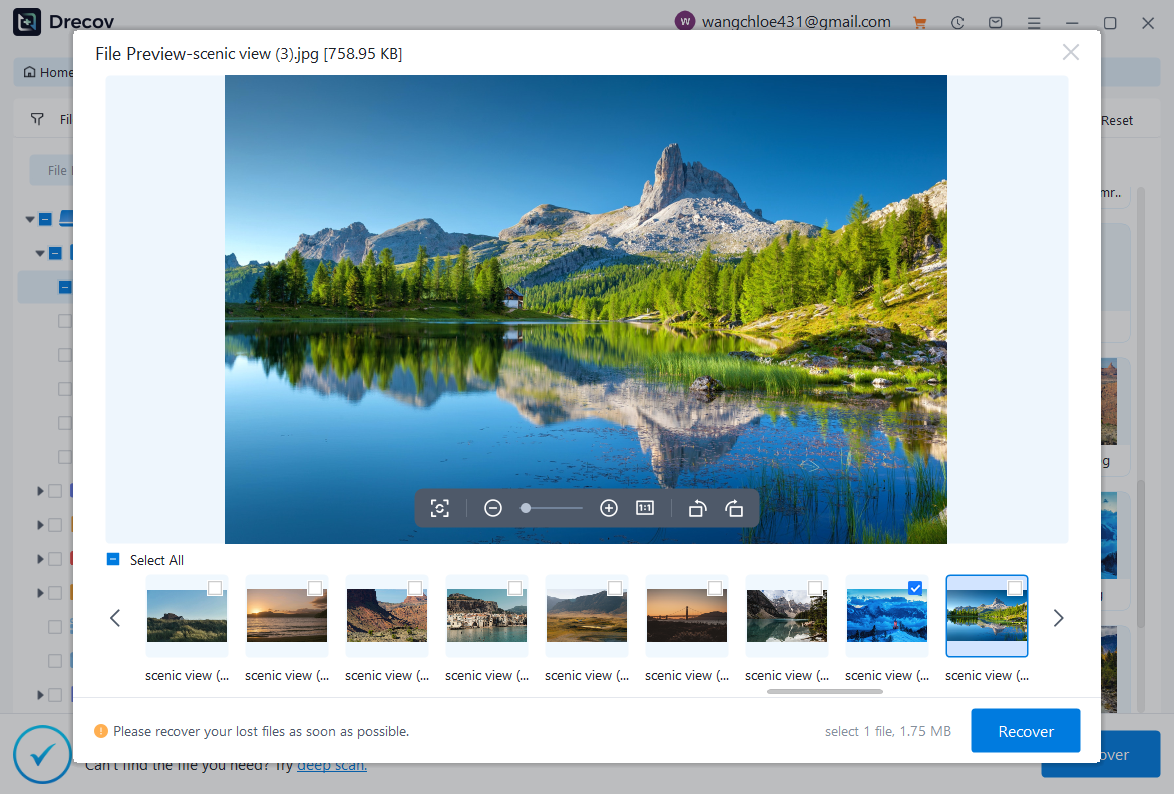
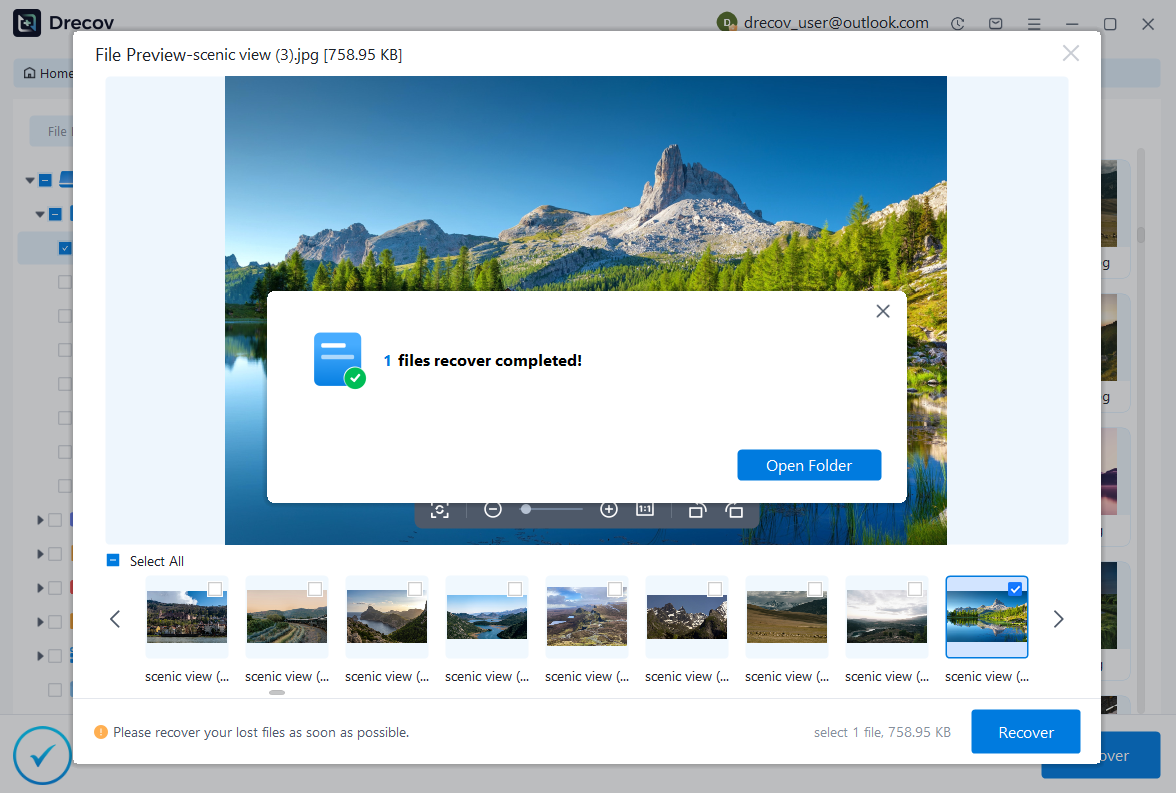
- Launch PandaOffice Drecov.
- Select the location where the PDF is stored.
- Scan for recoverable or duplicate files.
- Preview and restore the correct version.
- Save the recovered file and apply compression if needed.
This method is especially helpful when dealing with:
- Corrupted PDF files
- Duplicate versions increasing storage usage
- Unexpected file size inflation after recovery

Why Choose PandaOffice Drecov?
PandaOffice Drecov is a versatile and reliable solution for recovering a wide range of lost or inaccessible files. Whether you need audio recovery, video recovery, or excel recovery files, PandaOffice Drecov provides fast and efficient results, ensuring your important data is safely restored.
For creative professionals, it supports file recovery Illustrator projects, allowing designers to retrieve unsaved or accidentally deleted artwork without compromising file integrity. Businesses and individuals can also benefit from its restore Windows previous date feature, which helps recover documents or spreadsheets that were lost due to system errors or accidental deletions.
When external storage devices fail, such as a Lacie hard drive not showing up, PandaOffice Drecov can detect and restore files from these drives, ensuring you do not lose critical data. Even deleted files in the recycle bin can be recovered using its advanced recycle bin recovery software capabilities.
Additionally, the software supports recovering data from lost partitions, making lost partition recovery straightforward and reliable. Its intuitive interface allows users to perform audio recovery, video recovery, and excel recovery effortlessly, even for large or complex files.
With PandaOffice Drecov, you get a professional, all-in-one recovery solution that covers nearly every type of file and storage scenario. Its robust algorithms, combined with easy-to-use tools, make it the go-to choice for anyone who wants to restore lost or corrupted data quickly and securely.
By restoring a clean version of the document, you can avoid unnecessary file bloat and ensure better compatibility with compression tools.
FAQ About PDF Too Large to Email
How can I quickly fix a PDF too large to email without software?
You can use online compression tools or cloud storage services. Uploading your file and sharing a link is often the fastest workaround when you don’t want to install additional software.
Does converting a PDF to ZIP always reduce file size?
Not always. Understanding how to convert a big PDF into a ZIP file is useful, but ZIP compression works best for text-based files. Image-heavy PDFs may not see significant reduction.
What is the best file size for email attachments?
Ideally, keep attachments under 20MB to ensure compatibility across most email platforms. This reduces the risk of delivery failure.
Will compressing a PDF reduce its quality?
Yes, compression can affect quality, especially for images. However, most tools allow you to choose a balance between size and clarity.
Conclusion: Best Practices to Handle Large PDFs
Dealing with a pdf too large to email problem doesn’t have to be frustrating. With the right approach, you can quickly reduce file size or bypass email limitations altogether.
The most effective strategies include:
- Compressing the PDF using built-in or online tools
- Learning how to convert a big PDF into a ZIP file for easier transfer
- Splitting large documents into smaller sections
- Using cloud storage for seamless sharing
- Optimizing images and recreating PDFs with better settings
Each method has its own advantages, and the best choice depends on your specific situation. For quick fixes, compression and ZIP conversion work well. For larger or more complex files, cloud sharing is often the most efficient solution.
By applying these techniques, you can ensure your PDFs are always ready to send—without compromising quality or efficiency.





