







A deleted user account Windows 10 event can remove both sign-in information and the local profile data associated with that account. Creating another account with the same name does not restore the old Desktop, Documents, Downloads, or application data. Stop installing programs and saving files to the affected Windows partition. First check whether the old profile folder, a backup, or a synced copy still exists; if not, recover files before routine use overwrites their space.
Account removal and file deletion are separate events
A Windows account is an identity used to sign in. Its profile is a collection of folders, registry settings, application data, and permissions stored locally, usually beneath C:\Users. Removing an account may remove its local data from the device, but it does not necessarily delete the person’s Microsoft account or cloud data. Microsoft makes that distinction in its official page for managing user accounts in Windows.
The exact outcome depends on how the account was removed. Settings may have shown an “Account and data” removal action. An administrator may have deleted the profile through advanced system settings. A domain or work account may have been disconnected while the local profile remained. Resetting Windows, deleting a user folder manually, or running a cleanup tool creates different evidence. Write down what was done and when before trying to reconstruct the account.
| What remains | Meaning | Next move |
|---|---|---|
C:\Users\OldName opens and contains current files | The local profile data still exists | Copy it to another drive before changing ownership or permissions |
| The folder exists but access is denied | Permissions or encryption may block the new account | Identify ownership and encryption; do not delete or replace the folder |
| The folder is absent, but OneDrive contains files | Some known folders were synchronized | Download a separate copy and check version history |
| The folder is absent everywhere | Local deletion is likely | Reduce writes and scan the original Windows volume |
| The drive is unstable or makes unusual sounds | Physical failure may accompany the loss | Stop direct scans and seek imaging or professional recovery |
Search the places that do not require recovery software
Inspect every profile folder without moving it
Sign in with a separate administrator account and open C:\Users. Look for the old account name, a shortened Microsoft account name, OldName.000, or a profile bearing the computer or domain name. Enable Hidden items so that you can see AppData when needed. Do not drag the entire profile into a new account. First copy visible personal folders to an external drive and open representative files there.
An Access Denied message does not mean the data is gone. Permissions may still refer to the old security identifier. Taking ownership modifies access-control information, so preserve a backup or disk image when the files are important. Files protected with Encrypting File System require the original certificate and private key; ordinary ownership changes do not decrypt them.
Check OneDrive and other account-based storage
If Desktop, Documents, or Pictures was backed up to OneDrive, sign in through the web rather than immediately reconnecting a new local folder. Check the online Recycle Bin and version history. Verify dates and contents before downloading to another healthy location. Repeat this check for business storage, other cloud services, and application-specific accounts.
Look for File History, image backups, and Windows.old
Connect a File History drive without allowing new backups to overwrite old versions. Browse the backup by the former username and restore to a separate destination. If a system image exists, mount or examine a copy rather than restoring the whole computer immediately. After an upgrade or reset, Windows.old\Users may hold a previous profile, but Windows can remove that folder automatically after a retention period. Copy useful data while it is available.
Do not recreate activity on the affected volume
Every browser download, Windows update, temporary file, and newly installed program can reuse clusters that held the deleted profile. Creating another account also writes a fresh profile. If the missing files matter, use the computer as little as possible. A second PC is preferable for downloading recovery software and preparing a destination drive.
Do not create a new account with the expectation that Windows will reconnect the deleted folder. A matching display name does not recreate the old security identifier. Avoid System Restore as a file-recovery method; restore points focus on system state and are not a reliable archive of personal documents. Do not run cleanup, optimization, CHKDSK, reset, or reinstall operations before recovering needed data.
If Windows no longer starts, the same recovery-first rule applies. Use a stable boot environment or connect the drive to another Windows PC only if the device is physically healthy. Preserve BitLocker recovery information before moving an encrypted system drive. Without the key, recovery software cannot bypass encryption.
Use Drecov when the old profile files are actually missing
Drecov is Windows data recovery software that can search a stable PC drive, HDD, SSD, external disk, USB device, SD card, or memory card. Its read-only recovery mode avoids repairing the source. Quick Scan, Deep Scan, filters, preview, and Lost Partition Recovery can locate documents, photos, videos, email data, audio, and archives. In this scenario, its role is to recover deleted local files from the original Windows volume. It cannot recreate the account, restore passwords, bypass BitLocker or EFS, repair physical damage, or recover data that has been fully overwritten.
Prepare an external drive large enough for the recovered profile data. Do not install Drecov on the Windows partition that held the deleted account. If the source is an SSD, deletion and TRIM may reduce recoverability. That is a reason to minimize use, not a guarantee about the outcome. If the drive disconnects, overheats, clicks, or reports severe read errors, stop and seek an image or specialist assessment.
⚠ Warning: Install it on a drive different from the one where your data was lost to prevent overwriting.
Step 1: Open Drecov and select the former profile volume
Choose the partition that contained C:\Users\OldName. Confirm it by capacity and layout. If the partition itself disappeared, select Lost Partition Recovery instead of creating a new partition.

Step 2: Start Quick Scan and trace the old folder structure
Run Quick Scan first. Browse for the former Users path and filter by file type, name, modified date, and size. Search for a few known filenames from Desktop, Documents, Downloads, Pictures, and project folders.

Step 3: Continue with Deep Scan only on stable storage
If Quick Scan does not find important files and the disk remains consistently detected, run Deep Scan. Stop at new instability; repeated direct scanning cannot make failing hardware safer.
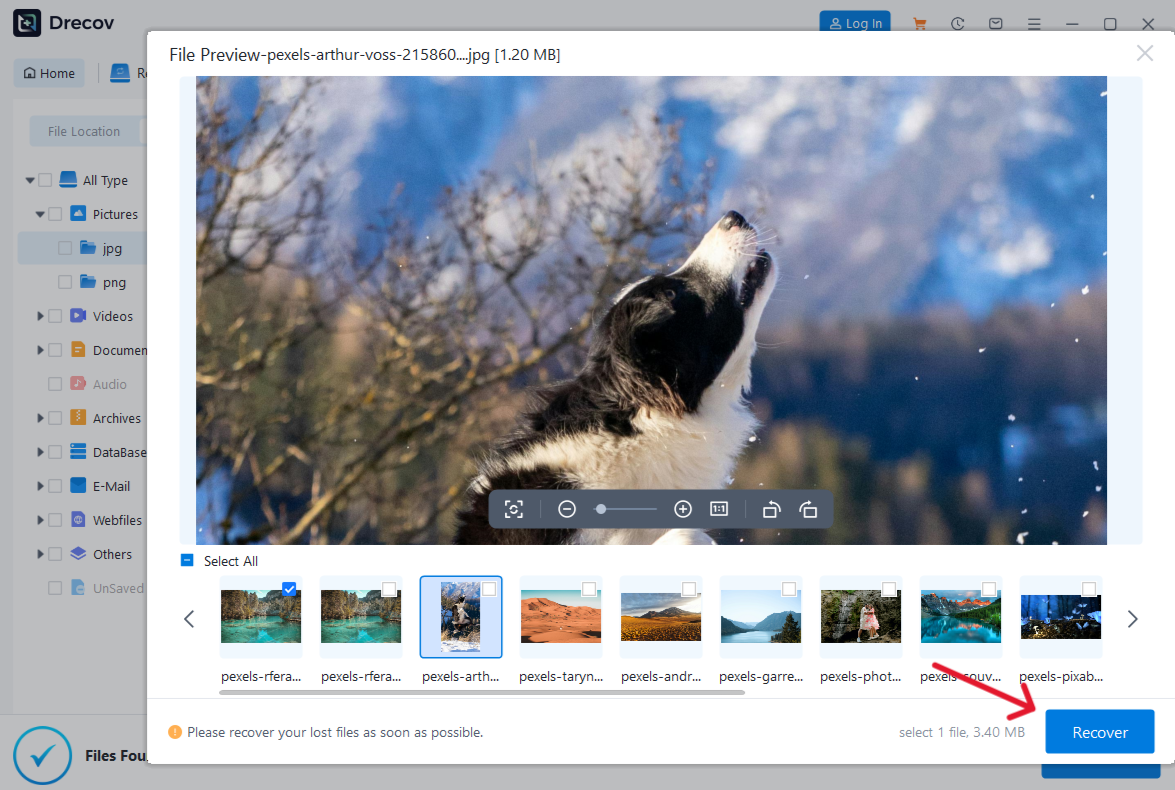
Step 4: Filter, preview, and recover to the external drive
Use old paths, filenames, types, dates, and sizes to narrow the results. Preview representative supported files. Preview confirms that the sample can be decoded, not that every page, embedded object, or archive member is intact. Recover selected data to the external drive, never to C:. If output is not where expected, check Drecov Folder or Recovery Folder.
Step 5: Verify the recovered profile as data, not as an account
Open documents, images, videos, and archives from the destination. Compare folder counts and dates. Keep the recovered set unchanged, then copy only verified personal files into a newly created account. Do not copy the old registry hive or all of AppData blindly, because damaged settings and stale security data can follow.
⚠ Warning: Install it on a drive different from the one where your data was lost to prevent overwriting.
Rebuild access after the files are safe
Create a new account only after recovery. Use a distinct temporary name so the new folder cannot be confused with recovered material. Sign in once to let Windows build the profile, then copy verified documents into the corresponding folders. Reinstall applications from trusted sources instead of copying program directories. Import browser data, mail stores, templates, and application settings selectively.
For future protection, keep at least one backup that does not depend on the same Windows account. Test restoration, not just backup completion. A cloud sync protects some changes but can also synchronize deletions; an offline or versioned copy provides a different failure boundary.
Related Drecov resources include the Drecov homepage, methods to recover deleted files, a Windows-focused data recovery overview, and guidance for retrieving a deleted document outside the Recycle Bin. These support file recovery; none recreates the former Windows identity.
Deleted user account Windows 10 FAQs
Does deleting a Windows user delete the Microsoft account?
No. Removing the Windows account from a device does not itself delete the online Microsoft account, although local sign-in data and profile files may be removed.
Can I create an account with the same name to restore the files?
No. The new account receives a different security identifier and a new profile. Recover or copy the old files separately.
Why can I see the old folder but not open it?
The new account may lack permission, or the files may be encrypted. Preserve the folder before changing ownership and locate any EFS or BitLocker keys.
Will System Restore bring back the user profile?
Do not rely on it for personal files. Use File History, cloud versions, image backups, or file recovery instead.
Can Drecov recover the deleted account password?
No. Drecov recovers eligible files from storage. It does not recover account credentials or bypass encryption.
Conclusion
After a deleted user account Windows 10 event, separate identity repair from data recovery. Search the old Users folder, cloud storage, File History, images, and Windows.old first. If local files are genuinely gone, reduce writes and use Drecov to scan the original volume, recover candidates to another drive, and verify them. Rebuild the account only after the data is safe, then transfer verified personal files rather than the entire damaged profile.
⚠ Warning: Install it on a drive different from the one where your data was lost to prevent overwriting.






