







If your WD My Passport not showing up, start with a direct USB connection, another known-good cable, and another computer. Then check Device Manager and Disk Management. Do not initialize, format, or run CHKDSK when the drive contains needed files. If it clicks, repeatedly disconnects, or cannot stay powered, stop using it and seek professional recovery. Software is suitable only when the device remains stable and Windows can detect the physical disk.
Quick Answer
If you are dealing with a WD My Passport not showing up, connect the drive directly rather than through a hub, try another port and cable, and allow Windows a minute to enumerate it. If Disk Management shows a healthy volume without a letter, assign an unused letter. If it appears as RAW, unallocated, not initialized, or wrong capacity, protect the data before modifying it. Western Digital lists cable, port, power, and another-computer checks in its official My Passport detection guidance.
What the Symptom Usually Means
A My Passport can be absent from File Explorer while still appearing in Disk Management. That difference matters. The general removable drive detection guide explains the Windows layers, while this article focuses on WD My Passport power, cable, and failure behavior.
Listen only long enough to classify behavior. Normal spin-up followed by stable detection suggests a logical or configuration issue. Clicking, repeated spin attempts, hot operation, severe slowdown, or constant disconnects suggests physical trouble. Avoid repeated power cycles when those signs appear.
| Clue | Likely area | Safest first action |
|---|---|---|
| No sound and no Device Manager entry | Cable, port, or power path | Try a direct port and known-good cable |
| Disk Management shows healthy volume | Missing drive letter | Assign an unused letter |
| Disk shows RAW or unallocated | File system or partition damage | Recover files before repair |
| Clicking or repeated disconnects | Possible physical failure | Stop DIY work and seek a specialist |
Classify the My Passport Before Trying a Fix
Stable Detection Suggests a Logical Problem
A drive that spins normally, stays connected, and appears with the correct capacity in Disk Management may have a drive-letter, file-system, or partition problem. Read-only inspection is appropriate. Cancel any prompt to initialize or format the disk while files are needed.
Unstable Behavior Changes the Recovery Plan
- Stop if the drive clicks, scrapes, repeatedly spins down, or vanishes during reads.
- Do not keep swapping ports when every connection produces the same unstable behavior.
- Avoid CHKDSK on a RAW or intermittently detected volume because it modifies file-system structures.
- Do not open the enclosure or assume that an enclosure swap is safe for every My Passport model.
Prepare for a Stable Logical-Recovery Attempt
Use a direct USB connection and a known-good cable. Prepare a separate healthy destination before scanning. If the disk remains stable, perform one controlled recovery attempt. If stability deteriorates, stop and seek imaging or professional service.
Fixes From Lowest to Highest Risk
1. Check the Physical Connection
Disconnect USB hubs, extension cables, and docks. Connect the My Passport directly to a rear desktop port or a main laptop port. Try a known-good compatible cable and another computer. If the drive becomes stable only with one cable or port, copy important files immediately to a healthy disk.
2. Inspect Device Manager
Open Device Manager and expand Disk drives and Universal Serial Bus controllers. A visible WD device confirms partial detection. Scan for hardware changes after reconnecting once. Do not repeatedly uninstall controllers on a system with other unstable USB devices. Driver troubleshooting cannot repair a clicking disk.
3. Use Disk Management Without Writing
Open Disk Management and identify the drive by capacity. If its volume is healthy but lacks a letter, assign an unused letter. If it is Offline, review why before bringing it online. Cancel requests to initialize or format. Read-only inspection is diagnostic; creating a volume is a destructive change.
4. Address a Conflicting Drive Letter
Choose Change Drive Letter and Paths only for a healthy recognized volume. Select a letter not used by network mappings or other disks. The related external hard drive connection guide provides context for USB storage behavior. A drive letter will not fix RAW or unallocated space.
5. Recover Before File-System Repair
If the disk is stable but folders are inaccessible, recover files first. A RAW volume needs a recovery-before-repair approach. The file recovery workflow explains scanning and preview decisions without treating repair as recovery.
Recover Data From a Stable My Passport Before Repair
In cases of WD My Passport not showing up correctly, recovery is appropriate when Windows detects the physical My Passport consistently but its files are missing, RAW, or inaccessible. It is not appropriate for a clicking drive or one that cannot remain connected. Initialization, formatting, and CHKDSK should wait until important files are safe.
Why Drecov May Be Suitable
PandaOffice Drecov is Windows data recovery software for external drives and other supported storage. Its read-only recovery workflow includes Quick Scan, Deep Scan, filtering, preview, and export to a selected healthy destination. It does not repair USB power faults or physical disk damage.
⚠ Warning: Install it on a drive different from the one where your data was lost to prevent overwriting.
Step 1: Choose the Detected My Passport
Open Drecov and select the original My Passport location. Confirm its capacity so you do not scan the computer disk or recovery destination by mistake. Install and run the software from a healthy Windows location.

Step 2: Match the Scan to the Symptom
Start with Quick Scan when a drive letter or folders recently disappeared. Use Deep Scan when the volume is RAW, unallocated, or the expected directory tree is missing. Stop immediately if the device begins disconnecting or producing abnormal sounds.
Step 3: Preview Files and Recover to Another Drive
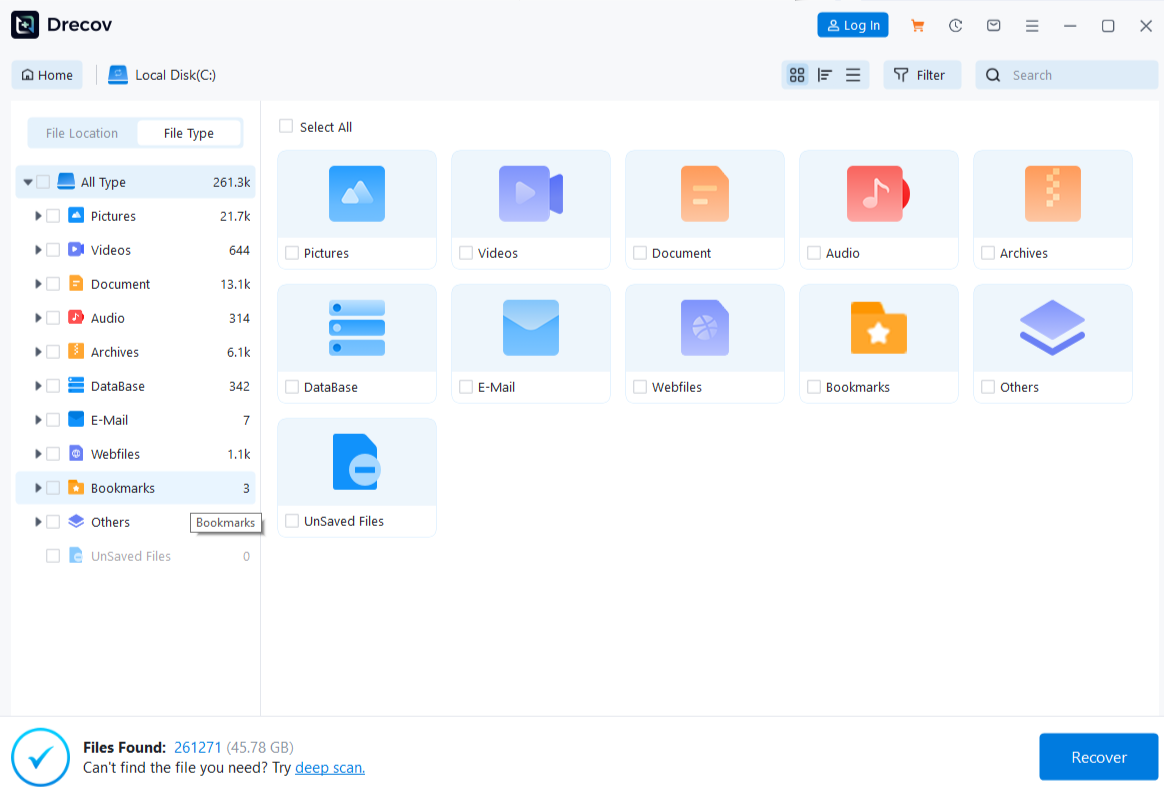
Filter for the needed documents, photos, videos, emails, audio files, or archives. Preview important items and recover them to another healthy device. If the output is not where expected, inspect the Drecov folder or Recovery folder. Back up verified files before repairing or reformatting the My Passport.
When to Stop DIY Work
Stop if the My Passport clicks, scrapes, spins up and down, disappears during reads, becomes unusually hot, or reports a wildly incorrect capacity. Do not open the enclosure. Portable WD models may have hardware and encryption details that make casual enclosure swaps unsuitable.
Every reconnect spins and reads the My Passport again. Repeated attempts can add stress when the drive clicks, drops offline, or slows dramatically. Stop direct scans, avoid opening the enclosure, and use a specialist when the disk cannot remain stable long enough for a controlled image.
Confirm Whether the My Passport Is Truly Stable
Verify Detection and File Access
Reconnect the drive once and confirm its model, capacity, file system, and drive letter. Open several files from different folders and copy critical data to another disk. Brief detection is not enough if the drive later disappears.
Watch for Returning Hardware Symptoms
Listen for repeated spin cycles and monitor disconnects during ordinary reads. If either returns, stop testing. Do not treat a successful drive-letter change as evidence that the hardware is healthy.
Repair Only After Two Copies Exist
Keep the recovered set on a healthy destination and create a second backup when the data is valuable. Only then consider CHKDSK, initialization, a new volume, or formatting for reuse. Replace the drive if stability remains doubtful.
Retest the Original Cable Path
Label the cable and port that provided stable detection. After the data is safe, compare one alternative cable or computer. If failures follow the drive rather than the connection, retire the device. If they follow one cable or hub, replace that component and continue monitoring the backup copy.
WD My Passport Not Showing Up FAQs
Why does My Passport appear in Disk Management but not File Explorer?
A missing drive letter, unsupported or damaged file system, offline state, or lost partition can hide it from File Explorer. The Disk Management status determines the next safe action.
Should I initialize a WD drive when Windows asks?
Not when it contains needed files. Initialization writes partition metadata. Recover or image first, then initialize only after data is safe.
Will CHKDSK make the drive appear?
CHKDSK changes file-system structures and can make recovery harder. It is not the first step when files matter or the disk is unstable.
Can recovery software fix a clicking My Passport?
No. Clicking and repeated disconnects can indicate physical failure. Software does not repair hardware, and scanning may add stress.
Conclusion
For WD My Passport not showing up, begin with cable, port, power, Device Manager, and read-only Disk Management checks. Assign a letter only to a healthy volume. Recover with PandaOffice Drecov only when the disk is stable and detectable, and stop DIY attempts at physical-failure signs.





