







It is a scenario every computer user dreads: you plug in your USB drive to access critical files, only to find your flash drive not showing up on your computer. Whether you are dealing with an unrecognized device error or total silence from your operating system, the initial panic is entirely understandable. Fortunately, this common technical glitch rarely means your data is permanently gone. In most cases, the issue stems from minor software conflicts, corrupted file systems, or outdated device drivers that you can fix right from your desk.
Before you take drastic measures that might permanently erase your files, you need a reliable roadmap to diagnose the problem and safeguard your data. This comprehensive guide will walk you through exactly why a flash drive not showing up happens and provide clear, step-by-step solutions to fix it. Let us dive in and get your data back.
Understanding the Basics of Flash Drive Not Showing Up
When a flash drive not showing up error occurs, it means the operating system’s communication loop with the USB controller has broken down. For a storage device to appear in your file explorer, your system must successfully detect the hardware connection, allocate a drive letter, and read the drive’s partition table.
Common Causes of USB Detection Issues
- Physical Port Failure: Dust, physical debris, or damaged pins inside the USB port can prevent a solid connection.
- Driver Corruption: Operating system updates or unsafe removals can leave your USB mass storage drivers in a corrupted state.
- File System Incompatibility or Corruption: If a drive was formatted using a file system your current OS cannot read (like an Apple HFS+ drive plugged into a Windows machine), it will fail to load normally.
- Drive Letter Conflicts: Sometimes, Windows assigns a drive letter to the USB that is already in use by a network share or an internal drive, causing it to remain hidden.
Introducing PandaOffice Drecov Data Recovery Software
When your system struggles to mount a storage device, your first priority should always be data preservation. This is where PandaOffice Drecov data recovery software comes into play. Built with advanced deep-scanning algorithms, this utility can bypass standard operating system restrictions to read raw sectors on unrecognized or RAW storage drives.
⚠ Warning: Install it on a drive different from the one where your data was lost to prevent overwriting.
You can confidently rely on PandaOffice Drecov data recovery software across a wide variety of data loss scenarios, including:
- Accidental deletion of critical work documents or media files.
- Formatting a drive before realizing important files were still on it.
- Retrieving data from a drive showing a “RAW” file system in Disk Management.
- Extracting files after a virus or malware attack corrupts the USB directory structure.
To ensure your system’s underlying architecture is completely ready to communicate with high-speed USB storage media, you may want to review our technical walkthrough on how to install drivers for USB 3.0 to HDMI adapter Windows 11, which covers vital USB controller driver updates.
Solutions to Flash Drive Not Showing Up Issues
Fixing a hidden USB drive requires a methodical approach. We have structured these solutions from basic troubleshooting to advanced system modifications so you can safely resolve the issue.
Method 1: Check Physical Connections and Use a Different Port
Often, the simplest solution is the most effective. Dust accumulation or a failing USB hub can easily mimic a dead flash drive.
- Unplug the flash drive from its current port.
- Inspect the metal contact points on the flash drive for debris.
- Insert the drive directly into a primary port on the computer’s motherboard (the back ports on a desktop tower) rather than an external USB hub.
- Listen closely for the Windows hardware connection chime.
Method 2: Recover Data Using PandaOffice Drecov Data Recovery Software
If the drive is detected in Disk Management but remains invisible or inaccessible in File Explorer, you must rescue your data before attempting any destructive repairs.
⚠ Warning: Install it on a drive different from the one where your data was lost to prevent overwriting.
Important Safety Note: Never download or install data recovery software directly onto the problematic drive. Always run the software from your internal system drive.
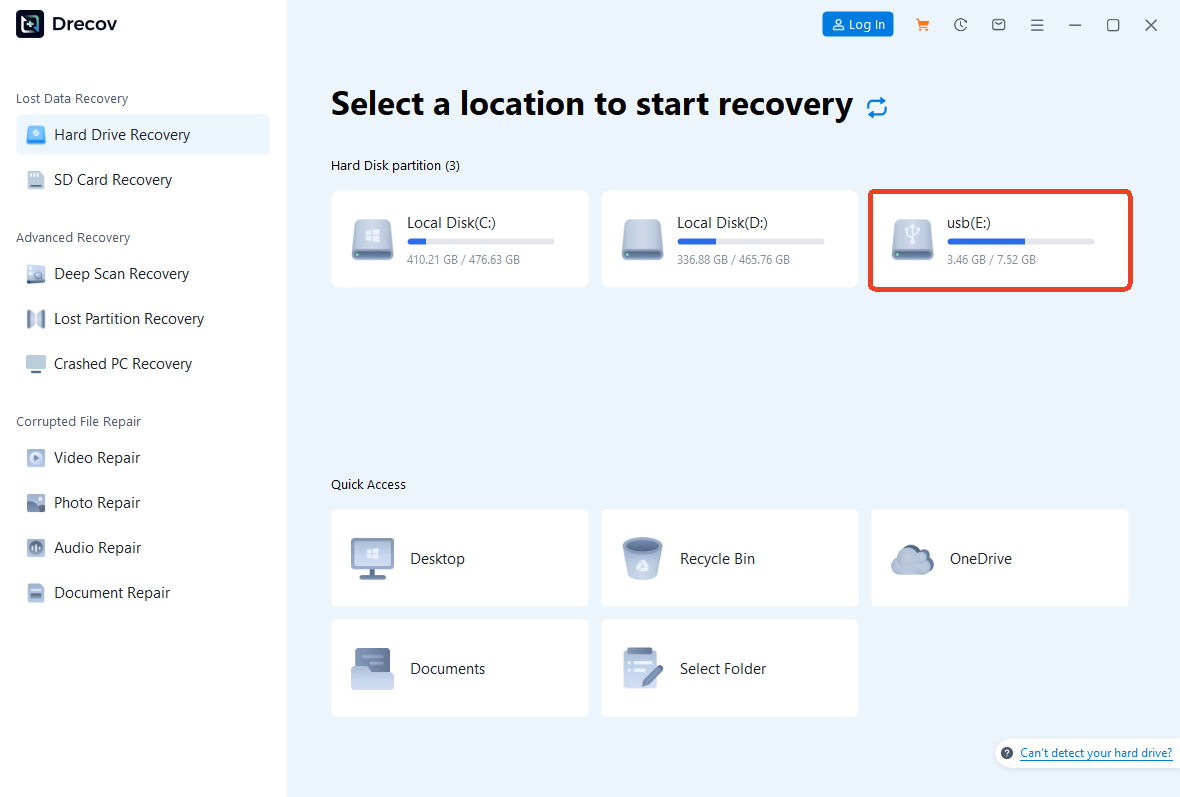
- 1. Open the program. On the primary dashboard, select your unrecognized flash drive from the list and click the Scan button.
- 2. Allow the deep scan to complete. Meanwhile, you can use the built-in file filters to sort through discovered images, documents, and videos.
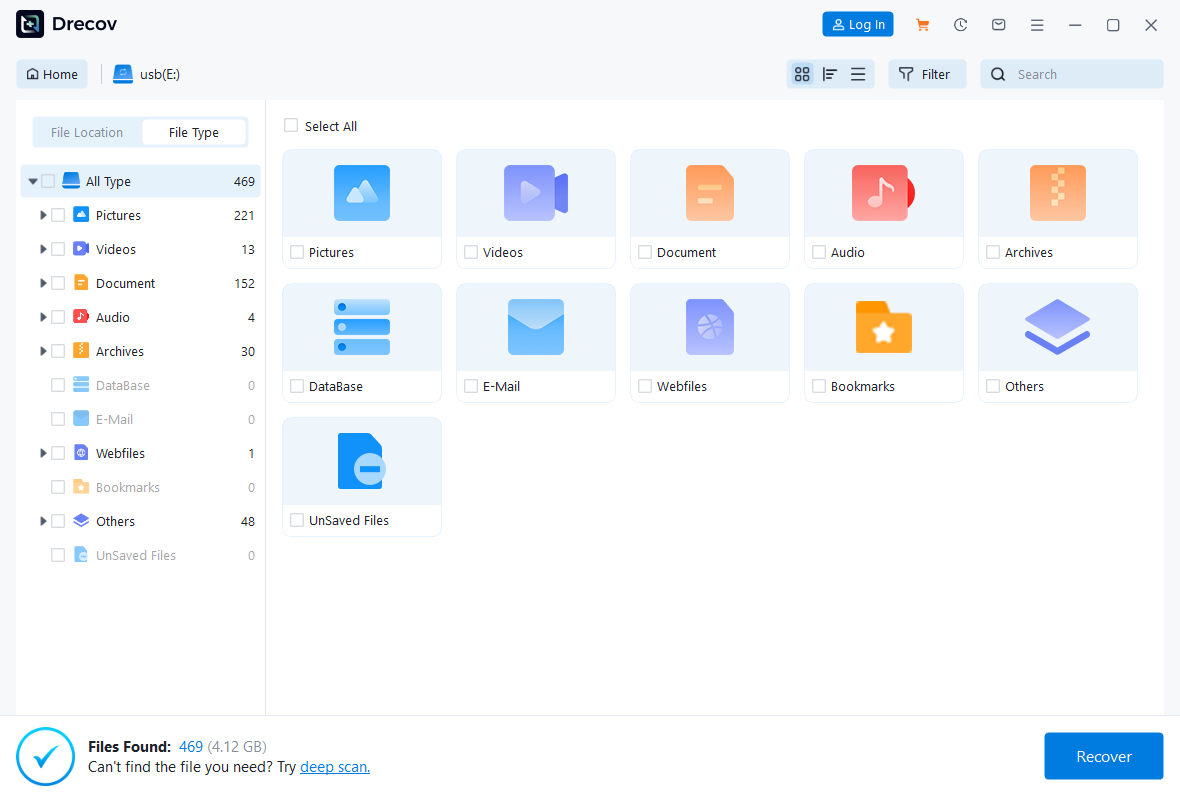
- 3. Check the boxes next to the files you wish to preserve, then click Recover. Choose a secure destination folder on your local computer hard drive to save the extracted files.
Method 3: Change the Assigned Drive Letter
If your system has a drive letter conflict, Windows will refuse to display the device in File Explorer.
- Press the Windows hotkey Win + X simultaneously to open the Power User menu, then select Disk Management.
- Locate your flash drive in the visual volume map at the bottom of the window.
- Right-click the partition on your flash drive and click Change Drive Letter and Paths….
- Click the Change button.
- Select a fresh, unused letter from the drop-down list (such as
M:orX:). - Click OK and then confirm the pop-up warning by clicking Yes.
Method 4: Reinstall the USB Mass Storage Drivers
Corrupted device drivers can prevent Windows from initializing a flash drive properly. Reinstalling them forces the OS to rebuild its hardware configurations.
- Press Win + R to open the Run dialog box. Type
devmgmt.mscand press Enter to open the Device Manager. - Scroll down to the bottom and double-click Universal Serial Bus controllers to expand the category.
- Locate USB Mass Storage Device. If it displays a yellow warning triangle, it is explicitly corrupted.
- Right-click USB Mass Storage Device and click Uninstall device.
- Confirm the prompt by clicking Uninstall.
- Unplug your flash drive from the computer, wait ten seconds, and then plug it back into a functional USB port. Windows will automatically detect the hardware change and reinstall a fresh copy of the driver.
Method 5: How to Format a Flash Drive via Diskpart
If the file system on your drive is completely corrupted and you have already secured your files using PandaOffice Drecov data recovery software, clearing the drive partition structure using the command-line interface can restore it to working order.
- Type
cmdinto your Windows search bar, right-click Command Prompt, and select Run as administrator. - Type
diskpartand press Enter to initialize the command utility. - Type
list diskand press Enter. Carefully inspect the list to identify your flash drive based on its storage capacity (e.g., Disk 2 for a 32GB drive). - Type
select disk X(replaceXwith your exact flash drive number) and press Enter. - Type
cleanand press Enter to completely wipe all existing partition tables and metadata. - Type
create partition primaryand press Enter to establish a new foundation. - To complete the process of how to format a flash drive, type
format fs=ntfs quick(orfs=exfat quickif you plan to use it across Mac and Windows systems) and press Enter. - Type
assignto give the drive a fresh drive letter, then typeexitto close the utility.
Alternative or Complementary Methods
While manual system tools provide effective fixes, alternative approaches can help you check if a drive is truly dead or just experiencing a temporary system hiccup.
Software Comparison Matrix
When choosing an approach to deal with an uncooperative drive, utilizing specialized data rescue tools often yields better results than relying solely on operating system command prompts. The table below outlines how popular solutions stack up:
| Recovery Tool & Method | Data Recovery Success Rate | Target Technical User Level | Primary Use Case |
| PandaOffice Drecov | Exceptionally High | Beginner to Professional | Corrupted, RAW, or hidden partition file rescue. |
| Recuva | Moderate | Beginner | Quick recovery of recently deleted files on healthy drives. |
| Windows Diskpart | N/A | Advanced | Re-initializing storage hardware after data rescue. |
If you are looking at free third-party utilities, it is crucial to understand what you are getting. For a transparent analysis of alternative freeware choices, check out our deep-dive review on Recuva free version limitations: Is it really free in 2026?.
Manual Diagnosis on Alternative Systems
Furthermore, testing your drive on an entirely separate computer isolates operating system glitches from hardware failures. If a flash drive fails to show up on your personal Windows 11 desktop, try plugging it into a Mac or a laptop running Linux. If the device loads perfectly on those systems, the root cause is a local configuration issue on your primary computer rather than a dead flash drive.
Tips & Best Practices for USB Management
Proper handling of external media reduces the likelihood of file system corruption and sudden hardware dropouts.
Safely Remove Media Every Time
Always use the Safely Remove Hardware and Eject Media taskbar icon before pulling your drive out of a USB slot. Unplugging a flash drive while a background application is actively writing data can corrupt the master boot record (MBR) or file allocation table (FAT), resulting in a flash drive not showing up error the next time you plug it in.
Understand the Proper Way to Format Flash Drive Files
When managing external storage, knowing how to format a flash drive correctly ensures long-term device health. Always match the chosen file system to your operational goals:
- Use FAT32 for older electronic devices, media centers, and legacy equipment.
- Use exFAT for large external thumb drives that need to seamlessly move files larger than 4GB between Windows and macOS environments.
- Use NTFS exclusively for storage drives dedicated entirely to modern Windows computers.
Establish a Bulletproof Backup Strategy
Never store critical documents solely on a portable flash drive. These devices are easily lost, stepped on, or exposed to static electricity. Use a simple automated script or cloud storage solution to clone your flash drive files to your main hard disk or an offsite cloud platform. For those looking to learn how to store streaming web content or media directly onto local storage arrays for secure safekeeping, see our comprehensive how to download video from browser Firefox 2026 guide.
Flash drive not showing up FAQs
Why is my flash drive not showing up anywhere, including Disk Management?
Consequently, if a drive does not show up in Disk Management, the issue is almost certainly physical. The USB port could be dead, the drive controller chip could be damaged, or the drive itself isn’t receiving power. Try cleaning the connector pins with isopropyl alcohol and testing it across multiple physical machines.
Is it safe to format flash drive volumes after they turn RAW?
You should only format flash drive volumes after you have safely recovered your files. Formatting creates a brand-new file system structure, which makes it much harder for recovery software to piece together old files. Always run a scan with PandaOffice Drecov data recovery software first to salvage your data.
Will changing a drive letter erase my personal data?
No. Changing an assigned drive letter via Disk Management is completely safe for your data. This process simply updates the mount path within the Windows registry so that File Explorer knows where to point. It does not alter the actual data sectors on the drive.
Can I run a data recovery scan on a physically cracked flash drive?
No. Software utilities require a functional connection to read a drive’s storage sectors. If the physical circuit board or USB connector plug is snapped, software cannot bridge that physical gap. In these cases, you will need to ship the drive to a cleanroom laboratory for manual component replacement.
Conclusion
Dealing with a flash drive not showing up on your computer can be incredibly frustrating, but following a structured approach usually resolves the issue. By working through physical troubleshooting, driver reinstalls, and partition fixes, you can pinpoint the exact cause and get your device working again.
Throughout this entire process, protecting your files must remain your absolute top priority. Utilizing professional data rescue tools like PandaOffice Drecov data recovery software ensures that even if a file system becomes corrupted, your photos, documents, and creative projects remain safe and recoverable.
Moving forward, embrace proactive data habits. Always eject your storage drives safely, choose the correct file systems when you format flash drive hardware, and maintain independent backups. Taking these small steps today will save you from major data loss headaches tomorrow.





