







Upgrading to a modern NVMe or SATA M.2 drive is one of the fastest ways to improve computer speed and storage performance. However, many users encounter a frustrating issue where the new m.2 not showing up after installation. In some situations, the BIOS detects the SSD but Windows does not display it. In others, the drive is completely missing from the system.
This problem may appear in several forms, such as m.2 not showing up in disk management, m 2 ssd not showing up in file explorer, or new m 2 not showing up during Windows setup. These issues can be caused by hardware configuration errors, driver problems, or partition conflicts.
This guide explains the causes and provides practical solutions to help your system recognize the SSD properly. If files become inaccessible during troubleshooting, professional recovery tools like Pandaoffice Drecov can help restore lost data efficiently.
I bought a new laptop quite a while ago to replace an old one and I decided since this one provided an extra slot for an ssd, I may as well use the ssd from my old laptop and repurpose it. I did the same thing with the 8GB RAM stick from that same old machine and gave it away to someone to use in their laptop which has worked and now they’re running dual channel. I decided to take the gen3 ssd and put in the secondary M.2 slot in my current laptop. Now I now this SSD isn’t faulty since I booted up the old machine with a ram stick that I had lying around and I could boot into windows just fine, this ssd hasn’t been reset or reformatted or anything as well. I put it into the M.2 slot of my new machine as it was.—from Microsoft Store
Why Is My M.2 SSD Not Showing Up?
Before applying solutions, it is important to understand why ssd not showing up in disk management happens.
Several factors may prevent detection:
- BIOS configuration errors
- Disk not initialized
- Missing partitions
- Outdated storage drivers
- Hardware compatibility problems
- Disabled PCIe slot
- Incorrect physical installation
Some motherboards share bandwidth between SATA ports and M.2 slots. If a conflicting port is active, the SSD might not appear.
⚠️Warning: Avoid installing or removing SSD hardware while the system is powered on. This may cause permanent damage.
Check Whether the SSD Appears in BIOS
If the drive is visible in BIOS but missing in Windows, the issue is usually software-related.
Enter BIOS or UEFI Settings
Restart the computer and press the BIOS access key (commonly F2, DEL, or ESC). Navigate to storage or hardware information sections.
If the SSD is listed, your motherboard recognizes it correctly.
Enable NVMe or M.2 Mode
Some systems require manual activation of PCIe or NVMe support. Ensure the storage configuration is enabled instead of disabled.
⚠️Warning: Changing storage controller modes may cause boot problems if your operating system was installed under a different configuration.
Fix 1: Initialize the New M.2 SSD
One common cause of m.2 not showing up in disk management is that the disk has not been initialized.
Open Disk Management
Right-click the Start button and select Disk Management. If the SSD appears as “Unknown” or “Not Initialized,” initialization is required.
Initialize the Disk
Right-click the disk label and select Initialize Disk. Choose GPT for modern systems or MBR if compatibility with older systems is required.
After initialization, you can create partitions and use the storage normally.
⚠️Warning: Initialization may remove existing partition structures. Perform data recovery first if needed.
Fix 2: Create a Partition and Assign a Drive Letter
If the m 2 ssd not showing up in file explorer, the disk may exist without a usable partition.
Create a New Volume
Locate unallocated space in Disk Management. Right-click it and choose New Simple Volume. Follow the wizard instructions.
Assign a Drive Letter
Choose an available drive letter so Windows Explorer can display the storage.
This solution often resolves new m 2 not showing up problems after hardware installation.
Fix 3: Update or Reinstall Storage Drivers
Driver conflicts can prevent Windows from detecting new hardware correctly.
Update Drivers Using Device Manager
Open Device Manager and expand Disk Drives and Storage Controllers. Right-click the device and choose Update Driver.
Installing the latest drivers improves compatibility and detection.
Reinstall Storage Controllers
Uninstalling the controller and restarting Windows forces the system to reinstall drivers automatically, which may resolve detection issues.
⚠️Warning: Only download drivers from trusted manufacturer sources.
Fix 4: Check Physical Installation
Improper installation is a frequent cause of new m.2 not showing up.
Inspect the SSD Connection
Turn off the computer, disconnect power, and reinstall the SSD carefully into the slot at a slight angle before securing it.
Confirm Compatibility
Ensure the motherboard supports your SSD type. Some slots support only SATA or only NVMe drives.
Fix 5: Enable the M.2 Slot in BIOS
Even when installed correctly, the slot may be disabled.
Locate Storage Configuration
Open BIOS and navigate to Advanced or Storage settings.
Enable the Slot
Set the M.2 configuration to Enabled or Auto, then save changes and restart.
Fix 6: Check SATA Port Conflicts
Some motherboards disable SATA ports when M.2 drives are installed.
Review Motherboard Manual
Identify shared ports and disconnect unnecessary drives temporarily to test detection.
Fix 7: Recover Data If SSD Becomes Inaccessible
If partitions disappear during troubleshooting, data recovery may be required.
Use Pandaoffice Drecov
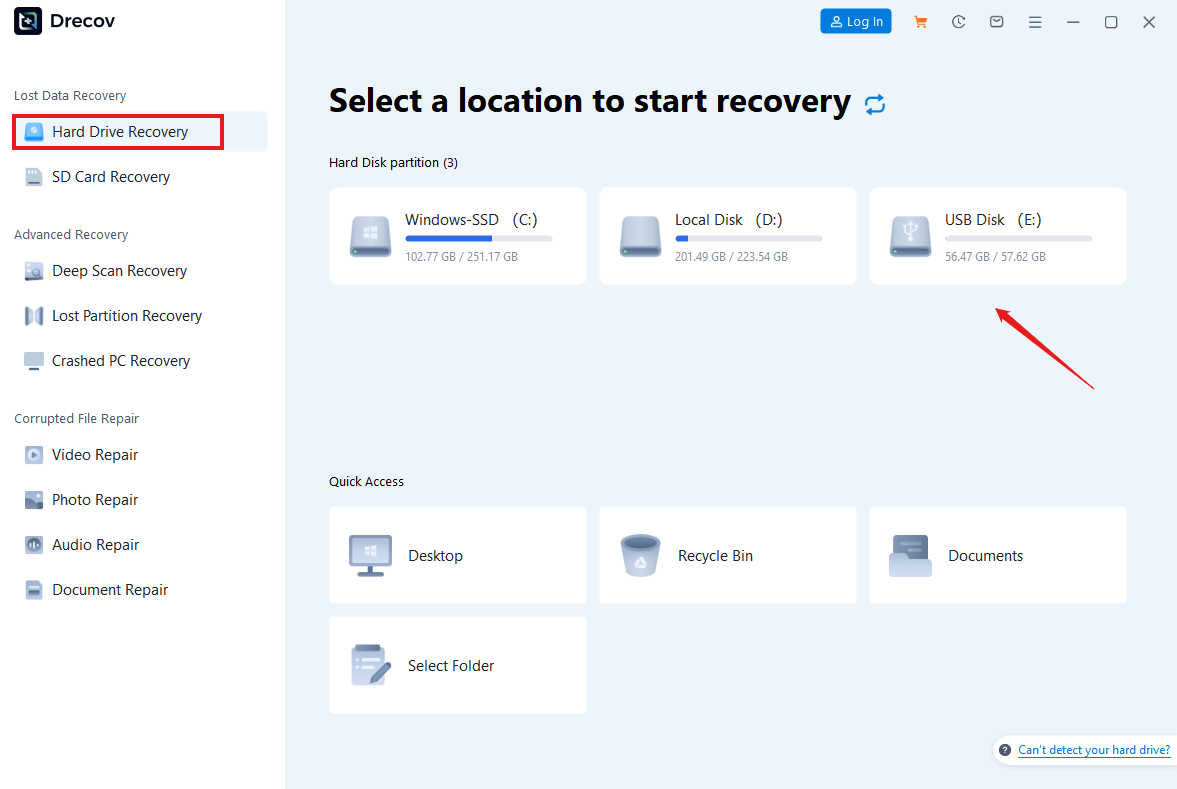
Pandaoffice Drecov can recover files from SSDs, damaged partitions, and inaccessible storage devices. Its deep scanning technology helps retrieve lost data safely before performing repairs like formatting or initialization.
Fix 8: Format the SSD to Repair File System Errors
File system corruption may cause m 2 ssd not showing up in file explorer.
Format the Drive
Right-click the partition in Disk Management and select Format. Choose NTFS or exFAT depending on usage needs.
⚠️Warning: Formatting deletes existing data unless recovery is completed beforehand.
Advanced Solutions for SSD Not Showing Up Issues
When basic troubleshooting does not resolve the new m.2 not showing up problem, more advanced methods may be required. These solutions focus on deeper system configuration, command-line repair, and hardware diagnostics.
Fix 10: Use Command Prompt to Detect the SSD
Windows command-line tools can identify storage devices even when they do not appear in Disk Management.
Open Command Prompt as administrator and type:
diskpart
list disk
If the SSD appears in the list, it means Windows recognizes the hardware but configuration problems prevent visibility. You can then create partitions or assign drive letters using DiskPart commands.
This method often resolves ssd not showing up in disk management situations.
Fix 11: Update BIOS or Firmware
Outdated firmware can cause compatibility issues with modern NVMe drives.
Visit your motherboard manufacturer’s website and download the latest BIOS update. Carefully follow installation instructions to avoid system failure.
Updating firmware improves hardware detection, stability, and compatibility with newer storage devices.
⚠️Warning: Interrupting a BIOS update may damage the motherboard permanently.
Fix 12: Check PCIe Configuration Settings
Some BIOS systems allow manual PCIe configuration for storage slots.
Enter BIOS settings and locate PCIe or storage configuration options. Ensure the slot is configured for NVMe mode instead of SATA or disabled status.
Incorrect configuration may prevent the SSD from being detected entirely.
Fix 13: Test the SSD on Another Computer
Testing hardware on another system helps determine whether the issue is with the SSD or the motherboard.
Install the SSD into another compatible computer or use an external enclosure adapter. If the drive works elsewhere, your original system configuration is likely the cause.
If it fails on multiple systems, the SSD may be defective.
Fix 14: Check for Windows Updates
Operating system updates often include driver improvements and compatibility fixes.
Open Windows Update settings and install all available updates. Restart the system afterward and check whether the m 2 ssd not showing up in file explorer issue is resolved.
Keeping Windows updated improves hardware detection reliability.
How to Prevent M.2 SSD Detection Problems
Preventive measures reduce the chance of encountering new m 2 not showing up in the future.
Always verify compatibility before purchasing hardware. Install SSDs carefully using proper mounting screws. Keep BIOS and drivers updated regularly. Avoid sudden power loss during disk operations, which can corrupt partitions.
Using reliable hardware components significantly lowers the risk of detection failures.
What to Do If Data Is Lost on an Undetected SSD
When an SSD becomes inaccessible, files may appear permanently lost. However, data often remains recoverable if no overwriting occurs.
Professional recovery software such as Pandaoffice Drecov can scan inaccessible drives, recover deleted partitions, and restore files from damaged storage. Its deep scanning technology increases recovery success even when the SSD is not visible in File Explorer.
Why Choose Pandaoffice Drecov?
When it comes to reliable data recovery, choosing the right tool can make the difference between permanent loss and successful restoration. Pandaoffice Drecov is designed with advanced scanning algorithms and user-friendly workflows to help individuals and professionals recover lost files quickly and safely across multiple storage scenarios. Whether you accidentally deleted important security footage or lost precious photos, the software provides comprehensive support for different devices and file systems.
For example, if you need to recover deleted Blink videos, Drecov can scan storage locations and retrieve video files even after accidental removal or formatting. Photographers and everyday users also benefit from its powerful usb photo recovery capabilities, allowing restoration of images from USB flash drives, memory sticks, and other portable devices without complicated steps.
In addition, the software excels at deleted sd card photo recovery, making it ideal for recovering lost pictures from cameras, drones, or mobile devices. Even when files seem permanently erased, deep scanning technology increases the chances of successful recovery. For larger storage failures, Drecov also supports recover external hard drive scenarios, including corrupted partitions, inaccessible drives, or accidental formatting.
Beyond its technical capabilities, Pandaoffice Drecov prioritizes safety and simplicity. The read-only recovery process ensures no further damage is done to your data, while the intuitive interface allows users of all experience levels to complete recovery in just a few clicks. With broad device compatibility, fast scanning performance, and dependable results, Pandaoffice Drecov is a trusted solution for anyone facing unexpected data loss.
Professional recovery tools significantly increase success rates compared to manual attempts.


Frequently Asked Questions
Why is my new SSD detected in BIOS but not Windows?
This usually happens when the disk is not initialized, lacks a partition, or has no drive letter assigned. Disk Management tools can resolve the issue quickly.
Why does my SSD not appear in File Explorer?
If the m 2 ssd not showing up in file explorer, the partition may be missing, corrupted, or hidden. Assigning a drive letter or formatting the partition typically fixes the problem.
Can a faulty SSD cause detection problems?
Yes. Physical damage, controller failure, or manufacturing defects can prevent detection. Testing the drive on another system helps confirm hardware failure.
Is it safe to initialize an SSD?
Initialization is safe for new drives but may remove partition information from used drives. Always recover important files before performing initialization.
⚠️Warning: Data recovery becomes more difficult after formatting or overwriting.
Conclusion
Experiencing a new m.2 not showing up problem can be frustrating, but most detection issues are fixable with the right approach. Whether the cause is BIOS configuration, missing partitions, driver conflicts, or hardware installation errors, systematic troubleshooting can restore functionality.
If files become inaccessible during the process, recovery tools like Pandaoffice Drecov provide a reliable way to retrieve lost data before performing repairs. By following the solutions in this guide and maintaining proper system updates, you can ensure stable SSD performance and avoid future detection problems.






