







Digital photography has transformed how we preserve memories, but it has also created a massive challenge: managing thousands of files across cloud platforms. Many users find themselves staring at a chaotic mess of images, wondering how to get onedrive photos in order without losing their minds—or their data. When your timeline is out of sync or photos appear in the wrong folders, it isn’t just an annoyance; it can lead to accidental deletions and lost memories.
In this comprehensive guide, we will explore the best strategies for organizing your cloud library. Furthermore, because a messy file system often leads to accidental data loss during “clean-up” sessions, we will introduce the PandaOffice Drecov data recovery software to ensure your precious photos remain safe even if a mistake happens.
Understanding the OneDrive Photo Ecosystem
Before we tackle the specific steps for how to get onedrive photos in order, we must understand how Microsoft’s cloud handles metadata. OneDrive primarily uses the EXIF data (Exchangeable Image File Format) embedded in your photos to determine their chronological position. If this metadata is missing or corrupted, your photos will default to the “Date Modified” or “Date Created” on the server, which often results in a jumbled mess.
Why Is My OneDrive Photo Gallery Messy?
Several factors contribute to a disorganized gallery:
- Social Media Downloads: Apps like WhatsApp or Facebook often strip EXIF data, leaving OneDrive with no “Date Taken” info.
- Device Sync Conflicts: If you sync from both an iPhone and a Windows PC, conflicting time zones can scatter photos.
- Batch Uploads: Uploading old folders often resets the “Date Modified,” causing old memories to appear as “Today’s” photos.
Learning how to get onedrive photos in order requires a multi-layered approach, starting from simple interface tweaks to advanced metadata editing.
How to Get OneDrive Photos in Order: Step-by-Step Solutions
We have arranged these methods from the simplest interface settings to more advanced organizational techniques.
Method 1: Using Built-in Sorting and View Options
This is the fastest way to fix the visual layout of your gallery. It doesn’t change the files themselves, but it changes how OneDrive displays them to you.
- Step 1: Log in to OneDrive.com on a desktop browser for the most robust options.
- Step 2: Click on the Photos tab in the left-hand sidebar.
- Step 3: Look for the Sort button in the top-right corner.
- Step 4: Select Date Taken instead of “Date Uploaded.” This ensures the timeline follows when the shutter clicked, not when the cloud received the file.
- Step 5: Toggle between Descending (newest first) or Ascending (oldest first) based on your preference.
Method 2: Organizing into Albums vs. Folders
OneDrive offers two ways to group images. Understanding the difference is key to knowing how to get onedrive photos in order.
- Step 1: Select a group of related photos.
- Step 2: Click Add to Album. Albums are “virtual” collections; a photo can be in three albums without taking up triple the storage space.
- Step 3: Use the Folder view if you want to physically move files on the hard drive. This is better for long-term backups.
- Step 4: Name folders using a YYYY-MM-DD-Description format (e.g., 2026-04-Paris). This ensures they remain in alphabetical and chronological order automatically.
Method 3: Fixing Metadata with Windows File Explorer
If the cloud is confused, you may need to fix the source files on your PC.
- Step 1: Open your synced OneDrive folder in File Explorer.
- Step 2: Right-click a photo (or a batch of photos) and select Properties.
- Step 3: Go to the Details tab.
- Step 4: Find the Date Taken field. If it’s blank, enter the correct date.
- Step 5: Click Apply. Once the OneDrive app syncs, the cloud gallery will automatically re-order itself based on this new data.
The Risk of Mass Organization: Data Loss Prevention
As you move thousands of files to figure out how to get onedrive photos in order, the risk of “fat-finger” errors increases. A simple drag-and-drop mistake can send a folder into the digital void. Furthermore, OneDrive’s “Files On-Demand” feature can sometimes fail during large moves, leaving you with 0-byte corrupted files.
PandaOffice Drecov Data Recovery Software: Your Photo Safety Net
When organization goes wrong, you need a professional solution. The PandaOffice Drecov data recovery software is specifically optimized to retrieve high-resolution image formats like JPEG, PNG, HEIC, and RAW files. If you accidentally deleted a folder while trying to clean up your cloud, Drecov can scan your local hard drive’s cache to find the original bits.
⚠ Warning: Always install the software on a different partition (e.g., Drive D:) if your photos were lost on Drive C: to prevent overwriting.
How to Recover Lost Photos Using PandaOffice Drecov
Follow these precise steps to rescue your images if they disappear during the sorting process:
- Step 1: Choose the Scan Location. Launch the application and select the local OneDrive sync folder location.

- Step 2: Run the Scan. Click “Scan.” The PandaOffice Drecov data recovery software will execute a sector-by-sector search for photo signatures.

- Step 3: Filter by File Type. Use the “File Type” filter to show only “Pictures.” You can even narrow it down by specific extensions like
.heic(for iPhone users).
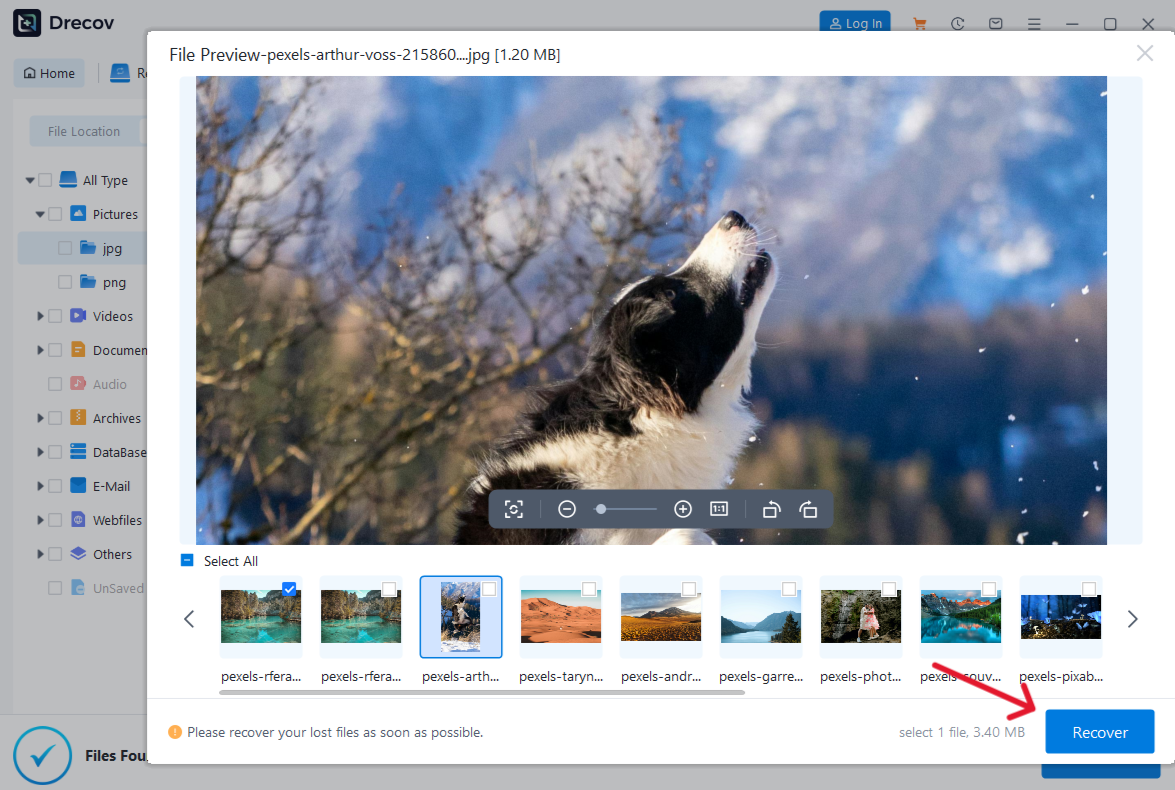
- Step 4: Preview and Save. Double-click a photo to preview its quality. Select the ones you need and click Recover. Save them to an external drive or a USB stick to ensure total data integrity.
Advanced Tactics: How to Get OneDrive Photos in Order Automatically
For users with tens of thousands of photos, manual sorting is impossible. You need automation.
Method 4: Using Microsoft 365 Search Tags
Microsoft uses AI to help you figure out how to get onedrive photos in order without moving a single file.
- Step 1: Use the search bar at the top of OneDrive.
- Step 2: Type keywords like “Beach,” “Cat,” or “Birthday.”
- Step 3: OneDrive’s AI scans image content. You can then select all “Cat” photos and move them into a dedicated folder or album in one click.
Method 5: Utilizing the “On This Day” Feature
This tool is a great way to find “lost” photos that aren’t in your current view.
- Step 1: Open the OneDrive mobile app or web interface.
- Step 2: Check the “On This Day” notification.
- Step 3: Use this opportunity to see if these old photos are tagged with the correct date. If not, edit them immediately to keep your long-term archive healthy.
Troubleshooting Sync and Sorting Issues
Even after you learn how to get onedrive photos in order, technology can act up. Here are the most common fixes for persistent sorting problems:
- Duplicate Photos: Use the “Group by” function in File Explorer to find files with the same size and name (often appended with “-copy”).
- HEIC Compatibility: Windows users might see blank thumbnails for iPhone photos. Install the HEIF Image Extensions from the Microsoft Store so your computer can read the metadata correctly.
- Sync Stalling: If photos won’t move, right-click the OneDrive icon in the taskbar and select “Pause Syncing,” then “Resume.”
Essential Maintenance for OneDrive Users
Organizing your photos is often part of a larger cleanup strategy. Before you make major changes to your account, ensure you are following the right procedures to prevent data loss. Check out our specialized guides:
- Delete OneDrive the right way: Don’t lose your life’s work – Learn the critical difference between deleting a cloud copy and a local copy.
- How to remove OneDrive without losing files – A safe exit strategy for those moving to different storage solutions.
- How to unsync OneDrive without losing data – Master the art of keeping your local files while disconnecting from the cloud.
Get Onedrive Photos In OrderFAQs
1. Why does OneDrive show the wrong date for my photos?
This usually happens because the file lacks EXIF “Date Taken” metadata. OneDrive defaults to the “Date Uploaded” or “Date Modified,” which might be the day you moved the file to a new folder.
2. Can I change the date of multiple photos at once?
Yes. In Windows File Explorer, select all the photos, right-click, select “Properties,” then “Details,” and edit the “Date Taken.” This batch-updates all selected files.
3. Does sorting photos into folders delete them from the “Photos” timeline?
No. The “Photos” view in OneDrive is a chronological stream of every image in your account, regardless of which folder they are stored in.
4. Is it possible to get onedrive photos in order by file size?
Yes, in the web interface or File Explorer, you can click the “Size” column or use the Sort menu to organize from largest to smallest, which is great for finding storage-heavy videos.
5. What should I do if a photo appears as a gray box?
This indicates a sync error or file corruption. Try to download the file again. If the local file is also corrupted, use PandaOffice Drecov data recovery software to find a previous, healthy version on your hard drive.
Conclusion
To truly master how to get onedrive photos in order, consistency is your best friend. Always ensure your camera app has “Location Services” and “Date/Time” correctly set, as this provides the metadata OneDrive needs to do its job. Regularly check your “Pictures” folder and use the YYYY-MM-DD naming convention for folders to maintain a logical structure that survives any software update.
Moreover, treat your local PC as the primary “sorting station” and the cloud as the “mirror.” It is much easier to manage thousands of files using Windows File Explorer’s powerful batch-rename and detail-edit tools than it is to use a web interface.
Finally, never underestimate the value of a local backup. While OneDrive is a powerful tool, it is not infallible. Having the PandaOffice Drecov data recovery software ready on your system ensures that even if a “Move” command goes wrong or a sync error wipes a folder, your memories are never more than a few clicks away from recovery.






