







How much does data recovery cost? The useful answer begins with the failure, not a price tag. A file available in a backup may need no recovery purchase. Deleted files on a stable Windows drive may justify a software attempt. A clicking, disconnected, or electrically damaged device needs specialist assessment, often with a different scope of work. No honest estimate can promise that a particular file will be recoverable before the source and its condition are understood.
How much does data recovery cost: safe diagnosis
“Data recovery” describes several activities that should not be priced as though they were identical. Restoring an available version from a cloud service or File History is essentially locating and validating a copy. Software recovery reads a stable device and tries to reconstruct accessible files after deletion, formatting, or some logical loss. Professional recovery may require controlled imaging, replacement of damaged components, or specialized techniques. The last category is not something a desktop scan can imitate.
Before buying anything, note where the files lived and what happened immediately before they vanished. Check whether the device is identified with the correct capacity. Look in Recycle Bin, cloud trash, version history, another computer, and offline backups. If one of those contains the needed material, preserve it on a healthy destination and open representative files. A recovered name alone is not proof that the content is current or complete.
Stop using the affected drive while deciding. Further downloads, installations, CHKDSK, formatting, and partition changes can write to storage you may need to recover. SSD TRIM and later writes may reduce what remains recoverable. No paid tool can guarantee restoration of fully overwritten content. If the disk clicks, repeatedly disappears, or reports severe read errors, stop direct scanning. A trial scan could consume its remaining readable time.
What you are paying for in each route
Existing copies and built-in restore options
A backup is generally the first route because it does not require scanning the failed source. Its real cost is the time to locate, transfer, and verify the correct version. If the copy is cloud-hosted, account access and download capacity may matter. Ask an administrator for a file-level restoration to a separate location. A broad rollback could remove later team changes. This route is usually preferable even when a recovery product is already available.
DIY software on stable local storage
Software pricing can involve licenses, recovery limits, subscriptions, supported devices, or different editions. Those terms change. Compare the current vendor page before paying, not a number quoted in an old article. More important, determine whether the product can inspect the source without writing to it. Check preview support for your file type and choose an output destination. A cheap license is no saving if you install onto the lost-file partition or restore results back to it.
A specialist’s physical or complex recovery work
A professional quote may cover initial diagnosis, imaging, component work, extraction, and return media. Ask which stages are included and which depend on what the lab finds. Packaging, shipping, a donor part, encryption, and verification can all change the eventual work. A business database also demands more careful validation than a handful of household photos. Do not infer a specific price from the advertised capacity of the drive alone.
The external-drive diagnosis guide distinguishes a connection issue from a failing source. That distinction is economically useful: a known-good cable check is a different decision from repeated software reads of a clicking disk. A lab may be the least costly route in terms of data risk when the files are irreplaceable, even though its invoice may be higher.
Use the failure signs to choose a budget path
| Observed state | First sensible route | Why it changes cost |
|---|---|---|
| Good dated backup exists | Restore a separate copy and verify it | May avoid a recovery purchase entirely |
| Stable drive, deleted file, no suitable backup | Evaluate local recovery software | Work is mainly scanning, selection, and validation |
| Lost partition but storage remains stable | Protect data before any partition edits; assess recovery mode | Wrong metadata changes can create additional work |
| Clicking, repeated disconnection, or serious read errors | Stop direct scans; seek specialist imaging | Physical condition drives the service scope |
| Cloud-only file or network share | Contact the service or storage owner | Local software cannot scan data it does not physically access |
This is a decision framework, not a price quotation. A stable drive does not guarantee recovery, and a failing one does not automatically require every service a vendor offers. If the device is detected with the wrong capacity, document the symptom and stop destructive attempts. Do not initialize it to make it visible in File Explorer. If data matters, seek advice before changing any storage structure.
Microsoft’s Windows File Recovery guidance reinforces two basic principles: reduce use of a source containing deleted files, and keep the destination on a different drive. It is a useful no-purchase option for technically comfortable Windows users, but its command-line workflow still requires correct source selection. It cannot recover cloud-only storage or a network share by pretending the mapped letter is a local disk.
Where Drecov fits a software-first decision
It helps diagnose how much does data recovery cost without changing the source data. PandaOffice Drecov is Windows data recovery software for eligible PCs, hard drives, SSDs, USB devices, SD cards, memory cards, and external drives. It supports document, photo, video, audio, email, and archive recovery from suitable local storage. Its read-only recovery mode and Quick Scan begin a guided search. Deep Scan, filtering, preview, and a healthy output destination support later decisions. Lost Partition Recovery is available when a partition has disappeared. These features do not repair hardware or guarantee a result. Check the current Drecov product or checkout page for commercial terms rather than trusting a number repeated elsewhere.
This check is especially useful for how much does data recovery cost. Before a software session, preserve existing backups and prepare a healthy output drive. Do not install Drecov on the partition that held the files. If the source shows physical warning signs, stop and seek imaging or professional help. A license cannot fix the device. On a stable, correctly identified source, the workflow may reveal plausible files before a later purchase decision.
⚠ Warning: Install it on a drive different from the one where your data was lost to prevent overwriting.
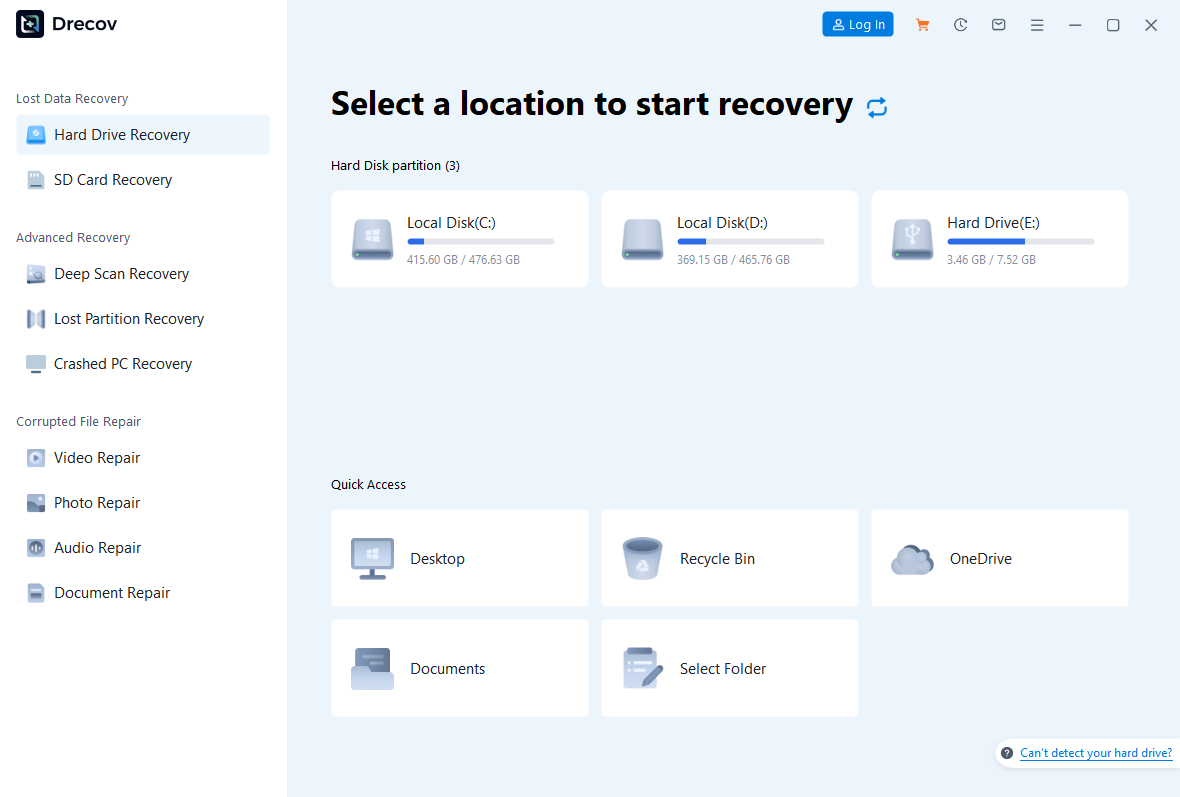
Step 1: Open Drecov and select the original loss location
Choose the drive or partition that actually stored the missing files. A backup drive, download directory, or empty replacement partition is not the source merely because it is easier to select. If the entire partition is missing, review the Lost Partition Recovery route before making any new partition. The separate lost-partition guide describes that risk boundary.
Step 2: Run Quick Scan and inspect likely results
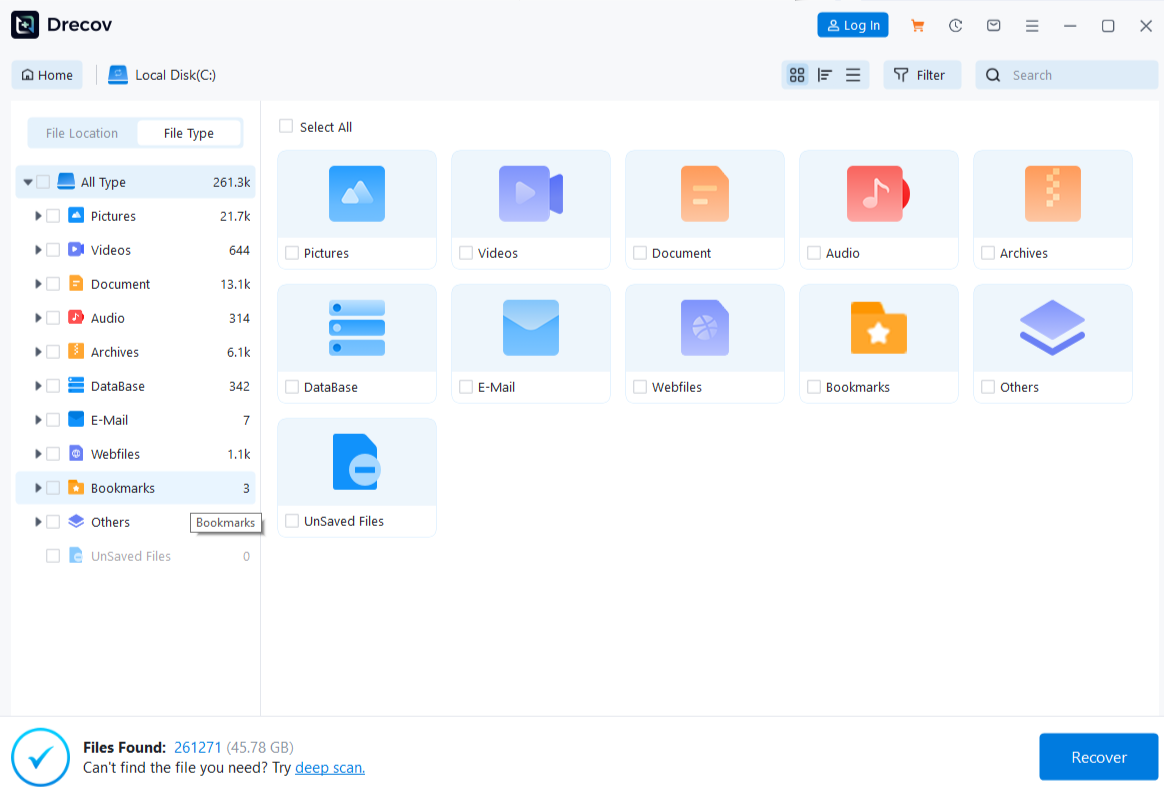
Start Quick Scan on the stable source. Look for the known parent folder, file name, type, and size. Several plausible candidates may appear; keep their differences in mind rather than treating a familiar name as proof of complete recovery.
Step 3: Use Deep Scan if the device remains stable
When Quick Scan misses the target and the drive still behaves normally, run Deep Scan. Stop if errors or disconnections begin. A longer scan is not a guarantee that overwritten data exists, and it is not a substitute for physical recovery work.
Step 4: Filter and preview before selecting output
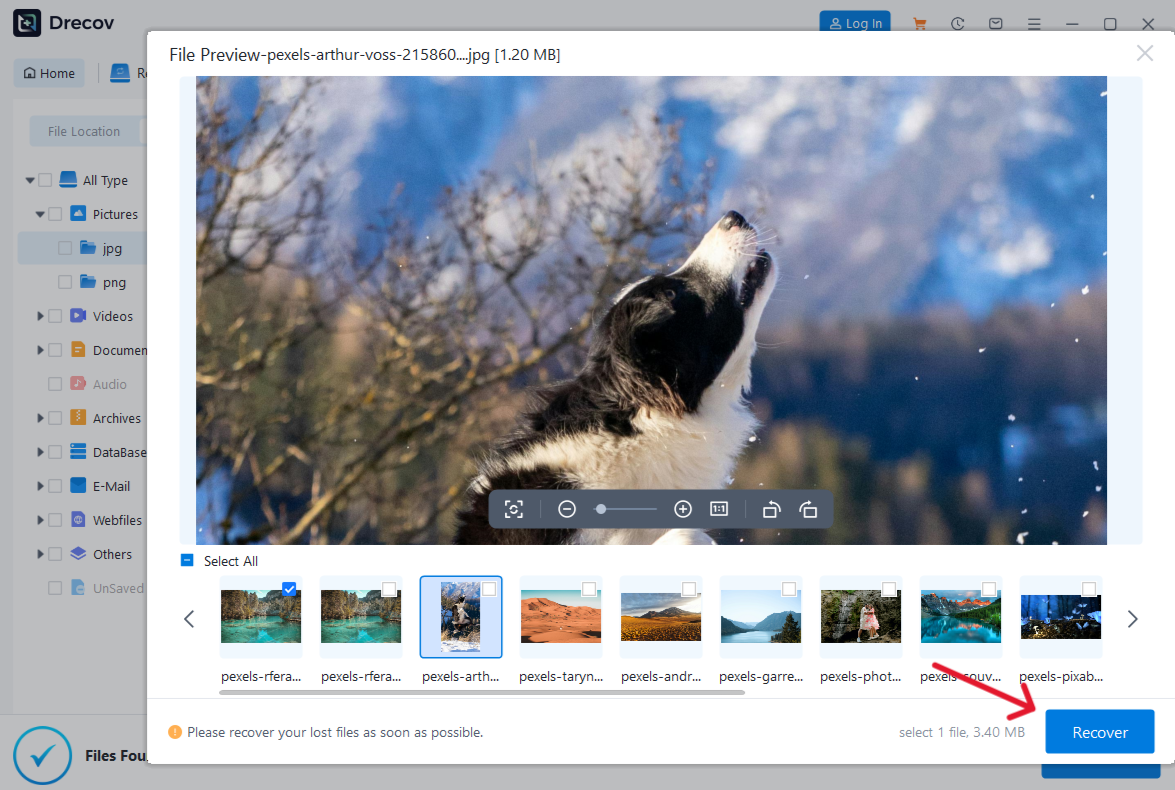
Narrow results by available type, path, or remembered name. Preview representative supported files. A preview helps select candidates but cannot prove every page, frame, formula, or archive member is intact. If the critical item cannot be validated, keep your backup and specialist options open.
Step 5: Recover to a healthy drive and verify
Save selected files to the separate healthy destination, never back to the source. If you do not see output where expected, check the Drecov folder or Recovery folder. Open sample files in their normal applications and compare them with the missing set. Only after the needed data is verified should you consider formatting or repairing the original drive. The Drecov homepage is the product entry point; a separate restorable backup plan helps avoid the next loss.
⚠ Warning: Install it on a drive different from the one where your data was lost to prevent overwriting.
Questions to ask before accepting a professional quote
Ask what the diagnosis includes, whether imaging is required, how they protect the original, and which work needs your approval. Clarify whether the quoted amount covers return media and whether a partial result changes the terms. A vendor’s promise to “recover everything” without inspecting the device is not a reliable basis for a decision. If the data is sensitive, ask how access is controlled, who handles the media, and how temporary copies are deleted after delivery.
Give the provider a short inventory of the essential files. Prioritize the folders or formats that matter, including application files that must be opened and checked. Ask for a file list or other meaningful validation before you authorize reuse or disposal of the original. The completed job is not merely a bag of file names; it is verified access to the records you needed.
For a stable drive, compare a software attempt with the value of your time and the importance of the data. For a failing device, compare the specialist’s preservation plan with the risk of further DIY reads. Those are different decisions. The lowest advertised number is not necessarily the least expensive outcome if it jeopardizes the only readable copy.
Conclusion
To answer how much data recovery costs, identify whether you need a backup restore, logical file recovery, or physical-device work. Do not substitute a fixed figure for that diagnosis. Drecov offers a clear Windows workflow for stable, eligible local storage, while a clicking or repeatedly disconnected drive calls for specialist assessment. Preserve the source, verify recovered files on another device, and decide what to pay for only after you know which kind of recovery the evidence supports.
⚠ Warning: Install it on a drive different from the one where your data was lost to prevent overwriting.





