







External drive repair should begin with diagnosis, not CHKDSK or formatting. Disconnect a drive that clicks, repeatedly drops offline, smells burned, or freezes Windows, because repeated scans can worsen physical failure. If the drive is quiet, stable, and identified with the correct capacity, test its cable, power, port, and read access. Recover important files before any command that changes the file system or partition layout.
Place the Drive in the Correct Repair Branch
A drive can fail at the cable, enclosure, bridge board, power supply, controller, media, partition table, file system, or individual-file level. The hard-drive recovery safety article explains why access and repair are separate goals. Microsoft’s Disk Management overview helps interpret status, model identity, capacity, sound, and disconnect behavior provide more useful direction than the word “repair.”
| What you observe | What it suggests | Safest next move |
|---|---|---|
| Not listed anywhere | Power, cable, enclosure, controller, or serious hardware failure | Try one known-good connection; do not initialize |
| Correct model and capacity, no letter | Mount-point or letter issue | Inspect the existing volume before assigning a path |
| RAW volume | File-system structures are unreadable | Recover files before CHKDSK or format |
| Unallocated space | Partition metadata may be missing | Use lost-partition recovery before creating a volume |
| Clicks or repeated spin-up | Mechanical failure is plausible | Power down and seek professional imaging |
| Copies some files but stalls | Localized read errors or unstable media | Copy critical readable files or image the source |
Read the Drive’s Behavior as Evidence
For external drive repair, use the matching observation, make one reversible change, and then retest the original symptom.
If You See: Not listed anywhere
Power, cable, enclosure, controller, or serious hardware failure becomes the leading explanation, but the observation does not justify a destructive change by itself. Try one known-good connection; do not initialize.
When the Result Is: Correct model and capacity, no letter
This result shifts attention toward mount-point or letter issue. Use the narrow response: inspect the existing volume before assigning a path.
What RAW volume Changes
The practical implication is file-system structures are unreadable. The next action should therefore be limited to this branch: recover files before chkdsk or format.
Do Not Misread: Unallocated space
It can indicate partition metadata may be missing, yet it does not prove every other component is healthy. Start with use lost-partition recovery before creating a volume.
The Safe Branch for Clicks or repeated spin-up
Here, mechanical failure is plausible deserves priority over broad system repair. Power down and seek professional imaging.
Escalation Point: Copies some files but stalls
Treat this as a sign of localized read errors or unstable media. Beg
Protect Recoverable Data Before Writing to the Disk
Check backups first and copy irreplaceable readable files to another device. Record the model, reported capacity, connection, BitLocker state, partition map, and exact Windows message. Do not accept an initialization prompt on a previously used drive. CHKDSK changes file-system structures, formatting creates a new file system, and partition rebuilding writes metadata; none is a first recovery step. The separate recovery destination explanation shows why recovered output must not return to the source.
Use Repair Methods Only for the Proven Layer
Rule Out the Connection Once
Use the manufacturer power adapter when required, one known-good cable, and a direct motherboard port. A second computer can separate host trouble from device trouble, but stop retesting if each connection causes new disconnects or abnormal sounds.
Fix a Healthy Volume That Only Lacks a Letter
When Disk Management shows the expected partition and file system as healthy, assign an unused letter. If the space is RAW or unallocated, a letter cannot rebuild missing structures and initialization will not restore the old layout.
Use CHKDSK Only After Recovery
CHKDSK may correct logical NTFS or FAT structures on a stable device, but it can discard damaged references while making the volume mountable. Recover or image valuable data first, then run it only on the confirmed volume with enough time and stable power.
Format Only for Reuse
Formatting belongs after data recovery and hardware assessment. If a format fails, the disk returns errors, or health indicators deteriorate, replace the drive rather than trusting it with the only copy of important files.
Recover Files From a Stable External Drive Before Repair
If the external disk is quiet, stays connected, and appears with the correct capacity, PandaOffice Drecov can recover files from logical loss, a RAW volume, or a lost partition before structural repair. Drecov reads the source during recovery; it does not fix an enclosure, controller, motor, head, or other physical component.
⚠ Warning: Install it on a drive different from the one where your data was lost to prevent overwriting.
Step 1: Select the External Drive or Its Stable Image
Open Drecov on a working Windows computer and choose the original external drive. If a controlled image was created because the disk has weak areas, select that image instead. Do not select the healthy device reserved for recovered output. Stop if the source begins clicking, disconnecting, freezing Windows, or reporting an implausible capacity.

Step 2: Scan for the Missing Volume and Files
Begin with Quick Scan when files recently disappeared or the volume lost normal access. Use Deep Scan if the expected folders are absent, the file system is damaged, or partition information has been lost. A long scan is suitable only for media that remains stable.

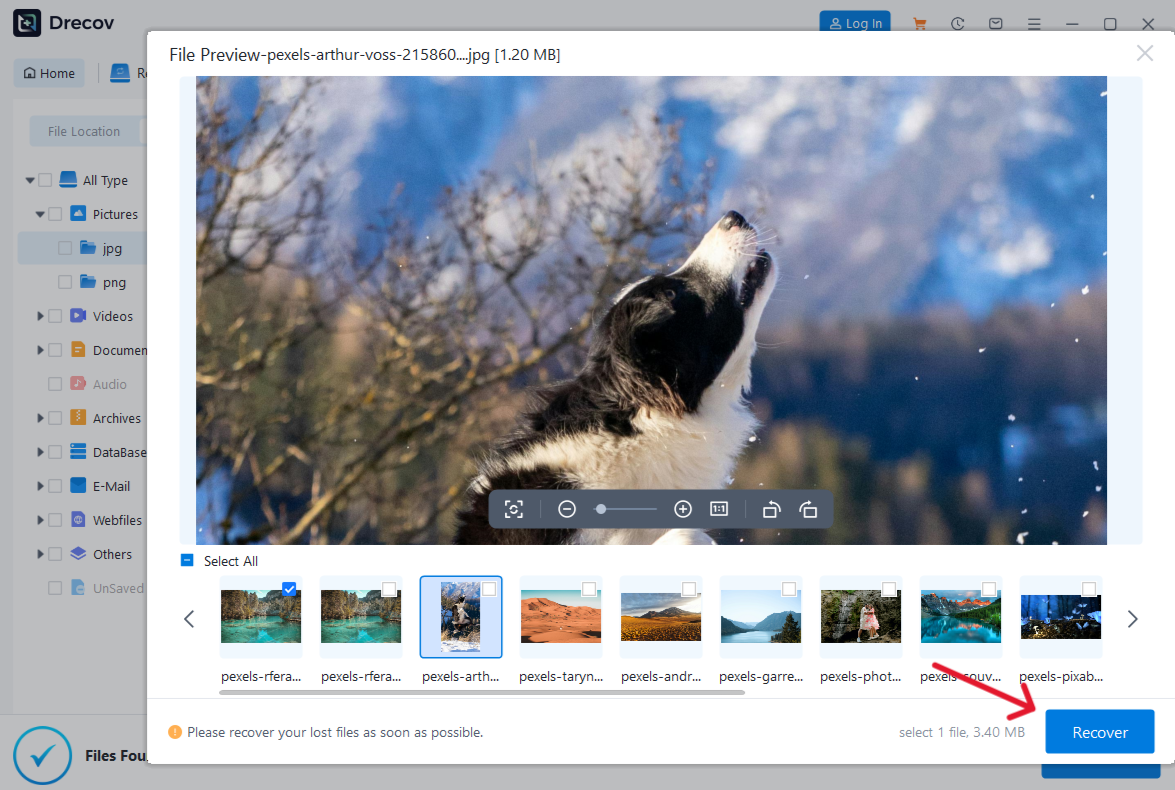
Step 3: Check the Results Before Saving Anything
Filter by path, name, date, or file type, then preview representative documents, photos, videos, and archives. Recover selected data to another healthy device with adequate free space. If the original directory tree is unavailable, inspect the Drecov folder or Recovery folder and verify file contents rather than relying on reconstructed names.
Verify the Recovered Files and Decide Whether to Retire the Drive
Open documents, play media beyond the first seconds, extract archives, and compare important folders with a known inventory. The external-drive detection checklist can help confirm whether the enclosure and connection remain reliable. Reformat only after verified recovery, then run the manufacturer diagnostic and a full read or write test on nonessential data. A drive that disconnects, accumulates errors, or fails validation should be retired.
- Running CHKDSK before securing files from a RAW or damaged volume
- Initializing a previously used disk because Windows offers the button
- Repeating scans on clicking or frequently disconnecting hardware
- Saving recovered files onto the same external drive
- Assuming a successful format proves long-term hardware health
A useful diagnosis also considers time. A disk that mounted normally yesterday but now takes minutes to enumerate is not equivalent to a healthy volume that merely lost its letter. Slow directory listings, repeated retries on the same folder, and a transfer rate that falls to zero can point to unreadable areas even when Windows still shows the correct capacity. In that case, prioritize the smallest irreplaceable folders or a controlled image; do not use a long “repair” pass as a test.
Enclosures deserve separate attention. A SATA drive behind a failing USB bridge may look dead on one connection and stable in a compatible replacement enclosure, but opening a sealed retail unit can affect its warranty and an incorrect adapter can supply the wrong power. Confirm the drive interface and power requirements before changing hardware. If BitLocker is enabled, preserve the recovery key and do not interpret an encrypted volume as corruption. These details decide whether the next step is a cable change, imaging, logical recovery, or professional service.
External Drive Repair Questions
Can an external hard drive be repaired without formatting?
Yes, when the problem is a cable, drive letter, driver state, or limited logical issue. RAW, unallocated, and unstable cases need recovery or imaging first.
Should I run CHKDSK on an external drive?
Only after important data is safe and the device is stable. CHKDSK modifies file-system structures and is not a file-recovery tool.
Why does the drive keep disconnecting?
Power, cable, port, enclosure electronics, overheating, controller faults, or failing media can cause disconnects. Repeated drops are a stop signal.
Can Drecov repair the external drive?
Drecov recovers data from supported stable storage and lost partitions. It does not repair cables, motors, heads, USB bridges, or other hardware.
When should I replace the drive?
Replace it after recurring disconnects, diagnostic failure, increasing read errors, failed format or verification, or any physical symptom.
Use a Nonessential Read Test After Logical Repair
After verified recovery and any chosen file-system repair, reconnect the drive from a normal shutdown and read several nonessential files from different folders. A directory listing alone is not enough because it may be served from cached metadata. Compare the reported capacity and partition layout with the record made before repair, then watch for new disconnects, delayed reads, or controller events. If the disk will be reused, write only disposable test data at first and confirm that it can be read again after safe ejection. Recurring faults mean replacement is safer than returning the device to backup duty.
Conclusion
External drive repair is safest when connection, capacity, sound, and stability determine the next step. Protect readable data before CHKDSK, initialization, partition work, or formatting. For a stable logical loss, Drecov can scan the original drive or its image, preview recoverable files, and save them to another healthy device. Physical symptoms require imaging or professional recovery instead of repeated software repair.






