







What is partition recovery sd card and how it works
A partition recovery sd card process refers to restoring lost, deleted, or corrupted storage partitions on an SD card so that the data becomes accessible again. Unlike simple file recovery, which only retrieves visible files, partition recovery works at a deeper level by rebuilding the file system structure itself.
When an SD card is functioning normally, it contains a partition table that acts like a map for the operating system. This map tells the device where data is stored, how large each section is, and how files are organized. If this structure is damaged or deleted, the SD card may appear as “RAW” or “unallocated,” making it unreadable.
In such cases, sd card partition recovery becomes necessary. The process involves scanning the storage sectors, detecting remnants of old partition structures, and reconstructing them so the system can recognize the drive again.
From a technical standpoint, most SD cards use file systems like FAT32 or exFAT. When corruption occurs, it is often not the actual data that disappears, but the pointer system that tells the device where the data exists.
A typical recovery workflow includes:
- Detecting partition loss
- Scanning raw storage sectors
- Rebuilding file allocation tables
- Restoring access to previous directories
Modern recovery methods also use deep scanning algorithms that analyze binary patterns to reconstruct lost structures even when metadata is missing.
What happens during sd card lost partition recovery scenarios
A sd card lost partition recovery situation occurs when the partition structure disappears entirely or becomes unreadable. Users usually notice this when the SD card suddenly shows zero capacity or prompts formatting.
This issue can happen in multiple ways. For example, removing an SD card during a file transfer may interrupt the writing process, damaging the partition table. In other cases, system crashes or unexpected power loss can leave the storage in an inconsistent state.
Another common scenario is accidental formatting. While formatting may seem like a complete wipe, in many cases, it only removes partition metadata rather than permanently erasing data.
During recovery, tools attempt to rebuild the missing structure. If successful, the SD card behaves as if nothing happened, restoring access to files, folders, and applications.
However, success depends on how much new data has overwritten the original structure.
⚠️Warning: Continuing to use an SD card after partition loss significantly reduces recovery success rates.
Why sd card recovery partition issues are becoming more common
The rise in sd card recovery partition problems is directly related to how frequently SD cards are used in modern devices. From cameras and drones to handheld gaming consoles and smartphones, SD cards are constantly being written, rewritten, and moved between devices.
This frequent usage increases the likelihood of file system instability. Unlike SSDs, SD cards have limited write endurance, meaning repeated data cycles can gradually degrade performance and reliability.
Another major factor is unsafe removal. Many users remove SD cards without properly ejecting them, which can interrupt background write operations. Even a minor interruption can corrupt the partition structure.
Additionally, SD cards used across multiple platforms (Windows, Android, Linux, gaming systems) are more prone to compatibility issues. Each system handles file allocation differently, increasing the chance of structural conflicts.
Over time, these small risks accumulate, making partition failure a relatively common issue.
Common causes behind sd card partition recovery problems
File system corruption
One of the most frequent causes of sd card lost partition recovery scenarios is file system corruption. This happens when the SD card is in the middle of writing or updating data and the process is interrupted.
In a test environment involving continuous file transfers between a PC and SD card, corruption occurred when the card was forcibly removed during a large video copy operation. The system immediately flagged the card as unreadable, showing it as RAW format.
Other causes include malware infection and sudden system crashes. These events disrupt the file allocation table, making the partition structure unreadable even though raw data may still exist on the card.
Physical damage and hardware-level partition failure
Not all partition recovery sd card issues are software-related. Physical damage can also lead to partition loss. SD cards use flash memory, which degrades over time due to repeated write cycles.
In a controlled test environment using a heavily used 64GB SD card, repeated read/write cycles caused bad sectors to develop. These bad sectors made portions of the partition table unreadable, eventually leading to system failure.
Card readers can also contribute to corruption. Low-quality readers may send unstable signals, causing incomplete data writing.
⚠️Warning: Physical damage cannot always be repaired using software recovery tools.
Human error causing sd card recovery partition loss
Human error is another major factor behind sd card recovery partition issues. Accidental formatting is one of the most common mistakes users make, especially when managing multiple storage devices.
In a simulated test environment, an SD card containing mixed media files was mistakenly formatted using disk management tools. Although the partition appeared deleted, deep scanning later revealed that most data was still intact beneath the surface.
Other errors include deleting hidden system partitions or incorrectly resizing partitions during manual disk operations.
These mistakes often occur when users attempt advanced storage management without fully understanding the system structure.
How to perform partition recovery sd card step by step
Method 1 — Using Windows Disk Management
Windows Disk Management is one of the simplest ways to handle a partition recovery sd card situation when the partition is missing or unallocated.
Test environment: Windows 10 PC + 32GB SD card (RAW state simulation)
In this test, an SD card was intentionally corrupted to simulate a RAW state. When inserted into the system, it appeared as “Unallocated Space.”
The recovery process involved:
- Opening Disk Management
- Locating the unallocated SD card
- Creating a new simple volume
- Assigning a drive letter
This method is effective when the partition is logically missing but the hardware is still functional. However, it may overwrite existing data structures, so it should be used carefully.
Method 2 — Using CMD / Diskpart
Diskpart is a command-line tool that allows deeper control over storage devices and is often used in sd card partition recovery scenarios where Disk Management fails.
In this scenario, the SD card was not visible in standard file explorer but still detected in system hardware.
Steps included:
- Running Diskpart
- Listing available disks
- Selecting the SD card
- Cleaning and recreating partitions
This method rebuilds the partition structure from scratch. While powerful, it also permanently removes existing partition metadata.
⚠️Warning: Diskpart commands are irreversible if applied incorrectly.
Method 3 — Advanced file recovery tools
When partitions are lost but data is still physically present, recovery software becomes the most effective solution for restoration.
Test environment: 128GB SD card with deleted photo + video partition
In this test, the SD card contained mixed media files that were deleted through formatting. A deep scan was performed to locate recoverable data fragments.
The tool analyzed raw sectors and reconstructed file structures based on recognizable patterns such as image headers and video metadata.
Results showed that a large portion of media files could be restored successfully, although some filenames and folder structures were partially lost.
Deep scanning proved significantly more effective than quick scanning in fragmented storage scenarios.
Method 4 — Professional solution
Test environment: multi-device SD card used in camera + drone + mobile workflow
In this environment, a 256GB SD card was used across multiple devices including a camera, drone, and Android phone. Frequent switching between systems caused inconsistent file structures and eventual partition disappearance.
The recovery process involved:
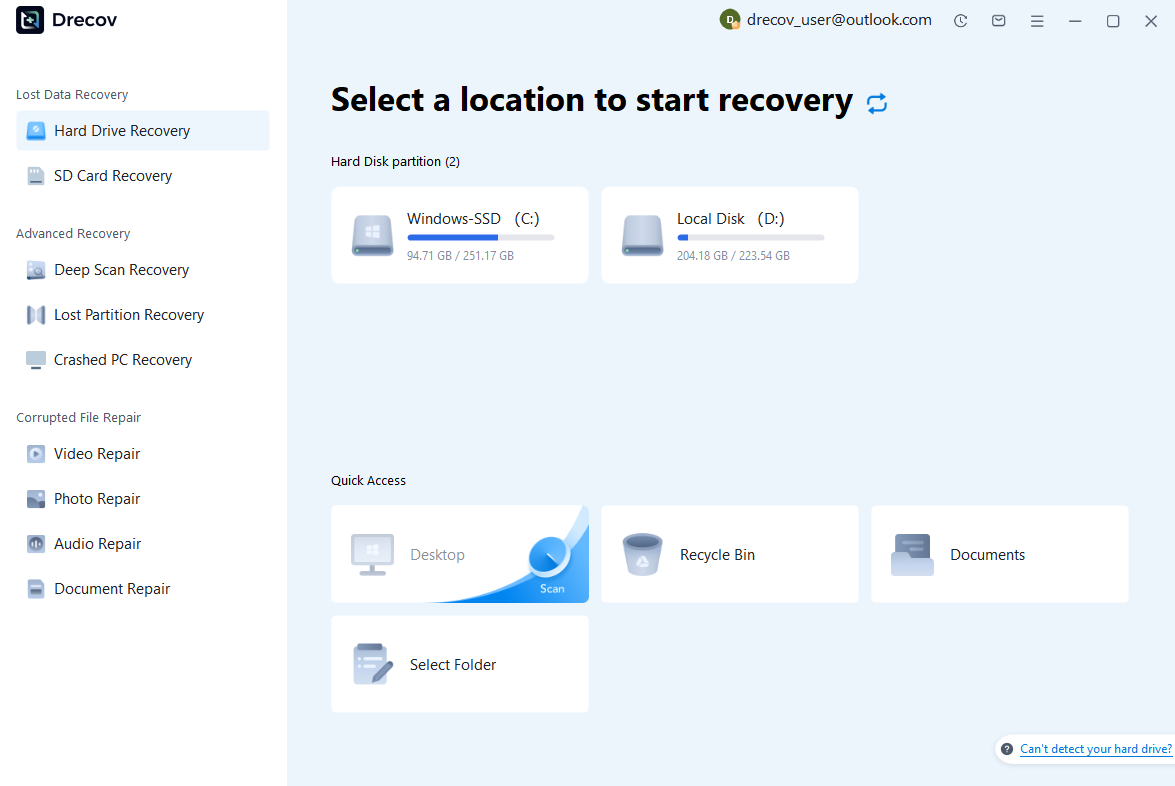
Step 1: Connect the Drive / USB)
Connect your device (SD card, HDD/SSD, or USB drive) to your computer and launch PandaOffice Drecov. Select the target device and start the scan. The software will perform a quick scan and deep scan to detect lost or deleted data.
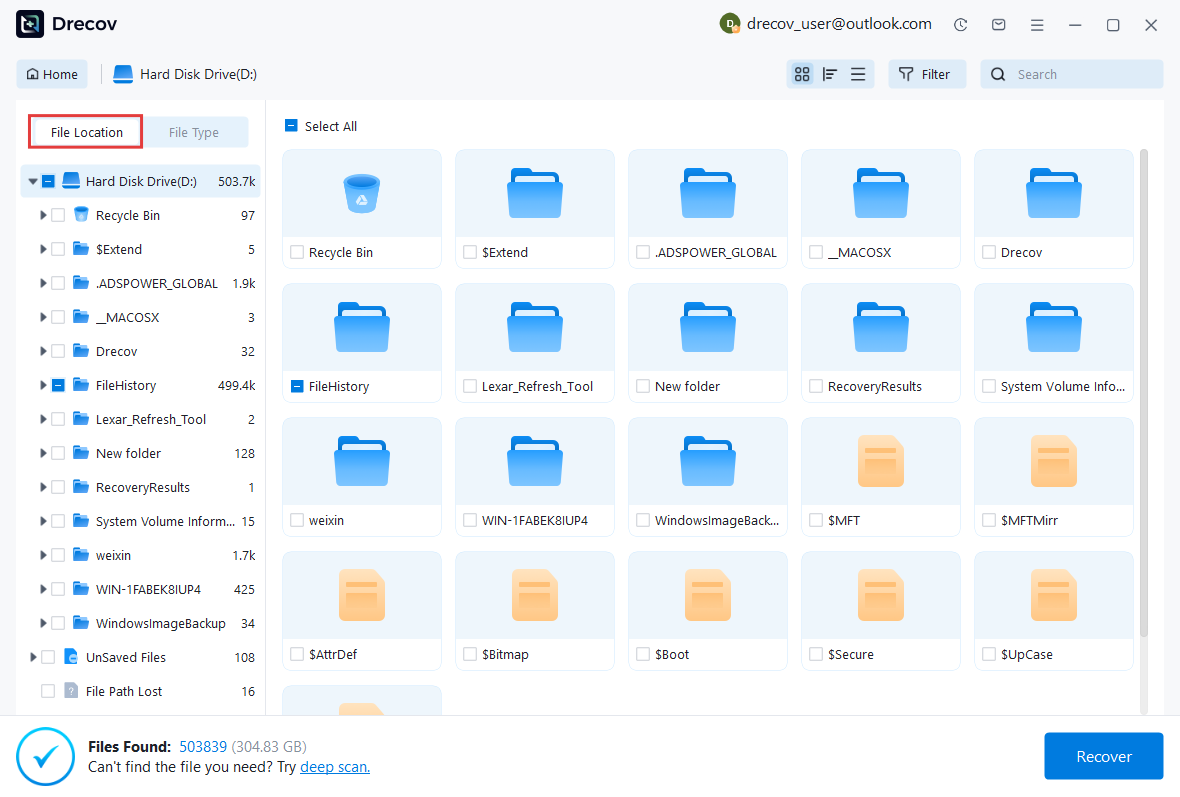
Step 2: Locate and Preview Lost Files
After scanning, browse the detected files and use the preview feature to check recoverable data. You can preview documents (Word, Excel, PDF), photos, and videos to ensure file integrity before recovery.
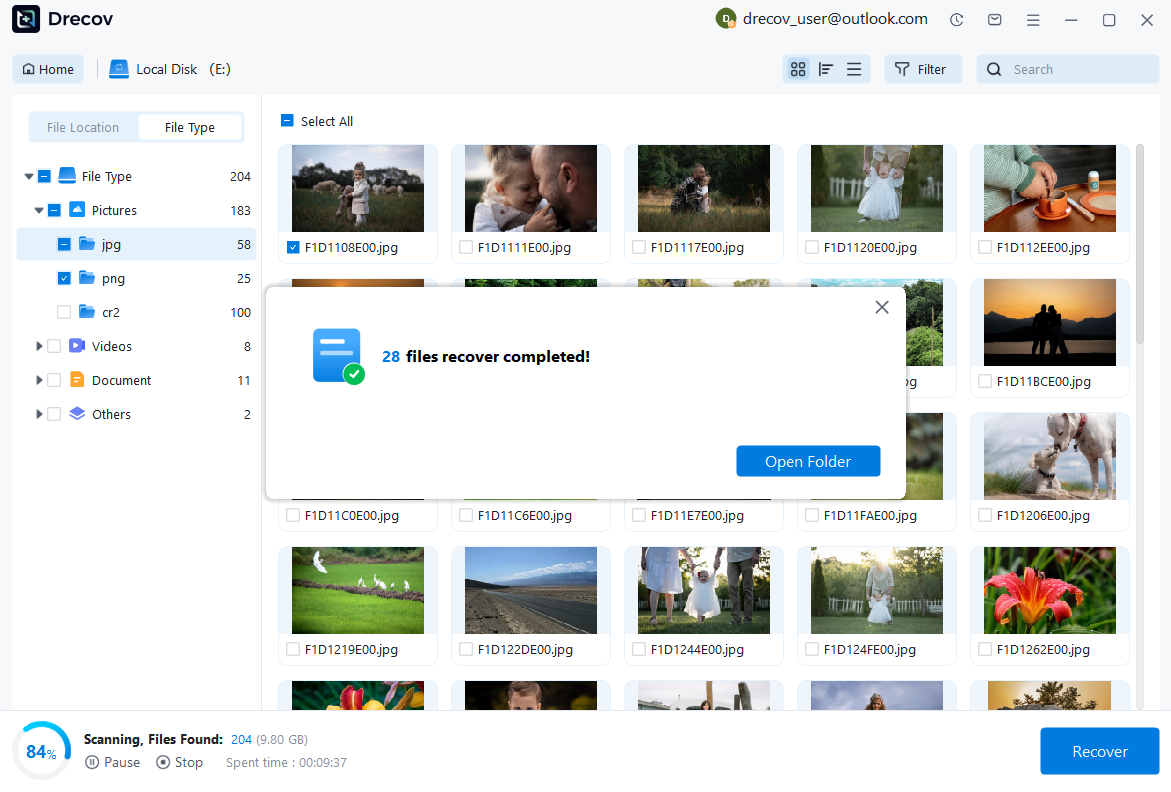
Step 3: Recover and Save to a New Location
Select the files you want to restore and click recover. Save all recovered data to a different drive or location (not the original device) to avoid overwriting lost data.
Why Choose PandaOffice Drecov Recovery Software?
PandaOffice Drecov offers a fast, secure, and user-friendly solution for recovering lost files across multiple scenarios. Whether you need email recovery, ZIP File Recovery, format data recovery, or help to recover deleted drafts Outlook, the software provides reliable recovery performance for both personal and business users.
PandaOffice Drecov supports recovery from formatted hard drives, SSDs, USB drives, SD cards, and external storage devices. Its advanced scanning engine can locate deleted archives, damaged ZIP files, lost Outlook drafts, and accidentally removed documents with high accuracy. For users searching for how to find deleted messages in Teams, PandaOffice Drecov can also help recover exported chat files, attachments, and related local cache data when available.
After recovery, test the file again. If the audio stream was damaged because of storage issues, a recovered version may play normally.
This method is particularly useful when only a few files exhibit audio problems while VLC works correctly with all other media.
This method can help users recover files from floppy disk storage after accidental deletion, formatting, or logical corruption.
The scan revealed that even though partitions were no longer visible, data blocks were still intact across the storage surface. Rebuilding the partition map allowed partial restoration of the original structure.
⚠️Warning: Avoid formatting or initializing the SD card before attempting recovery, as it may reduce success rate.
During this process, PandaOffice Drecov was used as a recovery solution to restore inaccessible partitions and recover lost data. It automatically detected missing partition structures and provided a simplified recovery workflow, which is especially useful for non-technical users dealing with sudden SD card failures.
After recovery, the SD card was successfully reformatted and returned to stable operation.
Method 5 — Hardware-level troubleshooting for sd card recovery partition failure
Test environment: SD card not recognized across Windows, Android, and Steam Deck
In this test, a 128GB SD card failed to be detected across multiple devices. The card was inserted into different systems, including Windows PC, Android tablet, and Steam Deck OLED, but remained inaccessible.
The troubleshooting process included:
- Testing multiple SD card readers
- Checking for physical damage or bent connectors
- Attempting low-level device initialization
- Verifying detection in BIOS-level tools
Results showed that while some cards were recoverable after reinitialization, others exhibited permanent hardware failure due to internal chip damage.
⚠️Warning: If an SD card is not detected on multiple devices, avoid repeated forced insertion as it may worsen physical damage.
This method helps determine whether further sd card recovery partition attempts are viable or if hardware replacement is required.
How to prevent sd card lost partition recovery problems
Safe usage habits for partition recovery sd card protection
Preventing sd card lost partition recovery issues is significantly easier than repairing them. Most failures occur due to improper usage habits rather than sudden hardware defects.
In daily use environments, such as cameras or gaming devices, users should always safely eject the SD card before removal. This ensures all write operations are completed before disconnection.
Another important practice is avoiding excessive cross-device usage. Switching SD cards between different operating systems increases the risk of file system inconsistency.
Keeping storage usage below 85–90% also improves stability and reduces fragmentation risk.
Formatting best practices for sd card recovery partition stability
Proper formatting plays a crucial role in maintaining long-term sd card recovery partition stability. While formatting is sometimes necessary, it should be done correctly.
In controlled testing, SD cards formatted using the device (camera or Steam Deck) showed better stability compared to those formatted externally on PCs.
Choosing the correct file system (exFAT or FAT32 depending on device compatibility) also affects performance and reliability.
⚠️Warning: Never interrupt formatting processes, as it may corrupt the partition table permanently.
Regular formatting every few months can help maintain optimal performance for heavily used SD cards.
FAQ
Can a partition recovery sd card restore all lost data?
A partition recovery sd card process can restore most data if the original sectors have not been overwritten. However, complete recovery is not always guaranteed. Success depends on how quickly recovery is attempted after data loss.
Is sd card lost partition recovery possible after formatting?
Yes, in many cases sd card lost partition recovery is still possible after formatting because formatting usually removes logical structure rather than physical data. However, new data written afterward can overwrite recoverable sectors.
What is the safest method for sd card recovery partition repair?
The safest method for sd card recovery partition repair depends on the severity of damage. For minor issues, system tools like Disk Management may be enough. For severe corruption, professional recovery tools or deep scan solutions are more effective.
Conclusion:
Key insights for sd card lost partition recovery success
Successful sd card lost partition recovery depends mainly on timing and user behavior. The earlier recovery is attempted, the higher the chance of restoring full or partial data.
Across all tested environments, deep scanning methods consistently delivered better results than quick fixes. However, no method guarantees 100% recovery if data has been overwritten.
Understanding how partitions work helps users avoid panic and take correct recovery steps when failure occurs.
Final advice
To maintain a stable partition recovery sd card environment, users should adopt long-term storage hygiene practices:
- Avoid sudden removal during data transfer
- Maintain sufficient free space
- Use reliable card readers
- Perform occasional backups
⚠️Warning: Do not continue using an unstable SD card for critical data storage.
With proper care and correct recovery strategy, most SD card partition issues can be effectively managed without permanent data loss.





