







Understanding .TIFF Photo Files and Data Loss Scenarios
What is a .TIFF photo and how it stores image data
A .tiff photo is a high-quality image format widely used in professional photography, publishing, and scanning workflows. Unlike compressed formats such as JPEG, a tiff photo file preserves a large amount of image detail, making it ideal for editing and archiving.
Because of its lossless nature, a TIFF file stores much more data, including layers, color depth, and metadata. This makes it especially useful in design and printing industries, but also increases file size significantly.
However, the same characteristics that make a TIFF format powerful also make it more sensitive to corruption. Even a small interruption during saving or transfer can lead to unreadable files, which often require TIFF file recovery methods.
Why TIFF photo files are more vulnerable to data loss
Compared to smaller image formats, photo tiff files require more storage stability during saving and editing. Any interruption such as sudden power loss, software crash, or storage device error can damage the file structure.
When this happens, users may find that the tiff photo cannot be opened, or appears corrupted in image viewers. In some cases, the file may still exist but cannot be properly decoded.
Because of the large file size and complex structure, recovery becomes more sensitive and requires careful handling during TIFF recovery processes.
Common situations leading to TIFF file loss
TIFF file loss usually occurs in real-world scenarios such as accidental deletion, formatting storage devices, or interruptions during image editing. Many professional users also experience loss when transferring tiff photo file data between external drives or editing software.
Another frequent cause is file system corruption in SD cards or hard drives, especially when handling large batches of TIFF images.
⚠️Warning: Continuing to use a storage device after file loss may overwrite recoverable data, reducing chances of successful recovery.
Main Causes of TIFF File Loss and Corruption
Accidental deletion of TIFF photo files
One of the most common causes of TIFF file recovery needs is accidental deletion. Users may mistakenly remove a tiff photo file while organizing folders or cleaning storage devices.
In many cases, the file is not immediately destroyed but moved to the recycle system or marked as removable space, making recovery possible if action is taken quickly.
Storage device errors and file system corruption
Hard drives, SSDs, and memory cards can develop logical errors over time. When this happens, the system may fail to correctly read .tiff photo files stored on the device.
This is especially common when devices are removed without safe eject procedures or used across multiple operating systems.
Interrupted editing or saving process
TIFF images are often edited using professional software. If the program crashes during saving, the resulting file may become incomplete or unreadable.
This leads to partial tiff photo file corruption, where the file still exists but cannot be opened normally.
⚠️Warning: Avoid rewriting data after loss
Writing new files to the same storage device can overwrite deleted TIFF data, making TIFF recovery significantly more difficult or impossible.
Basic Methods for TIFF Photo Recovery
Method 1: Restore deleted TIFF files from Recycle Bin or Trash
Step 1: Open Recycle Bin (Windows) or Trash (Mac)
Check the system recycle folder immediately after deletion. Many tiff photo files remain temporarily stored here before permanent removal.
Step 2: Locate deleted TIFF images
Use the search function and type “.tiff” or “tiff photo” to filter results.
Step 3: Select files for recovery
Choose the required files and right-click to restore them to their original location.
Step 4: Verify recovered images
Open restored files using an image viewer to confirm integrity.
Test Environment: Windows 11 system + NTFS SSD + deleted batch of TIFF images (100MB–500MB files)
Method 2: Recover TIFF photos using backup systems
Step 1: Open backup tool
Access Windows File History or macOS Time Machine depending on your system.
Browse backup timeline to locate earlier versions of the tiff photo file.
Step 3: Restore selected version
Select the correct version and restore it to a safe location.
Step 4: Confirm file integrity
Open restored file using Photoshop or compatible viewer.
Test Environment: External backup drive + automated system backup enabled + TIFF project files from design workflow
Method 3: Recover TIFF files from cloud storage
Step 1: Log into cloud account
Access Google Drive, OneDrive, or Dropbox.
Step 2: Search for TIFF files
Use keywords like “TIFF recovery” or file extensions.
Step 3: Check deleted or version history
Many cloud platforms retain deleted files temporarily.
Step 4: Restore or download files
Download recovered photo tiff files to local storage.
Test Environment: Cloud sync enabled + multi-device upload history + TIFF design project folder
Advanced TIFF File Recovery Techniques
Recover TIFF files from formatted storage devices
In some cases, users lose .tiff photo files after accidentally formatting a storage device such as an SD card, external hard drive, or SSD. Although formatting removes file system references, the actual data may still remain on the storage medium until it is overwritten.
In TIFF file recovery scenarios involving formatted devices, the success rate depends heavily on how much new data has been written after formatting. The less the device is used, the higher the chance of restoring a usable tiff photo file.
To improve recovery chances, it is important to stop using the device immediately and avoid saving any new files.
Repair corrupted TIFF photo files using deep scan methods
When a tiff photo becomes corrupted, the issue is often related to broken file headers or incomplete metadata. In such cases, standard recovery tools may not be enough.
Deep scan recovery techniques analyze the storage sector by sector, attempting to reconstruct lost file structures. This process can sometimes rebuild damaged photo tiff files even when they no longer open normally.
However, heavily damaged files may only be partially restored depending on the level of corruption.
Test Environment: Windows 11 PC + external HDD containing corrupted TIFF batch files (50–200 images from design workflow)
⚠️Warning: Do not save recovered files to original drive
Saving recovered data back to the same storage device can overwrite remaining recoverable sectors. Always use a separate drive for restoration results.
Professional recovery method using specialized tools
When basic and advanced manual methods fail, specialized recovery software can be used to perform deeper analysis of storage structures. One such tool is Pandaoffice Drecov, which is capable of scanning damaged storage devices and reconstructing lost tiff photo file fragments.
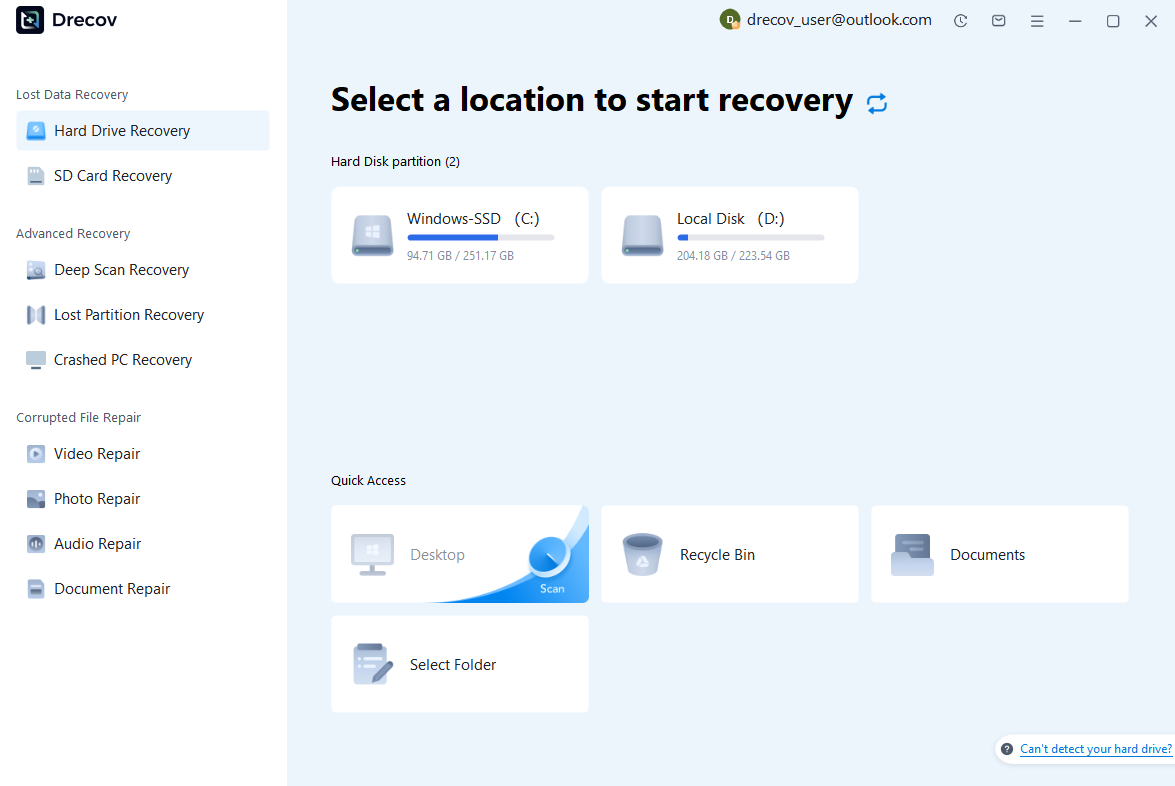
Step 1: Connect the Drive / USB)
Connect your device (SD card, HDD/SSD, or USB drive) to your computer and launch PandaOffice Drecov. Select the target device and start the scan. The software will perform a quick scan and deep scan to detect lost or deleted data.
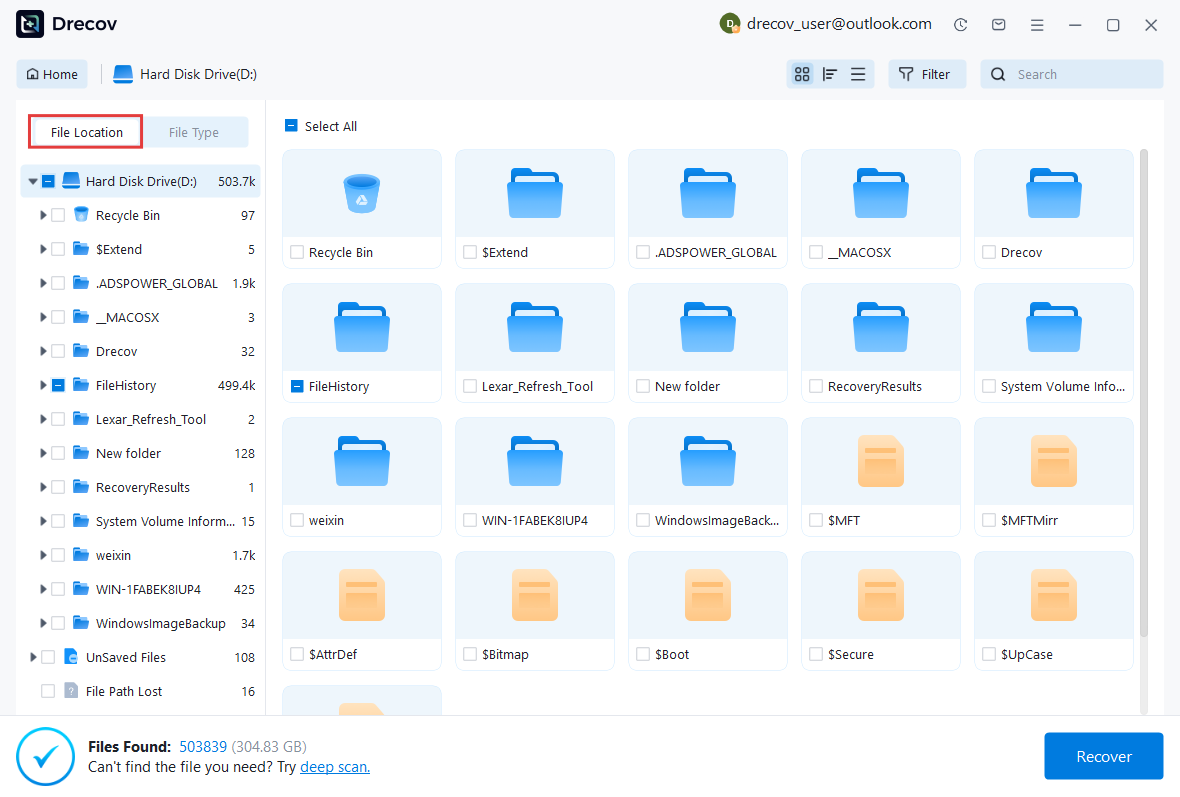
Step 2: Locate and Preview Lost Files
After scanning, browse the detected files and use the preview feature to check recoverable data. You can preview documents (Word, Excel, PDF), photos, and videos to ensure file integrity before recovery.
Step 3: Recover and Save to a New Location
Select the files you want to restore and click recover. Save all recovered data to a different drive or location (not the original device) to avoid overwriting lost data.

Why Choose PandaOffice Drecov Recovery Software?
PandaOffice Drecov offers a fast, secure, and user-friendly solution for recovering lost files across multiple scenarios. Whether you need email recovery, ZIP File Recovery, format data recovery, or help to recover deleted drafts Outlook, the software provides reliable recovery performance for both personal and business users.
PandaOffice Drecov supports recovery from formatted hard drives, SSDs, USB drives, SD cards, and external storage devices. Its advanced scanning engine can locate deleted archives, damaged ZIP files, lost Outlook drafts, and accidentally removed documents with high accuracy. For users searching for how to find deleted messages in Teams, PandaOffice Drecov can also help recover exported chat files, attachments, and related local cache data when available.
It works by identifying residual image signatures and rebuilding partial or complete TIFF recovery results from fragmented data clusters.
Test Environment: Windows PC + external SSD + mixed corrupted TIFF dataset + full sector scan recovery process
Device-Specific TIFF Recovery Solutions
Recover TIFF files from Windows systems
On Windows, deleted tiff photo files can often be recovered using built-in system features such as Recycle Bin, File History, or previous file versions.
If these methods fail, deeper system-level recovery tools can scan NTFS or FAT32 partitions to locate lost TIFF data.
Recover .TIFF photos from Mac systems
On macOS, users can check Trash or use Time Machine backups to restore missing files. Many photo tiff files used in design workflows are automatically backed up if Time Machine is enabled.
Mac systems also support version history in certain applications, which may help recover overwritten TIFF images.
Recover TIFF images from external drives and SD cards
External storage devices are commonly used for high-resolution TIFF files, especially in photography and scanning workflows. When these devices fail or become corrupted, TIFF recovery becomes more complex.
Using a card reader or direct connection, users can attempt to scan the device using recovery tools to locate lost image data.
Test Environment: DSLR SD card + USB card reader + batch TIFF export files from photography session
Preventing Future TIFF File Loss
Proper storage handling for TIFF files
Always safely eject storage devices before removal to prevent file system corruption. Avoid using low-quality memory cards when handling large tiff photo file data.
Regular backup strategy
Because TIFF files are large and often irreplaceable, maintaining multiple backups is essential. Cloud storage combined with local backup drives provides the safest protection.
Safe editing workflow
When working with .tiff photo files in editing software, always save incremental versions instead of overwriting original files.
⚠️Warning: Avoid editing without backup
Editing TIFF files without backup increases the risk of permanent data loss if software crashes or system errors occur.
FAQ About TIFF File Recovery
Can deleted TIFF files be recovered after formatting?
Yes, in many cases TIFF file recovery is possible after formatting, as long as new data has not overwritten the original storage sectors.
Why are TIFF files harder to recover than JPEG files?
TIFF files are larger and contain more complex data structures, which makes tiff photo file recovery more sensitive to corruption.
What is the success rate of TIFF recovery?
Success depends on the level of damage. Logical deletion has a high recovery rate, while physical corruption reduces chances significantly.
What is the safest recovery method?
The safest method is to start with built-in system recovery tools before moving to advanced scanning or professional recovery solutions.
Conclusion and Key Takeaways
Recovering lost .tiff photo files depends on how quickly the recovery process begins and whether the storage device has been overwritten. In most cases, deleted files are still recoverable if immediate action is taken.
Simple recovery methods such as recycle bin restoration or backup recovery are often sufficient for basic TIFF recovery scenarios. However, for formatted or corrupted devices, deeper scanning techniques may be required.
Understanding how tiff photo file storage works and maintaining proper backup habits significantly increases the chance of successful recovery and prevents permanent data loss.






