







Understanding Data Loss on a Broken Laptop or Dead Computer
What happens to files when a laptop stops working
When a laptop becomes broken or fails to start, the operating system becomes inaccessible, but the data stored on the internal drive usually remains intact. This is why get pictures off broken computers is often possible even when the device appears completely dead.
In most cases, photos are stored on the hard drive or SSD, which is separate from the operating system. Even if Windows or macOS fails to load, the data itself is not immediately destroyed.
This means users still have a strong chance to get photos off a broken laptop, provided the storage device has not been physically damaged or overwritten.
Difference between hardware failure and system failure
A key factor in recovery success is understanding whether the issue is hardware-related or software-related. System failure usually involves corrupted files or operating system errors, while hardware failure refers to physical damage such as a broken hard drive or SSD malfunction.
System failures are generally easier to recover from using external tools, while hardware failures require more advanced recovery methods.
This distinction is important when trying to determine how to recover pictures from a dead computer, as the approach depends entirely on the type of failure.
Why photos are still recoverable in many cases
Even when a computer is no longer functional, the stored data is often still present on the physical drive. Operating systems only remove file references, not the actual data immediately.
This is why many users can still retrieve files using external access methods or recovery tools. In many get photos off a broken laptop scenarios, success depends on how quickly recovery is attempted before data is overwritten.
⚠️Warning: Do not repeatedly power on a broken laptop
If a laptop shows signs of hardware failure, repeated startup attempts can worsen internal damage, especially in mechanical hard drives. This may reduce the chances of successful recovery.
Main Causes of Broken Laptop Data Inaccessibility
Hard drive or SSD failure
One of the most common reasons for data inaccessibility is storage device failure. Hard drives may develop bad sectors, while SSDs can fail due to controller or firmware issues.
In such cases, users often need advanced methods to get photos off broken computers, since normal system access is no longer possible.
System crash or operating system corruption
A corrupted operating system can prevent the laptop from booting properly. However, the underlying data usually remains intact on the drive.
This makes it possible to recover files by connecting the drive to another working system.
Physical damage to the laptop
Physical damage such as water exposure, drops, or overheating can prevent the device from turning on. However, the storage drive may still be functional.
This is a common scenario in get photos off a broken laptop recovery cases.
Motherboard or BIOS failure
If the motherboard fails, the laptop may not power on at all. Despite this, the storage drive often remains readable when removed and connected externally.
⚠️Warning: Avoid DIY repairs on severely damaged hardware
Improper handling of damaged hardware can lead to permanent data loss, especially if internal components are physically damaged.
Basic Methods to Get Photos Off a Broken Laptop
Method 1: Remove hard drive and connect to another computer
Step 1: Power off and remove battery
Ensure the laptop is completely powered off before attempting any disassembly.
Step 2: Remove internal hard drive or SSD
Carefully open the back panel and locate the storage device.
Step 3: Connect drive to another computer
Use a SATA-to-USB adapter or docking station to connect the drive externally.
Step 4: Access photo files
Once detected, browse folders such as Pictures, Desktop, or Downloads.
This is one of the most effective methods to get photos off broken computers when the device cannot boot.
Test Environment: Windows 11 PC + SATA-to-USB adapter + 1TB laptop HDD from non-booting system
Method 2: Use external enclosure to access storage drive
Step 1: Insert drive into enclosure
Place the removed hard drive into a compatible external enclosure.
Step 2: Connect to working PC
Plug the enclosure into a functioning computer via USB.
Step 3: Access stored data
Navigate through file explorer to locate image folders.
Step 4: Copy files safely
Transfer photos to a separate storage device.
This method is commonly used for get photos off a broken laptop without requiring internal hardware knowledge.
Test Environment: External HDD enclosure + Windows desktop PC + mixed photo dataset (JPEG/RAW files)
Method 3: Use bootable USB recovery system
Step 1: Create bootable USB
Prepare a Linux Live USB or Windows PE recovery drive.
Step 2: Boot from USB
Insert USB into broken laptop and change boot priority.
Step 3: Access internal drive
Once system loads, locate internal storage without using installed OS.
Step 4: Copy files to external drive
Transfer photos to USB storage or external disk.
This method is useful when trying to how to get photos off a broken computer without removing hardware.
Test Environment: Bootable USB (Linux Live) + non-booting Windows laptop + external storage drive
Advanced Methods for Recovering Photos from a Dead Computer
Deep scan recovery from extracted hard drive
When basic methods fail, the next step is performing a deep scan on the extracted storage drive. This method is especially useful in cases where the operating system cannot boot, but the drive itself is still readable.
A how to recover pictures from a dead computer scenario often involves scanning the drive sector by sector to locate hidden or deleted image fragments. These fragments can sometimes be reconstructed into usable photos depending on how much the disk has been overwritten.
Deep scan recovery is particularly effective when dealing with accidental deletion combined with system failure.
Test Environment: Windows 11 recovery PC + extracted 1TB HDD + deep scan recovery software + mixed JPG/RAW photo dataset
Recover photos from corrupted or unreadable partitions
In some cases, the drive may be detected but show as “unallocated” or “corrupted.” This usually indicates partition table damage rather than full data loss.
Advanced recovery tools can rebuild partition structures and make the data accessible again. This is a common method used to get photos off broken computers where the system recognizes the drive but cannot open it.
Once the partition is restored virtually, users can browse and extract image files normally.
Test Environment: External HDD + corrupted NTFS partition + Windows recovery environment + partition reconstruction tool
⚠️Warning: Do not format or initialize the drive
If the system prompts you to format the drive, do NOT proceed. Formatting can overwrite critical file structure data and significantly reduce recovery success rates.
Professional recovery method using advanced tools
When the drive is physically intact but logically damaged, professional tools can provide deeper recovery capabilities. One such solution is Pandaoffice Drecov, which performs full sector-level scanning and reconstructs lost image files from fragmented data.
Step 1: Connect the Drive / USB)
Connect your device (SD card, HDD/SSD, or USB drive) to your computer and launch PandaOffice Drecov. Select the target device and start the scan. The software will perform a quick scan and deep scan to detect lost or deleted data.
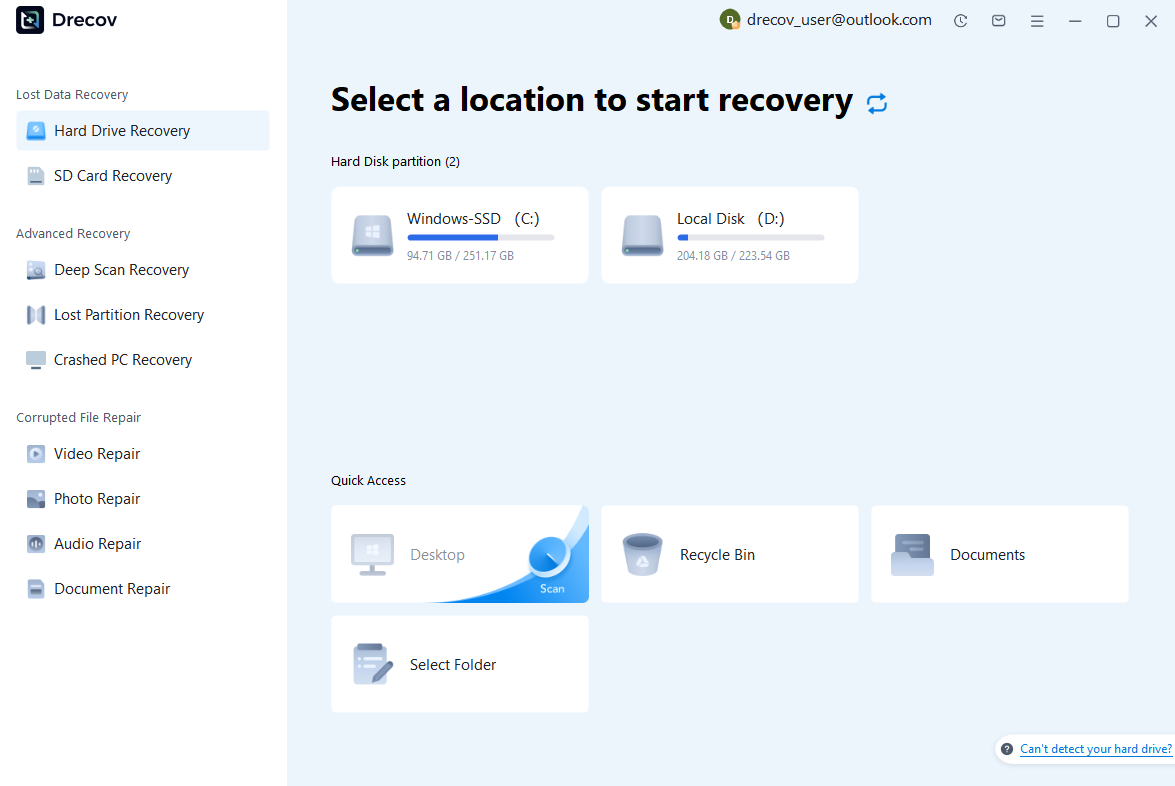
Step 2: Locate and Preview Lost Files
After scanning, browse the detected files and use the preview feature to check recoverable data. You can preview documents (Word, Excel, PDF), photos, and videos to ensure file integrity before recovery.

Step 3: Recover and Save to a New Location
Select the files you want to restore and click recover. Save all recovered data to a different drive or location (not the original device) to avoid overwriting lost data.

Why Choose PandaOffice Drecov Recovery Software?
PandaOffice Drecov offers a fast, secure, and user-friendly solution for recovering lost files across multiple scenarios. Whether you need email recovery, ZIP File Recovery, format data recovery, or help to recover deleted drafts Outlook, the software provides reliable recovery performance for both personal and business users.
PandaOffice Drecov supports recovery from formatted hard drives, SSDs, USB drives, SD cards, and external storage devices. Its advanced scanning engine can locate deleted archives, damaged ZIP files, lost Outlook drafts, and accidentally removed documents with high accuracy. For users searching for how to find deleted messages in Teams, PandaOffice Drecov can also help recover exported chat files, attachments, and related local cache data when available.
This method is commonly used in severe get photos off a broken laptop cases where other methods fail or the system cannot detect files normally.
Unlike basic tools, it can detect residual image signatures even from partially corrupted storage sectors.
Test Environment: Windows PC + external SSD/HDD + severely corrupted drive image + full disk scan mode enabled
Device-Specific Recovery Scenarios
Recover photos from Windows laptops
On Windows systems, most recovery starts with external drive access. Once the internal disk is connected, users can directly browse folders such as Users, Desktop, or Pictures.
If the system partially boots, File Explorer or recovery utilities may still allow access to missing images.
This is one of the most common approaches for get photos off a broken laptop without professional assistance.
Recover photos from MacBooks
Mac systems offer Target Disk Mode, which allows a broken Mac to behave like an external drive when connected to another Mac.
Time Machine backups can also restore lost images if enabled beforehand.
Recover photos from physically damaged laptops
If the laptop is damaged due to water, impact, or overheating, the first step is always to remove the storage device and test it externally.
Even if the device cannot power on at all, the internal drive may still contain intact photos.
Test Environment: Water-damaged laptop + SSD extraction + USB adapter + secondary PC access test
Comparison of all recovery methods (pros, cons, and effectiveness rating)
Overall recovery methods comparison table
When users try to get photos off a broken laptop, different recovery methods offer different success rates depending on the type of failure. The table below summarizes all major approaches discussed in this guide, including their advantages, disadvantages, and recommended usage scenarios.
| Method | Advantages | Disadvantages | Recommended Rating |
|---|---|---|---|
| Remove hard drive and connect to another PC | High success rate, direct access to files, no software needed | Requires physical disassembly, risk if hardware is fragile | ⭐⭐⭐⭐⭐ |
| External enclosure method | Easy to use, safe for beginners, stable access | Requires extra hardware enclosure | ⭐⭐⭐⭐⭐ |
| Bootable USB recovery system | No need to remove hardware, works on non-bootable systems | Requires technical setup, slower access speed | ⭐⭐⭐⭐ |
| Deep scan recovery (software-based) | Can recover deleted or hidden files, works after deletion | Time-consuming, not always 100% recovery | ⭐⭐⭐⭐ |
| Partition recovery (corrupted drive repair) | Can restore access to lost partitions | Risky if misused, requires advanced tools | ⭐⭐⭐⭐ |
| Pandaoffice Drecov (advanced recovery tool) | Deep sector scan, reconstructs fragmented photos | May take long scan time, depends on drive condition | ⭐⭐⭐⭐⭐ |
| Direct system access (Windows/Mac recovery tools) | Simple, built-in solutions, no extra tools needed | Only works if system partially boots | ⭐⭐⭐ |
How to interpret this comparison
Each method used to get photos off a broken laptop depends on the severity of the damage. For example, if the drive is physically intact, hardware-based access methods are usually the most effective. However, when dealing with corruption or formatting, deep scan and recovery software become necessary.
In more complex how to get photos off a broken computer cases, combining multiple methods often yields the best results—for example, using external enclosure first, then applying deep scan tools if needed.
⚠️Warning: Do not rely on a single recovery method
Different failures require different recovery strategies. Relying on only one method may reduce success chances, especially in cases involving both physical and logical damage.
Updated conclusion of recovery strategy effectiveness
Based on real-world recovery scenarios, hardware-based extraction methods (such as removing the hard drive or using an external enclosure) generally offer the highest success rates. Software-based recovery methods are most effective when the drive is still readable but files are lost or corrupted.
Professional tools like Pandaoffice Drecov become essential when other methods fail, especially in severe get pictures off broken computers cases involving deep corruption or partition loss.
Preventing future photo loss from laptop failure
Use multiple backup systems
To avoid losing important files, users should maintain at least two backup locations, such as cloud storage and external drives.
Monitor disk health regularly
Tools that monitor SMART status can detect early warning signs of drive failure, helping prevent sudden data loss.
Safe shutdown practices
Improper shutdowns increase risk of file corruption. Always ensure systems shut down properly before disconnecting power.
⚠️Warning: Backup before hardware failure signs appear
Slow performance, clicking sounds, or frequent crashes are early signs of storage failure. Immediate backup is strongly recommended.
FAQ About Getting Photos Off a Broken Laptop
Can I recover photos from a laptop that won’t turn on?
Yes, in most cases you can still recover photos by removing the hard drive and connecting it to another working computer.
What is the safest way to get photos off a broken computer?
The safest method is using external drive access or enclosure-based recovery before attempting any advanced repair.
Is data still recoverable after physical damage?
It depends on the severity. If only the laptop casing is damaged but the drive is intact, recovery is often possible.
How to get photos off a broken computer without losing data?
Avoid formatting, avoid repeated boot attempts, and use external access or professional recovery tools.
Conclusion and Key Takeaways
Recovering photos from a broken laptop is often possible because data remains on the storage device even when the system fails. The key factor is choosing the right method based on the type of failure.
Simple hardware extraction, external enclosure access, or bootable USB methods are usually enough for most get pictures off broken computers cases. For more severe damage, deep scan or professional recovery may be required.
Understanding how storage works and acting quickly significantly increases success rates when trying to get photos off a broken laptop or recover data from a dead system.






