







A Complete Step-by-Step Recovery Guide for Beginners
Introduction: Lost Files on a Hard Drive — Is Recovery Still Possible?
“My hard disk is corrupted. Can I still get my files back?”
“I accidentally deleted important documents. How do I restore lost files from hard drive without damaging anything?”
Data loss from a hard drive is one of the most stressful problems for computer users.
In many cases, photos, work documents, Excel files, and personal records may disappear suddenly after a system crash, power failure, accidental deletion, or hard drive corruption. As a result, users often respond with panic. Under such circumstances, they may perform unsafe actions, such as formatting the drive or repeatedly restarting the computer, which can further worsen the situation.
The good news is that losing files does not always mean they are permanently gone. In many situations, data still exists on the hard drive and can be recovered safely if the correct method is used. The key is understanding how to restore lost files from hard drive without overwriting the remaining data.
This article is written for ordinary Windows users with limited technical experience. It provides a complete recovery roadmap, starting from the easiest free methods and progressing to professional tools and services. You will learn how to diagnose data loss scenarios, apply step-by-step recovery solutions, and decide when specialized tools like pandaoffice drecov or professional data recovery services are necessary.
Common Reasons Why Files Are Lost from a Hard Drive
Before attempting how to restore lost files from hard drive, it is essential to identify the cause of data loss. Different causes require different recovery strategies, and using the wrong method may permanently destroy your files.
1. File System Corruption
File system corruption often occurs after sudden power failures, forced shutdowns, system crashes, or unsafe removal of external hard drives. When this happens, Windows may display messages such as “The drive is not accessible” or “You need to format the disk before using it.”
In this case, files are usually still present but inaccessible.
2. Accidental Deletion
Users frequently delete files unintentionally using Shift + Delete, emptying the Recycle Bin, or deleting the wrong folder. This is one of the most common data loss scenarios and usually has a high recovery success rate.
3. Formatting the Hard Drive
Formatting removes file system references, making files invisible to Windows. Even so, formatting does not immediately erase file data, which means recovery is often possible if the drive is not reused.
4. Virus or Malware Attacks
Certain viruses hide, encrypt, or delete files. Some malware modifies file extensions or makes folders appear empty. In many cases, data can still be recovered using recovery software.
5. Bad Sectors or Aging Hardware
Old hard drives may develop bad sectors that prevent Windows from reading files correctly. If the drive is still detected, data recovery software may retrieve files from readable areas.
📌 (Insert: Hard drive data loss troubleshooting flowchart here)
Core Solutions: How to Restore Lost Files from Hard Drive
Below are six proven recovery methods, arranged from easiest to most advanced. Beginners should always start with simpler solutions before moving to advanced tools.
Method 1: Restore Files from the Recycle Bin
Best for: Recently deleted files
Difficulty: Very easy
When learning how to restore lost files from hard drive, the Recycle Bin should always be checked first.
Steps:
- Double-click Recycle Bin on your desktop
- Locate the deleted file or folder
- Right-click and choose Restore
Advantages and Disadvantages of Restoring Files from the Recycle Bin
Restoring files from the Recycle Bin is the easiest and safest way to recover recently deleted data from a hard drive. One key advantage is simplicity. The process requires no technical knowledge, no third-party software, and only a few clicks, making it ideal for beginners. Because it is a built-in Windows feature, there is no risk of data overwriting, malware, or file corruption. In addition, restored files return to their original locations with complete folder structures and filenames preserved.
Another benefit is speed. Recovery is almost instant, which is helpful when users notice accidental deletion quickly. It is also completely free, making it the most cost-effective recovery method.
However, this method has limitations. It cannot recover files deleted using Shift + Delete, files removed after emptying the Recycle Bin, or files deleted from some external devices. Large files may also bypass the Recycle Bin. Therefore, while this method is convenient, it works only for basic data loss situations.
💡 Tip:
If the Recycle Bin was emptied, proceed to the next recovery method immediately.
Method 2: Restore Lost Files from File History Backup
Best for: Users who enabled Windows backup
Difficulty: Easy
File History is a built-in Windows feature that periodically backs up personal files.
Steps:
- Open Control Panel
- Go to File History
- Click Restore personal files
- Browse previous versions and restore the needed files
Advantages and Disadvantages of Restoring Files with File History
Using File History is a reliable method for restoring lost files when Windows backup was enabled in advance. One major advantage is that it allows users to recover files from earlier versions, even if the originals were deleted, overwritten, or damaged. The process is relatively simple and does not require third-party software, making it suitable for users with limited technical experience. File History also helps preserve file integrity, folder structure, and timestamps, ensuring accurate recovery.
Another benefit is its ability to restore specific versions of files, which is especially useful for documents that were modified incorrectly. It is also a free, built-in Windows feature, making it a cost-effective recovery option.
However, File History has clear drawbacks. It only works if the feature was enabled before data loss occurred. If backups were never configured or the backup drive is unavailable, recovery is impossible. Additionally, it mainly protects personal folders and may not cover all system locations or file types.
Method 3: Use “Previous Versions” to Restore Files
Best for: Overwritten or modified files
Difficulty: Easy
Windows sometimes saves shadow copies of files and folders.
Steps:
- Right-click the folder where the file was stored
- Select Properties
- Open the Previous Versions tab
- Restore an earlier version if available
Advantages and Disadvantages of Using “Previous Versions”
The “Previous Versions” feature is a convenient way to recover overwritten or modified files on Windows systems. One major advantage is that it allows users to restore an earlier version of a file or folder without using third-party recovery software. The process is simple and user-friendly, making it suitable for beginners. It is especially useful for documents such as Word or Excel files that were accidentally overwritten or saved incorrectly. Since it relies on Windows shadow copies or restore points, recovered files usually maintain good integrity.
Another benefit is that this method is free and built into Windows, requiring no additional installation. It can save time compared to full data recovery scans.
However, this method also has limitations. Previous Versions are only available if System Protection or File History was enabled before the data loss occurred. In many cases, no versions are available at all. Additionally, it cannot recover files that were permanently deleted or lost due to disk formatting or severe corruption.
Method 4: Repair File System Errors Using CHKDSK
Best for: File system errors, missing files
Difficulty: Medium
CHKDSK is a Windows command-line tool that fixes logical file system issues.
Steps:
- Press Win + R, type
cmd - Right-click Command Prompt → Run as administrator
- Enter:
chkdsk X: /f
(X represents the affected drive letter)
Advantages and Disadvantages of Using CHKDSK
CHKDSK is a powerful built-in Windows tool designed to repair logical file system errors and resolve issues such as missing or inaccessible files. One major advantage is its ability to fix structural problems on a hard drive, including corrupted file tables and directory errors. It can make an unreadable drive accessible again without requiring third-party software. Since CHKDSK is included with Windows, it is free and readily available to all users.
Another benefit is that it helps improve overall disk stability and can prevent future errors by repairing bad file system entries. This makes it useful after sudden shutdowns or power failures.
However, CHKDSK also has significant risks. During the repair process, it may delete damaged file fragments or convert them into unusable files, leading to permanent data loss. For this reason, it is not recommended before attempting data recovery. In addition, it requires command-line operations, which may be confusing for beginners.
⚠️ Warning:
This command may cause permanent file loss in certain situations. Avoid using CHKDSK before attempting data recovery if files are critical.
Method 5 (Recommended): Use pandaoffice drecov to Restore Lost Files from Hard Drive
Best for: Deleted, formatted, corrupted, or inaccessible drives
Difficulty: Beginner-friendly
Success Rate: High
When users search how to restore lost files from hard drive, professional recovery software offers the safest and most reliable solution.
Why pandaoffice drecov?
pandaoffice drecov is designed specifically for non-technical users who need a powerful yet simple hard drive recovery solution. It supports recovery from internal hard drives, external HDDs, USB drives, and memory cards.
Step-by-Step Recovery Process
Step 1: Download and Install
Download pandaoffice drecov from the official website. Install it on a different drive to avoid overwriting lost data.
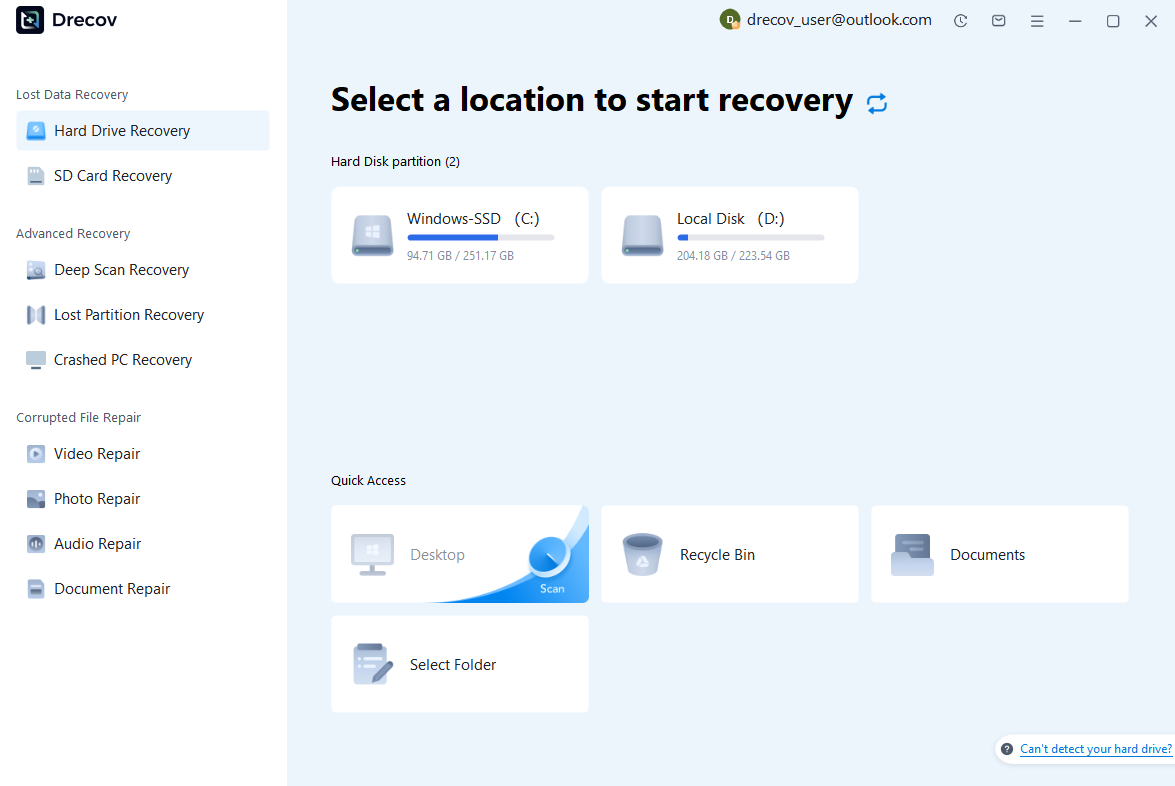
Step 2: Select the Hard Drive
Launch the program and choose the hard drive or partition where files were lost.
Step 3: Scan for Lost Files
Start scanning. The software performs a quick scan first, followed by a deep scan to locate more recoverable files.

Step 4: Preview Files Before Recovery
Preview documents, photos, videos, and spreadsheets. This step is especially useful for users looking for how to restore lost Excel file data.
Step 5: Recover Selected Files
Choose the files you want and click Recover.

Step 6: Save to a Safe Location
Save recovered files to another hard drive, USB device, or external storage.
Key Advantages:
- Works on Windows 10 and Windows 7
- No technical knowledge required
- More affordable than traditional data recovery services
- Supports multiple file types and file systems
Method 6: Professional Hard Drive Recovery Services
Best for: Physical damage, severe hardware failure
Difficulty: Professional-only
For this reason, if the hard drive is not detected by BIOS, makes clicking noises, or shows signs of physical damage, software recovery is no longer safe.
Typical Pricing
| Recovery Type | Estimated Cost |
|---|---|
| Logical data recovery | $100 – $300 |
| Physical hard drive repair | $500 – $2000+ |
Professional hard drive recovery service should only be used when all software-based methods fail.
How to Repair a Hard Drive After Data Recovery
Once you successfully complete how to restore lost files from hard drive, you may want to repair the drive to prevent future data loss.
Basic Checks
- Replace USB or SATA cables
- Try different ports or computers
- Check Disk Management for unallocated space
Advanced Repairs
- Windows Error Checking tool
- Manufacturer diagnostic tools
- PandaOffice repair utilities
📌 (Insert: pandaoffice repair tool screenshot here)
⚠️ Always recover files before formatting or repairing the drive.
Important Recovery Warnings You Must Read
- Do not format the hard drive before recovery
- Do not install recovery software on the affected drive
- Avoid repeated scan attempts with multiple tools
- Command-line repairs may overwrite file structures
Taking the wrong step is the most common reason recovery fails.
⚠️ Warning: Incorrect actions can permanently destroy data
FAQ: How to Restore Lost Files from Hard Drive
Yes. If the drive is recognized by Windows, recovery software can often retrieve files successfully.
They work only for minor deletion cases. Complex corruption requires advanced tools.
Using professional recovery software is the safest method for beginners.
Yes. Previewing files before recovery helps ensure file integrity.
Only for physically damaged drives or critical data scenarios.
Final Summary: Best Way to Restore Lost Files from Hard Drive
When files disappear from a hard drive, the most important rule is stop using the drive immediately. Acting quickly and correctly dramatically improves recovery success.
Recommended Recovery Order:
Use pandaoffice drecov ⭐⭐⭐⭐⭐
Windows backup and built-in tools ⭐⭐⭐
Professional data recovery services⭐⭐
👉 Learn More about Hard Drive Recovery
Finally, remember that regular backups are the only guaranteed way to prevent future data loss. Prevention is always easier than searching for how to restore lost files from hard drive again.





