







If your screen record didn’t save, leave the recorder open if it is still running and check its output location before restarting the computer. A completed recording may be in a different folder, while an interrupted session may leave a temporary or unfinished video. Copy any candidate to a healthy location before testing it. A data recovery scan helps only if a local file was written and later deleted; it cannot retrieve frames that the recorder never saved.
screen record didn’t save: safe diagnosis
“Screen recording” can mean Xbox Game Bar, Snipping Tool, OBS Studio, a meeting app, a browser extension, or a built-in phone utility. Each has its own save behavior. Identify the exact application, whether you pressed Stop, and whether the app displayed an export or save confirmation. Write down the approximate start and stop time. Those details make a targeted search much more useful than scanning every video file on the computer.
In the recorder’s settings, inspect the recording path. For Xbox Game Bar, the usual Windows location is Videos\Captures, though settings can change how captures are managed. In OBS, the Recording Path is configurable, and an automatic remux can create another output after a recording ends. OBS explains these settings in its recording output guide. A browser-based or meeting recorder might upload to an account rather than save locally; check its web dashboard and trash before touching the disk.
Search File Explorer by the recording date and plausible extensions such as .mp4, .mkv, or .mov. The local video-location checks can widen the search without touching the disk’s file system. Sort results by modification time and inspect file size. A tiny file written at the right time may be a placeholder, while a larger file in an unexpected folder may be the complete recording. Do not assume the last file you see is the correct one; some applications write a temporary container and later create a final export.
Separate an Unfinished Export From a Deleted Video
If the recording app remains open, inspect its current project, recent recordings, and export queue. Do not close or force-quit it merely because the final file is absent. A long recording may still be finalizing its container. If the app reports a failed export, preserve any project or temporary files before trying again. Export a copy to another healthy drive when possible.
An interrupted MP4 recording can be especially awkward because final metadata may not have been written. OBS recommends MKV for better resilience to an ungraceful stop, then remuxing to another container when needed. That is a prevention setting, not a guarantee that an already broken recording can be repaired. Work on copies of the unfinished file. The corrupted-video troubleshooting path applies when bytes exist but playback fails.
A recording that never started or was blocked by permissions may have produced no file at all. A local disk scan cannot recover a non-existent capture. Check the app’s notification history, storage permission, disk space, and whether the correct screen or window was selected. These checks help avoid spending hours scanning a drive when the real issue is an incomplete recording session.
Search the Most Likely Copies in a Safe Order
Check the recorder’s configured folder first, then the Windows Videos and Captures folders, Desktop, Documents, and the folder last chosen in Save As. Search the app’s project directory if it keeps session files separately. If the recording was made in a meeting service, inspect cloud recordings under the correct account and organizer. A file may belong to someone else in the meeting, not the local PC.
Look for synchronized copies in OneDrive or another backup service. If you find two versions, preserve both before opening them. A shorter file may be a partial export, but it may contain the only surviving beginning of the session. A larger file can be a temporary raw capture that still needs finalization. Do not delete either candidate until the usable playback has been verified.
Check the Recycle Bin and application trash. If a screen capture was saved and then removed during cleanup, ordinary restore may recover the file without a scan. The deleted-video recovery methods cover broader file-level options. They should not be confused with fixing an export that never completed.
When a Local Recording Was Deleted
Once you have evidence that a video existed on local storage and was deleted, stop writing to its source. Recording another screen session onto the same disk can overwrite the lost one. On a system SSD, ordinary Windows activity and TRIM may sharply reduce the recovery opportunity. A clicking HDD, repeated disconnections, or severe read errors means stop direct scans and consider imaging or professional help.
PandaOffice Drecov is Windows data recovery software for PCs, HDDs, SSDs, USB drives, SD cards, memory cards, and external storage. Its read-only recovery mode can search a stable source for a deleted capture file. Quick Scan and Deep Scan provide staged searches; filtering and preview help identify video candidates before export. It also supports documents, photos, audio, emails, and archives, with Lost Partition Recovery for files on a missing partition. It cannot reconstruct frames never written, fix a recorder’s permissions, repair physical hardware, or guarantee overwritten content.
⚠ Warning: Install it on a drive different from the one where your data was lost to prevent overwriting.
Prepare another healthy device with enough capacity for a potentially large video. Do not install Drecov on the partition that held the lost capture or export recovered files there. Use the Drecov home page for the official Windows application once the source is stable and identified.
Step 1: Open Drecov and select the original recording drive
Choose the drive named in the recorder’s output path, not simply C: by habit. If OBS or another app saved to an external SSD, that device is the source. If its partition vanished but the device remains stable and detected, consider Lost Partition Recovery. Leave its partition map unchanged during this search.

Step 2: Run Quick Scan
This check is especially useful for screen record didn’t save. Search for the recording date, expected extension, and output folder. A matching filename is a candidate, not proof that the video is complete. Stop if the drive begins dropping offline. Preserve the remaining evidence rather than attempting more direct reads.

Step 3: Use Deep Scan only on stable media
If the capture is absent from the first results, run Deep Scan on the stable source. Results may have generic names or lost folder paths. Compare file sizes with the expected recording length, but avoid inventing an exact duration from size alone; bitrate varies widely.
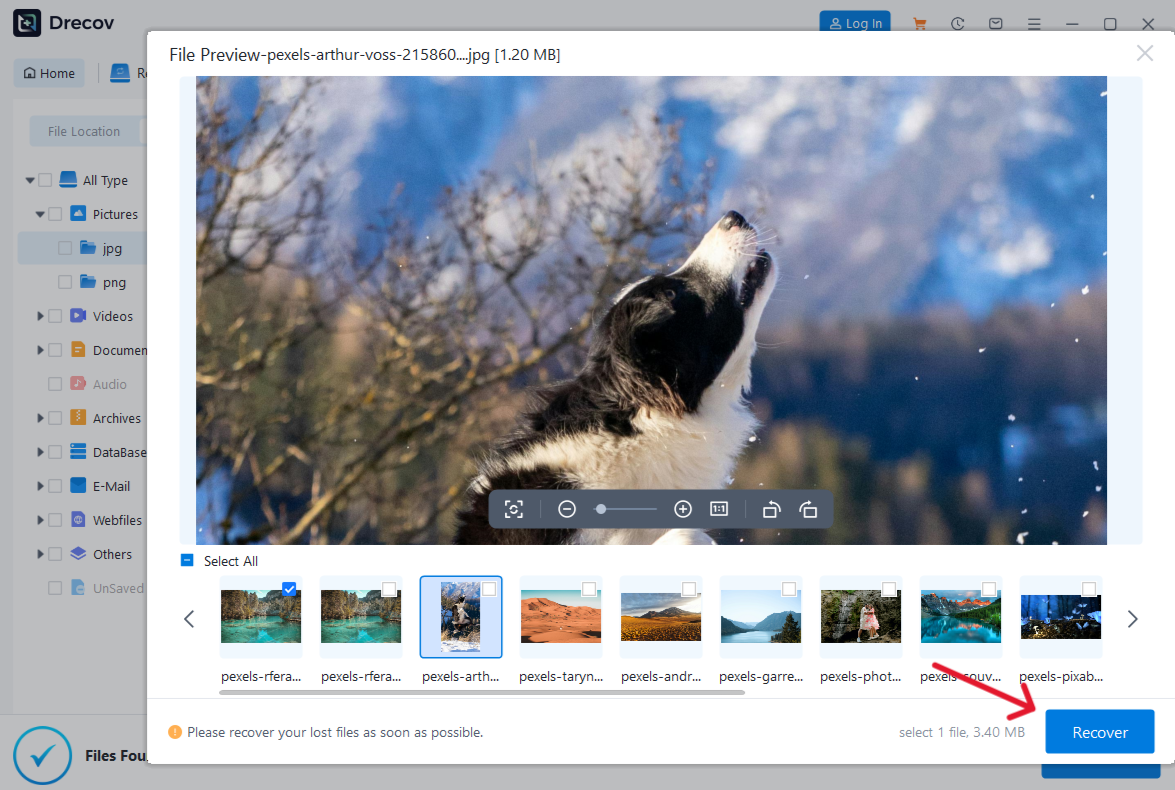
Step 4: Filter and preview candidate videos
Filter by video type, name, or location when possible. Preview promising files, then plan a full playback test after export. The opening seconds can work even when the end of an interrupted recording is missing. Recover several plausible versions separately if you cannot identify the final one.
Step 5: Export elsewhere and check the whole timeline
Save recovered candidates to another healthy device, never to the source. If you cannot find the exported capture, inspect the Drecov folder or Recovery folder on that destination. Play the beginning, middle, and end; check audio and the specific moment you needed. Only after verification should you repair, format, or resume heavy recording on the original drive.
⚠ Warning: Install it on a drive different from the one where your data was lost to prevent overwriting.
Screen record didn’t save FAQs
Could the file still be inside the recorder?
Yes. Some apps keep projects, temporary recordings, or an unfinished export queue. Inspect the application before closing it and copy any candidate files to a healthy location. Do not assume an absent MP4 means no recording data exists.
Does a zero-byte file contain recoverable video?
Not within that file. It may be a placeholder while another temporary file holds the data. Search the recorder’s project and temp paths. If no bytes were ever written, a disk scanner cannot invent the missing video.
Should I record the screen again to test the app?
Not on the same source if a valuable capture may have been deleted. A new video can overwrite it. Test the recorder on another drive after preserving or recovering the first session.
Can Drecov repair an unfinished MP4?
Its role in this scenario is finding a deleted local file on stable storage. An incomplete container may need a separate repair or remux workflow, using a copy. Neither action can create frames that were never saved.
What if the recording was saved to a cloud account?
Check that service’s recording library, organizer account, trash, and retention settings. Drecov scans local storage, not the cloud service. A local scan is relevant only if a local copy was written and later lost.
Conclusion
When a screen record didn’t save, the right answer depends on the recorder and the save stage. Locate its configured output, preserve unfinished files, and check cloud or backup copies. If a complete local recording was actually deleted from a stable drive, Drecov can search that original location and export candidates to another device. Verify the whole playback and audio before declaring the capture recovered. If nothing was ever written, focus on the recorder’s permissions and workflow for the next session.
⚠ Warning: Install it on a drive different from the one where your data was lost to prevent overwriting.





