







Exploring R-Studio Data Recovery Software
What Is R-Studio Data Recovery and Who Is It For?
When files disappear unexpectedly, many users begin searching for professional recovery tools that can retrieve lost information from hard drives, SSDs, memory cards, and external storage devices. Among the many solutions available, R-Studio Data Recovery is frequently mentioned because of its extensive recovery capabilities and support for advanced storage environments.
Originally designed for data recovery professionals, IT administrators, and forensic specialists, the software has evolved into a comprehensive platform capable of handling a wide range of data loss scenarios. It supports recovering files from deleted partitions, damaged file systems, formatted drives, and even certain RAID configurations.
Unlike basic recovery utilities that focus only on accidental deletion, R-Studio includes advanced scanning technologies that attempt to reconstruct file structures when directory information has been damaged or removed. This makes it particularly appealing to experienced users dealing with complex recovery situations.
The software is available for Windows, macOS, and Linux, allowing users to work across multiple operating systems. It also supports numerous file systems commonly used in consumer and enterprise environments.
While beginners can use the software, its interface and feature set are often considered more technical than many entry-level recovery tools. Users who are comfortable managing storage devices, partitions, and file systems typically gain the most benefit from its advanced functionality.
Key Features Included in R-Studio Recovery
One reason R-Studio recovery has maintained popularity for years is its extensive collection of recovery and disk management features.
The software includes deep scanning technology capable of searching storage sectors for recoverable files even when file system records are damaged. This can improve recovery opportunities in situations involving accidental formatting or partition corruption.
Another notable feature is support for virtual disk images. Users can create image files from failing drives and perform recovery operations on the image rather than the original device. This helps minimize additional wear on damaged storage media.
Additional capabilities include:
- Raw file recovery
- RAID reconstruction
- Network recovery support
- File preview functions
- Disk imaging tools
- Hex editor integration
- SMART monitoring
The preview feature allows users to inspect recoverable files before restoration, helping determine whether recovery results are usable.
For advanced users, RAID reconstruction tools can be particularly valuable when dealing with multi-disk storage systems. Although these features require technical knowledge, they significantly expand the software’s capabilities beyond basic file recovery.
These functions collectively position R-Studio as a professional-grade solution for more demanding recovery tasks.
Supported File Systems and Storage Devices
Storage compatibility plays a major role in evaluating any recovery utility. Fortunately, R-Studio data recovery software supports a wide variety of file systems and storage technologies.
Supported file systems commonly include:
- NTFS
- FAT32
- exFAT
- ReFS
- APFS
- HFS+
- Ext2
- Ext3
- Ext4
- UFS
This broad compatibility allows users to recover data from Windows, macOS, and Linux devices using a single software platform.
The software also supports many storage device categories:
- Internal hard drives
- SSDs
- USB flash drives
- Memory cards
- External HDDs
- External SSDs
- RAID arrays
- Virtual disks
This flexibility makes the software useful in both personal and business environments.
However, successful recovery depends on the condition of the storage media. Severe physical damage may require specialized hardware recovery services rather than software-based solutions.
⚠️ Warning: If a drive is producing unusual noises such as clicking or grinding sounds, stop using it immediately to avoid worsening physical damage.
Evaluating R-Studio File Recovery Capabilities
Common Data Loss Situations R-Studio Can Handle
Many users consider R-Studio file recovery because it supports numerous data loss scenarios that standard operating system tools cannot address.
Accidental deletion remains one of the most common situations. When files are removed and bypass the recycle bin, recovery software may still locate recoverable file records before they are overwritten.
Formatting errors are another frequent issue. Whether a partition was intentionally formatted or accidentally erased, recovery tools may be able to reconstruct data structures and restore files.
Other supported situations include:
- Lost partitions
- Corrupted file systems
- System crashes
- Virus attacks
- Boot failures
- Damaged partition tables
- RAID issues
Recovery success varies according to factors such as storage health, file system condition, and the amount of new data written after loss occurred.
In many cases, immediate action improves recovery chances significantly. Continued use of the affected device may overwrite recoverable sectors and permanently reduce available recovery options.
For this reason, recovery experts typically recommend stopping all write operations immediately after discovering data loss.
Strengths of R-Studio Recovery for Advanced Users
The biggest advantage of R-Studio data recovery lies in its advanced capabilities. While many consumer-focused recovery applications emphasize simplicity, R-Studio prioritizes flexibility and control.
Professional users often appreciate detailed scan configuration options. The ability to customize scanning parameters allows targeted recovery efforts that may improve efficiency in complex cases.
Another strength is support for network recovery operations. Administrators can perform recovery tasks remotely without physically removing storage devices from connected systems.
Disk imaging functionality also provides significant value. Creating a sector-by-sector image helps protect original media from further degradation while allowing repeated recovery attempts.
Additional advantages include:
- Extensive file system support
- RAID reconstruction features
- Advanced diagnostics
- Detailed recovery logs
- Cross-platform compatibility
These tools make the software particularly attractive to technicians, consultants, and IT departments.
However, users unfamiliar with storage concepts may initially find the interface challenging. The abundance of options can create a steeper learning curve compared to beginner-focused alternatives.
Limitations That New Users Should Know
Despite its powerful capabilities, R-Studio is not without drawbacks.
One of the most frequently mentioned concerns involves usability. New users may feel overwhelmed by technical terminology, partition information, and advanced recovery settings presented throughout the interface.
Unlike some recovery tools that guide users through simplified workflows, R-Studio often expects users to understand storage structures and file system concepts.
Additional limitations include:
- Higher learning curve
- Professional-oriented interface
- Potentially longer scan times
- More complex recovery configuration
- Advanced features that may be unnecessary for casual users
Pricing may also be a consideration. Users seeking occasional recovery assistance may find some professional features unnecessary for their needs.
Another factor involves SSD recovery limitations. Like all recovery software, results may be affected by TRIM technology, which can permanently remove deleted data from solid-state drives.
⚠️ Warning: If TRIM has already erased deleted SSD data, recovery software may be unable to restore the affected files.
How to Use R-Studio Data Recovery Software
Method 1: Scan and Recover Deleted Files with R-Studio
The most common use case involves recovering accidentally deleted files.
Test Environment
- Windows 11 Pro 24H2
- 1TB NVMe SSD
- NTFS partition
- Deleted office documents and photos
Steps to Recover Deleted Files
- Install and launch the software.
- Select the affected drive.
- Start a drive scan.
- Wait for the analysis to finish.
- Browse detected file structures.
- Preview recoverable files.
- Select desired items.
- Recover files to another drive.
During testing, scan duration depended largely on storage capacity and file system complexity.
Preview functionality proved useful for identifying intact files before recovery.
For best results, recovered files should always be saved to a different storage device rather than the source drive.
⚠️ Warning: Writing recovered files back to the original drive may overwrite additional recoverable data.
Method 2: Recover Data from Formatted Drives
Formatting a drive does not always erase every file immediately. In many cases, the operating system simply removes references to existing data while leaving the actual file contents on the storage media until new information overwrites them. This is one reason R-Studio recovery is often used after accidental formatting incidents.
Test Environment
- Windows 11 Pro 24H2
- 500GB SATA SSD
- NTFS partition
- Quick-formatted drive
- Mixed documents, photos, and videos
Steps to Recover Files from a Formatted Drive
- Connect the formatted drive to the computer.
- Launch R-Studio.
- Select the formatted partition.
- Run a deep scan instead of a quick scan.
- Wait for the analysis to complete.
- Review discovered partitions and file structures.
- Preview files whenever possible.
- Select recoverable items.
- Save recovered data to a separate storage device.
Deep scanning typically requires more time than standard deleted-file recovery because the software must search for file signatures and rebuild damaged directory structures.
Recovery success often depends on whether new data has been written to the drive after formatting. Quick formatting generally provides better recovery opportunities than full formatting because fewer storage sectors are overwritten.
Users should stop using the affected drive immediately after accidental formatting to maximize recovery potential.
Method 3: Restore Files from Damaged or Corrupted Partitions
Partition corruption can occur due to improper shutdowns, power failures, malware infections, hardware issues, or file system errors. When a partition becomes inaccessible, files may still exist on the storage device even though the operating system cannot locate them normally.
Test Environment
- Windows 11 Pro
- 2TB external HDD
- Corrupted NTFS partition
- Simulated file system damage
Steps to Recover Data from a Corrupted Partition
- Connect the affected storage device.
- Open R-Studio.
- Identify the damaged partition.
- Perform a full partition scan.
- Analyze discovered file system structures.
- Review reconstructed folders.
- Preview important files.
- Recover selected data to a healthy drive.
One strength of R-Studio file recovery is its ability to recognize multiple file systems and attempt reconstruction even when partition metadata is partially damaged.
In testing scenarios, scan duration increased significantly with larger drives and severe corruption. However, the software often recovered substantial amounts of data that were inaccessible through normal operating system tools.
For heavily damaged drives, creating a disk image before scanning may provide additional protection against further data degradation.
Method 4: Recover Lost Files with PandaOffice Drecov as an Alternative
While R-Studio data recovery software offers extensive advanced features, some users prefer a simpler recovery experience with a more beginner-friendly interface. In such cases, PandaOffice Drecov can serve as an alternative option.
Test Environment
- Windows 11 Pro
- 256GB USB flash drive
- Deleted image and document files
- PandaOffice Drecov latest version
Steps to Recover Lost Files
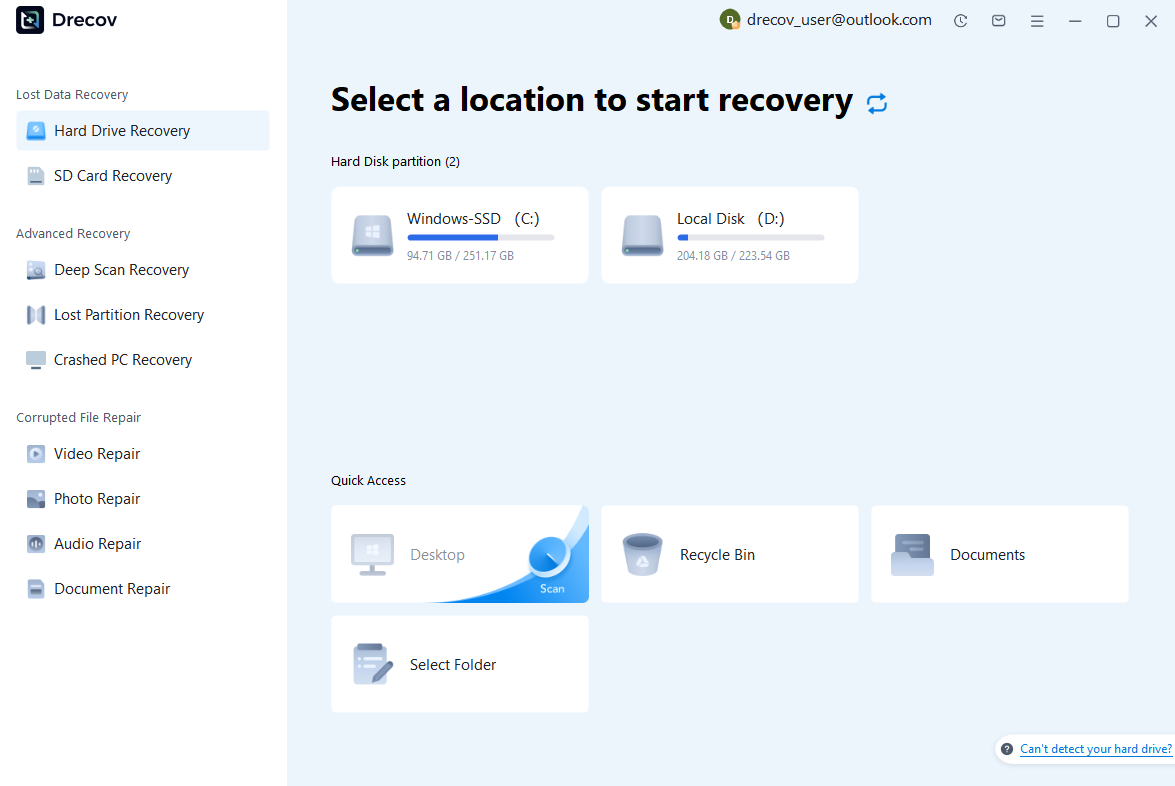
Step 1: Scan the Storage Device (SD Card / Hard Drive / USB)
Connect your device (SD card, HDD/SSD, or USB drive) to your computer and launch PandaOffice Drecov. Select the target device and start the scan. The software will perform a quick scan and deep scan to detect lost or deleted data.
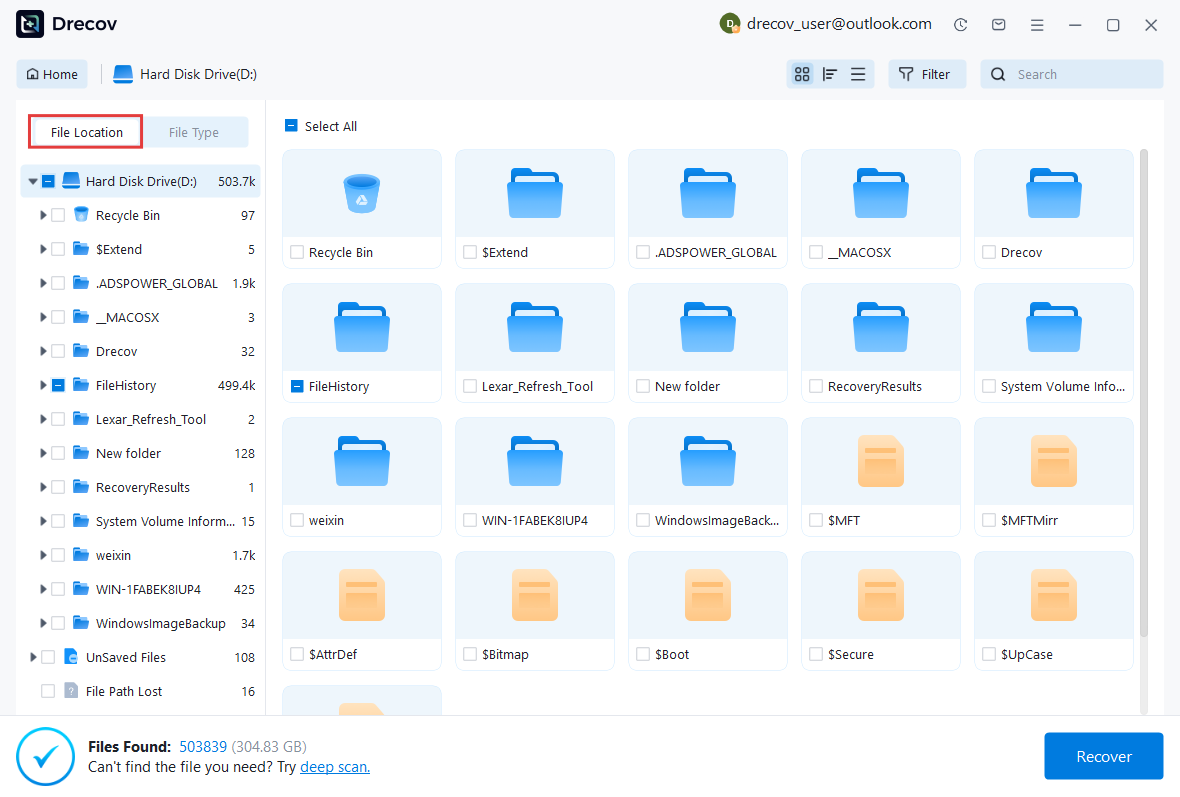
Step 2: Locate and Preview Lost Files
After scanning, browse the detected files and use the preview feature to check recoverable data. You can preview documents (Word, Excel, PDF), photos, and videos to ensure file integrity before recovery.
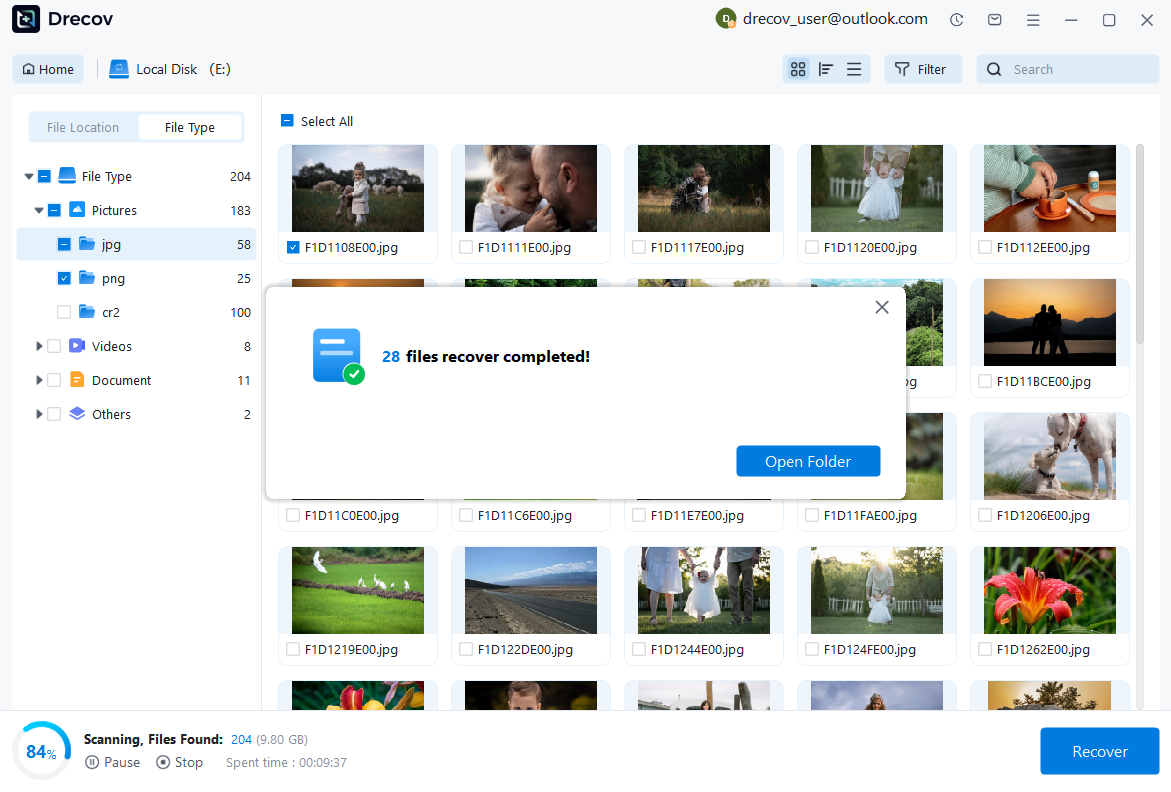
Step 3: Recover and Save to a New Location
Select the files you want to restore and click recover. Save all recovered data to a different drive or location (not the original device) to avoid overwriting lost data.
Why Choose PandaOffice Drecov Recovery Software?
PandaOffice Drecov offers a fast, secure, and user-friendly solution for recovering lost files across multiple scenarios. Whether you need email recovery, ZIP File Recovery, format data recovery, or help to recover deleted drafts Outlook, the software provides reliable recovery performance for both personal and business users.
PandaOffice Drecov supports recovery from formatted hard drives, SSDs, USB drives, SD cards, and external storage devices. Its advanced scanning engine can locate deleted archives, damaged ZIP files, lost Outlook drafts, and accidentally removed documents with high accuracy. For users searching for how to find deleted messages in Teams, PandaOffice Drecov can also help recover exported chat files, attachments, and related local cache data when available.
Key advantages include:
- Deep scan technology for complex data loss situations
- Support for emails, archives, videos, photos, and office documents
- Recovery from accidental deletion, formatting, corruption, and system crashes
- Easy preview before restoring files
- Compatible with Windows and multiple storage devices
Unlike complicated enterprise recovery tools, PandaOffice Drecov keeps the recovery process simple. Users can scan, preview, and restore files in just a few steps without technical expertise.
Whether you are dealing with lost Outlook drafts, corrupted ZIP archives, formatted drives, or missing communication data, PandaOffice Drecov provides an efficient and practical recovery experience designed to minimize downtime and protect important files.
Disk imaging ensures that even partially corrupted drives can be preserved. This is often the safest approach before attempting any aggressive repair operations for fix bad sectors on hard drive situations.
Many users appreciate simplified recovery workflows because they reduce the amount of technical knowledge required to perform successful recovery operations.
This approach may be especially beneficial for home users dealing with accidental deletion, formatted drives, memory card issues, or common file loss situations.
Regardless of the software used, immediate action after data loss remains one of the most important factors affecting recovery success.
⚠️ Warning: Never install recovery software on the same drive where data was lost, as installation activity may overwrite recoverable files.
R-Studio Recovery Pricing, Performance, and Comparison
License Options and Cost Overview
Before investing in recovery software, users often evaluate licensing options and pricing structures. R-Studio data recovery is generally positioned toward professional and technical users rather than occasional home users.
The software typically offers several editions that vary according to supported operating systems and advanced feature availability. Some versions are intended for personal use, while others target enterprise environments and professional recovery technicians.
Common licensing considerations include:
- Operating system support
- Commercial usage rights
- Network recovery functionality
- RAID recovery features
- Technical support availability
- Update policies
Potential buyers should compare available editions carefully because feature availability may differ between versions.
A trial version is often available, allowing users to evaluate scanning performance and determine whether their lost files can be detected before purchasing a full license.
This evaluation process helps reduce uncertainty and provides insight into expected recovery results before making a financial commitment.
Recovery Speed and Scan Accuracy
Performance is a major consideration when evaluating any recovery tool. Scan speed and recovery accuracy directly affect the overall user experience.
Several factors influence scanning performance:
- Drive capacity
- Storage technology
- File system type
- Degree of corruption
- Scan configuration
- Computer hardware specifications
During testing, smaller drives typically completed scans significantly faster than larger multi-terabyte storage devices.
Deep scans naturally require more processing time because the software examines storage sectors more thoroughly. However, these scans often discover additional recoverable files that quick scans may overlook.
One advantage of R-Studio recovery is the level of detail provided during scanning. Users can monitor progress, review discovered partitions, and analyze scan results before initiating recovery.
Accuracy generally depends on the condition of the storage media and the amount of overwritten data. Intact file systems often produce excellent recovery results, while heavily damaged drives may require more advanced reconstruction techniques.
How R-Studio Compares to Other Recovery Solutions
Every recovery application balances usability, features, and performance differently.
Compared with many consumer-focused tools, R-Studio data recovery software emphasizes advanced functionality. Its extensive support for RAID systems, network recovery, disk imaging, and forensic-style analysis makes it attractive to professionals.
Key strengths include:
- Extensive file system support
- Advanced partition recovery
- RAID reconstruction
- Detailed diagnostics
- Cross-platform compatibility
Potential drawbacks include:
- More complex interface
- Higher learning curve
- Greater technical focus
- Advanced features that casual users may never use
Users should evaluate their own requirements before selecting a recovery solution. Home users recovering family photos may prioritize simplicity, while IT professionals may require advanced storage management features.
The best choice depends on recovery goals, technical expertise, and the complexity of the data loss situation.
Frequently Asked Questions About R-Studio File Recovery
Is R-Studio Suitable for Beginners?
The software can be used by beginners, but it is generally considered more technical than many entry-level recovery applications.
Users familiar with storage devices, partitions, and file systems often adapt quickly to the interface. Those with limited technical experience may require additional time to learn available features and workflows.
Fortunately, preview functions and structured recovery processes help simplify many common recovery tasks.
Can R-Studio Recover Data After Formatting?
Yes, in many situations.
Formatted drives often retain recoverable information until new data overwrites existing sectors. R-Studio file recovery includes deep scanning technologies designed to locate and reconstruct files from formatted partitions.
Recovery success depends on factors such as:
- Formatting type
- Amount of overwritten data
- Storage device condition
- Time elapsed since formatting
The sooner recovery begins, the better the chances of success.
Does R-Studio Support SSD Recovery?
Yes. The software supports SSDs and can scan solid-state drives similarly to traditional hard drives.
However, SSD recovery presents unique challenges due to TRIM technology. When TRIM permanently removes deleted data, software recovery may become impossible.
For this reason, users should discontinue SSD usage immediately after discovering data loss.
Is the Free Version Enough for Most Users?
The answer depends on recovery requirements.
Trial versions generally allow users to scan storage devices and evaluate detected files. This helps determine whether recovery is possible before purchasing a license.
For users experiencing significant data loss, a full license may be necessary to complete recovery operations and access advanced features.
Evaluating scan results before purchasing can help users make informed decisions.
Final Verdict on R-Studio Data Recovery Software
Who Should Choose R-Studio Recovery
After reviewing features, performance, and recovery capabilities, it becomes clear that R-Studio recovery is designed primarily for users who require advanced functionality.
Ideal users include:
- IT professionals
- System administrators
- Data recovery technicians
- Advanced computer users
- Small business support teams
These users often benefit from advanced scanning options, RAID reconstruction tools, network recovery capabilities, and detailed storage analysis features.
For straightforward recovery tasks, some users may prefer solutions with simpler interfaces. However, those who regularly work with complex storage environments often appreciate the flexibility provided by R-Studio.
Key Takeaways Before Downloading
Choosing recovery software involves balancing usability, features, and recovery requirements. R-Studio data recovery continues to stand out because of its comprehensive toolset and professional-grade functionality.
Important points to remember:
- Supports numerous file systems.
- Works with many storage device types.
- Handles deleted files, formatted drives, and damaged partitions.
- Offers advanced RAID and imaging features.
- Includes powerful deep scanning technology.
- May require a learning period for beginners.
Ultimately, R-Studio data recovery software remains a strong option for users seeking extensive recovery capabilities and advanced storage management tools. Whether dealing with accidental deletion, partition loss, or complex recovery scenarios, it provides a broad set of features capable of addressing many data loss challenges.





