







Bookmarks are undoubtedly one of the most valuable features in any modern web browser. They help users save favorite websites, important research pages, online tools, shopping links, and work-related resources for quick access. If you are currently switching computers, reinstalling your operating system, or moving to a completely new browser profile, learning how to transfer firefox bookmarks becomes absolutely essential to preserve your digital workflow.
In this comprehensive educational guide, you will learn exactly how to transfer firefox bookmarks using automatic backup files, HTML export features, Firefox Sync, manual profile folder transfers, and secure cloud storage methods. Additionally, as data recovery specialists, we will explore advanced troubleshooting techniques for recovering lost browser data, ensuring your digital assets remain safe under any circumstances.
What Are Firefox Bookmarks?
Firefox bookmarks are saved website links stored securely inside the browser’s local database. They allow users to revisit complex webpages quickly without typing lengthy URLs repeatedly or searching through pages of history.
In everyday usage, bookmarks can include:
- Favorite websites and daily communication portals.
- Research pages for academic or professional projects.
- Online banking portals and secure payment gateways.
- Work dashboards and cloud-based software tools.
- Educational resources, tutorials, and online courses.
- Entertainment sites, streaming platforms, and blogs.
- Shopping pages and product wishlists.
Firefox stores these bookmarks locally in a dedicated browser profile folder on your hard drive unless cloud syncing features are manually enabled by the user.
Why Transfer Firefox Bookmarks?
There are many diverse situations where learning how to transfer firefox bookmarks becomes necessary for data continuity:
Switching to a New Computer
When upgrading your desktop PC or purchasing a new laptop, transferring bookmarks saves massive amounts of time and preserves your personalized browsing habits seamlessly.
Reinstalling Windows or macOS
Performing a clean installation of your operating system completely wipes local application data. Backing up and transferring your bookmarks prevents catastrophic data loss during this reinstallation process.
Using Multiple Devices Simultaneously
Many modern users want the exact same bookmarks available on their work desktop, personal laptop, and mobile devices at all times.
Browser Migration
If you choose to switch your primary web browser, bookmarks can be systematically transferred from Firefox to another browser, or vice versa, to avoid starting from scratch.
Data Protection and Redundancy
Creating manual bookmark backups protects your valuable collection against accidental deletion, unexpected software corruption, or sudden storage drive failures.
Method 1: Transfer Firefox Bookmarks Using Firefox Sync
If you are looking for the most automated and seamless approach, learning how to transfer firefox bookmarks via Firefox Sync is your best option.
What Is Firefox Sync?
Firefox Sync is a built-in, cloud-based feature provided by Mozilla that securely synchronizes your bookmarks, saved passwords, open tabs, add-ons, and browsing history across all your authorized devices.
How to Set Up Firefox Sync
- Step 1: Open FirefoxLaunch the Mozilla Firefox browser on your primary computer.
- Step 2: Access the Menu. Click the Menu button, which is represented by three horizontal lines in the top-right corner of the window.
- Step 3: Sign In to Firefox Account. Click on Sign in to Firefox (or Sign in next to Sync). If you do not already have an account, enter your email address and create a secure password to set one up immediately.
- Step 4: Enable Bookmark Sync. After successfully signing in, open your Firefox Settings, select the Sync panel from the left sidebar, and ensure the checkbox for Bookmarks is completely filled or enabled.
- Step 5: Sign In on Your Another Device. Install Mozilla Firefox on your second destination device (such as a new laptop or smartphone) and log into the exact same Firefox account.
Important Note: Once signed in, your bookmarks will automatically download and appear in the destination browser after the synchronization process completes. This usually takes just a few seconds depending on your internet speed.
Benefits of Firefox Sync
Firefox Sync offers several distinct advantages over manual extraction methods:
- Automatic Updates: Any bookmark you add or delete remains updated across all connected devices in real time.
- Secure Encryption: Mozilla employs strict end-to-end encryption for all synced data, ensuring your privacy is fully protected from external threats.
- Multi-Device Support: It works flawlessly across multiple operating systems, including Windows, macOS, Linux, Android, iPhone, and iPad.
Additional Sync Features
Beyond showing you how to transfer firefox bookmarks, Firefox Sync also seamlessly transfers:
- Saved login passwords and usernames.
- Active open tabs from other devices.
- Browsing history and search bar queries.
- Installed extensions and custom browser themes.
Method 2: Export Firefox Bookmarks to HTML
When you need to migrate your data across different browser brands, learning how to transfer firefox bookmarks using the HTML export method is highly recommended. This is considered the most universal transfer mechanism available.
Why Use HTML Export?
HTML bookmark files utilize a standard format that can be instantly recognized and parsed by almost any web browser in existence. These files can be easily imported into:
- Mozilla Firefox (other profiles)
- Google Chrome
- Microsoft Edge
- Apple Safari
- Brave and Opera browsers
How to Export Firefox Bookmarks
- Step 1: Open Firefox. Launch your Firefox browser on the source computer.
- Step 2: Open Bookmark Manager. Press the hotkey combination Ctrl + Shift + O on Windows (or Cmd + Shift + O on Mac) to open the Library window.
- Step 3: Open Import and Backup. In the Library toolbar, click the Import and Backup button (indicated by an icon with a star and arrows).
- Step 4: Export Bookmarks. Select Export Bookmarks to HTML… from the drop-down options.
- Step 5: Save the File. Choose a safe, easily accessible location such as a USB drive, your Desktop, or a Cloud storage folder, give the file a recognizable name, and click Save.
How to Import Firefox Bookmarks
Once you have the HTML file on your destination device, follow these instructions to bring your links back into a fresh copy of Firefox:
- Step 1: Open Firefox on the new computer.
- Step 2: Press the hotkey combination Ctrl + Shift + O to launch the Library window.
- Step 3: Click the Import and Backup button on the toolbar.
- Step 4: Select Import Bookmarks from HTML… from the menu.
- Step 5: Browse to the location where you stored your exported HTML file, select it, and click Open.
All of your saved bookmarks will be imported instantly and will appear within the Bookmarks Menu folder.
Method 3: Transfer Firefox Bookmarks Using Backup Files
Firefox automatically creates hidden backup files of your bookmarks locally. Learning how to transfer firefox bookmarks via native JSON backup files is an excellent option for users who want a perfect, 1:1 replica of their browser’s bookmark setup.
Why Use Backup Files?
Unlike HTML exports, which occasionally lose subtle grouping data, native backup files (.jsonlz4 format) preserve:
- The exact multi-layered bookmark folder structure.
- Custom tags assigned to specific links.
- Keyword shortcuts designated for fast navigation.
- The exact chronological sorting and placement of folders.
This method is inherently more robust when you are performing a direct Firefox-to-Firefox data migration.
Create a Firefox Bookmark Backup
- Step 1: Open the Firefox Bookmark Manager by pressing Ctrl + Shift + O.
- Step 4: Click on the Import and Backup option located at the top of the Library window.
- Step 3: Select Backup… from the list.
- Step 4: Choose a target folder (like an external hard drive or flash drive) to save the generated JSON backup file securely.
Restore Firefox Bookmark Backup
When you want to restore these links on your new device, keep in mind that this process will completely overwrite any existing bookmarks currently saved in that specific Firefox browser.
- Step 1: Open the Library window using Ctrl + Shift + O on the destination PC.
- Step 2: Click the Import and Backup button.
- Step 3: Hover your mouse over the Restore option.
- Step 4: Click on Choose File… at the bottom of the pop-out list.
- Step 5: Navigate to your external storage media, select the JSON backup file you created earlier, and confirm the action. Your original bookmark setup will be fully restored.
Method 4: Manually Transfer Firefox Profile
For advanced power users and IT technicians, knowing how to transfer firefox bookmarks by copying the entire underlying user profile is the ultimate solution. This bypasses the browser interface entirely.
What Does a Firefox Profile Include?
The local Firefox profile folder contains the entire digital footprint of your browser. It stores:
- All bookmarks and historical browsing records (contained within the
places.sqlitefile). - Saved passwords and web form autofill information.
- Installed browser extensions, custom add-ons, and themes.
- Site-specific preferences, permissions, and security cookies.
Locate the Firefox Profile Folder
To find this folder manually, you must navigate through hidden system directories based on your operating system:
Windows Operating Systems
Press the hotkey shortcut Windows + R to trigger the Run dialog box. Type the exact path environment variable string below and hit Enter:
Plaintext
%APPDATA%\Mozilla\Firefox\Profiles\
macOS Operating Systems
Open Finder, select “Go to Folder” from the menu bar, and enter the following path:
Plaintext
~/Library/Application Support/Firefox/Profiles/
Linux Operating Systems
Open your file manager or terminal environment and navigate directly to:
Plaintext
~/.mozilla/firefox/
Transfer the Profile Folder Steps
- Step 1: Completely close down Mozilla Firefox on your source machine to prevent file locking.
- Step 2: Locate your active profile folder (usually named with a string of random characters ending in
.defaultor.default-release). - Step 3: Copy the entire profile folder and paste it onto an external storage media device like a USB flash drive.
- Step 4: Connect the USB flash drive to the destination machine, locate its new Firefox profiles directory using the paths provided above, and paste the folder there.
- Step 5: Update the
profiles.iniconfiguration file or use the Firefox Profile Manager (firefox.exe -P) to link the browser to this newly moved profile.
Method 5: Transfer Firefox Bookmarks with Cloud Storage
If you do not want to set up an account with Mozilla but still want a wireless migration path, learning how to transfer firefox bookmarks using standard cloud storage providers is highly effective.
Popular Cloud Services to Utilize
You can use any free or premium cloud platform that you already have configured on your machines:
- Google Drive
- Dropbox
- Microsoft OneDrive
- iCloud Drive
Step-by-Step Cloud Transfer Process
- Step 1: Follow the instructions in Method 2 or Method 3 to export your bookmarks as an HTML file or a JSON backup file.
- Step 2: Open your cloud storage folder or web interface on the source computer and upload the exported file directly to the cloud.
- Step 3: Turn on your destination device, log into the same cloud storage provider, and download the file down to your local storage drive.
- Step 4: Open your new web browser, access the import configurations, and pull the downloaded file directly into your browser bookmark ecosystem.
Advanced Recovery: How to Recover Lost Firefox Bookmarks
Sometimes, unexpectedly bad situations happen during data migration. A system crash, a quick formatting of a drive, or an accidental deletion can cause your bookmarks to vanish completely. When manual restoration strategies fail because the files themselves are missing from your drive, you need an advanced solution.
Recovering Lost Browser Profiles via PandaOffice Drecov Data Recovery Software
If your local browser profile folder was wiped out during an operating system reinstallation, or if you accidentally deleted your backup files from a USB flash drive, specialized data recovery utilities are required. Using PandaOffice Drecov data recovery software, you can perform a deep diagnostic sector scan of your hard drive to find and piece together lost places.sqlite databases or deleted .jsonlz4 files.
⚠ Warning: Install it on a drive different from the one where your data was lost to prevent overwriting.
Below is the precise operational breakdown to salvage your browser data using this tool:
- Step 1: Select the Target Location for Scanning. On the primary user interface dashboard, select the specific drive where your Firefox profile directory used to live (typically the local system
C:drive for Windows users). Click the Scan button to initiate an intelligent recovery cycle.

- Step 2: Filter and Locate Your Lost Firefox Files. As the software performs its real-time sector-by-sector scan, utilize the search filter bar located in the upper right quadrant of the screen. Type in target file names or file extensions such as
.sqliteor.jsonlz4to instantly isolate your hidden bookmark storage databases.

- Step 3: Preview File Integrity and Verify Data. Double-click on the found files within the interface to inspect their creation dates and historical file sizes, ensuring they match your missing profile structure before initiating extraction.
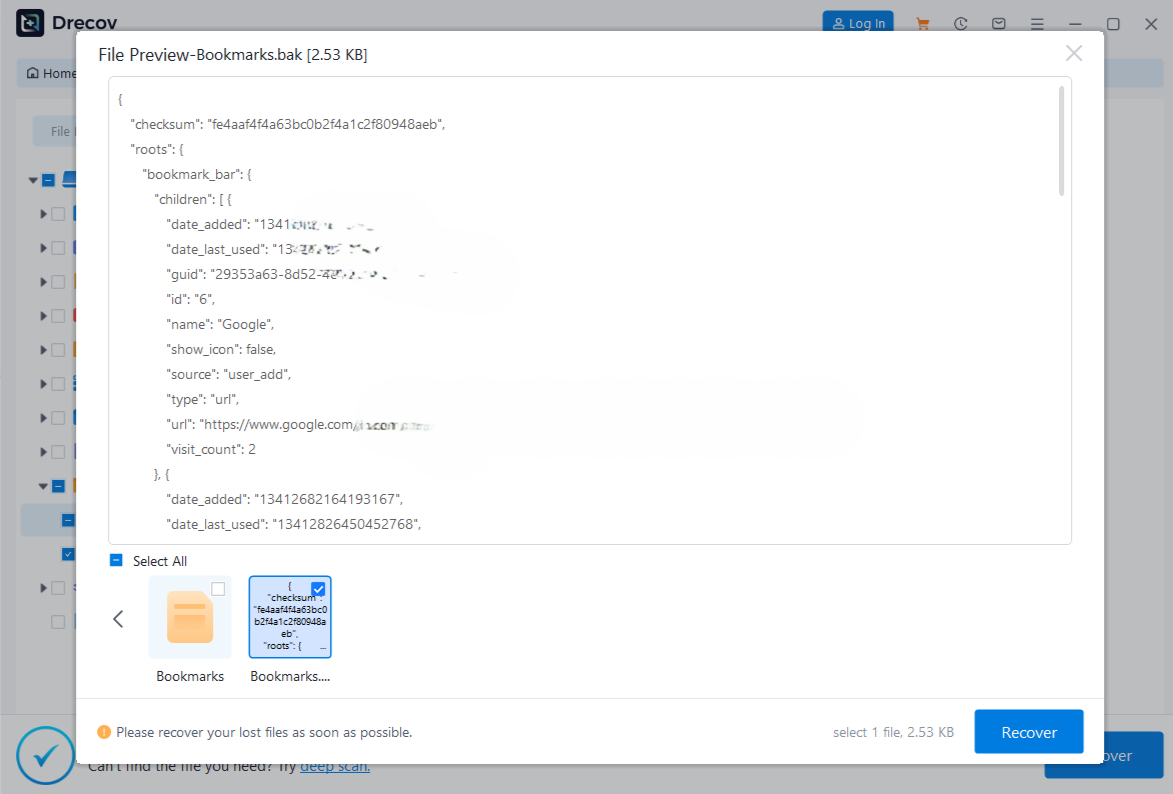
- Step 4: Recover and Save to a Secure External Location. Mark the checkboxes next to your missing browser files and click the Recover button. Choose an external hard disk or an independent USB storage drive as the destination path to prevent any possibility of file corruption or data collision.
Warning Prompt: Never save recovered profile folders or bookmark files directly back onto the exact same drive partition where they were lost. Doing so will permanently overwrite the underlying raw data clusters, making future recovery attempts impossible.
Once you have successfully extracted your original files using this method, you can easily read more about general browser data restoration strategies by exploring our related guide on how to get your Google Chrome bookmarks back. Furthermore, if your bookmark backup files were originally saved on an external storage medium that became unreadable, reading our comprehensive flash CF card guide can provide you with deep insights into professional flash media management. Similarly, if you find yourself dealing with other types of missing application files during a complex system migration, you can reference our advanced complete guide to Illustrator file recovery to master broader automated data retrieval workflows.
Common Problems When Transferring Firefox Bookmarks
Even with explicit instructions, minor software variations can trigger unexpected friction. Let’s look at common issues and how to fix them.
Bookmarks Are Not Appearing After Transfer
- Potential Causes: The browser account sync features are still processing in the background, you imported an empty profile file, or the backup file has suffered physical storage corruption.
- Actionable Solution: Double-check the exact file size of your HTML or JSON file to verify it contains data. Restart Firefox entirely to force the system to reload its UI.
Duplicate Bookmarks Everywhere
- Potential Causes: Running an HTML file import multiple times on top of an active Firefox Sync account causes links to append repeatedly.
- Actionable Solution: Open the Library window (
Ctrl + Shift + O), manually select the unwanted redundant folders, and hit Delete. Alternatively, search the official Mozilla Support Page for certified add-ons that safely automate duplicate bookmark removal.
Firefox Sync Is Failing to Update
- Potential Causes: Local network connectivity drops, out-of-date web browser versions, or account verification lockouts.
- Actionable Solution: Log out of your Firefox account inside the settings menu completely, close down the application, reopen it, log back in, and ensure your internet connection is stable.
Missing Bookmark Folders and Sub-Categories
- Potential Causes: This frequently occurs when using older HTML format standards that fail to interpret deeply nested modern bookmark directory paths.
- Actionable Solution: Abandon the HTML transfer approach and utilize the native JSON backup and restore workflow outlined in Method 3 to preserve structural organization.
Pro Tips for Managing and Protecting Firefox Bookmarks
Proper long-term bookmark maintenance reduces clutter and ensures that knowing how to transfer firefox bookmarks remains a clean, trouble-free operation in the future.
| Strategy Tip | Actionable Execution | Core Productivity Benefit |
| Create Logical Folders | Group your links neatly into macro folders named Work, Shopping, Research, or Finance. | Accelerates daily navigation speeds and minimizes visual clutter. |
| Purge Outdated Links | Conduct a biannual review to delete broken URLs, dead websites, or unneeded links. | Keeps database files small and highly optimized against corruption. |
| Leverage the Toolbar | Drag your absolute top-tier, daily-use shortcuts into the persistent Bookmarks Toolbar area. | Provides instantaneous, single-click web page access. |
| Schedule Periodic Backups | Save a manual JSON bookmark backup copy to an external location once a month. | Protects your assets completely independent of cloud systems. |
| Apply Tags & Keywords | Assign unique keywords or text tags to links via the properties section in the Library. | Enables users to summon hidden links instantly via the address bar. |
Benefits of Properly Transferring Firefox Bookmarks
Taking the time to master these migration techniques delivers massive real-world benefits:
- Saves Immense Technical Time: Avoid the frustration of trying to remember, type out, or search for obscure website addresses you saved months ago.
- Maintains Professional Productivity: Keeps your critical work tool links, cloud dashboards, and project tabs exactly where you expect them to be.
- Preserves Valuable Academic Research: Ensures that citations, research databases, and reference papers remain fully intact throughout an upgrade.
- Improves Device Migration Experiences: Makes moving onto a lightning-fast new computer an incredibly smooth process without data loss anxiety.
Frequently Asked Questions
Does Firefox Sync transfer my saved passwords as well?
Yes. Firefox Sync is highly customizable and can securely transfer your saved login credentials, browsing history, open tabs, cookies, and extension data along with your bookmarks.
Can I learn how to transfer firefox bookmarks without creating an account?
Absolutely. If you want to keep your data completely local, you can use Method 2 (HTML Export) or Method 3 (JSON Backup) to move your bookmarks using a standard physical USB drive.
Are Firefox bookmark backups created automatically by the system?
Yes, Firefox automatically saves daily automated backups within your hidden user profile folder. It retains the last several days of updates so you can roll back your browser state if a mistake occurs.
Is it possible to transfer desktop Firefox bookmarks to my mobile smartphone?
Yes. By installing the official Firefox application on your Android or iOS device and logging into your shared Firefox Account, all desktop bookmarks will sync over automatically.
What is considered the absolute safest method to transfer bookmarks?
For direct browser migration, utilizing a combination of local JSON backups alongside an active Firefox Sync configuration offers the ultimate redundant protection against data failure.
Conclusion
Learning how to transfer firefox bookmarks is a core operational skill for anyone who is upgrading their technology, performing clean operating system refreshes, or trying to achieve perfect data continuity across multiple computing platforms. Mozilla Firefox provides a wonderfully versatile set of native transfer options tailored to match any user preference—ranging from automatic cloud-based synchronization to precise manual file system manipulation.
By committing the strategic steps outlined across these five distinct methodologies to memory, you can definitively safeguard your browsing infrastructure against unexpected technical issues.






