







To fix RAR archive errors, keep the original package untouched and read the exact extraction message first. A missing multipart volume, wrong password, incomplete download, CRC mismatch, and failing drive require different responses. Put every archive part in one folder, compare their sizes with the source, and test a duplicate. Archive repair may salvage some contents, but it cannot invent missing bytes or replace a deleted original.
fix rar archive: safe diagnosis
Write down the complete message and the filename where extraction stops. “Next volume is required” means the extractor expects another part. “Wrong password” can indicate a credential problem, although damaged encrypted data may present confusing messages. “CRC failed” means the extracted data did not match the archive’s stored integrity value. “Unexpected end” often points to truncation. Do not treat these as interchangeable synonyms for corruption.
| Message or clue | First check | Reasonable next step |
|---|---|---|
| Next volume required | Check all numbered parts and naming sequence | Obtain the missing part; start extraction from the first volume |
| Unexpected end of archive | Compare downloaded size with source | Download a fresh copy to a healthy location |
| Wrong password | Confirm source, case, keyboard layout, and spaces | Ask the sender; do not brute-force an unknown file |
| CRC error on one member | Test archive copy and the storage device | Try another source copy or repair a duplicate |
| All archives fail on one drive | Check device stability and read errors | Protect data; image unstable media before extraction |
Before testing tools, determine whether the archive came from a browser download, cloud transfer, email attachment, backup set, or local disk. A newly downloaded file can usually be obtained again. The only copy of a family photo archive on a failing USB drive deserves a more conservative response.
Check multipart names and completeness
RAR archives can span several files. Common naming patterns include name.part1.rar, name.part2.rar, and later numbers; older sets may begin with a RAR file followed by numbered extensions. Put every part in the same folder without renaming one member. Begin extraction with the first part, not an arbitrary middle volume. A renamed extension does not recreate absent compressed data.
Compare the sequence and expected sizes. Most middle volumes in a set are similar in size, while the final part may be smaller. A zero-byte file, a part much smaller than its peers, or a browser temporary-download extension suggests an incomplete transfer. If the sender supplied a checksum, calculate it on a copy and compare. Matching size alone is useful but does not guarantee identical bytes.
For cloud downloads, use the service’s version or download history. Avoid repeatedly extracting the same damaged copy into the same destination. Each attempt writes partial output and can make it harder to tell which files are complete. Instead, create a fresh empty extraction folder for each test and retain the archive unchanged.
Test the archive on a copy and a healthy drive
Copy all parts to a healthy internal or external disk. If copying itself produces read errors or the source disconnects, stop. Archive tools must read large stretches of data and may stress weak storage. A clicking hard drive, overheated flash device, or repeated USB disconnect is a physical or connection problem, not a normal RAR header issue. Controlled imaging or specialist recovery is safer than repeated extraction.
Run the extractor’s Test command on the copied set. Testing checks archive integrity without filling a destination with partial files. Note whether the same member fails each time. If it fails at varying places, investigate memory, storage, and the extraction environment. If only one archived member fails consistently, the archive may contain local damage. Do not delete the rest; intact members may still extract.
Use a current, reputable extractor from its publisher. An outdated tool may not support a newer archive feature, but a different application cannot overcome missing volumes or unknown passwords. Avoid websites asking you to upload private archives for “instant repair.” An archive may contain financial, medical, or personal files, and uploading it changes the privacy risk.
Know what RAR repair can and cannot do
Some RAR archives include a recovery record added when the archive was created. That redundancy can improve the chance of reconstructing limited damage. The WinRAR publisher describes the recovery-record capability, but its presence and capacity depend on how the original was made. Repair is not a guarantee, and an archive without enough redundancy may yield only partial contents.
Use the repair function on a duplicate, never the sole original. Save the rebuilt result to another location, then test and extract it into a fresh folder. Compare the file list and sizes with the original manifest or sender’s copy. Open representative documents, images, and videos. A successful extraction notice does not prove that every page, frame, or nested archive is intact.
If the archive lacks a recovery record, an extractor may still reconstruct some header information or recover intact members. It cannot recreate a missing part’s actual payload. For a password-protected set, repair does not remove encryption. Obtain the correct password from the sender rather than trusting a tool that claims to bypass it.
Use another copy before trying recovery software
Check the original download link, email attachment, shared folder, cloud version history, backup, and sender. A fresh complete copy is generally more useful than trying to repair a truncated one. When a backup contains the archive, restore it to a healthy disk and test it there. Do not overwrite the suspect copy until the replacement has been verified.
This check is especially useful for fix rar archive. Drecov serves a different problem: the RAR archive or one of its volumes was deleted, a stable storage partition became inaccessible, or the original disappeared during a move. Drecov is Windows data recovery software for PCs, HDDs, SSDs, external disks, USB devices, and memory cards. It can search archives alongside documents, photos, video, audio, and email data through read-only recovery, Quick Scan, Deep Scan, filters, preview, and Lost Partition Recovery. It does not repair compressed members, recreate a missing volume, remove a password, or fix a physically failing device.
⚠ Warning: Install it on a drive different from the one where your data was lost to prevent overwriting.
Stop writing to the original disk. Prepare another healthy destination and do not install Drecov on the source partition. If the medium clicks, drops offline, or reports severe read errors, stop direct scanning and seek an image or specialist. On SSDs, TRIM may limit recovery after deletion; more scans cannot reverse that process.
Step 1: Open Drecov and select the archive’s old location
Choose the original folder’s partition, USB device, or lost-partition area. Identify it by size and old path. Search for all parts, not only the first RAR file.

Step 2: Run Quick Scan and search the volume names
Start Quick Scan. Filter by archive type, filename, date, size, and former folder. If this was a multipart set, record every recovered part and its numbering.

Step 3: Use Deep Scan only while storage remains stable
If Quick Scan misses a needed part and the device stays reliably detected, use Deep Scan. Stop at physical symptoms or serious read errors.
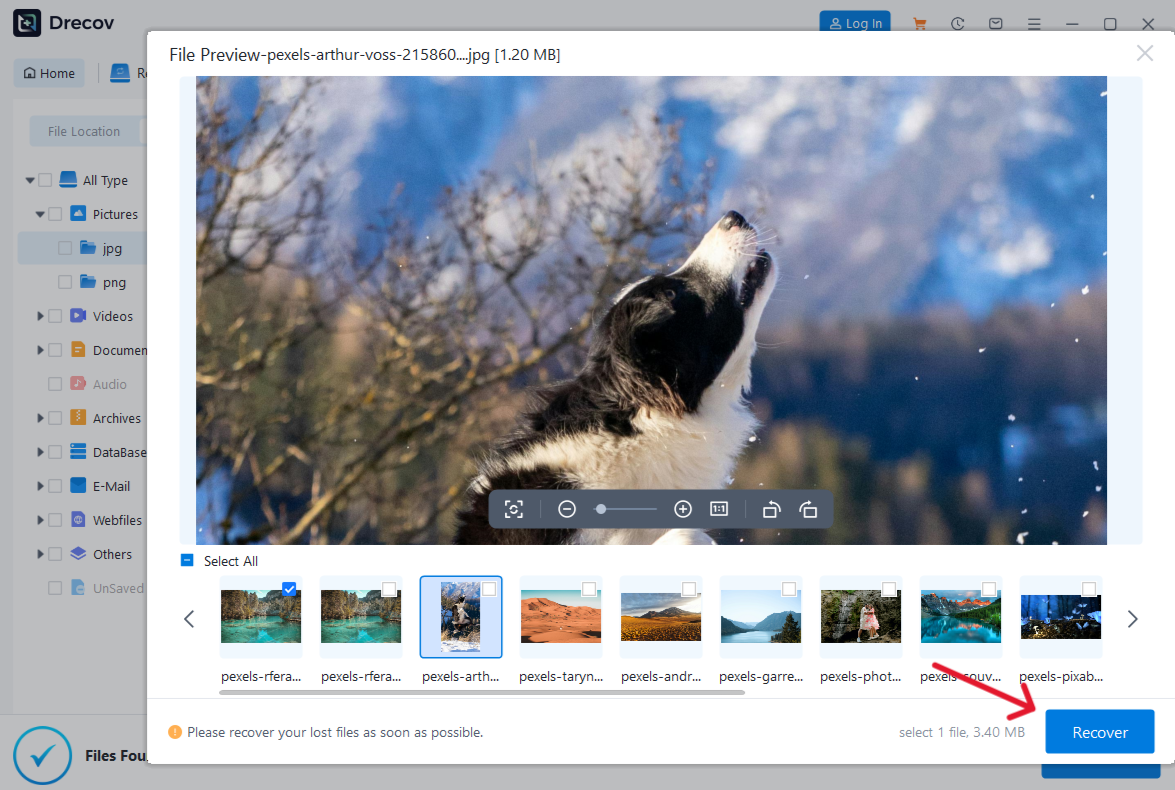
Step 4: Recover all candidates elsewhere and test a copy
Preview supported candidates when available, recognizing that preview does not certify each archive member. Recover the set to another healthy disk, never the source. Check Drecov Folder or Recovery Folder if output is not where expected. Preserve the recovered set, make a working copy, then test and extract that copy. Verify important files before attempting repair or formatting.
⚠ Warning: Install it on a drive different from the one where your data was lost to prevent overwriting.
Decide whether the archive is usable
Extract to a clean folder and compare the contents with a list from the sender, a previous backup, or the application’s expected project structure. Count files, inspect total sizes, and open important items. For a video, check playback at the beginning, middle, and end. For a document, examine more than the first page. For a project, open its main file and confirm linked assets. Keep the untouched archive until all of these checks pass.
If repair salvages only some members, label that result honestly. Do not merge partially extracted files from two inconsistent archive versions without recording their origin. For related help, see the Drecov homepage, advice when you cannot open a file as an archive, methods to recover deleted files, and the reason to recover to another drive.
Fix rar archive FAQs
Can a missing RAR part be generated from the others?
Usually not. Recovery volumes or redundancy created with the set may help in some cases, but ordinary parts do not recreate absent payload automatically.
Does a CRC error mean every file is lost?
No. It identifies a mismatch for affected data. Other members may extract and verify normally.
Can renaming ZIP to RAR fix extraction?
No. An extension change does not alter the archive format or repair missing bytes.
Should I repair the only archive file directly?
No. Copy it to a healthy disk and repair the duplicate so the original evidence remains available.
Does Drecov repair a corrupted RAR?
It recovers a missing archive file or volume from eligible stable storage. Archive-content repair is a separate process.
Conclusion
To fix RAR archive errors, identify the exact failure before using a repair command. Gather every part, compare sizes, test a copy, and use recovery records only when the archive actually contains them. If the original archive was deleted, Drecov can search its former location and recover candidates to another healthy drive. Verify the complete set and extracted contents before deleting any source copy.
⚠ Warning: Install it on a drive different from the one where your data was lost to prevent overwriting.





