







If you cannot open a file as an archive in 7-Zip, extraction is not the first problem to solve. Confirm that the file is really an archive and that every required byte arrived. A web error page renamed ZIP, an incomplete download, a missing multipart volume, or a damaged header can produce the same message. Preserve the original file, record its size and source, and test a duplicate rather than repeatedly editing or renaming the only copy.
Prove What the File Is Before Treating It as Damaged
An extension is only a label. Changing .bin to .zip does not create a ZIP structure, and a file named download.zip may contain an HTML login page. Begin with evidence that does not alter the source.
Compare the size with the source
Check the file’s Properties dialog and compare its byte size with the sender’s copy, download page, or manifest. A zero-byte file contains no archive payload. A smaller-than-expected file usually indicates an interrupted transfer. If the publisher provides a checksum, calculate the same hash for your copy. Matching hashes strongly support transfer integrity; different hashes prove that the copies differ.
Open a duplicate with a text or hex viewer
Do not edit the original. Inspect a copy. Readable text beginning with an HTML error, access-denied message, or cloud-sharing notice means the browser saved a response page rather than the requested archive. A genuine archive begins with format-specific binary structures. You do not need to memorize every signature; the useful finding is whether the content matches its claimed type.
Ask 7-Zip to test, not extract
Right-click a duplicate, choose 7-Zip, and use Test archive. The test reads the structure and data without creating extracted files. Record the complete result. The official 7-Zip FAQ distinguishes archive-opening and data-error situations. “Can not open the file as archive” points to recognition or structural failure. A CRC or data error after the archive opens indicates a different problem: the container is recognized, but some stored data does not validate.
| Evidence | Most likely explanation | Useful next action |
|---|---|---|
| File is zero bytes | No archive content was saved | Find another copy, version, or backup |
| File is smaller than the sender’s copy | Download or transfer ended early | Download again to a new filename and compare sizes |
| File contains readable web-page text | A login or error page was saved | Open the source page, authenticate, and download correctly |
| Names end in .001, .002, or part numbers | The archive is split across volumes | Place every part together and open the first volume |
| Archive opens but reports CRC errors | Stored data is incomplete or changed | Obtain a clean copy; salvage only unaffected items |
| Password prompt appears | The archive is recognized and encrypted | Use the correct password; renaming cannot bypass encryption |
Check Multipart Archives as a Set
Split archives fail when one component is missing, renamed, or copied incompletely. Common patterns include name.7z.001, name.7z.002, or RAR part numbers. Keep all volumes in one folder. Preserve their original base name and numbering.
Start with the correct volume
For a 7z split set, open the .001 file. For a multipart RAR set, begin with the first numbered part or the main RAR file, depending on how the set was created. Opening a middle volume may trigger an archive error even when that component is healthy.
Look for gaps and suspicious sizes
Sort by name and verify that numbering is continuous. Most parts have the same configured size, while the final part is often smaller. A missing number or an unexpectedly tiny middle part deserves attention. Ask the sender for the exact missing volume instead of downloading the whole set repeatedly.
Do not merge parts with ordinary copy commands
Archive volumes are meant to be interpreted by compatible software. Manually concatenating files can destroy useful boundaries or create an output that no longer matches the original format. Keep the set unchanged. If the first part is absent, recovery or a fresh transfer must find that part; renaming the second part to first does not recreate the header.
Retest a Clean Copy Under Controlled Conditions
When the source remains available, a clean replacement is usually more reliable than repair. Download to a different local folder and use a new filename. Avoid saving directly to a questionable USB drive, synchronized placeholder, or nearly full system partition.
Use the official source and finish authentication
Return to the publisher, cloud share, or sender. Confirm that the download starts after login and that the browser reports completion. Avoid third-party “archive fixer” download pages. They may bundle unrelated software, and they cannot recreate bytes that never reached your PC.
Compare the new and old copies
Record both file sizes and checksums when available. If the new copy opens and its size differs, the original transfer was incomplete. Keep the bad copy only until the clean archive is verified. If both copies match and fail identically, confirm the required 7-Zip version and ask the creator whether the archive was completed successfully.
Extract to a short writable path
Once the archive passes its test, extract to a local folder with sufficient free space. A long path, denied destination, security block, or insufficient space can interrupt extraction, but those conditions usually occur after the archive has been recognized. The site’s Windows extraction methods cover destination-specific problems without confusing them with a broken archive header.
Understand What Repair Can and Cannot Do
A repair tool may reconstruct limited container metadata when enough information survives. It cannot recreate missing compressed bytes, infer an unknown password, or manufacture an absent multipart volume. Always work on a duplicate. Preserve the source for a later clean copy, parity recovery, or specialist analysis.
Try an alternate reader only as a compatibility test
Use another reputable archive program on a duplicate. If one tool opens the file, extract to a separate healthy folder and verify the output. If every tool rejects the same header, compatibility is less likely. Do not cycle through unknown online services with confidential archives, because uploading exposes their contents and may violate data-handling rules.
Salvage only what validates
Some damaged archives allow unaffected entries to extract. Test the resulting documents, media, and nested archives individually. A filename in an extraction log does not prove usable content. CRC failures or unexpected end-of-data messages should remain attached to the recovery notes so no one mistakes partial output for a complete set.
Return to the uncompressed originals when possible
The creator’s source folder is usually better evidence than a broken archive. Ask for the original files or a newly created archive. If you only need to understand ordinary extraction, the site’s safe unzip workflow separates a valid container from destination and permission errors.
Use Drecov When the Original Archive or a Volume Is Missing
Drecov is not an archive repair utility. It becomes relevant when a ZIP, 7z, RAR, TAR, downloaded package, or required split volume was deleted or became logically inaccessible on stable Windows storage. First check the source website, sender, cloud version history, Recycle Bin, backups, and browser download list. A fresh verified copy is preferable to sector-level recovery.
⚠ Warning: Install it on a drive different from the one where your data was lost to prevent overwriting.
PandaOffice Drecov can look for a lost archive on Windows storage, including internal disks, removable drives, USB flash media, and camera cards. It reads rather than deliberately repairing the origin. Quick Scan surfaces recent traces first. A stable device can then receive a deeper logical pass. Archive extension, base name, former directory, date, size, and available preview evidence help assemble the correct volume set for recovery elsewhere.
Lost Partition Recovery can search when the partition holding the archive disappears. Drecov cannot repair a malformed archive structure, decrypt a protected file, or replace a missing volume with invented data. It cannot fix physical damage or guarantee overwritten content. SSD TRIM may sharply reduce prospects for deleted files. Stop scanning hardware that clicks, disconnects, freezes, or produces severe read errors.
Recover a Missing Archive or Split Volume With Drecov
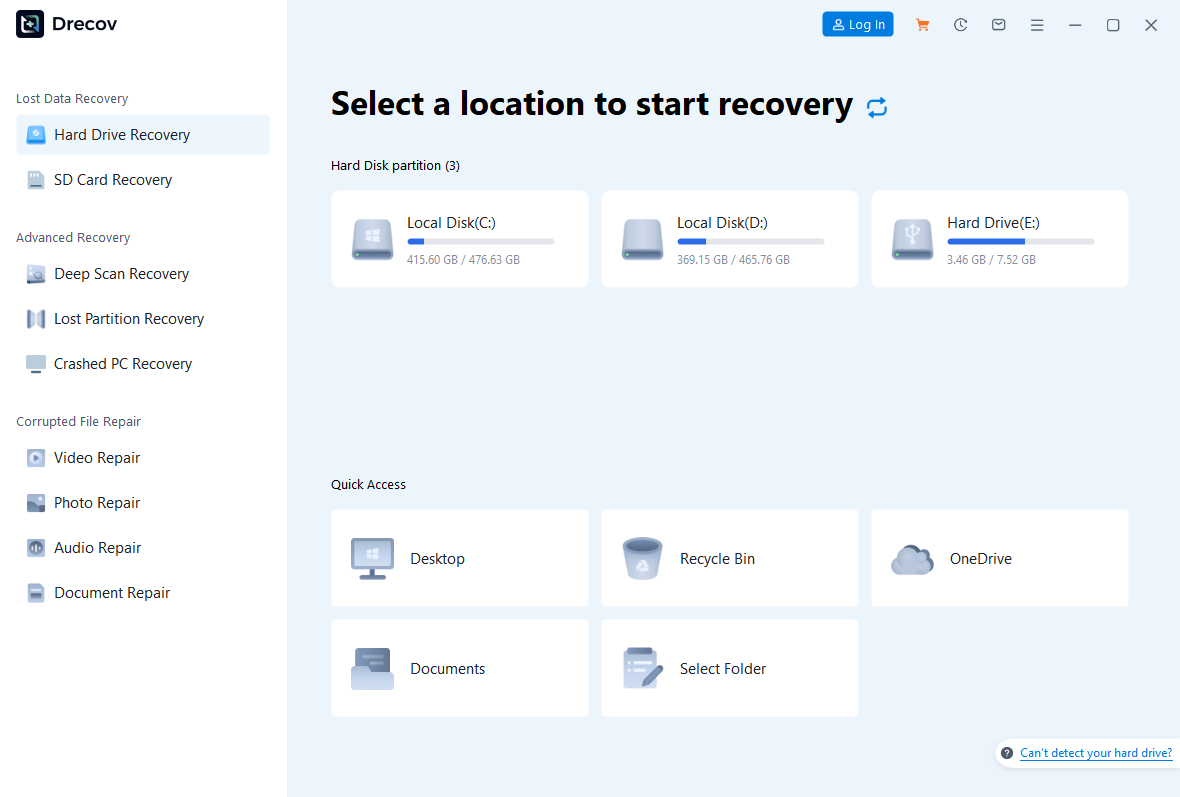
Step 1: Open Drecov and choose the archive’s former location
Set aside an independent, healthy destination. Keep Drecov’s installation off the volume that contained the archive. In the application, identify the original download directory, project area, partition, or removable source. If that volume itself is absent, enter Lost Partition Recovery without initializing the disk or accepting a format prompt.
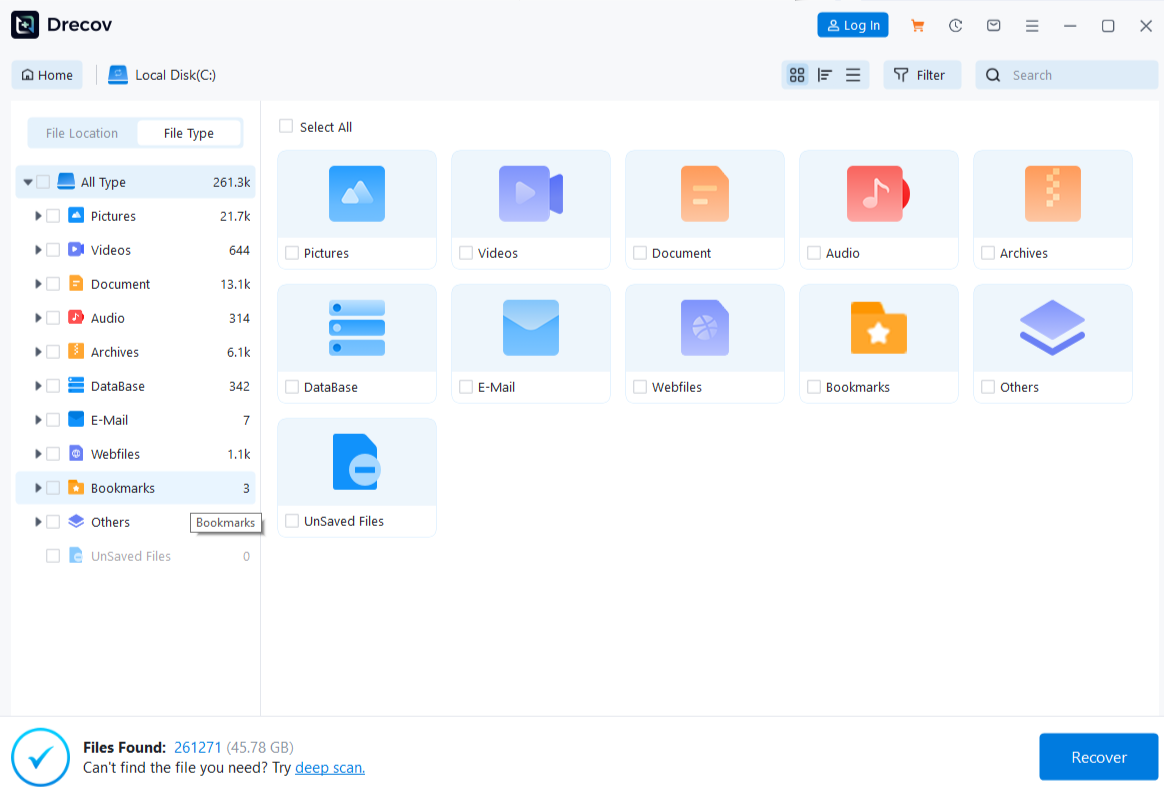
Step 2: Run Quick Scan and search for the whole set
Start Quick Scan. Filter by archive type, base filename, former path, and the transfer date. For multipart sets, search every expected suffix and number. Record candidate sizes. Recovering only the first part will not help if later volumes are missing.
Step 3: Use Deep Scan only while the device is stable
If Quick Scan misses a needed volume, run Deep Scan only when detection and reads remain consistent. Stop when the device drops offline, stalls, or reports new I/O errors. Deep Scan searches logical content more thoroughly; it does not stabilize failing hardware.
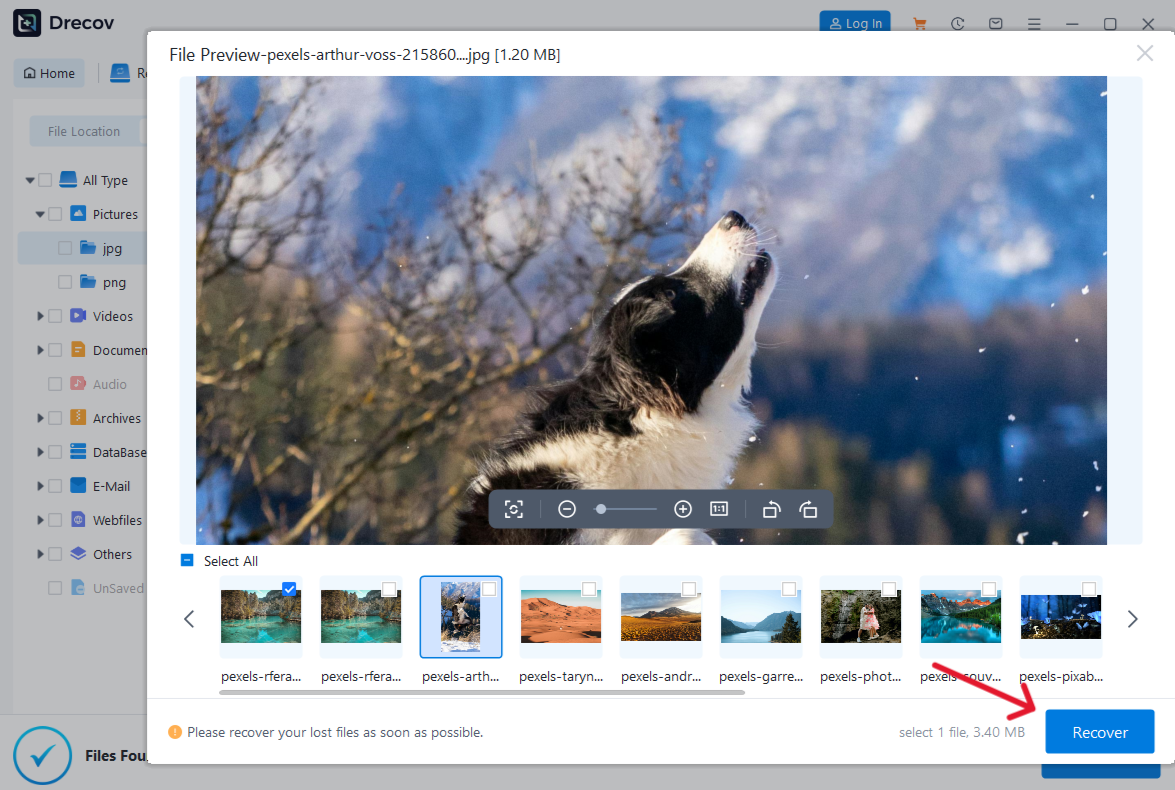
Step 4: Filter candidates and recover them elsewhere
Use name, path, type, date, and size together. Preview supported files where available, although archive preview cannot guarantee every compressed member is intact. Select complete-looking candidates and recover them to the healthy disk. Never restore them to the source device. Check Drecov Folder or Recovery Folder when output is not visible in the chosen location.
Step 5: Reassemble the set and verify every layer
Keep recovered originals untouched and test duplicates. Put all split volumes in one folder, confirm continuous numbering, and run 7-Zip’s Test command from the first volume. Extract to a separate folder. Open representative documents, play media, and test nested archives. Only after this review should you delete, repair, format, or reuse the source storage.
If the missing item was a browser download, the site’s lost-download recovery overview can help distinguish an unfinished transfer from a file deleted after completion.
Conclusion
When you cannot open a file as an archive in 7-Zip, establish whether it is genuine, complete, and accompanied by every numbered part. Compare sizes or checksums, test a duplicate, and obtain a fresh source copy when possible. No repair can invent absent compressed bytes. If an original package or split segment was deleted, Drecov can inspect the prior directory and restore likely matches onto separate storage. Reassemble the set, run 7-Zip’s test, and open extracted samples before trusting it.
⚠ Warning: Install it on a drive different from the one where your data was lost to prevent overwriting.






