







Error 0x800703EE means Windows considers an opened file invalid because its volume changed while the operation was in progress. It often appears during copying, backup, an update, or an optical-media transfer. The code does not identify whether the source, destination, cable, filter driver, or storage itself is at fault. Keep the original file untouched, record the exact action and both locations, then test one layer at a time. Do not format a drive to make a copy error disappear.
error 0x800703ee: safe diagnosis
Microsoft maps Win32 error 1006, ERROR_FILE_INVALID, to a volume for an opened file being externally altered. Its system error-code reference describes the condition, not the root cause. The display value 0x800703EE carries that underlying 0x3EE code. A changed mount, disconnected USB device, media swap, sync filter, or failing volume can all produce a similar symptom.
Write down whether the operation was Copy, Cut, backup, installation, or Windows Update. Note the full paths, device models, drive letters, and the percentage or file at which it stopped. Do not retry a Cut operation until you have confirmed the original still opens. File Explorer can leave a partial destination file that resembles success by name while its size or contents are incomplete.
| Controlled observation | What it points toward | Next safe comparison |
|---|---|---|
| Many source files fail to several destinations | Source drive, source file system, or source filter | Read a sample and check source stability |
| Several sources fail only on one destination | Destination port, cable, capacity, permissions, or media | Try a known-good destination |
| Only one file fails | File-specific corruption, lock, or unusual metadata | Copy another file from the same folder |
| Failure begins after antivirus or backup installation | Filter-driver interaction is possible | Test an approved clean boot or vendor guidance |
| Drive repeatedly disconnects or reports read errors | Physical or connection instability | Stop repeated copying; image or seek help |
Preserve the last good copy before isolating devices
When the source opens, copy the most important files to a different healthy disk in small groups. Confirm each copy opens and matches the expected size. If the error occurs during a move, stop moving and switch to copying until verification is complete. A move can remove the source after a seemingly successful transfer, leaving little room for a second attempt.
Check backup and cloud versions without allowing synchronization to replace the source. A cloud client may treat a damaged partial file as the newest version. Pause sync for the affected folder while preserving a local and an online version. If the source volume is encrypted, keep its unlock key available before connecting it to another computer.
Do not begin with CHKDSK, formatting, or DiskPart. CHKDSK writes file-system metadata, while formatting and clean replace storage structures. Those may have roles after data protection, but none diagnoses a transient USB cable fault. If the drive clicks, vanishes, changes capacity, or accumulates severe errors, cease direct retries. Imaging or professional recovery is safer than forcing the same read thousands of times.
Separate the source, destination, and transfer path
Test a small known-good file
Copy one small file from the same source folder to a healthy local disk. If it works, try a larger disposable file and then the problematic file. Keep destinations separate so you can tell which test produced which copy. A large file failing after several gigabytes can reveal a weak cable, insufficient space, file-system file-size limit, or heat-related disconnection that a tiny test would miss.
Check the removable connection
For USB storage, use a direct computer port and a known-good cable. Avoid hubs and front-panel connectors for the comparison. Safely eject between tests; do not pull a device during a write. Check whether Windows assigns a new letter after reconnecting. The error wording mentions a changed volume, so the identity of the mounted device matters more than the letter alone.
Check destination limits without rewriting it
Confirm free space, file-system type, and permissions on the destination. FAT32 cannot store one file larger than 4 GB, but do not format a drive to exFAT or NTFS while it contains unprotected data. Choose another compatible destination for a test. For a network share, verify that the connection and credentials remain stable. For optical media, try a different disc or drive only after retaining the source file.
Investigate software filters and update context
Antivirus, backup, encryption, synchronization, and virtual-drive software can intercept file operations. Note whether the error began after one of these changed. Update the affected application from its official publisher, then test a copy after a clean restart. A controlled clean boot can help isolate a third-party service, but do not disable security protections broadly and leave the machine exposed. Restore the normal startup configuration after testing.
If 0x800703EE appears during Windows Update or installation rather than a normal file copy, inspect the update or setup log and the health of the system and EFI volumes. Do not assume the same USB-copy fix applies. Some update failures point to a boot partition or temporary storage issue. Preserve a current backup before any EFI, BCD, or partition operation. Recreating partitions from a generic online command is not an appropriate first response.
When a backup application reports the code, check whether its source snapshot and destination remained mounted for the whole job. Run a small test backup to another healthy target. Then perform a restore test; a successful job status without a readable restored file is not proof of protection.
Use Drecov only if the original file is gone or inaccessible
Most 0x800703EE cases are transfer failures, not deleted-file cases. If the source remains readable, copy and verify it instead of scanning. Drecov becomes relevant when the original was deleted during a move, a stable volume became logically inaccessible, or the partition vanished. Drecov is Windows data recovery software for PCs, HDDs, SSDs, external disks, USB drives, SD cards, and memory cards. Its read-only recovery mode, Quick Scan, Deep Scan, filters, preview, and Lost Partition Recovery help locate documents, photos, videos, email data, audio, and archives. It does not repair a cable, controller, filter driver, or physically failing drive.
⚠ Warning: Install it on a drive different from the one where your data was lost to prevent overwriting.
This check is especially useful for error 0x800703ee. Stop writes to the source and prepare a different healthy destination. Do not install Drecov on the volume holding the missing file. If the device repeatedly drops offline or reports serious read errors, stop direct scans and consider an image or specialist. SSD TRIM may reduce the chance of recovering a deleted file; repeating scans cannot reverse it.
Step 1: Open Drecov and choose the original volume
Select the source, not the incomplete copy destination, unless the destination holds the only remaining data. Identify the device by capacity and former path. If its partition is missing, choose Lost Partition Recovery.

Step 2: Run Quick Scan for the lost original
Begin with Quick Scan. Filter by former folder, filename, type, date, and size. Compare candidates with any partial destination copy so you do not mistake that incomplete file for a recovered original.
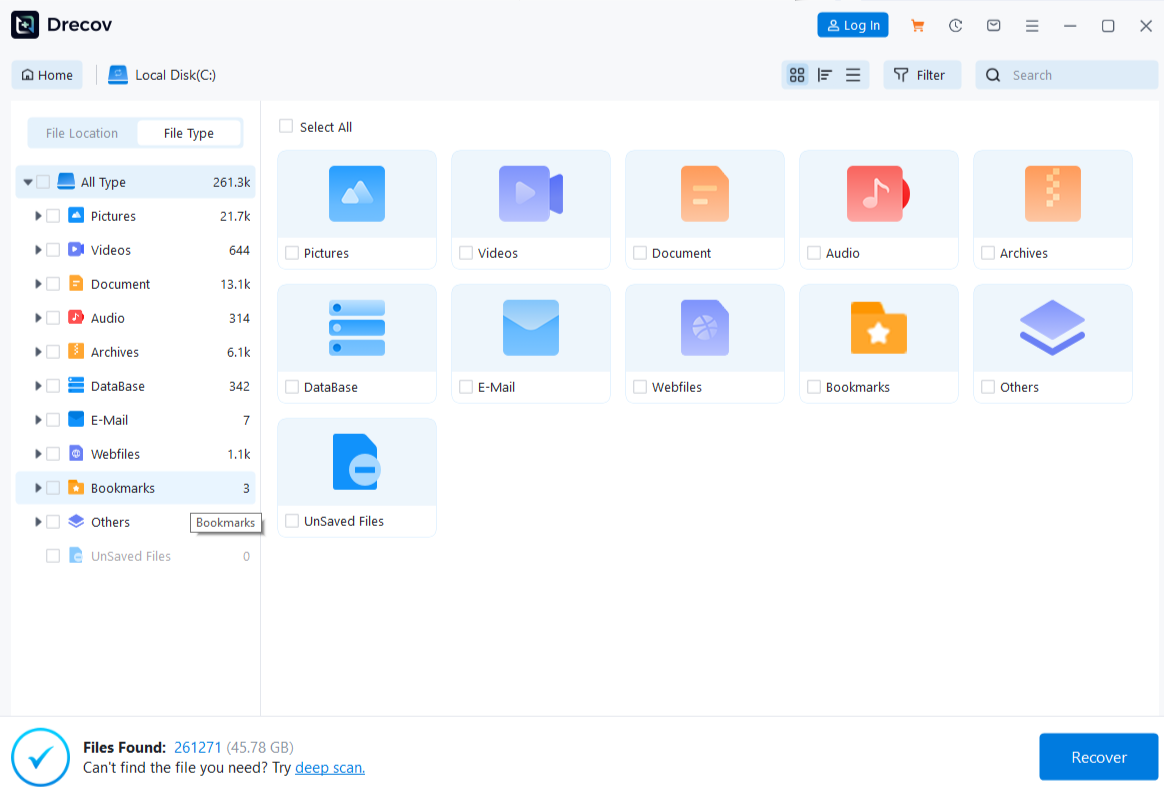
Step 3: Run Deep Scan only while storage stays stable
Use Deep Scan if Quick Scan misses the file and the source remains consistently detected. Stop at clicking, repeated disconnection, overheating, or severe read errors.
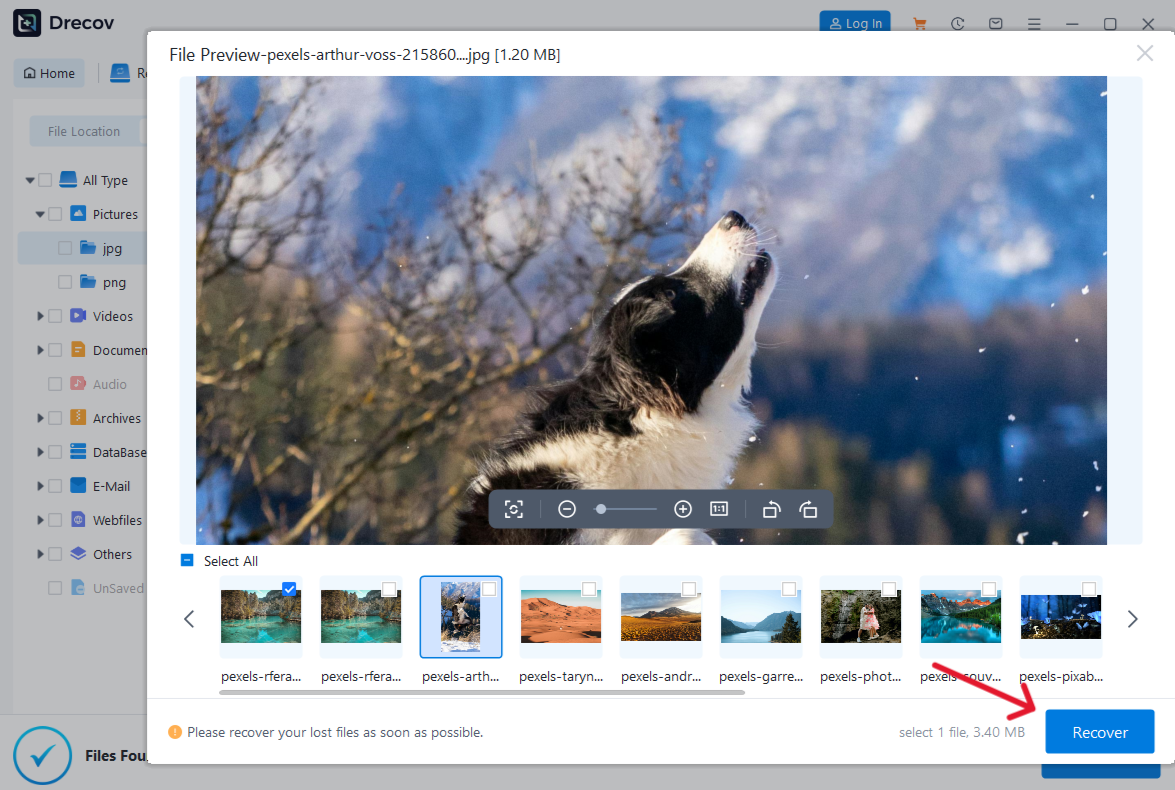
Step 4: Preview, recover elsewhere, and compare
Preview representative supported files, knowing that a sample cannot certify every page or frame. Recover to the prepared healthy disk, never the source. Check Drecov Folder or Recovery Folder if output is not where expected. Open the result and compare content, size, and when available a known hash before changing the original drive.
⚠ Warning: Install it on a drive different from the one where your data was lost to prevent overwriting.
Prove the fix with a repeatable transfer
After correcting the identified cable, destination, filter, or update issue, copy a disposable test set. Include small and large files. Compare file counts and sizes at both ends, then open samples. Eject and reconnect the destination before a final check. Only then resume the original backup or move operation. If the fault recurs, preserve the time, Event Viewer entries, and the exact file that failed.
For complementary reading, see the Drecov homepage, the broader guide to unexpected copy errors, advice on verifying an external-drive backup, and an explanation of why recovered files need another drive.
FAQ
Does 0x800703EE mean my file is permanently corrupt?
No. The code describes the open file becoming invalid because its volume changed. The file may still be readable at the source.
Should I move instead of copy to avoid the error?
No. Copy first and verify the destination. Moving can remove the remaining good source after a partial success.
Can antivirus cause this error?
A file-system filter can be involved, but do not assume it is the cause. Use a controlled comparison and vendor-supported updates.
Will CHKDSK fix it safely?
CHKDSK writes file-system metadata. Protect needed files and assess device stability before running it.
When should I use Drecov?
Use it only when the original file is missing or inaccessible on stable storage. It does not repair the transfer path.
Conclusion
Error 0x800703EE is best handled by identifying which volume changed during the operation. Keep the original, isolate source and destination with controlled copies, inspect connection and software filters, then verify a new transfer. If a failed move actually removed the only local file, Drecov can search the stable source and recover candidates to another healthy drive before file-system repair or formatting.
⚠ Warning: Install it on a drive different from the one where your data was lost to prevent overwriting.





