







Losing hours of progress due to a sudden system crash, a power outage, or accidentally clicking “Don’t Save” is an incredibly stressful experience. Fortunately, learning how to recover unsaved word document files is entirely possible, and you do not need to be a computer scientist to rescue your hard work. Microsoft Word has several built-in safety nets designed to capture your data in the background, minimizing the risk of permanent data loss.
However, native recovery options have their limitations, particularly if files are overwritten or deleted from your local storage drive entirely. In these complex data loss scenarios, utilizing a dedicated, professional solution like PandaOffice Drecov data recovery software provides an advanced, dependable mechanism to retrieve your lost work. This guide walks you through the exact steps to find unsaved word documents, starting from simple built-in tricks to professional automated deep scans.
Understanding the Basics of How to Recover Unsaved Word Document Files
Before diving into the manual recovery steps, it helps to understand how Microsoft Office manages temporary data. When you draft content, Word constantly writes background data to a temporary cache. If your computer shuts down unexpectedly, these background files often remain intact, waiting to be reconstructed.
Why Files Seem to Disappear
- Accidental Closure: Clicking “Don’t Save” explicitly instructs Word to clear its volatile cache, making manual internal recovery more challenging.
- System Crashes or Power Failures: Sudden disruptions leave AutoRecover files (
.asd) sitting in hidden system directories. - File Deletion: Sometimes, a folder cleanup or a malfunctioning software update completely purges the directory containing your drafts.
When built-in options fail because a file was completely wiped or deleted from the hard drive, a dedicated data recovery tool becomes necessary. PandaOffice Drecov data recovery software fills this gap by scanning the physical clusters of your storage device to rebuild fragmented .docx, .doc, and .asd files, bypassing operating system limitations to ensure data integrity.
3 Proven Ways to Recover Unsaved Word Document Files Accurately
Depending on how your document was lost, choose the approach below that best fits your technical comfort level.
Method 1: Document Recovery Pane & Menu
Depending on how your document was lost, choose the approach below that best fits your technical comfort level. Whether a sudden power outage cut your progress short or you accidentally closed a window without saving, these targeted strategies will help you rescue your missing text.
- Relaunch Microsoft Word: Open a fresh, blank instance of the application.
- Check the Side Pane: Consequently, if Word detects an unexpected shutdown, a Document Recovery pane will automatically appear on the left side of your screen.
- Open and Save: Click on the available file listed with the most relevant timestamp. Review the text, and immediately press Ctrl + S (or Cmd + S on Mac) to save it securely to a permanent folder.
If the pane does not pop up automatically, you can trigger the internal command manually:
- Open Word and click on the File tab in the top-left corner.
- Navigate to Info > Manage Document.
- Click the dropdown menu and select Recover Unsaved Documents.
- Select your missing draft from the File Explorer window and click Open.
Method 2: PandaOffice Drecov Data Recovery Software
When you manually close a document and mistakenly click “Don’t Save,” Word often clears the temporary storage path. Furthermore, file system corruption or malware can occasionally delete the directory structures entirely. This is where specialized data recovery software becomes the most effective strategy to recover unsaved word document items.
PandaOffice Drecov data recovery software uses complex deep-scanning algorithms to identify the raw signatures of Word documents on your solid-state drive or hard disk drive, even if the operating system considers that space empty.
⚠ Warning: Install it on a drive different from the one where your data was lost to prevent overwriting.
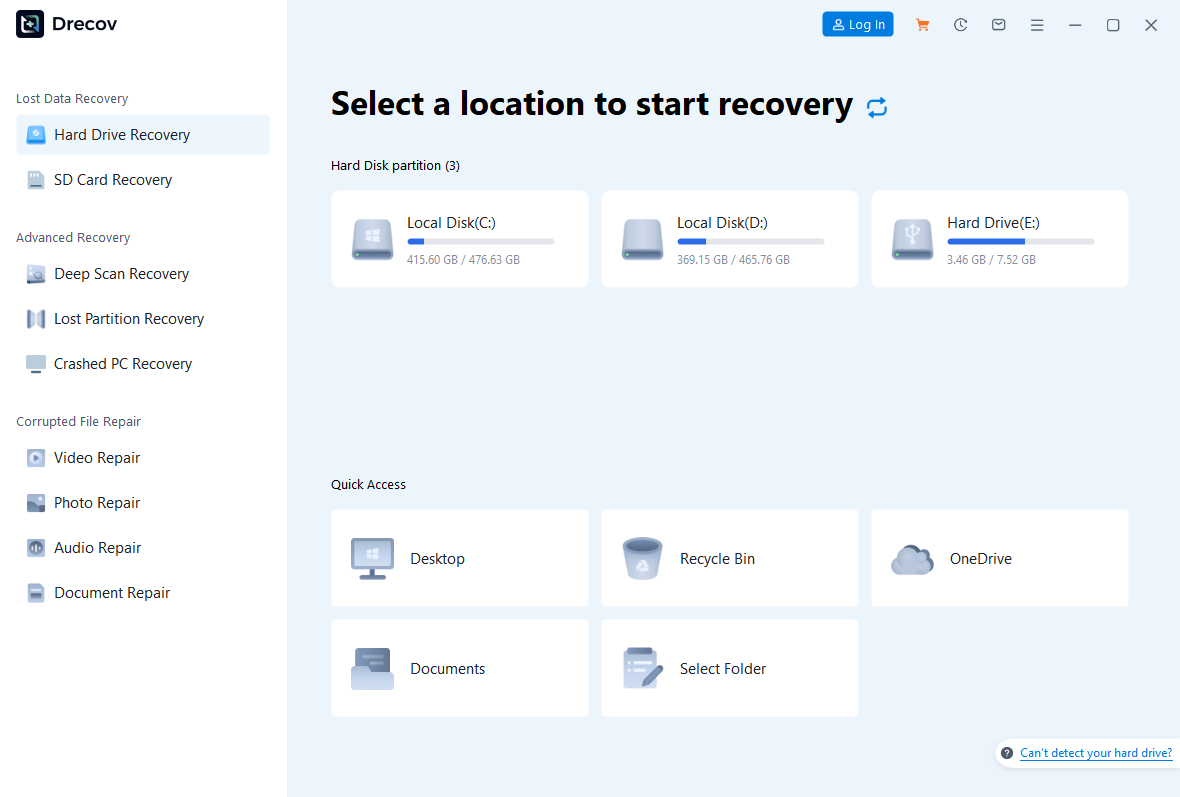
Step 1: Select the Target Location
On the home screen interface, select the specific logical drive or folder where your document was last processed. Click Scan.
Step 2: Filter and Target Word Files
While the scan runs, utilize the file type filter sidebar. Narrow your results down to Documents and check for files ending in .docx, .doc, or .asd.

Step 3: Preview and Rescue
Preview the extracted text directly within the interface to confirm file integrity. Select the correct checkbox and click Recover to extract your document to an external storage drive or safe local partition.
Method 3: Locating Hidden AutoRecover Paths
If you prefer a manual approach to how to find unsaved word documents, you can explore Windows’ hidden application data folders directly. Word saves snapshots every 10 minutes by default into hidden system folders.
- Press the Windows Key + R shortcut on your keyboard to launch the Run dialog box.
- To check your unsaved drafts, copy and paste the following environment variable path and press Enter:
%localappdata%\Microsoft\Office\UnsavedFiles - Alternatively, if the document was previously saved at least once but crashed mid-edit, paste this path instead:
%appdata%\Microsoft\Word - Look for files that feature a
.asdextension. Right-click the file, choose Open with, and select Word. Immediately convert the file using File > Save As to convert it back into a standard.docxfile.
Alternative or Complementary Methods
If the standard approaches do not yield immediate results, you can use built-in alternative features to try and rescue word document structural data.
| Method | Description | Pros | Cons |
| Windows Recycle Bin Search | Checking the local trash directory for accidentally deleted temporary files or older backups. | Extremely fast; zero technical knowledge required. | Will not contain files if you clicked “Don’t Save” inside Word. |
| Windows Temp Folder | Searching the operating system’s temporary file dumping ground for ~* .tmp strings. | Can extract raw text data from deep system caches. | Requires manual file extension renaming and sorting through messy system logs. |
| OneDrive Cloud Version History | Reverting back to an auto-uploaded cloud copy if your document directory is linked with Microsoft cloud backup. | Completely independent of local drive hardware crashes. | Only functions if real-time cloud synchronization was active beforehand. |
For deep file structure maintenance, you can also explore how to locate systemic storage hubs, such as checking the Windows 10 Recycle Bin location or inspecting common app data zones like the Firefox bookmarks location data hub to understand how applications save operational cache data locally.
Tips & Best Practices for Data Protection
Maximizing your file recovery success relies significantly on your immediate behavior directly after realizing a document is missing.
- Minimize Storage Activity: Stop downloading files, streaming media, or creating new documents immediately. Windows marks space occupied by deleted files as “free space.” Consequently, continuous use can overwrite your unsaved data.
- Adjust AutoRecover Frequency: By default, Word saves recovery points every 10 minutes. You can lower this to 1 or 2 minutes by navigating to File > Options > Save and modifying the time interval value.
- Enable Background Backups: Check the box for “Always create backup copy” within your Word advanced options. This automatically creates a stable
.wbkbackup file every single time you manually save your work. - Act Fast: Temporary local files are volatile. Operating systems frequently run automated background maintenance scripts that can permanently wipe out temporary directories within days.
If you ever experience similar asset loss challenges with media files beyond office documents, you can refer to this 5-minute photo recovery guide for a look at retrieving deleted media elements safely.
Frequently Asked Questions
How long does Microsoft Word keep unsaved AutoRecover files?
By default, Windows stores these temporary files for roughly 4 days before clearing out the cache directory. However, if you explicitly close a file and choose “Don’t Save,” the local system may delete it immediately, requiring professional file rescue utilities.
Can I recover a Word document if I clicked “Don’t Save”?
Yes. While this action purges the file from the basic AutoRecover menu, the raw data often physically remains on your drive clusters until new data overwrites it. Running a deep scan with PandaOffice Drecov data recovery software can successfully locate and reconstruct these orphan fragments.
What is the difference between an .asd and a .wbk file extension?
An .asd file is an automated snapshot created by Word at set intervals during an active workspace session. In contrast, a .wbk file is a backup copy generated of your previous save state, which is only created if you have specific backup settings enabled.
Why can’t I see the AppData folder when searching manually?
The AppData folder is a hidden system directory by default. To make it visible, open File Explorer, click on the View tab at the top menu bar, and check the box labeled Hidden items.
Conclusion
Losing progress on a critical file is frustrating, but knowing how to recover unsaved word document iterations ensures you do not have to rewrite your text from scratch. For immediate issues, Windows’ built-in AutoRecover paths or the Document Recovery sidebar provide quick fixes. In addition, implementing automated backup habits will shield you from future text loss.
When manual strategies fall short—especially after accidental deletions or system formatting issues—tools like PandaOffice Drecov data recovery software offer an effective fallback solution to salvage your hard work safely. Pair these file recovery steps with automated cloud saving to guarantee your documents remain protected against sudden disruptions.





