







Artificial intelligence is evolving faster than almost any other technology in modern history. Just when people finally got comfortable using ChatGPT-4, a newer and more advanced version arrived—ChatGPT-5. Naturally, users everywhere started asking the same question: what is the difference between chatgpt 4 and 5?
To help you protect your digital assets while navigating the modern tech landscape, this guide breaks down the biggest differences between ChatGPT-4 and ChatGPT-5 in simple, easy-to-understand language. Furthermore, we will provide a comprehensive, master-level blueprint on how to handle data recovery across various technical complexities—ensuring that your files remain safe, no matter which AI tools you choose to deploy.
What Is ChatGPT-4?
Before comparing the two versions, it’s important to understand what ChatGPT-4 brought to the table. Developed by OpenAI, ChatGPT-4 was a major advancement over earlier AI models because it drastically improved:
- Language understanding
- Context awareness
- Creativity
- Coding abilities
- Conversation flow
When it launched, many users were amazed by how human-like the responses felt. It could explain complex concepts, generate detailed articles, solve programming problems, and assist with professional work at a much higher level than previous models. For many people, ChatGPT-4 was the first AI model that felt genuinely useful beyond simple entertainment.
What Is ChatGPT-5?
ChatGPT-5 builds upon the foundation of ChatGPT-4 while introducing smarter reasoning, better memory handling, faster responses, and deeper multimodal capabilities. Instead of simply improving speed or adding a few features, ChatGPT-5 focuses heavily on:
- Better logical thinking
- Improved contextual understanding
- Reduced hallucinations
- More natural communication
- Enhanced personalization
Think of ChatGPT-4 as an excellent assistant and ChatGPT-5 as a highly experienced specialist who better understands nuance, intent, and complexity.
Major Differences Between ChatGPT-4 and ChatGPT-5
1. Improved Reasoning and Logic
One of the biggest upgrades in ChatGPT-5 is its reasoning ability.
- ChatGPT-4: Good at answering direct questions, but sometimes struggled with layered logic and could occasionally lose track in long discussions.
- ChatGPT-5: Features better multi-step reasoning, stronger analytical thinking, and vastly improved consistency in long conversations.
Imagine asking both models to solve a complicated business problem. ChatGPT-4 may provide useful ideas, but ChatGPT-5 tends to organize information more logically and deliver more refined solutions. This difference becomes especially obvious in fields like coding, mathematics, advanced research, and strategic planning.
2. Faster Response Speeds
Speed matters more than people realize, especially when integrating AI into live development environments. Even small delays interrupt workflow and reduce productivity.
- ChatGPT-4: Could slow down drastically during heavy global demand, resulting in longer response generation times for complex prompts.
- ChatGPT-5: Delivers faster overall responses through optimized infrastructure, providing more efficient processing and better handling of large prompts.
Using ChatGPT-5 feels smoother and more fluid, especially for professional users working on demanding tasks.
3. Better Understanding of Context
Context is one of the hardest challenges in AI conversation.
- ChatGPT-4 Context Handling: ChatGPT-4 already improved memory within conversations, but it sometimes forgot earlier details, misinterpreted long prompts, or repeated information unnecessarily.
- ChatGPT-5 Context Handling: ChatGPT-5 maintains conversation flow much more naturally. It better understands long discussions, user intent, subtle tone shifts, and highly complex instructions.
This makes conversations feel less robotic and more human-like. It is like talking to someone who actually remembers what you said five minutes ago instead of restarting the conversation repeatedly.
4. Reduced Hallucinations and Errors
AI hallucinations occur when a model confidently generates incorrect information.
- ChatGPT-4: Generally accurate, but still produced occasional fabricated answers or inaccurate citations.
- ChatGPT-5: Features improved factual reliability, better verification patterns, and a massive reduction in misinformation generation.
No AI system is perfect, but ChatGPT-5 tends to make fewer obvious mistakes during complex tasks, making it much safer for academic work, medical research, coding, and business operations.
5. Enhanced Writing Quality
Both models are strong writers, but ChatGPT-5 feels more polished, adaptable, and human.
- ChatGPT-4 Writing Style: Professional and structured, but occasionally formulaic or repetitive in its choice of vocabulary.
- ChatGPT-5 Writing Style: Features a more natural flow, better tone matching, and vastly improved creativity and nuance.
ChatGPT-5 adapts more effectively to casual writing, technical documentation, marketing copy, and deep storytelling. It feels less like reading generated text and more like reading content written by an experienced human author.
6. Multimodal Capabilities
Modern AI is no longer limited to simple text inputs. Multimodal AI can process text, images, audio, and large data files simultaneously.
- ChatGPT-4: Introduced stronger multimodal support compared to older models, allowing basic image analysis and document reading.
- ChatGPT-5: Expands these capabilities further with lightning-fast image understanding, comprehensive video/audio file analysis, and more accurate visual interpretation.
This makes ChatGPT-5 an invaluable tool for designers, engineers, students, and corporate researchers who deal with non-text assets.
7. Coding Performance
Developers are among the biggest AI users today, using these tools to build everything from mobile apps to data recovery scripts.
- ChatGPT-4 Coding: ChatGPT-4 became famous for generating functional code snippets, explaining bugs, and assisting developers with basic syntax.
- ChatGPT-5 Coding: ChatGPT-5 drastically improves debugging accuracy, structural code optimization, and the ability to understand entire software projects consisting of multiple interconnected files.
Think of ChatGPT-4 as a talented junior developer and ChatGPT-5 as a highly experienced senior engineer.
8. Personalization and Memory
AI interactions become much more powerful when the system remembers user preferences over long periods.
- ChatGPT-4: Offered limited personalization features, often requiring custom instructions to maintain a specific persona.
- ChatGPT-5: Provides highly improved adaptive responses based on historical user behavior, unique communication styles, and previous conversations across weeks or months.
This creates a deeply customized experience tailored specifically to your daily workflow.
Comparison Table: ChatGPT-4 vs ChatGPT-5
| Feature | ChatGPT-4 | ChatGPT-5 |
| Reasoning Ability | Strong | Much More Advanced |
| Speed | Fast | Faster |
| Context Understanding | Good | Excellent |
| Writing Quality | High | More Human-Like |
| Coding Support | Excellent | Superior |
| Multimodal Features | Advanced | Expanded |
| Hallucination Reduction | Moderate | Improved |
| Personalization | Limited | Better Adaptive Memory |
The Hidden Risk of the AI Era: Data Vulnerability
The leap from ChatGPT-4 to ChatGPT-5 shows how quickly AI is evolving. Tasks that once required teams of writers, technical specialists, and hours of manual effort can now be completed in minutes with AI assistance. However, this massive velocity of content creation has exposed an underlying vulnerability: our digital storage systems are under immense strain.
When you are constantly generating AI scripts, downloading massive multimodal datasets, and modifying system configurations, the risk of data loss increases exponentially. A wrong command line instruction written by an AI could wipe out a hard drive partition. An accidental deletion could remove a critical project folder. A sudden power loss during a massive file transfer can corrupt your solid-state drive (SSD).
When catastrophe strikes, you need to know exactly how to get your files back. Data recovery may seem intimidating, but it can be easily mastered when broken down by technical complexity. Below, we outline three distinct recovery methods, moving from simple built-in operating system features to professional-grade automated solutions, and finally to highly technical command-line interventions.
Level 1: Native Data Recovery Methods
Before panicking or executing deep system modifications, always check the built-in safety nets provided by your operating system. These methods are completely free, risk-free, and take less than two minutes to perform.
Method A: The Desktop Recycle Bin or Trash
When you delete a file on Windows or macOS, the operating system does not immediately erase it from the physical storage sectors. Instead, it moves the file to a designated temporary holding area.
- Step 1: Double-click the Recycle Bin icon on your Windows Desktop (or click the Trash icon in your macOS Dock).
- Step 2: Locate the accidentally deleted files or folders. You can use the search bar in the top-right corner to filter by file extension or name.
- Step 3: Right-click the selected files and select Restore (or Put Back on Mac). The files will immediately return to their exact original paths.
Method B: Restoring from Windows File History
If you configured Windows File History prior to the data loss event, you can roll back individual folders to an earlier state.
- Step 1: Press the Windows Key + S, type
Control Panel, and hit Enter. - Step 2: Navigate to System and Security > File History.
- Step 3: Click on Restore personal files in the left-hand sidebar menu.
- Step 4: Browse through the saved historical snapshots using the left and right arrow buttons at the bottom. Once you locate the version containing your missing data, select it and click the green Restore circle button to write the files back to their original location.
Level 2: Automated Recovery Using Professional Software
When files are permanently deleted via Shift + Delete, cleared from the Recycle Bin, or lost due to a drive formatting error, native OS tools cannot view them. This is where advanced logic is required. To scan the raw sectors of your storage device safely without risking further overwrites, you must utilize specialized tools.
Introducing PandaOffice Drecov Data Recovery Software
For users seeking a highly dependable, automated solution that bypasses technical jargon, PandaOffice Drecov data recovery software stands out as an exceptionally robust choice. Engineered with deep-scanning algorithms, it reads the unallocated space of hard drives, external SSDs, USB flash drives, and memory cards to piece together fragmented file signatures. Whether you are dealing with a sudden partition corruption or a standard accidental deletion, this software systematically restores hundreds of file formats with minimal effort.
⚠️ CRITICAL WARNING: Never download or install any software—including PandaOffice Drecov—onto the exact same drive partition where the data loss occurred! Doing so will cause the installation files to overwrite the deleted data sectors, permanently destroying any chance of a successful recovery. Always save the software onto a secondary drive or external disk.
Step-by-Step Guide to Recovering Files with PandaOffice Drecov
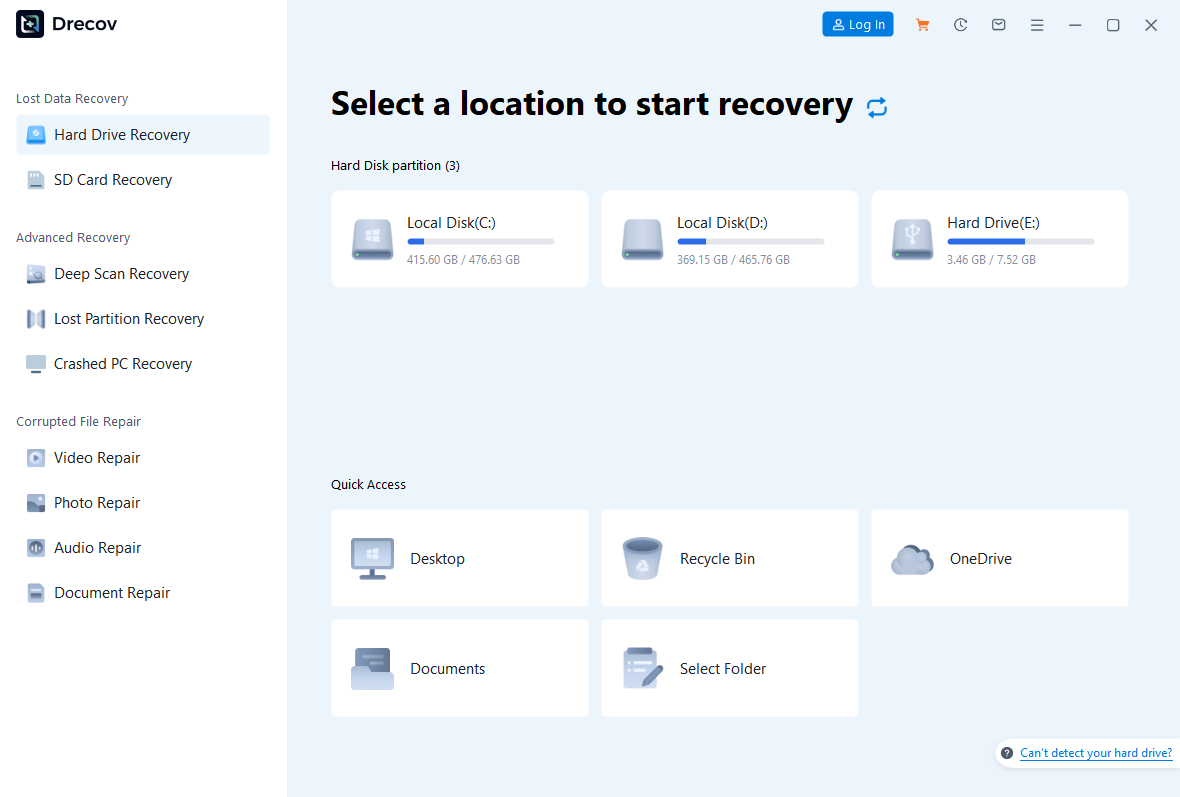
- Step 1: Launch the Interface and Select the Target Location. Open the program. On the primary dashboard, you will see a clean visual map of all connected storage media, including local hard drives, external devices, and common desktop locations. Left-click on the specific drive letter or folder where your missing files used to reside.
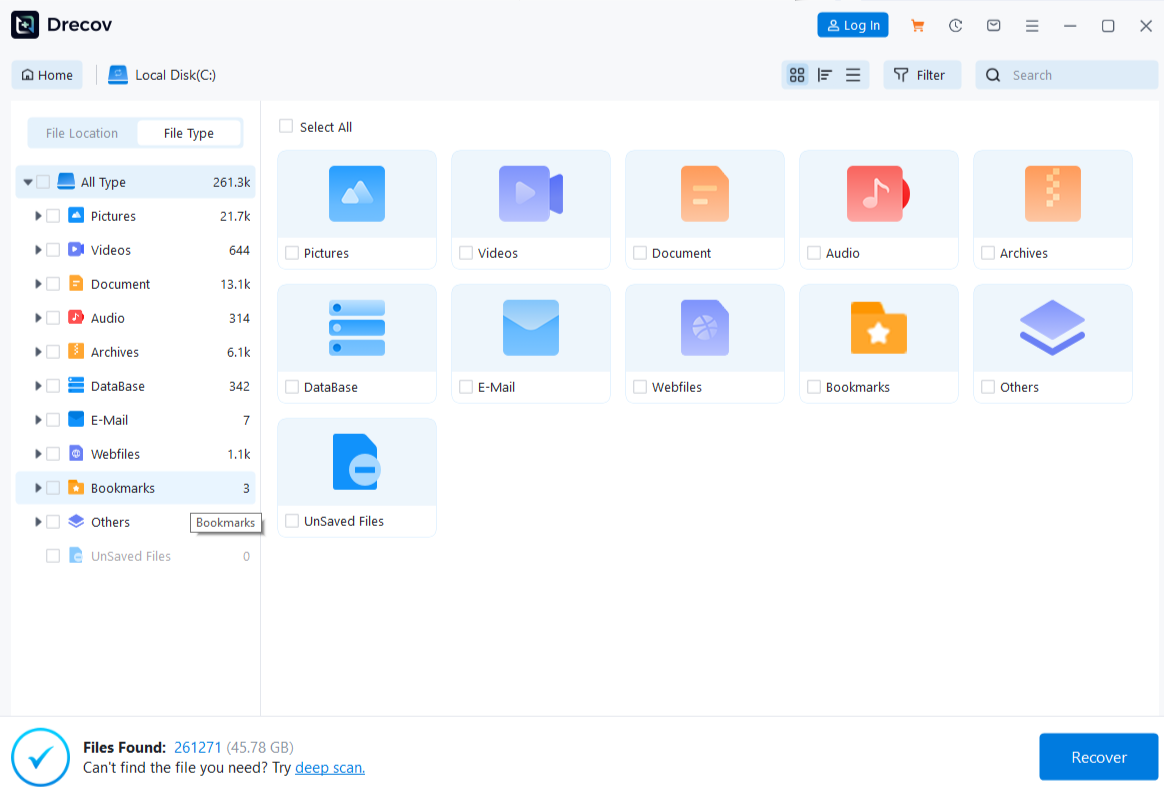
- Step 2: Execute the Deep Scan Operation. Click the Scan button. The software will automatically initiate a two-phased scanning process. First, a rapid scan identifies recently deleted file pointer references. Immediately following this, a deep scan evaluates raw file signatures across the entire storage layer. You can view discovered files in real-time categorized by file type (e.g., Documents, Images, Videos, Archives).
- Step 3: Filter, Preview, and Verify Your Data. Once the scan concludes, utilize the built-in file filter options to sort the results by modification date or size. Select a file (such as a lost PDF or image) and use the Preview panel to confirm that the file structure is intact and uncorrupted.

- Step 4: Export and Save the Restored Files. Check the boxes next to the files or folders you wish to retrieve. Click the Recover button in the bottom right corner. A prompt will appear asking for a destination path. Select an external hard drive or an entirely separate storage partition, then click OK to complete the data export process safely.
After completing these data recovery steps, you can also easily restore app-specific items, such as web browser elements or media configurations. For instance, if you accidentally wiped out your browser configuration folders during a system cleanup, you can learn how to get your google chrome bookmarks back or find out exactly where are firefox bookmarks stored on your pc to perform a direct manual copy. Furthermore, once your files are completely recovered, you should always back them up to external media; you can refer to how to transfer photos to usb drive the 2026 master guide for the most efficient storage transfer techniques.
Level 3: Command-Line and System-Level Interventions
For advanced developers, administrators, or those dealing with deep logical file system issues where standard graphical applications cannot interface with a drive, command-line execution becomes necessary. These methods carry an inherent risk of data destruction if typed incorrectly, so follow them with extreme caution.
Method A: Checking File System Integrity via CHKDSK
If a storage drive becomes unreadable, RAW, or throws file system errors due to a sudden disconnection or power failure, running the Check Disk tool can fix directory indices and restore file access.
- Step 1: Press the Windows Key, type
cmd, right-click on Command Prompt, and select Run as administrator. - Step 2: Type the following precise command, replacing
X:with your specific corrupted drive letter:DOSchkdsk X: /f /r - Step 3: Hit Enter. The
/fparameter instructs the utility to fix detected file system errors immediately, while the/rparameter searches for bad sectors and attempts to recover readable information from them. - Step 4: If prompted to unmount the volume, type
Yand press Enter. Allow the process to complete entirely—this may take several hours depending on the size and health of the drive.
Method B: Revealing Hidden Files using the ATTRIB Command
Sometimes, files are not actually deleted; instead, malware or system errors modify their metadata attributes, making them completely invisible to the Windows File Explorer.
- Step 1: Open an elevated Command Prompt (Run as administrator).
- Step 2: Input your target drive letter followed by a colon (e.g.,
E:) and press Enter to switch execution context to that specific drive. - Step 3: Type the following exact attribute string:DOS
attrib -h -r -s /s /d *.* - Step 4: Press Enter.
💡 Command Breakdown:
-hstrips the hidden file attribute;-rclears the read-only flag;-sremoves the system file designation. The/sand/dparameters apply these changes recursively to all files and directories across the storage medium. Once executed, open your drive via File Explorer to see if your missing directories have reappeared.
Conclusion
Understanding what is the difference between chatgpt 4 and 5 becomes much easier once you compare them across real-world scenarios. ChatGPT-4 transformed how we interact with AI, but ChatGPT-5 pushes boundaries further with smarter reasoning, better context awareness, and faster speeds. It is a highly capable, reliable, and intuitive AI ecosystem built for modern productivity.
As our reliance on AI-generated data grows, protecting your digital assets becomes equally critical. While technologies like ChatGPT-5 amplify your daily workflow, tools like PandaOffice Drecov data recovery software ensure your files remain completely secure against accidental loss. Embracing advanced AI tools alongside robust data recovery solutions gives you the ultimate edge in safety and efficiency in this fast-evolving digital era.






