







Disk Drill can be used safely when it comes from the official CleverFiles source, the affected storage is stable, the program is installed away from lost data, and recovered files go to another drive. No recovery program is safe for a clicking or repeatedly disconnecting disk. This is a documentation-based editorial assessment, not a laboratory test or a claim about recovery rates.
A Safety Review Has to Examine the Entire Recovery Session
Before comparing interfaces, preserve the source. Close programs that write to it, avoid downloads and updates, and confirm whether BitLocker or another encryption layer is involved. A safety verdict changes immediately if the disk cannot remain stable. Why the recovery destination matters For current vendor guidance, see the official support documentation.
| Observed condition | What it suggests | Next safe action |
|---|---|---|
| Installer came from CleverFiles | Reduces the risk of a repackaged installer | Verify the domain and digital signature before launch |
| Installer would go on the deleted-file volume | Installation may overwrite recoverable sectors | Use another Windows volume or computer |
| Disk is stable and correctly identified | A logical scan may be reasonable | Start with the least intensive documented scan |
| Disk clicks or disappears | Physical trouble is plausible | Stop software scans and image or escalate |
| Preview looks correct | The sample is promising, not a guarantee | Recover several representative files elsewhere |
| Destination is the source disk | Restored data could overwrite remaining evidence | Attach a separate healthy target first |
Inspect Safety Evidence Before Running a Utility
Installer came from CleverFiles
Reduces the risk of a repackaged installer. Verify the domain and digital signature before launch.
Installer would go on the deleted-file volume
Installation may overwrite recoverable sectors. Use another Windows volume or computer.
Disk is stable and correctly identified
A logical scan may be reasonable. Start with the least intensive documented scan.
Disk clicks or disappears
Physical trouble is plausible. Stop software scans and image or escalate.
Preview looks correct
The sample is promising, not a guarantee. Recover several representative files elsewhere.
Destination is the source disk
Restored data could overwrite remaining evidence. Attach a separate healthy target first.
Use Drecov for a Controlled Windows Recovery
Drecov offers a visual Windows recovery path with read-only recovery mode, Quick Scan, Deep Scan, filters, preview, Lost Partition Recovery, and an explicit separate-destination step. That combination is useful for users who want a clear sequence without navigating optional protection modules. PandaOffice Drecov is Windows data recovery software for PCs and storage that includes HDDs, SSDs, external drives, USB drives, SD cards, and memory cards. Read-only recovery mode uses Quick Scan, Deep Scan when needed, filtering or location tools, preview, and Lost Partition Recovery. It covers photos, videos, documents, emails, audio, and archives, and it saves selected results to a healthy destination. Drecov cannot repair physical damage, reverse fully overwritten data, fix the application or operating-system fault, or guarantee recovery.
⚠ Warning: Install it on a drive different from the one where your data was lost to prevent overwriting.
Step 1: Stop New Writes and Test Storage Stability
Stop using the affected location for downloads, updates, synchronization, temporary files, and new installations. Check backups without altering the source. If the device clicks, repeatedly disconnects, freezes Windows, returns severe read errors, or cannot retain its correct identity and capacity, stop direct scans. Image it under controlled conditions or seek professional recovery.
Step 2: Prepare Another Physical Destination
Connect a healthy drive with enough free space for the result set. Drecov must run from a healthy Windows installation and must not be installed on the partition that held the lost data. The destination should be writable, stable, and separate from the source.
Step 3: Open Drecov From a Safe Windows Environment and Select the Original Location
Open PandaOffice Drecov and select the stable drive or partition where the files were lost. Confirm the disk identity, capacity, user account, former folder, and loss event before starting a scan. If Windows cannot boot, connect a stable source drive to another working Windows PC rather than installing recovery software on that disk.

Step 4: Run Quick Scan Before Deep Scan
Start Quick Scan for a recent deletion or newly inaccessible path. If the target is not present and the source remains stable, continue with Deep Scan. Use Lost Partition Recovery when the volume entry itself disappeared; do not initialize, format, repartition, or create a replacement volume first.

Step 5: Filter and Preview the Right Candidates
Narrow results by former path, filename, date, and file type; review documents, photos, video, email data, audio, and archives separately. Preview representative supported files before selecting the full set. A successful preview shows that the sample can be decoded, but it cannot certify every page, frame, archive member, linked asset, game state, or byte.
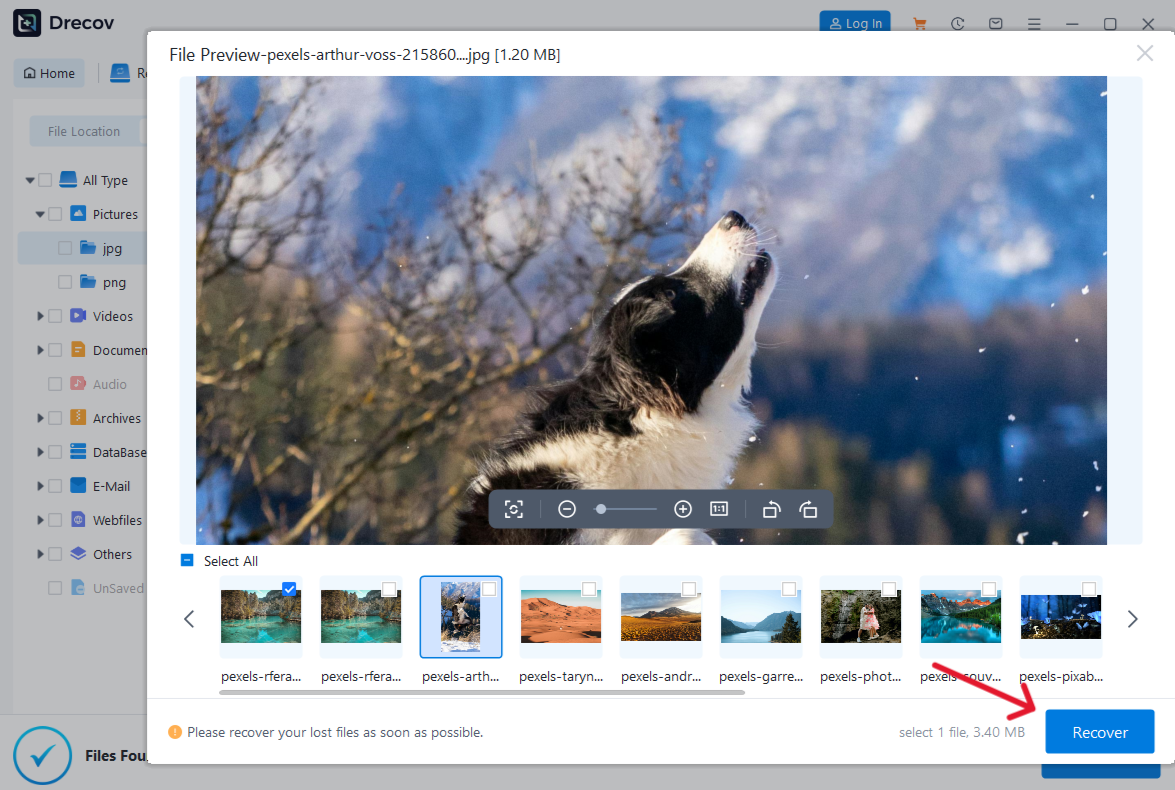
Step 6: Recover Elsewhere and Verify Before Repair
Recover selected files to the prepared healthy drive, never to the source. If results are not in the expected destination path, inspect Drecov Folder or Recovery Folder. Open documents, inspect images at full size, play several portions of videos, and test archives before trusting the set. Complete that validation before installing another recovery utility, changing protection settings, repairing a file system, or returning the disk to service.
Compare Documented Workflows Without Invented Scores
Verify the Installer and Publisher
Use the official vendor page and inspect the signed publisher. A familiar product name on a download portal is not equivalent evidence.
Understand Permissions
Disk access may require elevated or full-disk permissions. Grant only what the documented recovery task requires, then review background protection features separately.
Separate Recovery From Protection
Recovery Vault is a proactive metadata feature and must have been enabled before deletion. It does not store a second copy of file contents.
Respect SSD TRIM and Encryption
TRIM and encryption can sharply limit deleted-data recovery. No interface or scan option can promise to reverse those conditions.
Choose Between Disk Drill and Drecov by Workflow
Disk Drill documents broad recovery and protection features. Drecov emphasizes a direct Windows sequence of read-only scanning, filtering, preview, Lost Partition Recovery, and recovery to another device.
Validate the Restored Set Before Reusing the Disk
Open documents, inspect images at full size, play several portions of videos, and test archives before trusting the set. verifying recovered files Keep the recovered copy and any disk image until the underlying problem has remained stable through several normal uses.
- Do not treat “Installer came from CleverFiles” as proof of a different cause without completing its related check.
- Do not treat “Installer would go on the deleted-file volume” as proof of a different cause without completing its related check.
- Do not treat “Disk is stable and correctly identified” as proof of a different cause without completing its related check.
- Do not treat “Disk clicks or disappears” as proof of a different cause without completing its related check.
- Do not treat “Preview looks correct” as proof of a different cause without completing its related check.
Is disk drill safe FAQs
Does safe mean recovery is guaranteed?
No. Safety describes source handling and software provenance, not whether overwritten data can be restored.
Should I scan a clicking drive?
No. Software scanning can worsen an unstable physical failure.
Is Recovery Vault the same as backup?
No. Its documentation describes retained metadata, not a complete independent file copy.
Can Drecov repair hardware?
No. It recovers data from stable supported storage and does not repair physical components.
Which program is safer?
The safer session is the one that avoids source writes, uses verified software, stops on instability, and restores elsewhere. For additional context, see lost-partition recovery basics.
Conclusion
Disk Drill can be safe in a correctly prepared logical-recovery session, but the official installer alone does not make every scan appropriate. Protect the source, judge stability, and restore elsewhere. Drecov provides a straightforward read-only Windows workflow with Quick Scan, Deep Scan, filtering, preview, and Lost Partition Recovery when that approach better matches the user.






