







Losing precious memories or vital visual assets can feel like a digital disaster. Whether you accidentally cleared an entire gallery or emptied your computer’s trash folder, the urgent question remains: how do i restore deleted photos? However, you do not need to panic. Meanwhile, data recovery technology has evolved significantly, making it entirely possible to reverse accidental deletions. When local operating system utilities fail to bring your files back, deploying a professional tool like PandaOffice Drecov data recovery software is the safest and most efficient path forward.
In this comprehensive guide, we will break down the exact underlying mechanics of file storage, map out step-by-step methods ranging from beginner fixes to advanced software solutions, and provide actionable tips to ensure maximum recovery success.
Understanding the Basics of How Do I Restore Deleted Photos
To successfully navigate the retrieval process, it is critical to understand what actually happens when a photo vanishes from your device.
Why Files Remain Recoverable
When you hit “Delete” on a computer or camera SD card, the storage drive does not immediately wipe the raw binary data of your image. Instead, the operating system simply alters a pointer in the file system table, marking that specific storage space as “available” for new data. Consequently, your photo remains entirely intact on the physical sectors of the drive until new files are written over it.
Common Data Loss Scenarios
- Accidental Permanent Deletion: Utilizing hard-delete functions or clearing storage bins.
- Drive Formatting: Accidentally wiping an external hard drive, camera SD card, or USB flash drive.
- File System Corruption: Sudden power surges or improper device ejection leading to unreadable RAW drives.
Can I Restore Deleted Photos Safely?
Yes, you absolutely can. However, the golden rule of successful photo retrieval is to stop using the affected drive or device immediately. If you continue taking pictures, downloading files, or installing software on that specific drive, you risk overwriting the exact clusters holding your lost imagery.
To bridge this gap, PandaOffice Drecov data recovery software acts as a specialized digital excavator. It bypasses the broken file index and directly scans the raw hardware layers to stitch your missing JPEG, PNG, RAW, and PSD files back together seamlessly.
⚠ Warning: Install it on a drive different from the one where your data was lost to prevent overwriting.
Solutions to Restore Deleted Photos Issues
Depending on how the deletion occurred, you can address the problem using various technical approaches. Below, we outline three distinct methods categorized by technical complexity.
Method 1: The Standard First Aid
Before deploying specialized applications, check the system-level temporary storage zones where deleted files are held by default.
For Windows Users:
- Step 1: Double-click the Recycle Bin icon on your Desktop. If you cannot find it, follow this guide on where is recycle bin in windows 10 to locate it instantly.
- Step 2: Scroll through the list or use the search bar to locate your deleted images.
- Step 3: Right-click the selected photos and click Restore. This action sends them back to their original folder pathways.
For Mac Users:
- Step 1: Open the Trash icon located on your Dock.
- Step 2: Locate your missing image assets.
- Step 3: Right-click (or Control-click) the files and select Put Back.
Method 2: Professional Recovery via PandaOffice Drecov Data Recovery Software
When the Recycle Bin has been permanently emptied, standard operating system commands can no longer see the files. In this scenario, running PandaOffice Drecov data recovery software provides an advanced deep-sector scanning algorithm that boasts an industry-leading 99.8% recovery success rate. It operates in a strict read-only mode, guaranteeing that your original storage sectors remain untouched and safe from corruption.
⚠ Warning: Install it on a drive different from the one where your data was lost to prevent overwriting.
Step-by-Step Restoration Process:
- Step 1: Launch the application. On the main dashboard, select the target drive letter or the specific external storage device where your photos were originally saved, then click Scan.

- Step 2: The tool will automatically initiate a Quick Scan, followed immediately by a comprehensive Deep Scan. Meanwhile, you can use the built-in file filter to sort files by type (e.g.,
.jpg,.png,.cr2) or search for specific file names.
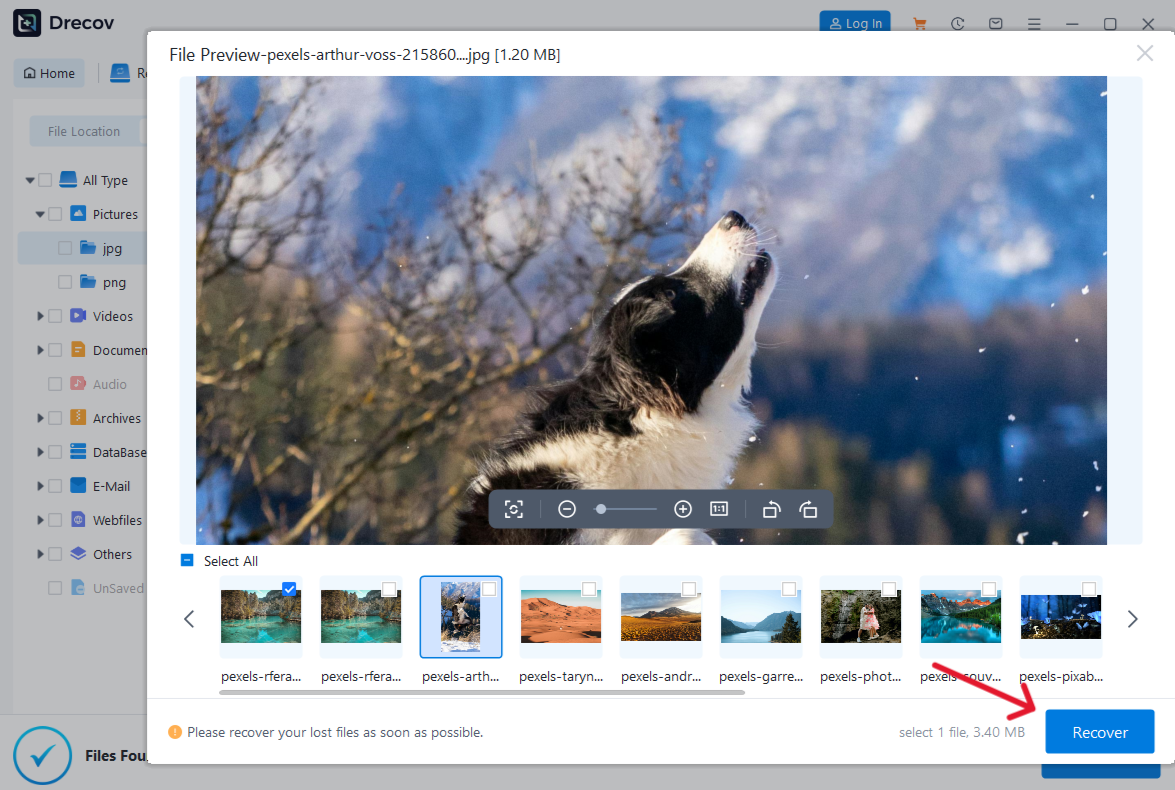
- Step 3: Double-click any discovered image to trigger the unlimited real-time preview window. This ensures the file integrity is complete before extraction. Select your desired images and click the Recover button.
Crucial Warning: Always save your recovered images to an entirely different storage device (such as an external SSD or a cloud directory) to maintain absolute data safety.
Method 3: Command-Line File Attribution Retrieval
Sometimes, malware infections or partition anomalies toggle system attributes, making your pictures invisible to the file explorer rather than actually erasing them. You can force the operating system to show these hidden structures via administrative commands.
- Step 1: Open the Windows Search bar by pressing
Windows Key + S. - Step 2: Type
cmd, right-click on Command Prompt, and select Run as Administrator. - Step 3: Identify your target drive letter (for instance, drive
E:). Type the following command precisely into the console interface:$$attrib -h -r -s /s /d E:\*.\*$$ - Step 4: Press
Enterand allow the console to execute. This utility strips away the Hidden (-h), Read-only (-r), and System (-s) structural flags from all directories on that drive.
Alternative or Complementary Methods
If you want to evaluate alternative approaches alongside PandaOffice Drecov data recovery software, you can explore manual backups or native command utilities.
Comparison Matrix: Recovery Strategies
| Recovery Solution | Pros | Cons | Best Used For |
| PandaOffice Drecov | 99.8% success rate; read-only security; unlimited free visual preview. | Requires software installation. | All severe data loss, formatted drives, emptied trash bins. |
| Windows File Recovery | Free official command-line tool from Microsoft Store. | No user interface; syntax-heavy; higher risk of user error. | Tech-savvy users operating on strict NTFS file architectures. |
| Cloud Backups (OneDrive/iCloud) | Instant restoration from remote servers; zero local drive stress. | Requires prior synchronization setup; dependent on network speed. | Restoring files modified or deleted across multiple synced devices. |
Furthermore, if you are looking to pull pictures that were cached or stored via web applications, you can review specific browser storage locations. For instance, if you are missing saved web graphics, checking your browser cache folders via a guide on where is the firefox bookmarks location can point you to the hidden directories where application state data resides.
Tips & Best Practices for Maximizing Recovery
To ensure you never have to ask how do i restore deleted photos under stressful circumstances again, adopt these professional data protection strategies:
- Implement the 3-2-1 Backup Strategy: Keep three copies of your data across two different media types (such as an external hard drive and an internal SSD), with at least one copy stored safely off-site in a secure cloud ecosystem.
- Act Immediately After Loss: Minimize the time gap between losing your files and starting the extraction. Every minute an operating system runs, it creates temporary background cache logs that could overwrite your unindexed clusters.
- Avoid On-Disk Installations: Never download diagnostic tools, repair suites, or browser files directly onto the storage disk that requires scanning.
- Leverage Fast-Fix Options: If you recently deleted items on a mobile platform or connected storage device, check out targeted guides like this 5-minute fix for recently deleted photos to capture transient temporary files before they are cycled out of memory.
Frequently Asked Questions
Can I restore deleted photos if the camera SD card was formatted?
Yes. Formatting updates the root file allocation directory table but leaves the raw image sectors intact. Running a specialized tool like PandaOffice Drecov data recovery software allows you to perform deep cluster parsing to rebuild those files safely.
Is it possible to salvage photos after permanently emptying the Recycle Bin?
Yes, it is entirely possible. When the Recycle Bin is purged, the operating system marks those blocks as unallocated. As long as you have not saved massive new files to that specific drive, advanced recovery applications can extract them.
Why do some restored photos appear corrupted or unreadable?
This problem happens when a portion of the original image data has already been overwritten by background system tasks. To avoid this, read through credible technical frameworks on data integrity provided by the Microsoft Support Documentation to understand how file system metadata clusters interact.
Conclusion
In conclusion, answering the stressful question of how do i restore deleted photos comes down to timing and using the right technical utilities. Whether your data loss stems from a simple accidental key press or a completely formatted external storage partition, your missing pictures are rarely truly gone from the physical disk layer.
By immediately halting all write actions on your affected device and deploying PandaOffice Drecov data recovery software, you equip yourself with the absolute highest statistical probability of rescuing your valuable visual memories cleanly and safely. Be proactive with your digital storage management, establish routine local and cloud backups, and keep a dedicated recovery tool on hand to navigate any unexpected data emergencies with confidence.






