







For canon photo recovery, protect the original data first. The safest response to a Canon memory-card loss starts with evidence, not a destructive shortcut. After deletion, the camera may mark space as reusable while image data remains until new captures overwrite it. Remove the card and lock it when the SD design provides a lock tab. Do not take test photographs, initialize the card, or accept a format prompt. Each write can replace clusters belonging to an older image or video. Preserve JPEG, RAW, and video files from the affected shoot, record the state of the Canon camera card, and change one variable at a time so the result remains understandable.
For current platform behavior and command details, consult the Canon Support. Preserve the current state before applying any modifying instruction.
Stop the Camera From Reusing Photo Space
Confirm whether the loss occurred in camera, during import, after editing, or on the computer. The original location determines which device should be protected. Search the computer’s Pictures, Downloads, import-library, cloud-sync, and editing-export folders. Check by capture date and camera filename pattern.
Remove the card as soon as the loss is noticed. New photographs, in-camera edits, video recording, and formatting all write to the same medium. The SD lock tab can prevent ordinary writes through compatible readers, but it is not a substitute for careful handling or an image of an unstable card.
Identify Deletion, Formatting, Transfer, or Card Failure
A card reader is preferable to operating the camera through a marginal battery during a long scan. Use one known-good reader and avoid repeated connection experiments. If the card reports the wrong capacity, disconnects, becomes unusually hot, or produces severe read errors, stop scanning. Physical recovery needs specialist equipment.
Establish where the photo vanished. Check the camera playback, the computer’s import destination, editing catalog, export folder, cloud sync, and any second card slot. A missing catalog reference may leave the original image intact, while an in-camera deletion points back to the memory card.
Adjacent tasks require their own checks: recover deleted photos covers the first neighboring issue, SD card recovery workflow addresses a different decision, and repair corrupted image files applies when the situation has already moved into data loss. For a Canon memory-card loss, use a linked procedure only when its symptoms match rather than combining several fixes at once.
Check Copies That May Already Exist
Canon cameras may create JPEG, RAW, and video files plus sidecar or catalog references. Recover the originals before evaluating whether an editor can open them. A thumbnail or preview may survive while full-resolution image data is damaged. Verify at full size and inspect more than the first file.
Use a reliable card reader and stable USB port. If the card mounts, copy nothing onto it. If Windows asks to format, cancel. A wrong capacity, heat, repeated disconnection, or severe read errors calls for imaging or professional recovery rather than multiple software scans.
Read a Stable Card Without Changing It
Formatting creates a new file-system structure and is not a recovery step. Camera repair functions may also modify card metadata. Keep the card unchanged after a successful scan until important results exist in two verified locations.
Recover both the camera original and any sidecar files used by the editing workflow. Check full-resolution detail, metadata, and several images from different parts of the shoot. For video, play the beginning, middle, and end; a visible thumbnail does not prove that the media stream is complete.
Use Drecov for the Original Canon Storage Card
File recovery cannot repair a cracked card, failed controller, or overwritten image. It also cannot guarantee that a partially recovered RAW file is complete. Future protection requires two copies after every shoot, a safe-eject habit, and card retirement after recurring errors.
Keep the original card unchanged until two verified copies exist. Only then consider formatting it in the camera. A card that produced unexplained errors should be retired from important work even if a later format appears successful.
⚠ Warning: Install it on a drive different from the one where your data was lost to prevent overwriting.
Use a Controlled Checklist Before the Irreversible Step
- Preserve: confirm that JPEG, RAW, and video files from the affected shoot exist on another healthy device and open representative copies.
- Identify: match the Canon camera card by capacity, location, label, or model instead of relying on a changing drive letter.
- Isolate: reproduce a Canon memory-card loss with one known-good comparison while keeping other variables unchanged.
- Decide: separate deletion, camera formatting, or an interrupted transfer from physical instability and choose recovery before repair whenever files are missing.
- Verify: repeat the successful check for a Canon memory-card loss, restart or reconnect where appropriate, and confirm that ordinary work still succeeds.
This a Canon memory-card loss checklist is deliberately slower than applying several fixes at once. It preserves rollback options and makes the outcome understandable. If a step reduces access, stop and return to the verified copy rather than continuing toward formatting the card in camera or returning it to service.
Keep the Canon camera card unchanged until the result has survived a real task, not only a status message. A reported success does not prove that every item among JPEG, RAW, and video files from the affected shoot is readable or that the underlying storage is healthy.
Reduce the Chance of Another A Canon Memory-Card Loss
This check is especially useful for canon photo recovery. Keep one verified copy of JPEG, RAW, and video files from the affected shoot outside the Canon camera card, and decide how often it must be updated from the amount of work you can afford to lose. Label storage used for a Canon memory-card loss clearly and remove it safely when applicable. Preserve encryption keys associated with the Canon camera card, note unusual errors, and retire it when disconnections or verification failures recur.
It helps diagnose canon photo recovery without changing the source data. Document the settings and test that resolved a Canon memory-card loss. After an update, migration, or hardware change, repeat that test before deleting the previous backup of JPEG, RAW, and video files from the affected shoot. If deletion, camera formatting, or an interrupted transfer occurs again, compare the new evidence with the saved baseline rather than immediately repeating formatting the card in camera or returning it to service. The resulting a Canon memory-card loss record shortens diagnosis without turning every warning into an invasive repair project.
Recover Files Affected by a Canon memory-card loss
PandaOffice Drecov is Windows data recovery software for PCs, USB drives, SD cards, memory cards, hard drives, SSDs, and external drives. In a Canon memory-card loss, its read-only workflow is relevant after deletion, camera formatting, or an interrupted transfer, provided the Canon camera card remains stable and recognizable. Quick Scan, Deep Scan, filtering, preview, and recovery to a selected healthy destination separate the search for JPEG, RAW, and video files from the affected shoot from formatting the card in camera or returning it to service. Drecov does not fix physical hardware or restore overwritten bytes.
⚠ Warning: Install it on a drive different from the one where your data was lost to prevent overwriting.
Step 1: Open Drecov and select the source involved in a Canon memory-card loss
Stop writing to the Canon camera card and prepare another healthy device with enough free space. Do not install Drecov on the partition that held JPEG, RAW, and video files from the affected shoot. Open the program and identify the Canon camera card by capacity and context before selecting it. If the Canon camera card disconnects, clicks, changes capacity, or produces severe read errors, stop direct scanning and seek imaging or professional recovery.

Step 2: Start Quick Scan for the missing material
Run Quick Scan first and look specifically for JPEG, RAW, and video files from the affected shoot. Browse the former paths and categories where JPEG, RAW, and video files from the affected shoot belonged rather than selecting every result immediately. This initial pass can locate recently lost entries without changing the Canon camera card.

Step 3: Use Deep Scan only if this source remains stable
If Quick Scan does not locate the required material and the Canon camera card remains stable, continue with Deep Scan. The deeper search may find content whose original folder record is gone, but it cannot reconstruct areas overwritten after deletion, camera formatting, or an interrupted transfer.
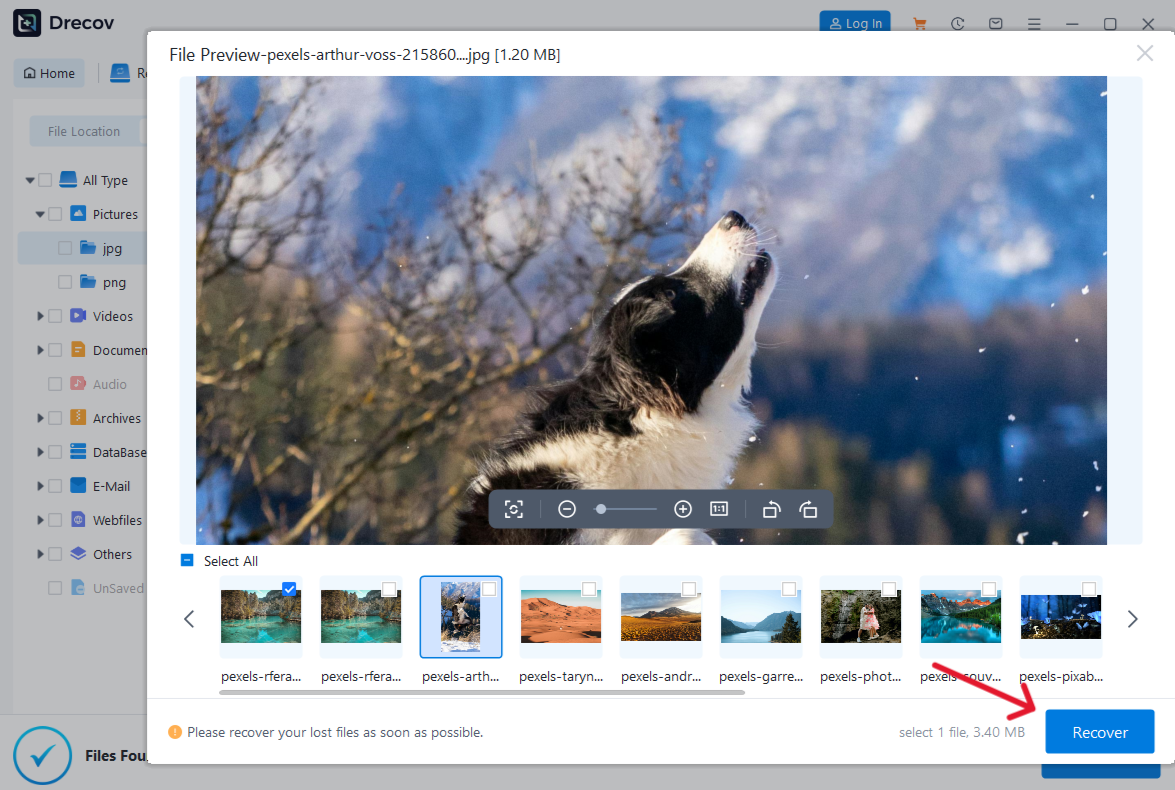
Step 4: Filter and preview files relevant to a Canon memory-card loss
Filter by file type, filename, former path, size, or date where those details are available. Preview several examples of JPEG, RAW, and video files from the affected shoot. A successful preview of JPEG, RAW, and video files from the affected shoot shows that a sample can be decoded; it does not certify every page, frame, linked item, or archive member.
Step 5: Recover to a healthy destination and verify the result
Recover selected items to the prepared healthy device, never to the Canon camera card. If JPEG, RAW, and video files from the affected shoot are not where expected, check the Drecov folder or Recovery folder. Open samples, compare expected sizes and dates, and leave the Canon camera card unchanged until the important results are verified. Only then consider formatting the card in camera or returning it to service.
⚠ Warning: Install it on a drive different from the one where your data was lost to prevent overwriting.
Questions About Canon Photo Recovery
Can I keep shooting after deleting photos?
No. New captures may overwrite the card space that still contains deleted image data.
Should I format when the camera asks?
Not before needed files are recovered. Formatting changes the card’s file-system structures.
Is the SD lock tab enough?
It helps prevent ordinary writes in compliant readers, but it cannot stabilize damaged media.
Why does a recovered photo show only a thumbnail?
The preview may survive while full-resolution image data is missing or overwritten.
Can I reuse the card afterward?
Only after two verified copies exist; retire it if errors, wrong capacity, or disconnects recur.
Conclusion
File recovery cannot repair a cracked card, failed controller, or overwritten image. It also cannot guarantee that a partially recovered RAW file is complete. Future protection requires two copies after every shoot, a safe-eject habit, and card retirement after recurring errors. For a Canon memory-card loss, the safest plan protects JPEG, RAW, and video files from the affected shoot first, verifies each result, and changes only the layer identified by the evidence.
⚠ Warning: Install it on a drive different from the one where your data was lost to prevent overwriting.





