







A BCK file restore should begin with identification, not renaming. The .bck extension has been used by more than one application and platform, so no universal “BCK opener” can safely restore every example. Preserve the original file, note where it came from, and look for the program, catalog, logs, or device that created it. If the BCK file was deleted rather than merely unreadable, stop writing to its original disk before trying data recovery.
bck file restore: safe diagnosis
A filename extension is a convention that helps an operating system choose an application. It is not a complete specification. One program may use BCK for a packaged backup, another for an image, and an older system for a backup save set. Even when two files share the extension, their internal headers, catalogs, compression, encryption, and restore procedures can be unrelated.
One documented use is the OpenVMS BACKUP ecosystem. The historical VMS Backup Utility manual shows why source context matters: a backup set belongs to a specific utility and command workflow. That does not prove that an arbitrary Windows BCK file is an OpenVMS backup. It simply demonstrates that BCK has no safe one-format assumption.
Do not change the extension to ZIP, BAK, BKF, or another familiar suffix and treat an error message as a diagnosis. Renaming changes only the label. It neither converts the contents nor supplies a missing catalog. An archive tool opening a few bytes also does not prove that it can restore the application data correctly.
Collect Provenance Before Touching the File
Start with the original path and neighboring files
The parent folder often gives the strongest clue. Look for product names, project folders, dated backup directories, manifests, index files, and logs created at the same time. Record filenames and timestamps before moving anything. Some backup jobs split data across numbered segments; opening one segment alone will fail even when the set is healthy.
Check the computer or device that created it
Review installed applications, old shortcuts, scheduled tasks, service names, and documentation. If the file came from industrial equipment, accounting software, a server, or a legacy workstation, the restore program may be vendor-specific. Preserve the program version and license information. A newer release may import the format, but that should be confirmed in the vendor’s documentation.
Record size, date, and header without editing
A zero-byte BCK contains no backup payload. A file whose size matches the capacity of an old disk may be an image, while a small file may be a catalog or configuration backup. Those are clues, not conclusions. Advanced users can inspect a copy with a hex viewer or file-identification utility, but should never save changes to the original.
Ask whether encryption or a password was used
Keep passwords, keys, and recovery notes with appropriate security. Recovery software can retrieve a deleted encrypted container, but it cannot remove legitimate encryption. If the creating application used media catalogs or key files, preserve them beside the container.
Restore a Known BCK File Through Its Source Application
Once you identify the creating product, make a working copy of the BCK file and any companion files. Install or open the correct application on a compatible system. Prefer an import, catalog, or restore command documented for that product rather than double-clicking the file. Point the application at the copy, not the sole original.
Choose an alternate restore destination whenever possible. Restoring over a current database, project, or configuration can replace newer data before you know what the backup contains. For an application-level backup, use a test profile, isolated virtual machine, or spare folder. For a disk image, confirm the target identity and capacity because image restoration can overwrite an entire disk.
After the restore, validate the result in the application that owns the data. Open records from different dates, verify attachments, check relationships, and compare expected counts. A job completion message confirms that a process ended; it does not prove that the restored content is complete or belongs to the correct backup point.
Keep a second verified copy on different media. The external-drive backup plan helps prevent the recovered container from becoming another single point of failure.
If you discover that the file is actually a common archive or database backup with the wrong extension, preserve the BCK original and work on a duplicate. The broader archive-opening guidance is relevant only after the internal format is confirmed.
Separate an Unrecognized Backup From a Deleted Backup
An existing BCK file that the source program rejects may be incomplete, from a different version, missing segments, encrypted, or corrupted. File recovery does not repair its internal structure. Search for another copy in the backup destination, cloud version history, removable media, previous versions, and old machines. Compare hashes or sizes when multiple copies exist.
A deleted BCK file presents a different problem. If it was removed from a local disk, external drive, USB device, SD card, or memory card, its storage space may remain recoverable until overwritten. Stop using that device. Do not download a recovery tool to the same partition, create a new backup there, defragment it, or run repair commands before the needed file is safe.
This check is especially useful for bck file restore. For SSDs, TRIM may reduce recovery prospects after deletion, but the outcome depends on the device and events after deletion. Avoid absolute promises. Check the Recycle Bin, backup repository, cloud trash, and storage snapshots first because those routes preserve names and folder structure better than a raw scan.
Recover a Lost BCK Container With Drecov
Drecov is Windows data recovery software for logical loss from PCs, hard drives, SSDs, external drives, USB devices, SD cards, and memory cards. It supports documents, archives, photos, videos, emails, and audio through a read-only recovery workflow with Quick Scan, Deep Scan, filters, preview, and recovery to another healthy destination. Lost Partition Recovery can search for data from a missing partition. Drecov can retrieve candidate BCK files, but it does not interpret every proprietary BCK format, rebuild a broken backup chain, defeat encryption, or repair physical media.
⚠ Warning: Install it on a drive different from the one where your data was lost to prevent overwriting.
Step 1: Open Drecov and select the original location
Prepare a healthy destination with enough space. Install and run Drecov somewhere other than the volume that held the BCK file. Select the original folder’s volume or the appropriate removable device. If the whole partition vanished, use Lost Partition Recovery instead of recreating or formatting it.

Step 2: Run Quick Scan and search for the known clues
Start Quick Scan. Search for the original filename and BCK extension, then compare former path, date, and size. Also locate companion catalogs, logs, and numbered segments. The practical Windows undelete workflow explains why early source protection matters.

Step 3: Use Deep Scan only on stable storage
If Quick Scan does not find the backup and the device stays connected without serious read errors, run Deep Scan. Stop if the source clicks, disconnects, reports changing capacity, or becomes unusually slow. An unstable device should be imaged with suitable tools or handled by a specialist instead of repeatedly scanned.
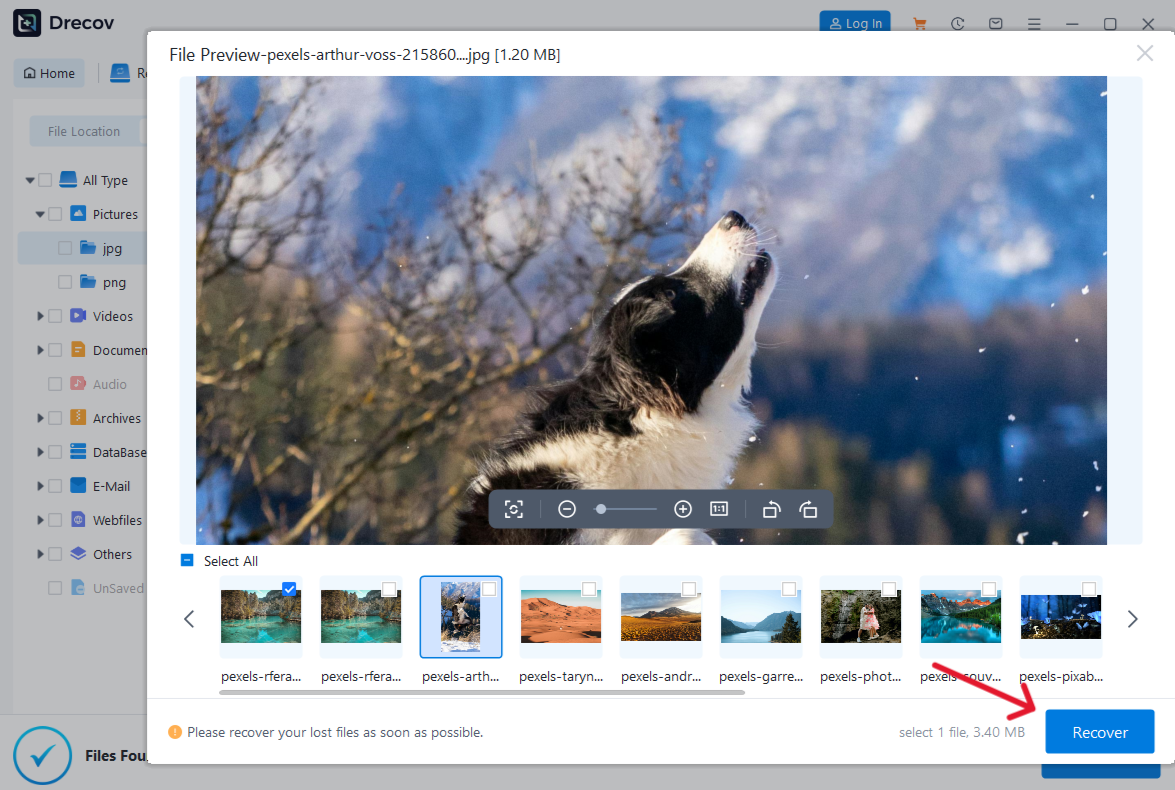
Step 4: Filter and assess candidates
Filter by name, extension, former path, date, and size where available. A proprietary BCK file may not support preview. In that case, recovery produces candidates for later validation; it does not certify them. Select all plausible chain members rather than only the largest file.
Step 5: Recover to another healthy device
Save the candidates to the prepared destination, never the source. Check the Drecov Folder or Recovery Folder if the results are not where expected. Keep separate folders for alternative versions so identical names do not overwrite each other.
⚠ Warning: Install it on a drive different from the one where your data was lost to prevent overwriting.
Step 6: Verify with the creating application
Work on copies. Import or restore the candidate in the source application, confirm the backup date, and test representative content. Only after verification should you repair, reformat, or return the source drive to service. The Drecov homepage provides the product entry point.
Questions That Prevent the Most Common Mistakes
Can I open every BCK file with one program?
No. The extension is ambiguous. Identify the creating software and platform first.
Will changing BCK to ZIP restore it?
No. Renaming does not convert data. It may only cause a different application to attempt an incompatible interpretation.
What if the source application is obsolete?
Preserve the files and seek the vendor’s migration guidance. A compatible legacy environment or official conversion step may be required.
Can Drecov repair a corrupt BCK container?
Drecov recovers lost file candidates. It does not guarantee repair of a proprietary container or a missing backup chain.
Should I restore over the current application data?
Not for the first test. Restore to an alternate folder or isolated environment, inspect the result, and keep the current data reversible.
Conclusion
A reliable BCK file restore depends on knowing who created the file, which version produced it, what companion data belongs with it, and where the restored output will go. Preserve the original and test a duplicate through the proper application. If the container itself was deleted, Drecov can search a stable source and recover candidates elsewhere. Identification and validation—not a convenient extension guess—turn a BCK file into a usable backup.
⚠ Warning: Install it on a drive different from the one where your data was lost to prevent overwriting.





