







Data loss can strike suddenly, leaving critical work documents, family photo collections, or essential business records completely inaccessible. Whether caused by accidental deletion, system crashes, partition corruption, or hardware wear, learning how to recover hard disk drive storage is a vital skill for every computer user. Sudden drive failures create immense stress, yet lost files often remain intact on the physical storage platters until new information overwrites them. Understanding proper retrieval techniques allows you to restore your valuable data without risking permanent corruption.
When file system pointers break or partitions turn RAW, specialized software tools become necessary. Among modern recovery tools, PandaOffice Drecov offers a powerful, user-friendly solution designed to address complex data loss scenarios. This comprehensive guide explores the fundamentals of drive recovery, provides step-by-step instructions for PandaOffice Drecov, compares complementary methods, and shares actionable best practices to maximize recovery success.
Understanding the Basics of Recover Hard Disk Drive Processes
Core Concepts of Disk Storage and File Deletion
To successfully recover hard disk drive files, it helps to understand how traditional magnetic drives organize information. Hard disk drives write data across spinning magnetic platters divided into tracks and sectors. File systems like NTFS or FAT32 maintain a master index—such as the Master File Table—that tracks the exact physical cluster address of every file.
When you delete a file or format a drive volume, the operating system does not instantly wipe the raw binary bits from the drive platters. Instead, it alters the file system index, marking the corresponding storage clusters as available space. Until new files write over those precise physical sectors, the original binary data remains completely intact. Data recovery software works by scanning these unallocated clusters directly, reassembling file fragments back into accessible data.
Common Mechanical and Logical Failures
Hard disk failures fall into two primary categories:
- Logical Failures: The drive hardware remains physically healthy, but corruption renders the structure unreadable. Common logical issues include file system corruption, accidental formatting, partition loss, virus attacks, and system crash blue screens. Logical data loss can almost always be solved using dedicated recovery software.
- Physical Failures: The mechanical or electrical components suffer physical damage. Examples include failing head assemblies, seized platter bearings, fried printed circuit boards, or physical impact damage. Physical failures often manifest as clicking sounds or complete failure to spin up. Physical damage requires specialized cleanroom hardware repairs rather than software recovery.
Introduction to PandaOffice Drecov
PandaOffice Drecov is a professional-grade software solution built specifically to recover hard disk drive data across various logical failure scenarios. Powered by deep-sector scanning algorithms, Drecov bypasses broken operating system drivers to read file signatures directly from raw storage blocks.
⚠ Warning: Install it on a drive different from the one where your data was lost to prevent overwriting.
Key technical features of PandaOffice Drecov include:
- Support for file systems including NTFS, FAT16, FAT32, exFAT, ReFS, ext2, ext3, ext4, and APFS.
- Deep raw-scan capabilities capable of identifying over 1,000 distinct file signatures.
- Non-destructive, read-only scanning operations that prevent target drive overwriting.
- Built-in file preview capabilities for image, document, video, and audio formats before final extraction.
- Bootable environment creation for recovering non-bootable Windows systems.
Common Scenarios for PandaOffice Drecov
PandaOffice Drecov handles a wide array of personal and enterprise recovery needs:
- Accidental Shift-Delete Operations: Restoring files permanently removed without passing through the Recycle Bin.
- Formatted Partition Recovery: Retrieving data from volumes formatted during OS reinstallations or drive setup.
- RAW Drive System Errors: Extracting files from drives that report raw status or require formatting before use, such as those suffering from IRQL_NOT_LESS_OR_EQUAL Windows system crashes.
- Corrupted Flash and External Media: Fixing flash storage converted into unusable structures, including ESD-USB drives formatted mistakenly by Windows media creation tools.
- Unbootable System Disk Crashing: Accessing internal hard drives when experiencing system errors like no boot disk detected on startup.
Solutions to Recover Hard Disk Drive Issues
Recovering lost files requires a structured, step-by-step approach. Below are two reliable recovery solutions: Windows native utilities for minor file losses, followed by PandaOffice Drecov for complete, deep-level partition and raw file recovery.
Solution 1: Native Command-Line Recovery via Windows File Recovery
Windows 10 and 11 feature a command-line utility called Windows File Recovery, available through the Microsoft Store. This utility helps restore recently deleted files on NTFS, FAT, and exFAT file systems.
Step 1: Install and Launch the Utility
Open the Microsoft Store, search for Windows File Recovery, and install the application. Press Win + S, type Windows File Recovery, and select Run as administrator.
Step 2: Identify File Systems and Drive Letters
Open File Explorer using Win + E, right-click your source drive, select Properties, and note the file system type. Choose a separate destination drive with enough free space to store your recovered files.
Step 3: Execute the Recovery Command
In the Command Prompt window, enter the recovery command based on your file system and situation. For an NTFS drive recovering recently deleted documents from drive C: to destination drive E:, execute:
winfr C: E: /regular /n \Users\Username\Documents\
For formatted or corrupted drives, use Extensive mode:
winfr C: E: /extensive /n *.pdf /n *.docx
Step 4: Verify Extracted Data
Confirm the recovery prompt by pressing Y. Once complete, open destination drive E: to inspect the automatically generated recovery folder.
Solution 2: Complete GUI Recovery Using PandaOffice Drecov
When file systems are severely corrupted, partitions disappear, or native command-line utilities fail, PandaOffice Drecov provides an automated graphic recovery environment.
⚠ Warning: Install it on a drive different from the one where your data was lost to prevent overwriting.
Step 1: Select the Target Location
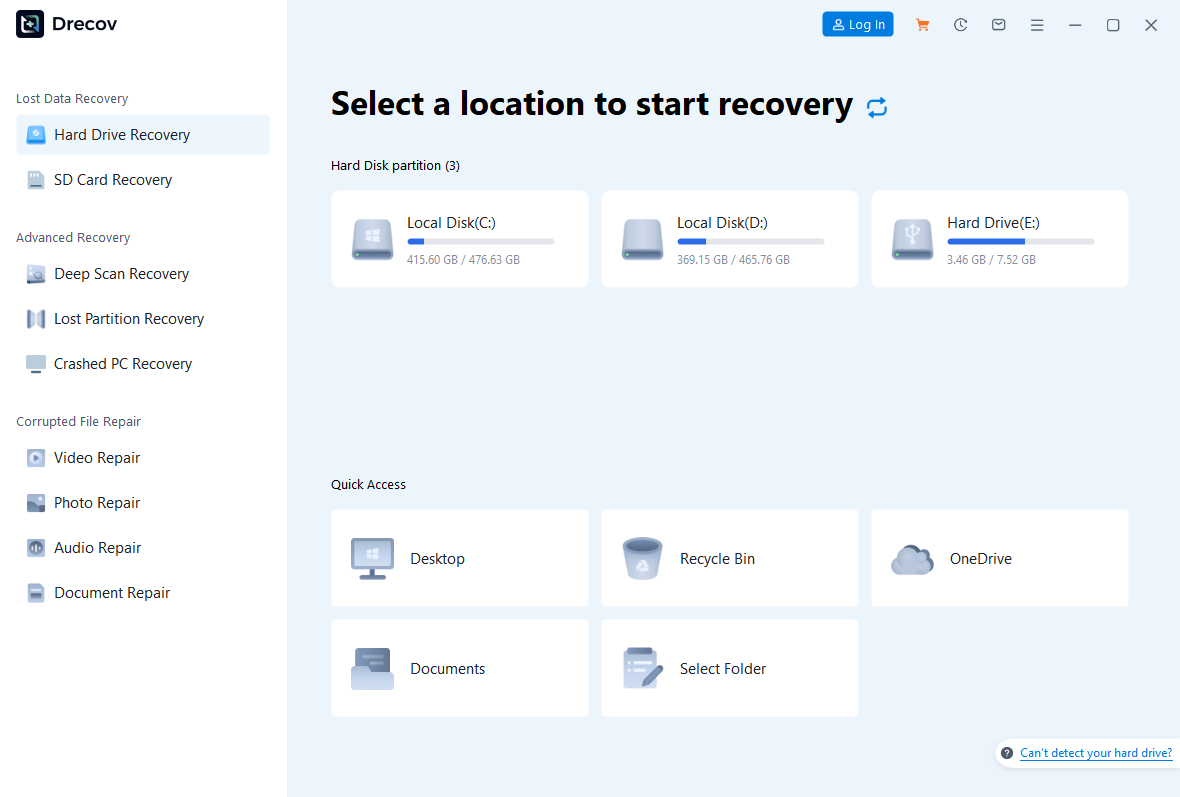
Launch PandaOffice Drecov using administrative privileges. The main dashboard displays all connected storage devices, including internal hard disk drives, external USB drives, and unallocated disk space. Select the partition or raw drive where data loss occurred, then click Scan.
Step 2: Run Quick and Deep Scans
PandaOffice Drecov initiates a two-stage scanning process:
- Quick Scan: Quickly analyzes the Master File Table and file system indexes to locate recently deleted files with intact directory structures.
- Deep Scan: Searches sector-by-sector to match file signatures directly from raw disk blocks. Deep scanning ensures maximum file retrieval even after formatting or severe file system damage.
Use built-in filter controls to narrow down scan results by file type, creation date, or file size. Press Ctrl + F inside the interface to open the file search bar.

Step 3: Preview and Recover Target Files
Double-click any discovered file to open the built-in preview pane. Drecov supports real-time previews for image formats, Office documents, PDFs, and video streams, letting you verify file integrity before performing a full extraction.
Select the checkboxes next to your target files, then click Recover. Choose a safe output location on a separate storage drive or external storage media. Click Save to begin data extraction.
Alternative or Complementary Methods to Recover Hard Disk Drive Files
While dedicated software like PandaOffice Drecov addresses most logical data loss scenarios, alternative approaches can help depending on the cause of the failure.
| Method | Target Scenario | Pros | Cons |
| PandaOffice Drecov | Formatted drives, deleted files, RAW file systems, corrupted partitions | High recovery rate, intuitive GUI, deep signature scanning, preview feature | Paid license required for unlimited bulk extraction |
| Windows File Recovery | Recent deletions on healthy NTFS/FAT drives | Free native utility, no third-party software needed | Command-line interface only, lower success on formatted drives |
| CHKDSK Disk Utility | File system structural bugs, bad sector file links | Built into Windows, fixes file system cross-links | Can overwrite orphan files during repairs if used incorrectly |
| Linux Live USB Environment | Unbootable Windows system partition | Bypasses Windows file locks, free open-source solution | Requires technical command-line knowledge |
| Professional Cleanroom Services | Physical head crashes, motor failure, physical impact | Can recover data from physically destroyed hardware | High cost, long turnaround time |
Command-Line File System Repair: CHKDSK
When a hard disk volume displays file system errors, the native Windows CHKDSK utility can repair underlying structure issues. Open Command Prompt as Administrator and execute:
chkdsk X: /f /r
Replace X: with your target drive letter. The /f parameter repairs file system errors, while /r locates bad physical sectors and recovers readable information.
Warning: Running
chkdsk /f /ron a physically failing hard drive can cause further mechanical wear. Always attempt data extraction using PandaOffice Drecov prior to running repair commands.
Cleanroom Hardware Recovery
For physical hardware damage, software solutions cannot restore access. Professional recovery laboratories open damaged drives inside ISO-certified cleanrooms, replacing failed magnetic heads or swapping printed circuit boards. While expensive, cleanroom service is the only reliable way to recover hard disk drive data from physical mechanical crashes.
Tips and Best Practices to Recover Hard Disk Drive Storage
Optimizing Data Recovery Success Rates
- Stop Using the Affected Drive Immediately: Avoid creating new documents, browsing the web, or downloading files on the affected drive, as system cache writes can overwrite lost data.
- Connect Drives directly via SATA or Native USB 3.0: When recovering from an internal drive, connect it directly via SATA or a high-speed USB 3.0 adapter rather than low-power USB hubs.
- Clone Suspect Drives Before Recovery: Create a sector-by-sector image of unstable hard disk drives using raw disk imaging, then run recovery scans on the image file.
Maintaining Long-Term Data Integrity
- Implement the 3-2-1 Backup Strategy: Maintain at least 3 copies of your critical data across 2 different storage media types, with 1 copy kept off-site or in cloud storage.
- Monitor S.M.A.R.T. Health Status: Regularly check hard disk drive parameters using diagnostic tools to spot early signs of drive failure, such as reallocated sector counts.
- Safely Eject External Storage: Always use the Safely Remove Hardware option before disconnecting external hard disk drives to prevent directory index corruption.
Frequently Asked Questions
Can I recover hard disk drive files after full formatting?
Yes. Quick formatting cleans the file system index while leaving the actual data on disk blocks intact. Software tools like PandaOffice Drecov perform deep-sector signature scans to locate and restore raw files. However, if a full format was performed in Windows 10 or 11, zero-filling may overwrite the storage blocks, making recovery impossible.
Is it safe to install PandaOffice Drecov on the same drive containing lost data?
No. Installing any software writes new files to the storage drive, which can permanently overwrite the deleted clusters you are trying to restore. Always download and install PandaOffice Drecov on a separate partition or healthy secondary drive.
What should I do if my external hard disk drive prompts me to format it before use?
Do not format the drive. A prompt to format usually indicates that the file system structure has turned RAW. Cancel the format prompt and launch PandaOffice Drecov to scan the RAW drive directly, safely extracting your files without wiping the disk.
How long does a deep sector scan take on a large hard disk drive?
Scan times depend on drive capacity, connection interface speed, and physical drive health. A deep sector scan on a healthy 1TB hard disk drive connected via USB 3.0 or native SATA typically takes between 1.5 and 3 hours. Drives with bad physical sectors may take longer as the scanner retries damaged areas.
What is the difference between logical data recovery and physical data recovery?
Logical data recovery fixes software-level issues like deleted files, corrupted file systems, or formatted volumes using software like PandaOffice Drecov. Physical data recovery repairs broken mechanical or electrical hardware, such as damaged read heads or failed spindle motors, inside specialized cleanrooms. Official guidelines on hardware diagnostics and operating system recovery procedures can be reviewed in detail through Microsoft Windows File Recovery Documentation.
Conclusion
Losing critical files due to sudden drive failures or accidental deletion can disrupt work and cause significant stress. However, as long as new information has not overwritten the original storage sectors, lost files remain retrievable. Understanding how file systems manage deleted data allows you to act quickly and safely when data loss occurs.
PandaOffice Drecov provides an efficient, accessible solution for handling logical hard drive issues. Its combination of quick file system indexing and deep raw-sector scanning makes it ideal for recovering deleted files, formatted partitions, and corrupted RAW storage volumes.
⚠ Warning: Install it on a drive different from the one where your data was lost to prevent overwriting.






