







If your Firefox browser acts strangely, websites fail to load, or you are suddenly logged out of accounts, corrupted cookies are likely the culprit. Learning how to clear cookies in Firefox is one of the simplest ways to improve browser performance, protect digital privacy, and troubleshoot common website errors.
Cookies are small text files websites leave inside your browser to remember login details and preferences. However, others track your activity across the internet. Periodically clearing cookies removes outdated data and forces Firefox to establish fresh connections, instantly fixing compatibility problems.
Understanding Cookies in Firefox
What Are Browser Cookies?
Cookies are small text files placed on your device by websites to remember your visit data. They store essential information like login sessions, shopping carts, and site preferences so platforms do not treat you as a stranger on every page refresh. Firefox saves these locally as either direct first-party cookies or ad-tracking third-party cookies. While harmless and necessary for modern web functionality, cookies can cause performance issues if they become bloated or outdated. Periodically clearing them serves as a necessary deep cleaning session for your browser.
Why Websites Store Cookies
Websites use cookies to maximize user convenience and streamline site functionality. By storing session data quietly in the background, they prevent you from constantly re-entering passwords or resetting preferences. However, advertisers also exploit them to track your cross-site activity and serve targeted ads. Over time, accumulating older cookies can cause system corruption, broken login loops, or severe layout glitches after a website updates its code. Clearing these outdated files forces fresh database connections, instantly resolving frustrating browsing glitches without complex troubleshooting.
Why You Should Clear Cookies in Firefox
Fixing Website Errors: Corrupted or outdated cookies frequently interfere with website communication, triggering endless redirect loops or broken layouts. Mastering how to clear cookies in firefox forces the browser to download fresh website data, serving as an effective troubleshooting step.
Privacy and Security: Modern tracking cookies collect browsing data to build consumer profiles. Manually executing instructions on how to clear cookies in firefox adds a layer of protection by removing existing tracking identifiers saved on your device. It also minimizes security risks on shared or public computers.
How to Clear All Cookies in Firefox
Step-by-Step Method for Desktop
Clearing all cookies in Firefox is straightforward once you know where to look. Mozilla recently refined the Privacy & Security menu, making cookie controls easier to access. According to Mozilla’s official support documentation, users can remove all cookies and cached site data directly from the browser settings.
Clearing Cookies Through Privacy Settings
Follow these steps carefully to implement how to clear cookies in firefox:
- Step 1: Open the Firefox browser on your desktop computer.
- Step 2: Click the three horizontal menu lines located in the top-right corner.
- Step 3: Select Settings from the drop-down options list.
- Step 4: Click Privacy & Security on the left-side navigation sidebar.
- Step 5: Scroll down until you encounter the Cookies and Site Data section.
- Step 6: Click the Clear Data… button to open the configuration box.
- Step 7: Ensure that Cookies and Site Data is fully checked.
- Step 8: Click the Clear button to execute the command immediately.
Once completed, Firefox removes stored cookies, site preferences, and some temporary website information. You will likely be logged out of websites afterward, which surprises many users the first time they execute how to clear cookies in firefox steps. That is completely normal because login sessions are stored inside cookie files.
Quick Shortcut Method
If you prefer faster access, Firefox includes native keyboard shortcuts for clearing browsing data. This provides a direct path for how to clear cookies in firefox without mouse clicking.
Press the following key combination simultaneously:
Ctrl + Shift + Delete (Windows/Linux) or Cmd + Shift + Delete (macOS)
This hotkey action instantly opens the Clear Recent History window. From there, you can easily adjust the time range dropdown and select Cookies from the checkbox selection grid. This method is particularly useful for power users who frequently troubleshoot websites or prioritize privacy.
How to Clear Cookies for One Website Only
Removing Site-Specific Cookies
Sometimes you do not want to wipe every cookie from Firefox. Maybe one website is malfunctioning while everything else works perfectly. In that situation, deleting cookies for a single site is the smarter move. It targets the problem area while preserving your active login sessions elsewhere.
Mozilla’s latest Firefox versions support site-specific cookie deletion directly inside Privacy & Security settings. Here is the operational breakdown for this process:
- Step 1: Open Firefox Settings by clicking the menu icon.
- Step 2: Navigate to the Privacy & Security side panel option.
- Step 3: Find the Cookies and Site Data sub-section on the page.
- Step 4: Click the Manage Data… button to launch the site registry.
- Step 5: Search for the specific website name using the input field.
- Step 6: Select the target domain from the populated search list.
- Step 7: Click Remove Selected to wipe that specific data partition.
- Step 8: Click Save Changes and confirm by clicking Remove.
When Selective Cookie Deletion Is Better
Selective cookie removal works best when you experience isolated problems. For example, maybe YouTube keeps buffering strangely, or a shopping site refuses to update your cart properly. Removing cookies only for that domain refreshes the site without forcing you to log back into dozens of unrelated services.
This approach also minimizes daily browsing inconvenience. Clearing all cookies may sign you out of banking apps, email accounts, productivity tools, and social platforms simultaneously. Selective deletion avoids that headache while still solving targeted problems.
Interestingly, recent browser updates introduced occasional bugs affecting site-specific clearing options. Some power users reported that the “Clear Cookies and Site Data” option appeared grayed out for certain websites under complex container configurations. Mozilla developers quickly addressed these edge cases to ensure that applying how to clear cookies in firefox remained completely reliable across all web environments.
How to Automatically Delete Cookies in Firefox
Enable Automatic Cookie Clearing
Firefox allows users to automatically delete cookies every time the browser closes. This is one of the best privacy features available for people who want a cleaner browsing footprint without remembering to clear data manually. It streamlines how to clear cookies in firefox by turning it into a background system function.
To enable automatic deletion, apply these steps:
- Step 1: Open the Firefox Settings menu interface.
- Step 2: Navigate to the Privacy & Security control sheet.
- Step 3: Scroll down until you reach the History options category.
- Step 4: Select Use custom settings for history from the dropdown menu.
- Step 5: Check the box next to Clear history when Firefox closes.
- Step 6: Click the adjacent Settings… button to open parameters.
- Step 7: Ensure that the checkbox for Cookies is actively checked.
- Step 8: Click OK to save your automatic deletion rules.
Setting Website Exceptions
Firefox also supports cookie exceptions. This means you can automatically delete most cookies while keeping trusted websites logged in. For example, you may want your webmail service and your banking site preserved while everything else gets wiped.
Mozilla’s Manage Exceptions… tool lets you whitelist specific domains easily:
- Step 1: Head to the Cookies and Site Data section in Settings.
- Step 2: Click on the Manage Exceptions… button.
- Step 3: Type the exact web address of the site you want to protect.
- Step 4: Click Allow to save its cookies permanently across sessions.
- Step 5: Click Save Changes to commit your rule adjustments.
Firefox Cookie Settings Explained
Standard Protection Mode
By default, Firefox implements Standard Enhanced Tracking Protection. This mode is carefully balanced to block trackers without breaking normal website layouts or features. It blocks social media trackers, cross-site tracking cookies, and cryptominers automatically in the background.
Standard protection ensures that you do not need to constantly research how to clear cookies in firefox just to avoid basic ad targeting. It manages the most invasive third-party elements while letting first-party data function normally. This means your login states and shopping baskets remain stable as you jump between internal web links.
However, standard protection does not stop a website from profiling you based on its own first-party data over extended periods. If you notice a site showing you highly specific ads based on your historical behavior on that exact domain, first-party cookie build-up is responsible. Wiping those files via manual how to clear cookies in firefox steps is the only way to reset that localized profile.
Strict Protection Mode
For users who want maximum security, Firefox provides a Strict Protection Mode. This setting blocks known tracking mechanisms across all browser windows, including cross-site cookies and advanced digital fingerprinting scripts.
To enable Strict mode:
- Step 1: Go to the Privacy & Security settings tab.
- Step 2: Locate the Enhanced Tracking Protection choices at the top.
- Step 3: Switch the selection bullet from Standard to Strict.
- Step 4: Click the Reload All Tabs prompt that appears to apply changes.
Method 2: System Optimization Tools and PandaOffice Drecov Data Recovery Software
When managing browser data, files sometimes get misplaced, corrupted, or accidentally wiped during automated system cleaning. If you clear cookies or browser assets too aggressively, you might accidentally delete important local profile folders or configuration records.
Introducing PandaOffice Drecov Data Recovery Software
If a system error or an over-aggressive cleaning routine deletes your underlying browser databases, you can turn to professional data recovery utility kits. The premier solution for restoring lost system paths, database files, and missing browser profiles is PandaOffice Drecov data recovery software.
This software features raw sector scanning algorithms that reconstruct fragmented storage blocks. If your local storage architecture becomes corrupted after a severe browser freeze, or if you accidentally format a partition containing your application profiles, this utility retrieves the records seamlessly.
⚠ Warning: Install it on a drive different from the one where your data was lost to prevent overwriting.
For instance, if your browser configurations vanish unexpectedly, you can quickly find out where are firefox bookmarks stored on your pc by running a file path diagnostic scan. Similarly, if you utilize multiple platforms, this program can help you learn how to get your google chrome bookmarks back with minimal administrative effort.
Step-by-Step Guide to Restoring Configuration Data
If an improper attempt to clean files results in severe application data loss, follow these operational steps to safely restore your data directory using PandaOffice Drecov data recovery software:
- Step 1: Select the primary system drive (typically the
C:partition) for inspection. Then, click the Scan button to begin the deep data mapping sequence.

- Step 2: Filter the results by typing application directory keywords like
MozillaorFirefox. Mark the missing database files or configuration folders from the parsed list.
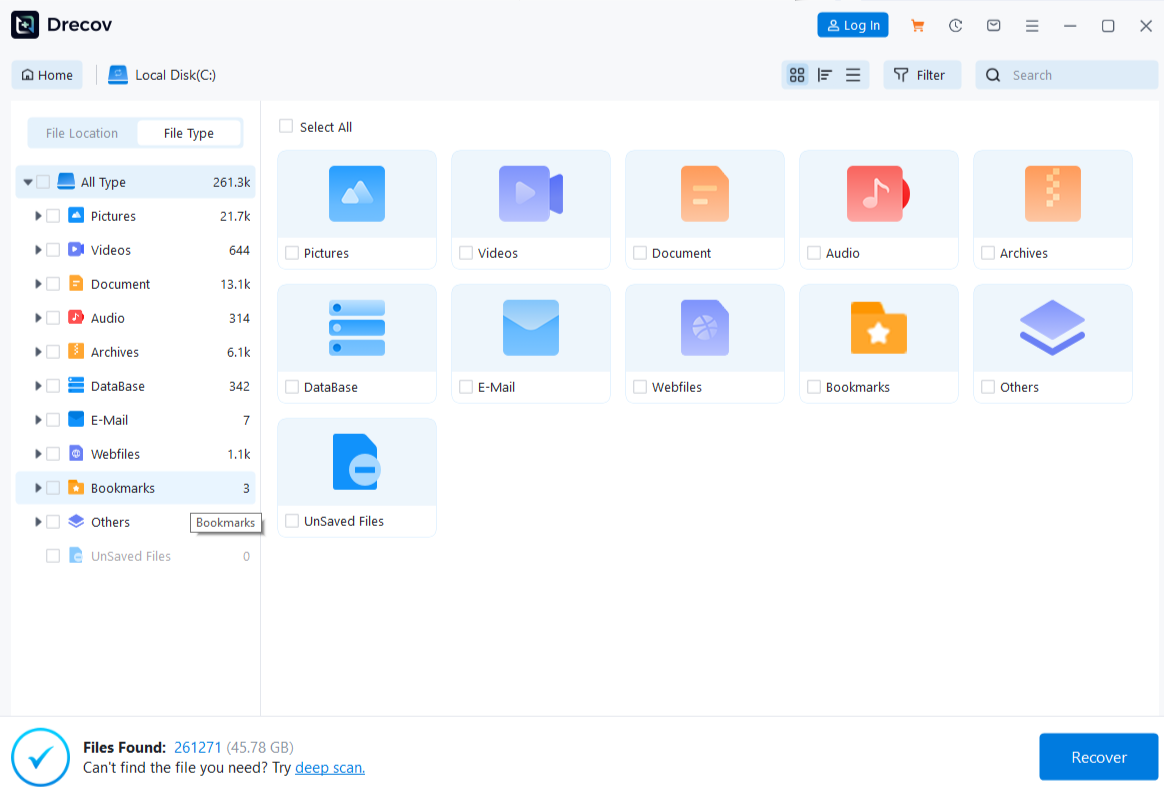
- Step 3: Click the Recover action button. Save the recovered application data files securely onto an independent storage drive.
[Warning] Never download or install data recovery applications onto the exact storage drive partition that suffered the file loss. Doing so will overwrite the delicate, unindexed file fragments remaining on the sectors, causing permanent data destruction.
Method 3: Advanced Manual Profile and Database Modification
For system administrators and advanced users, clearing cookie data can be performed directly within the operating system backend. Firefox stores all user data, including cookies, inside a SQLite database file located within your local profile directory. Wiping this file manually or using the terminal is the most absolute way to clear data without opening the graphical interface.
Manually Deleting the Cookies SQLite Database File
This advanced method completely bypasses the browser settings UI. It is highly effective for automated deployment scripts or fixing broken installations that refuse to open.
- Step 1: Ensure that Mozilla Firefox is fully closed and no background processes are running in Task Manager.
- Step 2: Press the
Win + Rkeys on your keyboard to launch the native Windows Run dialog block. - Step 3: Type
%appdata%\Mozilla\Firefox\Profiles\into the input field and hit Enter. - Step 4: Open the default profile folder, which typically contains a string ending in
.defaultor.default-release. - Step 5: Locate the specific file named
cookies.sqlitewithin the root directory list. - Step 6: Right-click the
cookies.sqlitefile and choose Delete (or pressShift + Deletefor permanent removal).
When Firefox reboots, it detects the missing database file. It then automatically generates a brand-new, completely empty cookies.sqlite container. This advanced approach forcefully resolves deeply embedded database corruption bugs instantly.
Clearing Cookies via Command Line or Terminal Shells
If you work in a Linux environment or prefer executing commands via Windows PowerShell, you can clear the cookie database file using terminal strings.
For Windows PowerShell Administrators:
- Step 1: Right-click the Windows Start menu button and select PowerShell (Admin).
- Step 2: Terminate active browser processes by typing:
Stop-Process -Name "firefox" -Forceand pressing Enter. - Step 3: Navigate to the local profile folder using your administration path keys.
- Step 4: Execute the deletion string:
Remove-Item "$env:USERPROFILE\AppData\Roaming\Mozilla\Firefox\Profiles\*\cookies.sqlite" -Force.
For macOS and Linux Terminal Users:
- Step 1: Open the native Terminal application utility.
- Step 2: Shut down any invisible running browser sessions using the string:
pkill firefox. - Step 3: Enter the target profile directory by executing:
cd ~/Library/Application\ Support/Firefox/Profiles/(on macOS) orcd ~/.mozilla/firefox/(on Linux). - Step 4: Remove the database file directly by typing:
rm */cookies.sqliteand hitting the Enter key.
Using these command-line protocols allows you to clear cookies across dozens of workstation profiles simultaneously via network scripts. It represents the highest technical tier of browser profile maintenance.
How to Clear Cookies on Firefox Mobile
Firefox for Android
Mobile devices accumulate substantial cookie data over extended browsing periods. Clearing this data on Android takes only a few simple taps within the application configuration menu.
- Step 1: Open the Firefox application on your Android smartphone or tablet.
- Step 2: Tap the three vertical dots icon located in the bottom-right or top-right corner.
- Step 3: Select Settings from the pop-up options window.
- Step 4: Scroll down to the Privacy and Security section and select Delete browsing data.
- Step 5: Ensure that the checkbox for Cookies is selected.
- Step 6: Tap the prominent Delete browsing data button at the bottom.
- Step 7: Confirm the action by tapping Delete in the pop-up warning box.
Once confirmed, your mobile browser memory is instantly refreshed. This frees up local system storage blocks and removes persistent mobile tracking cookies.
Firefox for iPhone and iPad
Apple iOS handles browser data parameters within a slightly different layout structure. Follow these precise steps to clear your cookies on an iPhone or iPad:
- Step 1: Launch the Firefox app on your iOS mobile device.
- Step 2: Tap the three horizontal lines menu icon located in the bottom-right corner of the screen panel.
- Step 3: Select Settings from the primary menu tray.
- Step 4: Scroll down to the Privacy heading and tap Data Management.
- Step 5: Toggle the selection slider switch for Cookies to the active position.
- Step 6: Tap the red Clear Private Data bar located at the bottom of the interface.
- Step 7: Confirm the final prompt box by tapping OK to finish the process.
Performing this quick cleanup keeps your mobile iOS browsing fast and prevents websites from tracking your handheld device across networks.
Common Problems After Clearing Cookies
Logged-Out Accounts
The most immediate effect of clearing your cookies is that you will be instantly logged out of almost every website. This happens because cookies store your active login validation data. When you delete the cookie, the website no longer recognizes your browser session and asks you to enter your credentials again.
To minimize this issue, ensure you know all your passwords before clearing data. Alternatively, you can use the selective deletion method outlined in Method 1 to only target problematic websites while leaving your main accounts undisturbed.
Website Preferences Reset
Many websites use cookies to remember your visual or operational preferences. For example, if you prefer dark mode on a specific forum, or if you adjusted the view columns on a news site, that data is stored in a preference cookie.
Wiping your browser cookies returns these websites to their default factory settings. The next time you visit them, you will have to re-select your preferred language, theme, and region settings.
Best Practices for Managing Cookies in Firefox
Using Private Browsing
If you want to browse websites without constantly accumulating cookie files, use Private Browsing mode. When you open a Private Window, Firefox automatically discards all cookies and temporary session data the moment you close the window.
To open a Private Window instantly, use the keyboard shortcut:
Ctrl + Shift + P (Windows/Linux) or Cmd + Shift + P (macOS)
This method lets you check sites or log into secondary accounts without altering your main browser configuration or saving persistent cookies to your storage drive.
Summary of Cookie Deletion Methods
| Method | Target Audience | Technical Level | Best For |
| Settings UI / Privacy Panel | General Users | Easiest (Beginner) | Routine maintenance and clearing all data quickly. |
Keyboard Shortcut (Ctrl+Shift+Del) | Power Users | Quick (Intermediate) | Fast troubleshooting when a website stops loading. |
| Manage Data / Selective Clearing | All Users | Targeted (Intermediate) | Fixing one broken website without losing other logins. |
| Automatic Clearing on Close | Privacy Enthusiasts | Automated (Advanced) | Hands-free data management and continuous privacy. |
| SQLite Database / File System | IT Administrators | Expert (Most Advanced) | Fixing broken profiles and automated network scripts. |
Conclusion
Learning how to clear cookies in Firefox is an essential skill for optimizing your browser performance, safeguarding your digital privacy, and resolving frustrating website loading errors. If you encounter deeper database issues or accidental data loss, utilizing advanced command-line techniques or tools like PandaOffice Drecov data recovery software can help restore your environment to perfect health. Adjust your settings today to achieve the perfect balance of convenience and security.






