







Bookmarks are essential tools for managing your favorite websites, saving research, and quickly accessing frequently visited pages. However, sometimes you may need to move your bookmarks to a new browser, create a backup, or transfer them to another device. Google Chrome, being one of the most widely used browsers globally, offers a simple yet effective way to export bookmarks. In this article, we will provide a detailed, step-by-step guide on how export bookmarks chrome, along with tips, troubleshooting, and advanced options to make the process seamless.
Why Exporting Chrome Bookmarks Is Important
Before diving into the how-to guide, it’s crucial to understand why learning how export bookmarks chrome can be highly beneficial for your daily digital workflow:
- Data Backup: Unexpected browser crashes or computer issues can result in losing valuable bookmarks. Exporting them ensures a secure backup.
- Switching Browsers: If you decide to switch from Chrome to Firefox, Edge, or another browser, exporting bookmarks allows for an easy transfer.
- Device Transfer: Moving bookmarks from a desktop to a laptop, or from one account to another, is simplified through export.
- Organization and Cleaning: Exporting bookmarks can also help in organizing them externally, allowing you to clean up duplicates or outdated links.
Step-by-Step Guide: How to Export Bookmarks in Chrome
Exporting bookmarks in Chrome is straightforward, and there are multiple methods to achieve it. Below is the most common method using Chrome’s built-in export feature.
Step 1: Open Google Chrome
First, launch the Google Chrome browser on your computer. Ensure it’s updated to the latest version to avoid any compatibility issues with the export function. You can verify the version by clicking the three dots, navigating to Help, and selecting About Google Chrome.
Step 2: Access the Bookmark Manager
Click on the three vertical dots (⋮) in the upper-right corner of the Chrome window. Hover over Bookmarks and lists in the drop-down menu, then select Bookmark manager. Alternatively, use the hotkey Ctrl + Shift + O on Windows or Cmd + Option + B on Mac for instant access.
Step 3: Open the Export Menu
In the Bookmark Manager interface, look for the secondary three-dot icon located at the top-right corner of the blue search bar area (just below the main browser address bar). Click on it and select Export bookmarks from the contextual drop-down menu.
Step 4: Save Your Bookmarks File
A file explorer window will pop up immediately. Choose a secure directory on your local storage. Chrome automatically exports your bookmarks as an HTML file, which ensures broad compatibility across almost all modern web browsers. Name the file clearly (e.g., ChromeBookmarksBackup.html) and click Save.
Alternative Methods to Export Chrome Bookmarks
While the built-in native export engine is highly reliable, specific situations call for alternative approaches depending on your network availability and hardware state.
1. Using a Google Account Sync
If you routinely utilize a Google Account across multiple desktop or mobile workstations, cloud synchronization eliminates the need to manually figure out how export bookmarks chrome via physical storage media.
- Step 1: Click the Profile icon in the upper-right corner of Chrome.
- Step 2: Log into your primary Google credentials.
- Step 3: Access Settings and click Turn on sync. Ensure the Bookmarks slider is active.
- Step 4: Log into the exact same profile on your destination machine to allow automated real-time database propagation.
2. Manual File Copy from Local AppData Paths
When Chrome experiences execution errors or fails to launch due to severe profile corruption, you cannot open the graphic interface to follow standard procedures. Fortunately, Chrome maintains a physical database copy directly within your operating system hidden system folders.
- Windows Direct Path: Navigate to
C:\Users\%USERNAME%\AppData\Local\Google\Chrome\User Data\Default\using your File Explorer. - macOS Direct Path: Open Finder, press Cmd + Shift + G, and type
~/Library/Application Support/Google/Chrome/Default/. - Target File Selection: Locate the raw configuration file named precisely
Bookmarks(it does not have an explicit file extension). Copy this file onto an external flash disk or cloud drive. To restore it later on a new machine, simply overwrite the corresponding file in the new installation’sDefaultdirectory.
Once you have successfully executed the task to how export bookmarks chrome, keeping that precious HTML asset solely on your local hard drive presents an ongoing risk. Hard drives fail, ransomware encrypts data, and laptops disappear. Therefore, a modern data safety workflow demands cloud integration. Knowing how to share onedrive folder locations allows users to distribute their browser configurations across corporate settings safely or share massive curated research vaults with team members instantly.
Step 1: Move the HTML File to OneDrive
Open your Windows File Explorer and click on your active OneDrive directory folder on the left navigation pane. Drag and drop your newly generated ChromeBookmarksBackup.html directly into your designated backup folder.
Right-click on the specific backup folder containing your files. Select Share from the context menu (marked with a blue cloud or link icon). A configuration modal will pop up.
Step 3: Adjust Permissions and Copy Link
Within the permissions menu, decide if you want the recipient to have editing privileges or read-only access. Click Apply, then hit Copy Link. You can now send this URL via text or corporate email, fulfilling the criteria of how to share onedrive folder distribution protocols seamlessly.
Advanced Emergency Recovery: PandaOffice Drecov data recovery software
What happens if you accidentally format your solid-state drive before learning how export bookmarks chrome properly? Or perhaps you accidentally hit Shift + Delete on your Bookmarks backup folder? When native utilities fail, professional data restoration engines become mandatory. This is exactly where the application of a high-performance scanner like PandaOffice Drecov data recovery software becomes invaluable.
This dynamic tool specializes in tracking down deeply buried file headers from corrupted partitions, RAW file systems, and accidental trash bin purges. It treats hidden application data directories with specialized sector-by-sector deep parsing algorithms to pull back lost configuration files.
⚠ Warning: Install it on a drive different from the one where your data was lost to prevent overwriting.
Step-by-Step Recovery Using PandaOffice Drecov
Follow this strict recovery procedure to rescue your lost browser data efficiently:
Step 1: Select Your Target Storage Partition
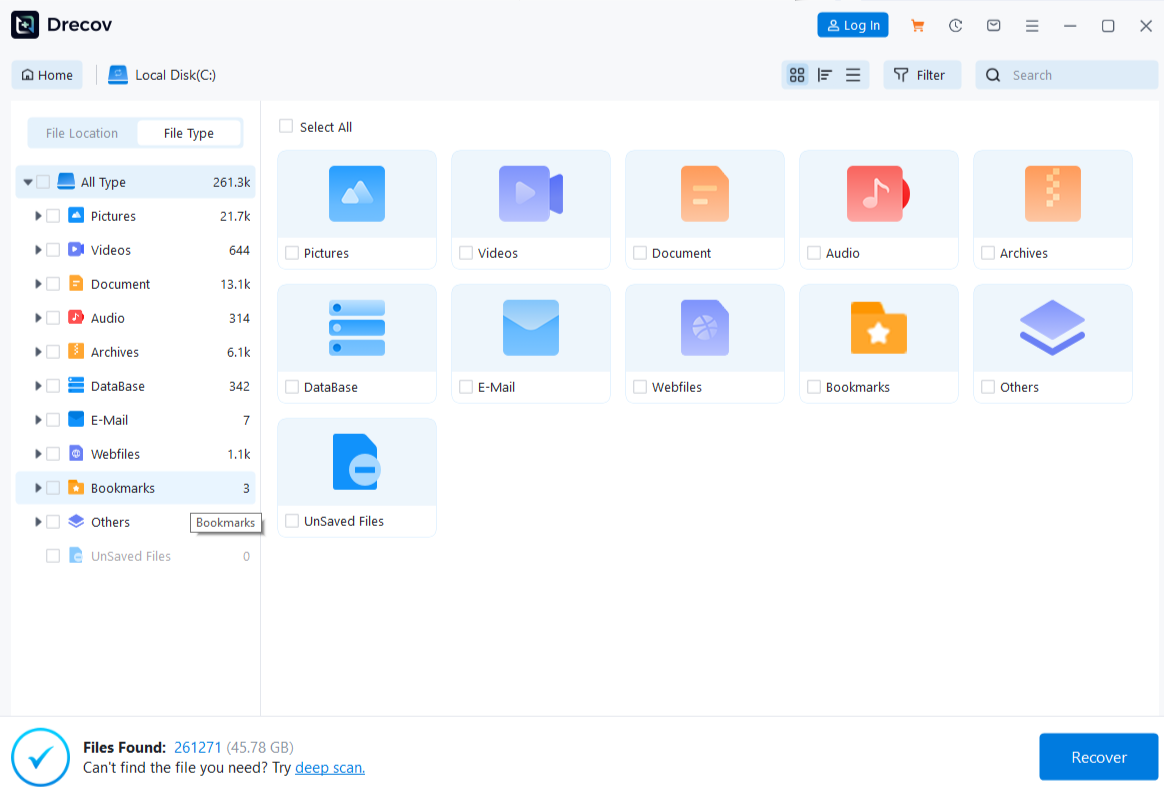
Launch the tool interface. Click on Local Disk (C:) since Chrome inherently records bookmarks inside your user profile profile path. Click the Start button to begin scanning.

Step 2: Execute Deep Scan Filtration
Allow the software to execute its initial quick pass followed by an automatic deep scan. To skip sorting through millions of system files, use the upper filter toolbar. Type Bookmarks directly into the search filter or restrict the file type scanner to look explicitly for the .html extension.
Step 3: Preview and Safely Extract Files
Browse the matching results displayed within the directory tree path structure (AppData > Local > Google > Chrome). Double-click found items to preview their text headers. Select the checkbox next to the files, hit the Recover button, and pick an external USB flash drive or secondary storage partition to write the salvaged files.
For deeper assistance regarding browser crash recovery, check out these specialized documentation resources:
- How to Get Your Google Chrome Bookmarks Back
- Where Are Firefox Bookmarks Stored on Your PC
- Where Is the Firefox Bookmarks Location: Find Your Data Instantly
Reintegrating Restored Profiles to Chrome
Once you have successfully deployed the power of PandaOffice Drecov data recovery software to retrieve your missing profile nodes, you must re-inject them into your functioning browser system.
Method A: Importing Restored HTML Files
If the data recovery software saved your file as an HTML archive, click Chrome’s upper-right settings icon (⋮), hover over Bookmarks and lists, and select Import bookmarks and settings. Choose Bookmarks HTML File from the dropdown menu, click Choose File, select your recovered file, and watch your links populate instantly.
Method B: Registry Validation for Lost Profiles
If Chrome fails to see your manually dropped profile folder, you must ensure your operating system hasn’t orphaned the user context. Open the Windows Registry Editor by hitting Win + R, typing regedit, and tracking down this specific destination path:
HKEY_LOCAL_MACHINE\SOFTWARE\Policies\Google\Chrome
Verify that keys such as UserDataDir are not locked with restrictive administrative policies that prevent Chrome from scanning your newly recovered folders.
Proactive Maintenance: Preventing Data Loss Disasters
Knowing how export bookmarks chrome when a crisis occurs is great, but executing structural protection strategies before your storage drive malfunctions is even smarter.
Automated Scripted Backups
Power users can construct a primitive Windows Batch command to back up their data automatically every evening. Copy the simple syntax below into a plain text document and save it as bookmarkbackup.bat:
DOS
@echo off
xcopy "C:\Users\%USERNAME%\AppData\Local\Google\Chrome\User Data\Default\Bookmarks" "D:\CloudBackups\Chrome\" /Y /I
You can seamlessly link this batch routine to the Windows Task Scheduler utility to run every Friday at 5:00 PM, creating an automated data defense system.
The 3-2-1 Storage Standard
Data recovery professionals universally advocate for the 3-2-1 backup paradigm to minimize data loss. Maintain three distinct copies of your data, store them on two separate media platforms (like an internal NVMe SSD and an external mechanical drive), and upload at least one copy to an offsite cloud environment. Utilizing these exact file protocols ensures you never face sudden data loss situations again.
Conclusion
Mastering the process of how export bookmarks chrome serves as an indispensable asset for navigating today’s internet ecosystem smoothly. Whether you are transitioning smoothly across physical machines, backing up corporate folders using standard network configurations, or deploying professional options like PandaOffice Drecov data recovery software during unexpected emergencies, your web navigation memory remains completely safe. Take five minutes out of your routine today to run an export step, back it up to a secure cloud platform, and ensure your important digital workflows remain completely uninterrupted.






