







BitLocker data recovery has a hard boundary: a recovery app cannot bypass encryption. First identify the correct drive and obtain its valid unlock method. Once Windows can read the unlocked volume, check backups and copy accessible files. If files were deleted from that stable, readable volume, Drecov can search for eligible copies and save them elsewhere. If the disk is failing or the key is unavailable, scanning encrypted sectors will not solve the problem.
bitlocker data recovery: safe diagnosis
A blue recovery screen, a locked external drive, a forgotten password, a file accidentally deleted after unlocking, and a drive that clicks are not one problem. They require different first actions. Treating all of them as “BitLocker recovery” often leads to unnecessary reset attempts or raw-disk scans. Those actions can consume time without changing the encryption boundary.
Start by recording whether the drive is the Windows system volume or a secondary/removable volume. Check whether the computer recognizes it at its expected capacity. Do not initialize or format a BitLocker-protected disk because Windows calls it inaccessible. A prompt that cannot display folders may mean the volume remains locked; it is not proof that the file system is destroyed.
| What you see | Likely first task | Unsafe assumption |
|---|---|---|
| BitLocker asks for a recovery key | Find the matching key ID and valid key. | A file scanner can decrypt without it. |
| Valid key unlocks the drive and folders appear | Copy vital files, then investigate any missing items. | Every missing file is an encryption failure. |
| Correct key is rejected | Verify the device, key ID and input before changing the drive. | Repeated guesses will repair damaged metadata. |
| Drive disconnects, clicks or changes capacity | Stop direct scans; pursue an image or specialist diagnosis. | Deeper software scanning fixes hardware. |
| Unlocked drive is stable but a folder was deleted | Check backup and Recycle Bin, then recover eligible local files. | The BitLocker recovery screen itself restores the folder. |
The most important distinction is between recovering access and recovering a deleted file. The valid key addresses access. File recovery may become relevant only after the protected volume is readable. If it was never unlocked successfully, do not interpret a list of encrypted blocks or an empty preview as evidence that your documents are gone.
Find the key before taking storage-repair steps
BitLocker recovery keys may have been saved to the Microsoft account used when protection was enabled, a work or school account managed by an organization, a printed record, a text file, or another approved location. Match the key ID on the prompt to the stored record. A key for a different computer or volume will not help. If the machine belongs to an employer or school, contact its administrator rather than altering the device independently.
The separate Drecov guide to finding a BitLocker recovery key walks through those sources. If a key is present but not accepted, use the narrower rejected-key checklist. Neither route authorizes guessing around encryption. A successful unlock is the checkpoint for any ordinary file-recovery workflow.
Microsoft’s BitLocker operations guide describes how a drive can be unlocked with an appropriate recovery credential. Prefer the normal Windows unlock interface when it works. Avoid pasting a recovery key into untrusted websites or sending it in support chats. It is a security credential for the contents of that volume.
If no valid key can be located, be direct about the outcome: Drecov cannot decrypt the disk, and neither can another general file-recovery app. Preserve the device and any account or organizational records while you search for the authorized key. A reset or format may make the computer reusable, but it will not recover the encrypted files you were trying to save.
Once unlocked, check what is actually missing
When the volume opens, copy irreplaceable files to another healthy device before experimenting with repairs. Start with the most important folders and verify several documents or photos at the destination. If a file is missing, search the unlocked volume by name and type. Then check Recycle Bin, File History, another backup, and cloud version history if that folder was synchronized. A BitLocker unlock does not rebuild a file that was deleted weeks earlier.
If only one file will not open, distinguish deletion from corruption. A readable but damaged document needs an intact older copy or a file-format repair approach. File recovery might find an earlier deleted copy, but it does not fix a damaged document’s internal structure. If Windows cannot open any folder despite accepting the correct key, the file system or underlying disk may be damaged. Preserve the unlocked view or image before changing metadata.
For a secondary drive that stays locked, do not repeatedly attach it to many computers. Confirm the correct machine and key first. For the system drive that will not boot, avoid reinstalling Windows until you have checked access to the encrypted data and protected what matters. Reinstallation and partition operations can overwrite the very storage you hope to recover.
Use Drecov only on a stable, readable source
For an unlocked, readable volume, PandaOffice Drecov provides a Windows file-recovery workflow on stable internal or external storage. It has a read-only recovery mode, Quick Scan, Deep Scan, filtering, preview, and recovery to a different healthy destination. It also offers Lost Partition Recovery for eligible lost partitions, but that mode does not unlock BitLocker or prove an encrypted partition is readable. These are file-recovery capabilities, not key extraction or encryption bypass. They do not repair physical damage or guarantee recovery of overwritten data.
The applicable branch is narrow: the volume is unlocked with an authorized method, Windows or Drecov can recognize the source, the device is stable, and the file you need is still absent after backup checks. Stop writing to that volume. Prepare another healthy disk for recovered output and do not install recovery software on the source partition. If the disk clicks, disconnects, or produces severe read errors, stop direct scanning and seek specialist imaging. An encrypted failing disk may need both hardware-safe acquisition and the valid key.
⚠ Warning: Install it on a drive different from the one where your data was lost to prevent overwriting.
Step 1: Open Drecov and select the unlocked original location
Choose the already unlocked drive or partition where the missing files lived after verifying its capacity and identity. Do not select a locked raw device merely because a drive letter exists. If the encrypted partition has disappeared, do not create a replacement partition; preserve the device and confirm the key and volume metadata before considering any partition-recovery mode.

Step 2: Start Quick Scan on the stable source
This check is especially useful for bitlocker data recovery. Browse the former folder and filter by the missing file’s type or name when those details are known. If a backed-up version already exists, compare it before selecting more results. The scan looks for files; it does not supply a missing recovery key.

Step 3: Use Deep Scan if needed and the drive stays healthy
When Quick Scan does not locate the required file, try Deep Scan only while the device remains stable. Read errors or repeated disconnects are stop signals, not reasons to start the scan again. Deep Scan may present files without original folder names, so content checks become more important.
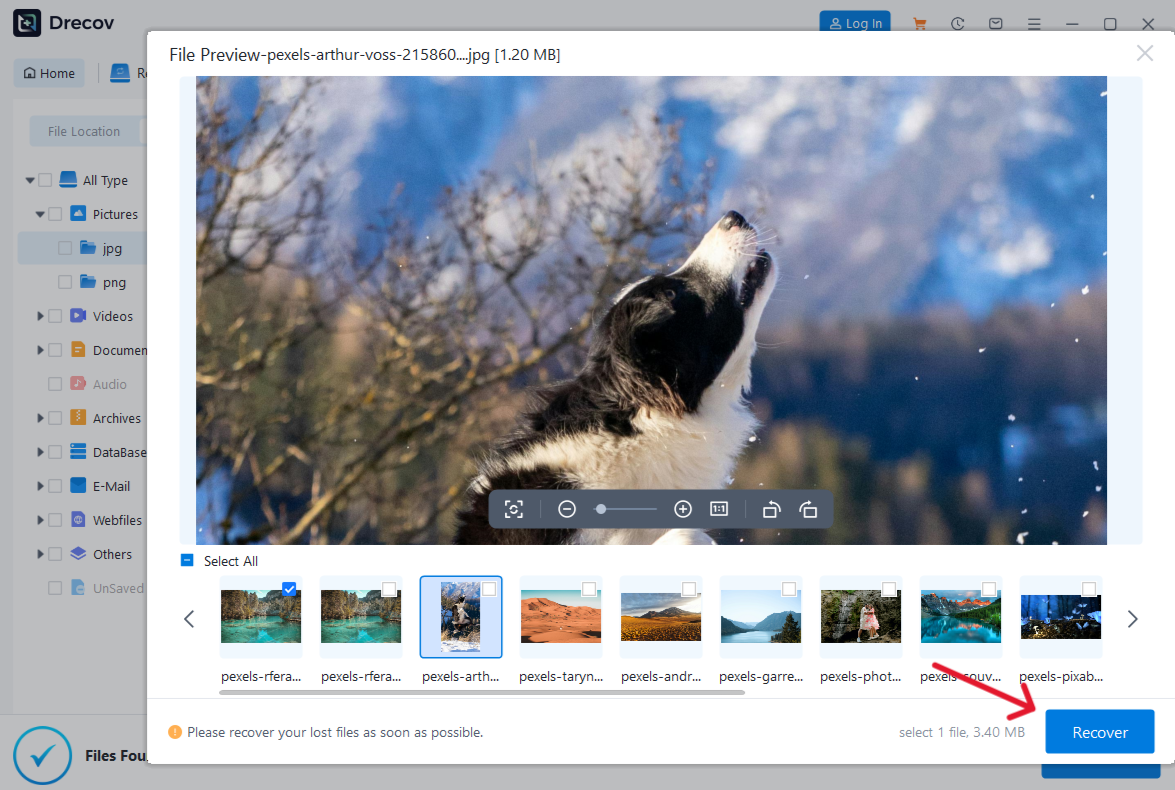
Step 4: Narrow results and preview several candidates
Use file type, previous path, names, and other available filters. Preview documents, pictures, or archives that represent the missing set. A visible preview cannot certify every page, formula, frame, or archive member. Preserve multiple plausible versions when they differ in size or date.
Step 5: Recover to another drive and verify
Save chosen files to the prepared healthy destination, never back to the encrypted source. If saved files are absent from the selected destination, check the Drecov folder or Recovery folder. Open representative recovered files and confirm their contents. Keep the source unchanged until you know which files are usable; only then consider file-system repair, decrypting the drive, or replacing hardware.
⚠ Warning: Install it on a drive different from the one where your data was lost to prevent overwriting.
Use the Drecov homepage for the product entry point. If the drive reports severe input/output problems, the I/O device error guide explains why physical stability must be resolved before repeated file scans.
Damaged BitLocker metadata is a different case
A correct key may still be insufficient for an ordinary unlock when BitLocker metadata or the disk is badly damaged. That does not mean a general recovery tool should be pointed at encrypted sectors and expected to produce readable documents. Microsoft has specialist BitLocker repair procedures that require valid recovery material and a separate output destination. On a physically unstable disk, imaging and professional assistance should come before metadata experiments.
Do not run decrypt, format, initialize, or partition-rebuild commands as a first reaction to an access error. Each changes the source or consumes read cycles. Record the exact message, whether the drive is physically present at the expected capacity, and whether another known-good connection changes the result. If the drive is under organizational management, its administrators may hold key material unavailable in your personal account.
For SSDs, deletion and later writes can reduce recovery prospects even after the drive is successfully unlocked. For a drive that was fully overwritten or reformatted and reused, no honest workflow can promise the original data. The purpose of the steps above is to preserve the evidence and recover what remains readable, not to guarantee an outcome.
Common BitLocker recovery decisions
Can Drecov recover files without the BitLocker key?
No. It does not bypass encryption. Obtain an authorized unlock method before treating the drive as a source of readable files.
What if the recovery key unlocks the drive but a folder is missing?
Check other paths, backups, Recycle Bin, and cloud history. If the folder was deleted from stable local storage, a file scan may help.
Should I turn off BitLocker before scanning?
Do not start a full decrypt merely to test a recovery idea. First unlock normally, copy accessible files, and preserve the source. Decryption writes to storage and is a separate operation.
Can a specialist work on a clicking BitLocker drive?
Possibly, with a safe image and the valid key. Stop repeated direct scans and explain both the physical symptoms and encryption state to the specialist.
Will Lost Partition Recovery reconstruct BitLocker encryption?
No. It is a way to search for files from a lost partition when the storage and access conditions permit. It is not a partition-table repair or key recovery feature.
Conclusion
The safest BitLocker data recovery plan starts by separating key access from file loss. Find the valid key, confirm that the disk is stable, and copy what is already readable. If an unlocked local volume has missing files, Drecov can search and recover eligible candidates to another healthy drive. Without the key, or when hardware is unstable, do not mistake repeated scanning for a solution.
⚠ Warning: Install it on a drive different from the one where your data was lost to prevent overwriting.





