







If Word has encountered a problem when pasting, save the document under a new name before clearing the clipboard or restarting the app. Then make two small tests: paste a short line of plain text into the problem document, and paste the original copied content into a new blank Word document. If plain text works but the original does not, inspect the copied format. If the original works elsewhere, investigate the destination document. This avoids turning a paste error into an unsaved-document emergency.
Protect the document that is still open
Word may still hold unsaved paragraphs even though the paste operation failed. Use File > Save As or Save a Copy with a distinct filename in a healthy folder you own. Open the new copy from File Explorer to verify that the existing work survived. If the document is in OneDrive or SharePoint, make a separate local copy before resolving a sync conflict. Do not close Word merely to clear the clipboard. If saving fails too, copy the text you have written into a new document and save that under another name. Keep the original open while you test.
Record exactly what you copied. Was it a sentence from a webpage, a table from Excel, an image, an entire page from another Word file, or a complex object? Paste failures involving only one item need a different response from failures involving every bit of text. Also note whether the destination is a normal editing area, a header, a text box, a comment, or a protected form field. Those areas accept different content. Do not strip protection from a document you are not authorized to edit.
| Test result | Likely area to investigate | Next move |
|---|---|---|
| Plain text pastes; copied object fails | Source format or object | Try text-only or Paste Special |
| Copied item works in blank document | Destination document or selection | Test another location, inspect protection |
| Nothing pastes in any Word file | Clipboard, add-in, or Word session | Save first, then isolate app-wide cause |
| Only one table or image fails | Object size or format | Copy smaller section or supported format |
Use two paste tests to locate the problem
Test simple text in the same document
Type a short harmless sentence in Notepad, select it, and copy it. Return to a normal paragraph in the Word document and try pasting. If that works, Word and the destination can accept plain text; the original copied item may contain formatting or an object that this location cannot handle. If it fails, try typing a few characters directly into the destination. When typing is also blocked, check whether the file is read-only, protected, or opened without editing permission. A paste fix will not grant rights to change a protected document.
Test the original item in a blank Word file
Create a new blank document and paste the original copied material there. If it works in the blank file but fails in your draft, the draft’s selection, layout, protection, or corruption deserves attention. Try a new normal paragraph outside a table or text box. If the same item fails even in a blank file, simplify what you copied. A browser can place HTML, images, links, and plain text on the clipboard at once; a large selection may carry structure Word cannot insert as expected. Copy a smaller section and compare.
These tests are deliberately small. They tell you whether to investigate the source or destination before changing application settings. Do not repeat Ctrl+V dozens of times in the same position and assume each failure confirms a different cause. When a file is important, work on its saved copy. One good paste into a blank document also gives you a temporary place to keep the content while you fix the original draft.
Try Paste Special or text-only when formatting causes the failure
With the document saved, choose Home and the arrow under Paste. Try Keep Text Only for ordinary words. If the source is a table, choose Paste Special and examine the available formats, which depend on the copied content. Microsoft’s Paste Special instructions describe this path and the choices that may appear. A plain-text paste removes source styling, links, and embedded objects. It is useful when you need the words, but not when exact table layout or an image must be preserved. Compare the result with the source before deleting it.
For a large webpage, paste one section at a time. For an Excel table, decide whether you need editable cells, a picture of the table, or just the values. A pasted picture will not update formulas; text-only may lose row structure. For images, save the original image file when permitted and use Word’s Insert > Pictures instead of pasting a complex clipboard object. If the source is another Word document, copy a small paragraph without its final paragraph mark as a test. Keep a safe copy of the original document if you experiment with its styles.
Do not use “paste as image” merely to make an error disappear when the reader needs editable text or an accessible document. Choose the format based on the task. After each successful paste, save the working copy and reopen it to confirm that the content persisted. A result visible on screen but absent from the saved file is a separate save or sync problem.
Check whether the target document restricts editing
If a blank document accepts the copied content but the original does not, look at the original’s title bar and any warning banner. It may be read-only, in Protected View, or restricted to filling form fields. Check whether typing works at the insertion point. Move the cursor to an ordinary body paragraph and try the simple-text test. If you are collaborating, confirm that you have permission to edit the file and that another person is not controlling the document. Do not remove a password or editing restriction without authorization.
Make a copy of the destination document before testing structural changes. A damaged table, text box, tracked change, or embedded object can affect one area while the rest works. Try pasting into a clean paragraph near the end of the copy. If that works, move content in smaller pieces and inspect the section that fails. Saving the copy under a new name gives you a comparison point. If Word reports unreadable content when reopening, follow the distinct guide to unreadable Word content. If the document instead reports a permission error, use the separate Word file permission path rather than assuming the clipboard caused every problem.
Sometimes an add-in changes how Word handles inserted material. Only investigate add-ins after the document is saved and the simple tests fail across several documents. On Windows, close Word, open it in Safe Mode using the supported launch method, and repeat a harmless paste into a blank file. If the failure disappears there, disable add-ins one at a time through Word’s options and restart normally after each change. Do not remove all add-ins at once if you need to identify which one interferes. On a managed device, ask IT before changing enterprise extensions.
When the problem affects every paste in Word
After preserving all open work, test copying a short sentence between two new Word documents. Also try pasting it into Notepad. If neither app receives the text, the clipboard or source application may be at fault. Recapture the text, close the source app only after saving its work, and try again. If Notepad works but Word does not, focus on Word’s session, add-ins, or Office installation. A reboot should be a late step, after every unsaved document is protected. Restarting without that check can lose more than the blocked paste.
When a Word restart fixes the issue, reopen the saved copy and verify that the text and formatting are intact. If the problem returns with the same add-in or object, note the pattern rather than repeatedly rebooting. A supported Office repair can be considered after backups and simpler tests, but it is not the first response to one troublesome table. This is an application diagnosis, not a file-recovery operation. Drecov will not repair the Windows clipboard or convert an unsupported pasted object into editable Word content.
Do not install random clipboard cleaners while a document is still open. They may replace the content you were trying to paste, and they cannot diagnose a protected destination. The source-versus-target tests above provide more useful evidence without adding software. If a web page is the only source that fails, copy the essential text in smaller segments or use its legitimate download function instead of changing Word globally.
If a Word file disappears during troubleshooting
Before scanning a drive, check Word’s recovery pane after an unexpected close, File > Info where available, OneDrive Version History, Recycle Bin, and existing backups. Search the exact filename in both original and Save As folders. A document that still exists in the correct cloud account should be downloaded from there. If the only saved local DOCX or an earlier local version has actually been deleted, stop writing new data to its source drive. Prepare another healthy destination; do not install recovery software on the same partition.
Drecov is Windows file-recovery software for locally lost documents on a stable, recognized PC drive or connected device. Quick Scan offers a first search; Deep Scan can follow when the file is missing and the source remains stable. Filters and supported previews help compare DOCX, DOC, and other candidate files. Recover to a different healthy location and open representative results in Word. Lost Partition Recovery is for a missing partition. Drecov does not fix paste behavior, reconstruct content that was only on the clipboard, or guarantee unsaved work that never reached the disk.
If the source disk clicks, repeatedly disconnects, or produces serious read errors, do not keep scanning it. Consider an appropriate image or professional service. A physical failure needs a different response from a copy-and-paste error. The article on a disappeared Word document helps trace the last known file location. Use file recovery only after confirming a local loss, not because a paste dialog mentions a problem.
Recover a saved document that went missing
⚠ Warning: Install it on a drive different from the one where your data was lost to prevent overwriting.
Step 1:
Open Drecov and select the original stable drive or folder where the saved document last existed.
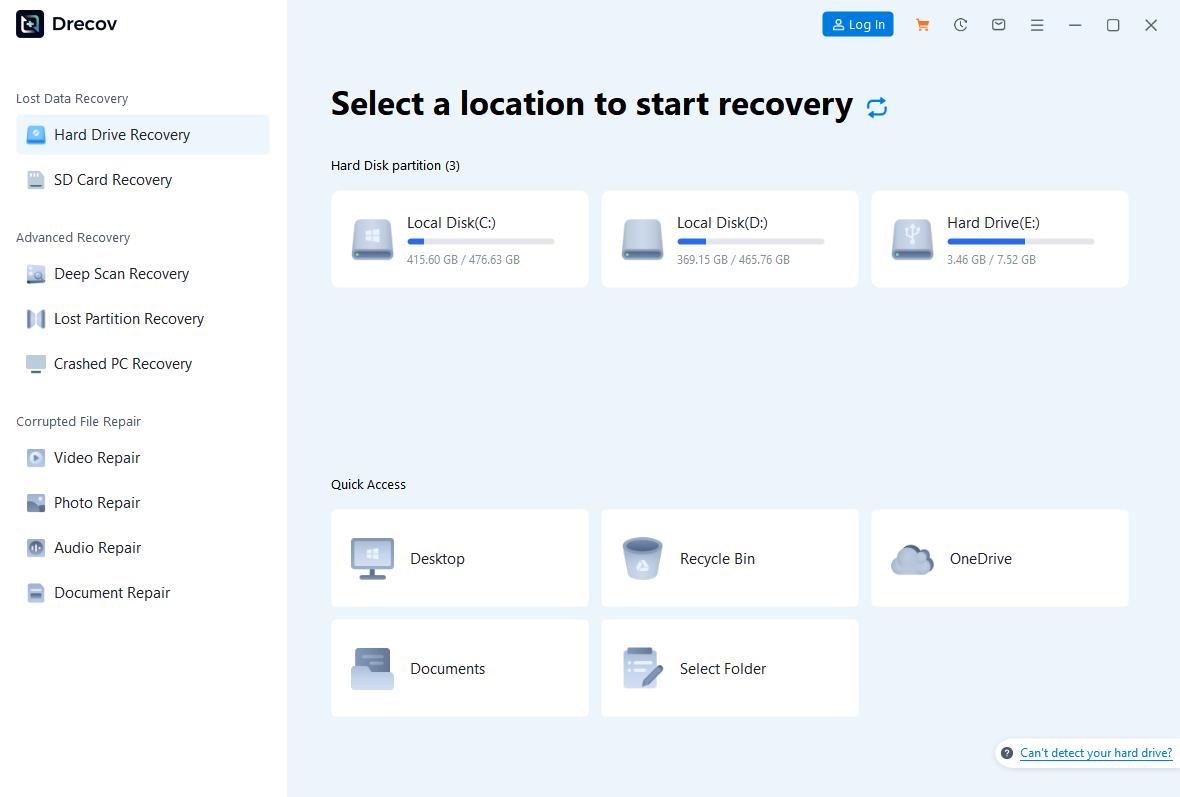
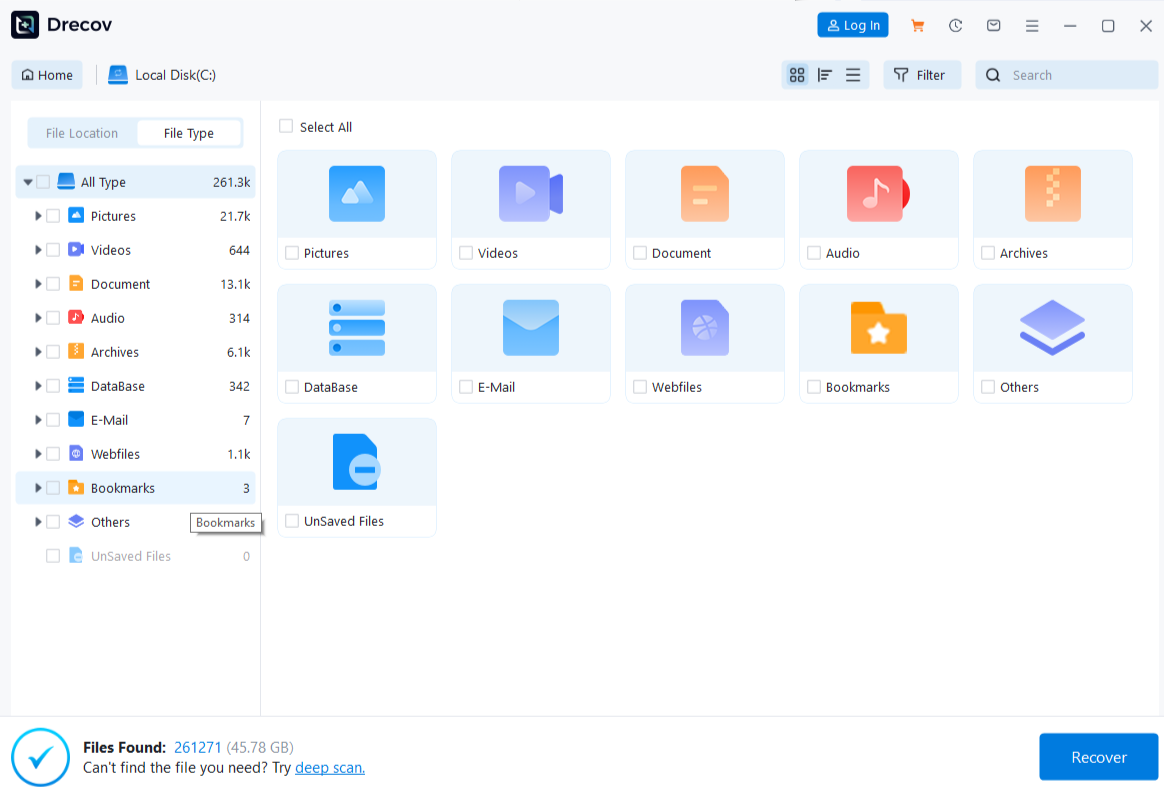
Step 2:
Run Quick Scan. If the document is absent and the device remains stable, run Deep Scan; stop on new hardware symptoms.
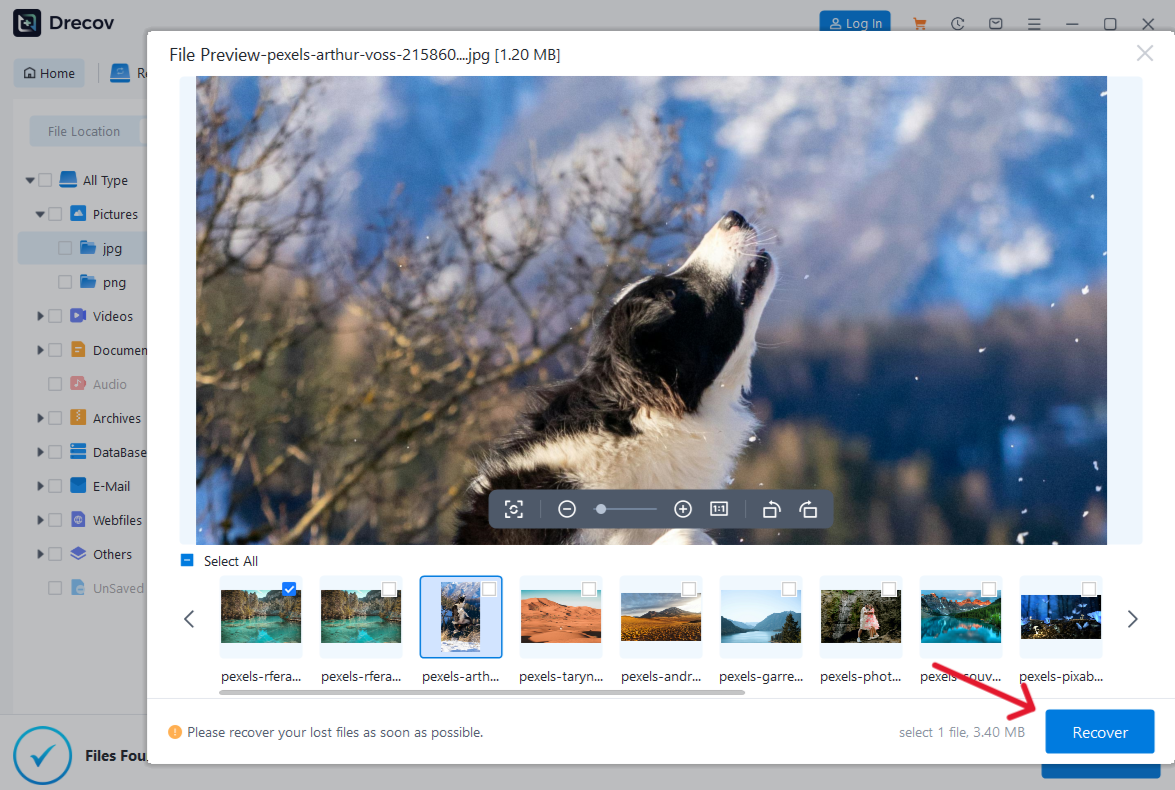
Step 3:
Filter by old path, filename, and document type. Preview supported candidates, but remember that a partial preview cannot certify every page, image, or linked object.
Step 4:
Recover candidates to another healthy drive, never back to the source. If the output is not in the expected place, check Drecov Folder or Recovery Folder on that destination.
Step 5:
Open recovered files in Word, check paragraphs and embedded objects, then save a working copy. Verify content before repairing, resetting, or formatting the old device. The Drecov home page describes the local recovery scope.
⚠ Warning: Install it on a drive different from the one where your data was lost to prevent overwriting.
FAQs
Why does text paste but an image does not?
The clipboard can hold several formats. Plain text may work while an image or complex HTML object fails in that document. Try inserting the saved image through Word’s Pictures command and verify that the result persists after saving.
Will Paste Special keep every part of an Excel table?
Not necessarily. The available format controls editability, appearance, and links. Choose based on whether you need values, an editable table, or a picture, then compare the result with the source.
Should I clear the clipboard immediately?
Save the Word draft and preserve the source content first. Clearing the clipboard destroys the current copied item and may make the problem harder to reproduce. A small plain-text test is more informative.
Does Safe Mode repair a broken document?
No. It is a diagnostic way to see whether Word behaves differently without certain extensions. Test on a copy, and do not treat a successful paste as proof that the original document has no other issues.
Can Drecov retrieve text that was never saved?
It cannot recover clipboard-only text as a file. Check Word’s recovery options and backups first. Drecov applies when a saved local document genuinely disappeared from a suitable stable drive.
Conclusion
When Word has encountered a problem when pasting, preserve the draft first. Compare plain text in the problem document with the copied item in a blank document, then choose a suitable paste format or inspect editing restrictions and add-ins. Reopen the saved result to verify the content. If a separate saved Word file truly goes missing, Drecov can search its stable original location and recover candidates to another drive. It cannot repair the clipboard or recreate text that never became a file.
⚠ Warning: Install it on a drive different from the one where your data was lost to prevent overwriting.