







“Why won’t my photos load?” has several answers on a Windows PC. One picture may be damaged. The Photos app may be stuck. A cloud placeholder may show a name even though the full file is not on the computer. Start by opening a copy of the same photo in another trusted viewer and by trying a different image in Photos. Those two checks protect the original while showing whether the failure follows the file or the app. Do not reset the application, rename an extension, or run a recovery scan merely because a thumbnail is visible but the picture will not open.
First, count how many pictures are affected
Open three images from different folders: the problem photo, a recent photo that used to work, and a small picture stored locally. If all three fail in Microsoft Photos but display in a second viewer, investigate the app or its file associations. When only one file fails everywhere, investigate that file and its source. If everything in one folder is unavailable, ask whether the folder is on an unplugged external device, a cloud account, or a network share. This simple grouping prevents a damaged-file repair attempt from becoming the first response to a missing drive.
A thumbnail is not the full photograph
Windows may display a cached thumbnail after the underlying image has moved, become inaccessible, or been replaced. Right-click the item in File Explorer, choose Properties, and note its size and location. A zero-byte file cannot contain the original photograph. A plausible size still does not prove the picture is intact, but it gives you a better clue than the thumbnail. Compare the extension with a known copy only as a label; changing .jpg to .png does not convert the data.
Keep a copy of any file that fails to open. An editor, repair tool, or synchronization client may write changes if you let it save over the only source. If the image came from a camera or phone, leave that device alone until you know whether another original is still there. For irreplaceable pictures, work on duplicates and put the preserved original on a different healthy drive.
Check whether the file is really on this PC
A cloud-synced folder can show a filename while the full image remains online. Look at the file’s availability indicator and confirm that you are signed into the expected account. Do not treat “online only,” “sync pending,” and “deleted” as the same state. If the service offers a download or keep-on-device action, use it for a copy and wait for completion before testing another viewer. If the account or network connection is wrong, a file-recovery scan of the local disk cannot pull the original from the cloud provider’s servers.
The exact availability controls depend on the app and account you use. When the missing item belongs to Google Photos rather than a local Windows folder, the Google Photos upload check is the more appropriate path. This article focuses on files that should be available to the Windows PC.
Also check external and network locations. If a folder lives on a USB device, reconnect it once through a known-good port. Then see whether File Explorer shows the correct capacity and folders. Stop if the device disconnects repeatedly, makes unusual sounds, or reports many read errors. Repeated opening attempts are not harmless on unstable storage. For a network share, confirm that the computer can reach the server and that your account still has access before changing local Photos settings.
When the Photos app is the only thing failing
If the same picture opens in another application, protect that useful file and troubleshoot the viewer. Close Photos, reopen it, and try a small local image. Check the default app for the file type by right-clicking a copy and choosing Open with. A file association can change after a new app is installed; that does not corrupt the photograph. You can choose a different trusted viewer for the test without making a permanent system-wide change.
If Photos still fails on several healthy local images, open Windows Settings > Apps > Installed apps, find Microsoft Photos, and inspect its advanced options. Where available, try Repair before Reset. Repair is the narrower app-level action. Reset can clear application settings, so note any preferences or unfinished app projects first. Microsoft’s Windows app repair instructions explain the current Settings route and the distinction between the options. Menu labels vary between Windows versions.
How to know the app check worked
Reopen the same three test images. If they now display and remain accessible after closing and reopening Photos, the application was the likely cause. When one picture still fails but the others work, stop repeating app resets and investigate that image. A problem that appears only with a particular cloud library or removable device calls for connection and permission checks before another Photos reset.
Do not delete the Photos app or reinstall Windows as an early response. Those actions are broader than the evidence supports. In particular, an app reset cannot recreate a missing photograph. The moment the file is absent from its folder or reads as zero bytes, switch from app troubleshooting to checking versions and backups.
When a particular image is unreadable
Look for an earlier version before testing repair. A cloud service may keep version history; Windows File History or another backup may hold the original. If the photograph came from a camera card, phone, editing project, or email attachment, compare the source copy. A failed export may leave a corrupt derivative while the original capture remains healthy. Recovering the source is often more valuable than forcing the derivative to open.
A JPEG, PNG, HEIC, or RAW extension identifies an expected format. It does not prove that the underlying bytes are intact. Test a duplicate in another trusted viewer that supports that format. An unsupported format can look like corruption when the app simply lacks the necessary decoder. If the file is readable elsewhere, export a new copy without overwriting the source. If every compatible viewer fails on the same bytes, the dedicated guide to corrupted image files addresses repair decisions and limits.
Watch for an unstable source drive. Images that take longer to copy or disappear between folder refreshes signal trouble. Repeated read errors are another stop sign. Stop running viewers and repair commands against that device. A professional image of the storage may preserve more than continued direct scanning. Protect important photographs before CHKDSK, formatting, or initializing a missing volume. Those actions change storage structures and are not image recovery.
Recover a missing local original, not a broken viewer
Suppose you found only a small thumbnail or an edited copy, while the full-resolution local original was deleted. Check Recycle Bin, backups, the camera or phone, and cloud version history first. Stop writing new photos to the Windows volume that held the lost file. If the source is stable and the full image is still absent, file recovery becomes a reasonable next step. The photo recovery page covers this file-loss branch; it is not a substitute for fixing the Photos app.
Drecov is Windows data-recovery software for local photos lost from a stable PC, USB drive, memory card, or other supported storage. It offers read-only recovery mode, Quick Scan, Deep Scan when needed, filters, preview, and recovery to a separate healthy destination. These features help locate an older original rather than merely opening a cache thumbnail. Drecov cannot download cloud-only photos from a remote service, repair a failed graphics display, overcome physical device damage, or guarantee a fully overwritten picture.
⚠ Warning: Install it on a drive different from the one where your data was lost to prevent overwriting.
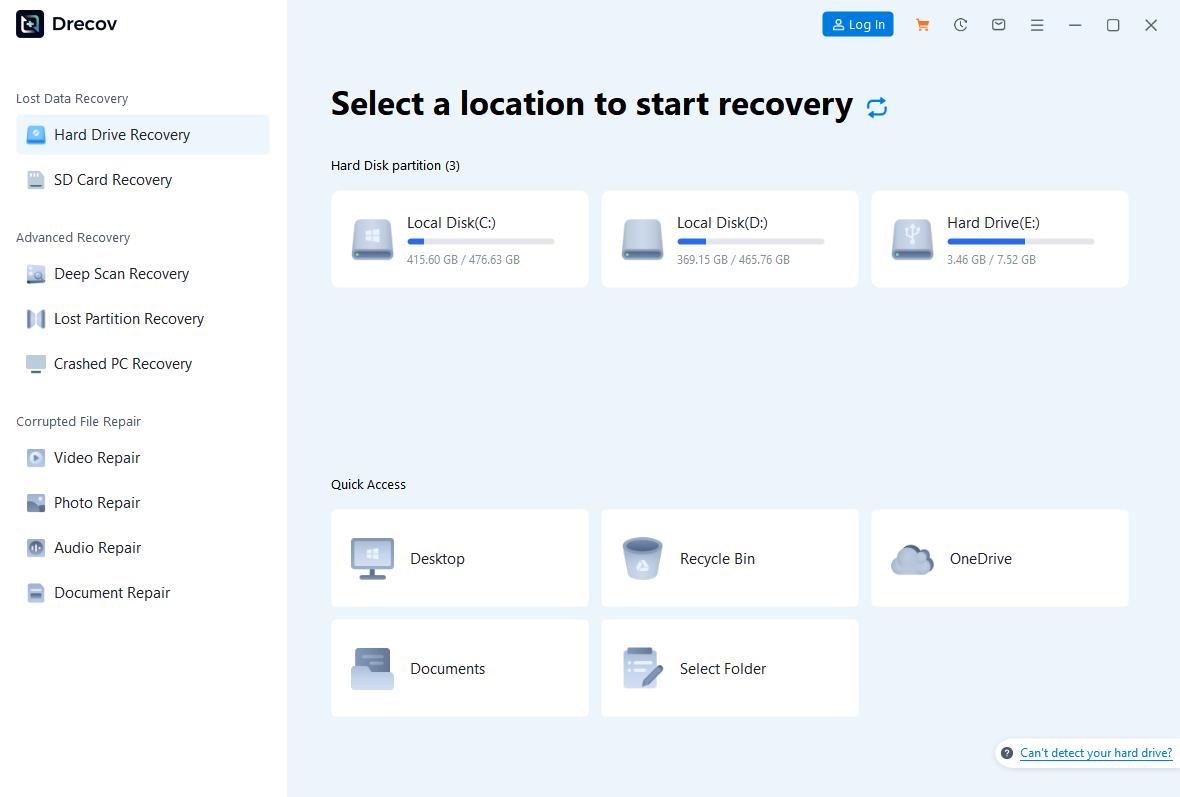
Step 1: Select the original photo location
Prepare another healthy drive for recovered pictures and do not install Drecov on the partition where the files were lost. Open Drecov and choose the original Windows volume or stable removable device. If a card reader or drive repeatedly disconnects, stop direct scans and seek imaging or professional help. An unstable source is not a good candidate for repeated software attempts.
Step 2: Search the likely folder with Quick Scan
Run Quick Scan. Use the former folder, image type, filename, or date if the results offer those fields. Compare full-sized candidates with tiny thumbnails; a matching picture in the preview may still be only a low-resolution cache. Note what you know about the original camera dimensions or file size instead of choosing by appearance alone.
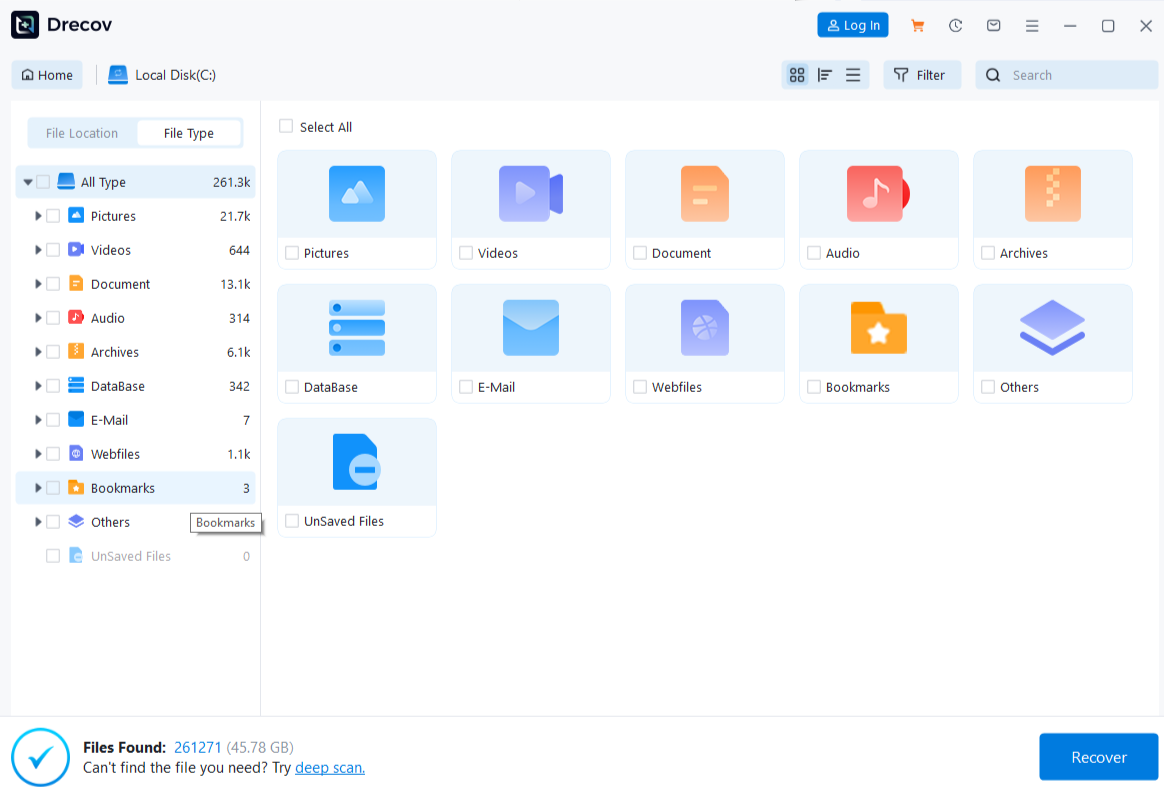
Step 3: Use Deep Scan only if the device stays stable
When Quick Scan misses the original and the source remains healthy enough to read, try Deep Scan. It may locate additional candidate files, but it cannot reconstruct pixels that were overwritten. A suddenly unstable device is a stop condition. Protecting the medium matters more than completing another scan.
Step 4: Preview and save to another drive
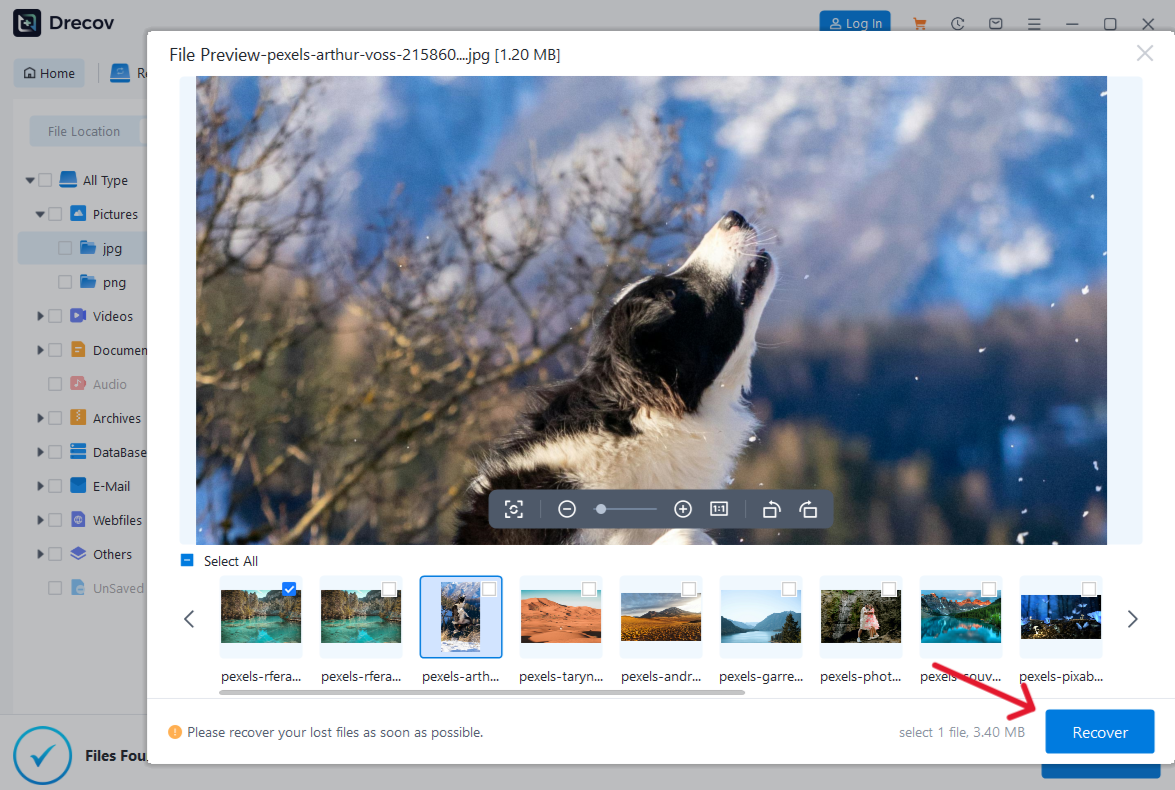
Filter the results, preview representative full-resolution images, and recover the best candidates to the prepared healthy destination. A preview shows that the sampled file can be decoded; it does not prove that every part or metadata field is intact. Never restore onto the source. If the output seems missing, look for a Drecov Folder or Recovery Folder on the destination before scanning again.
Step 5: Verify what you actually recovered
Open several images at full size. Zoom into important areas, check orientation and dimensions, and compare a sample with known backups. Only after you have a usable copy should you reset apps, repair file systems, format removable media, or clean up old variants. A recovered filename alone is not evidence that the photograph is complete.
⚠ Warning: Install it on a drive different from the one where your data was lost to prevent overwriting.
FAQs
Why do thumbnails appear when my photos will not open?
Windows may retain a cached thumbnail even when the full file is unavailable or damaged. Check Properties for size and location, then test a copy in another viewer.
Will repairing the Photos app delete my pictures?
App Repair targets the application, not the underlying image files. Keep a separate backup of valuable photos and read the Windows option before choosing a broader Reset. Neither action restores a deleted original.
Can a file format cause a photo to stay blank?
Yes. A viewer that lacks support for the file’s format may fail although another compatible viewer works. Test a duplicate in a trusted app before deciding the bytes are damaged.
Should I rename JPG to PNG to make it open?
No. Renaming changes the extension, not the image encoding. Find a compatible viewer or an intact earlier copy instead.
When is Drecov the right step?
Use it for a missing local original on stable Windows storage after checking backups and Recycle Bin. It does not fix cloud-only availability or a viewer that refuses an otherwise healthy file.
Conclusion
If photos will not load on Windows, first learn whether the failure follows one file, one location, or the Photos app. A second viewer, a known-good image, and the file’s actual storage state answer that question without changing the original. Repair the app only when healthy pictures fail there; seek another source when a particular image is damaged. If a full-resolution local original was deleted, Drecov can search its stable source and save candidates to another drive. Open the recovered pictures at full size before relying on them or repairing the original storage.
⚠ Warning: Install it on a drive different from the one where your data was lost to prevent overwriting.