







In the age of digital browsing, bookmarks have become an essential tool for organizing and quickly accessing favorite websites. Google Chrome, being one of the most widely used browsers, provides an efficient bookmarking system. However, many users have reported a frustrating issue known as chrome bookmark ghosting, where bookmarks seem to disappear, reappear, or fail to sync correctly.
When your saved links suddenly vanish, or old, deleted items mysteriously return from the dead, it ruins your workflow. This extensive educational guide will explore the deep-seated technical causes behind this phenomenon, provide structured troubleshooting methods, and walk you through advanced data recovery strategies to restore your data safely.
What is Chrome Bookmark Ghosting?
The term chrome bookmark ghosting refers to the phenomenon where bookmarks in Google Chrome appear to vanish or behave unpredictably. Instead of remaining permanently deleted or securely saved, the browser’s data layer experiences a state of flux. This issue typically manifests in several distinct ways:
- Sudden Disappearance: Bookmarks or entire folders completely vanish from the bookmark bar or menu unexpectedly.
- Zombie Bookmarks: Items you deleted days or weeks ago suddenly reappear in your list.
- Sync Asymmetry: Syncing issues cause bookmarks to appear on one device (like your phone) but fail to show up on another (like your work PC).
- Mass Duplication: Mysterious duplicate bookmarks emerge out of nowhere, sometimes multiplying every time you launch the browser.
This problem can severely disrupt daily productivity. When you rely heavily on curated links for work, research, or personal finance, losing access to them causes instant friction. To fix this permanently, we must first look under the hood at why Chrome behaves this way.
Common Causes of Chrome Bookmark Ghosting
Understanding why Chrome bookmarks ghost is crucial to solving the problem effectively. Because Chrome operates on a multi-process architecture and constantly balances local storage with cloud synchronization, several structural factors can trigger data instability:
1. Cloud Syncing Conflicts
Chrome uses your Google Account to sync browsing data across multiple platforms. If there are syncing issues, bookmarks may appear to disappear or reappear unpredictably. These conflicts frequently arise if multiple devices make changes simultaneously while one device is offline, or if a specific browser session experiences an authentication timeout.
2. Corrupted File Systems and Local Databases
Chrome writes its local data to physical files on your hard drive. If your computer experiences a sudden shutdown, an unexpected browser crash, or an interrupted software update, these physical files can suffer structural corruption. When the underlying database becomes unreadable, Chrome fails to parse your bookmarks correctly, resulting in ghosting.
3. Intrusive Browser Extensions
Extensions can enhance the functionality of Chrome, but third-party tools that request permission to access your browsing data may actively interfere with bookmarks. Malicious, outdated, or poorly coded extensions (especially third-party bookmark managers or session savers) can overwrite your local files or trigger loop synchronization errors.
4. Corrupted User Profiles
Chrome user profiles isolate settings, history, and extensions for different accounts. If the profile’s internal directory structure becomes compromised, the browser may repeatedly default to older cached versions of your data, rendering any newly added bookmarks temporary or “ghostly.”
5. Localized Malware or Virus Infiltration
In rare cases, malicious software operating on your operating system can tamper with application data directories. Hijackers may rewrite local files, inject unauthorized search tools, or block Chrome from saving data to disk, causing your browser state to reset continually.
Standard Troubleshooting for Chrome Bookmark Ghosting
Before moving into deep data recovery protocols, you should attempt these foundational fixes to see if Chrome can naturally realign its database.
Method 1: Audit and Reset Chrome Sync Settings
If your cloud sync engine is stuck in an infinite loop, it will continually overwrite your local changes with older data stored on Google’s servers.
- Step 1: Open Google Chrome, click the three vertical dots in the top-right corner, and select Settings.
- Step 2: Click on You and Google in the left sidebar, then click on Sync and Google services.
- Step 3: Select Manage what you sync. Toggle Bookmarks off, wait approximately 60 seconds, and toggle it back on to force a clean re-synchronization.
Method 2: Isolate Extensions via Clean Launch
To rule out a rogue extension causing your bookmarks to disappear or duplicate, run a quick isolation test.
- Step 1: Type
chrome://extensions/into your address bar and press Enter. - Step 2: Manually turn off every single active extension by toggling its blue switch to gray.
- Step 3: Close Chrome completely, relaunch it, and observe if the ghosting behavior stops. If the issue is resolved, turn your extensions back on one by one to isolate the culprit.
Method 3: Clear Corrupted Browser Cache
Cached system files can sometimes conflict with localized storage states.
- Step 1: Press Ctrl + Shift + Delete (Windows) or Cmd + Shift + Delete (Mac) to open the Clear Browsing Data dialog.
- Step 2: Set the time range to All time.
- Step 3: Check the boxes for Cached images and files and Cookies and other site data, then click Clear data.
Advanced Technical Solutions: Chrome Bookmark Recovery
When basic troubleshooting fails to resolve the problem, it means your underlying database file is either physically missing or fundamentally corrupted. In this section, we will shift our focus to manual database manipulation and systematic data retrieval. Executing a proper chrome bookmark recovery process requires precision, as manual mistakes can permanently overwrite your remaining historical data.
Method 4: Restoring via Local Database Rollbacks
Chrome automatically maintains a single, bare-bones backup file of your bookmark structure locally. If your primary file is corrupted, you can manually force Chrome to look at this backup alternative.
- Step 1: Close all open instances of Google Chrome completely. Open your system’s Task Manager (Ctrl + Shift + Esc) and verify that no background
chrome.exeprocesses are running. - Step 2: Open File Explorer and navigate directly to your local user profile directory using the precise system paths below:
- Windows:
C:\Users\<YourUsername>\AppData\Local\Google\Chrome\User Data\Default\(Note: Replace<YourUsername>with your actual Windows profile name. You may need to enable “Hidden items” under the View tab in File Explorer to see the AppData folder). - Mac OS: Open Finder, press Cmd + Shift + G, and paste:
~/Library/Application Support/Google/Chrome/Default/
- Windows:
- Step 3: Inside the Default folder, locate two critical files:
Bookmarks(the current corrupted file) andBookmarks.bak(the automatic backup).
| File Name | Functional Role in Chrome |
| Bookmarks | The live active file that Chrome reads every time the browser launches. If ghosting occurs, this file is likely broken. |
| Bookmarks.bak | A secondary snapshot file created automatically by Chrome. It holds data from the last time you opened the browser before the corruption event. |
- Step 4: Right-click the file named
Bookmarksand select Rename. Change it toBookmarks.old. - Step 5: Right-click the file named
Bookmarks.bakand rename it strictly toBookmarks(removing the.bakextension completely). - Step 6: Relaunch Google Chrome. The browser will read the newly renamed file, bringing back your missing links.
Method 5: Rebuilding via System Registry and Profile Recreation
If the profile directory itself is permanently unreadable due to deeper system configuration issues, creating a pristine profile layer is required.
- Step 1: Launch Chrome, click your profile icon in the top-right corner, and click Add under the profile section to generate a completely clean workspace.
- Step 2: If you prefer a total manual reset, close Chrome and press Windows Key + R to open the Run dialog box. Type
regeditand press Enter to open the Windows Registry Editor. - Step 3: Navigate carefully to the following registry path:
HKEY_CURRENT_USER\Software\Google\Chrome. - Warning: Modifying registry files incorrectly can cause system instability. Do not delete or alter any key unless explicitly instructed here.
- Step 4: If structural policy blocks are affecting your profile execution, you can view them under this folder. For standard profile recreation, it is safer to return to File Explorer, navigate to
C:\Users\<YourUsername>\AppData\Local\Google\Chrome\User Data\, and rename the entireDefaultfolder toDefault_Backup. - Step 5: Upon restarting Chrome, a brand new, completely uncorrupted
Defaultfolder will automatically generate, allowing you to re-sync your cloud data without localized errors.
Deep File Retrieval: PandaOffice Drecov Data Recovery Software
What happens if you check your User Data\Default folder only to discover that both Bookmarks and Bookmarks.bak have been completely wiped, overwritten, or deleted by a major system crash or a malware sweep? When files are physically scrubbed from your hard drive, standard browser tricks will not save them from a severe case of chrome bookmark ghosting.
In this scenario, you must deploy professional-grade file carving utilities. Utilizing PandaOffice Drecov data recovery software allows you to scan your storage drive’s raw sectors to locate, reconstruct, and rescue deleted configuration files before they are permanently overwritten by new system activity.
⚠ Warning: Install it on a drive different from the one where your data was lost to prevent overwriting.
Why Choose PandaOffice Drecov for Browser Recovery?
When files are deleted, the operating system simply marks that physical space on your Solid State Drive (SSD) or Hard Disk Drive (HDD) as “available for writing.” The actual binary data remains completely intact until new applications write over it.
The PandaOffice Drecov data recovery software specializes in reading deep file system structures (like NTFS, FAT32, exFAT, and APFS), identifying the unique file signatures of Chrome’s JSON-formatted bookmark databases, and pulling them back safely without altering your existing computer configurations.
Step-by-Step Guide to Rescuing Your Lost Bookmark Files
Step 1: Select the Target Location for Scanning
Launch the program interface. On the main dashboard, you will see a clean overview of all internal hard drives, external storage devices, and common system paths. Because Chrome stores application data within the user profile directory, you should select your primary system drive—typically Local Disk (C:)—to initiate the search.

Step 2: Run the Advanced Deep Scan Engine
Click the Scan button. The utility will first execute a Quick Scan to find recently deleted directory pointers, immediately followed by an automated Deep Scan. The Deep Scan searches through the drive’s deep raw storage sectors to locate fragmented application files. Do not close the software or turn off your PC during this phase.
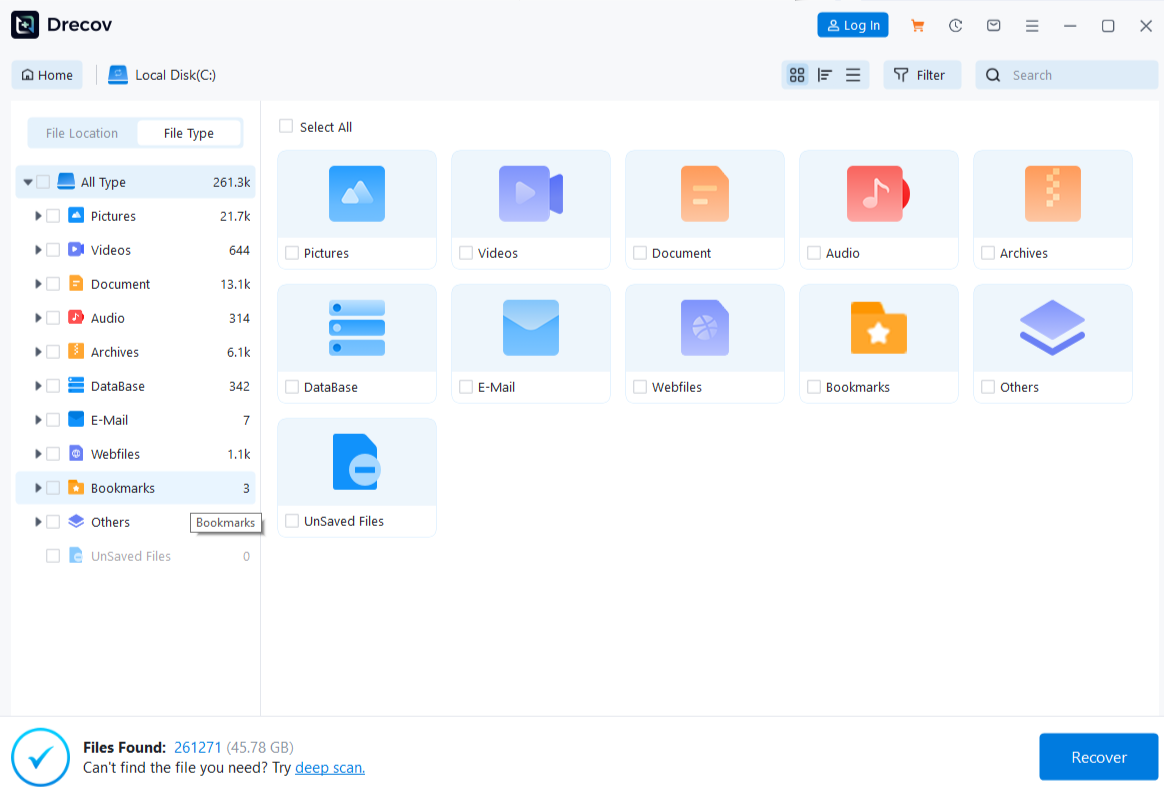
Step 3: Filter and Locate the Bookmarks Files
Use the built-in search bar in the top right corner of the application interface to find your targets. Type Bookmarks directly into the filter bar. The scan results will filter out irrelevant files, isolating items named Bookmarks or Bookmarks.bak.
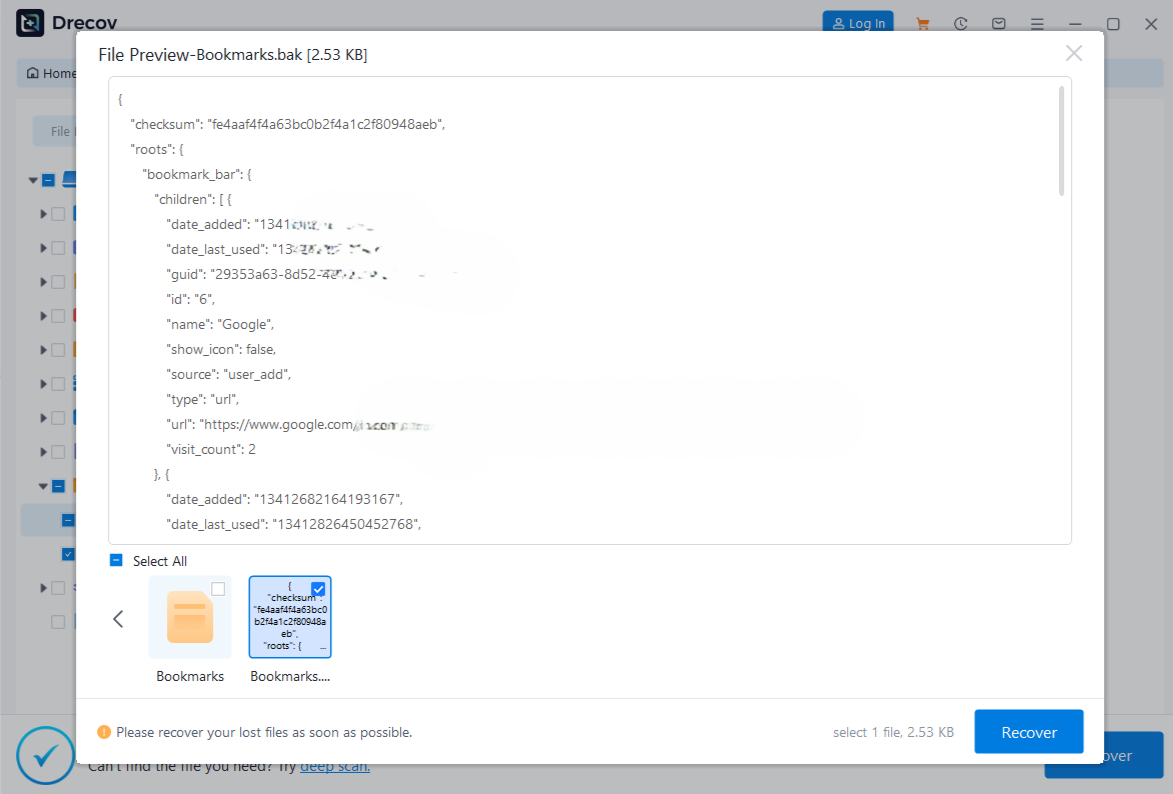
Step 4: Execute a Safe Data Extraction
Tick the selection boxes next to the healthy Bookmarks and Bookmarks.bak files you wish to pull back. Click the prominent Recover button located at the bottom right of the screen. A file prompt will pop up asking for an output destination. Select an external storage drive, a secondary hard drive partition, or a cloud folder to save the files.
Warning: Never save the recovered files directly back into the original Chrome folder during this step. Doing so risks corrupting the file structure before the recovery loop is safely completed.
Step 6: Reintegrate the Recovered Files into Google Chrome
Now that you have cleanly extracted the uncorrupted backup files via the recovery software, you can place them back into Chrome’s active directory:
- Verify Google Chrome is completely closed.
- Copy your recovered
Bookmarksfile. - Navigate back to
C:\Users\<YourUsername>\AppData\Local\Google\Chrome\User Data\Default\. - Paste the file directly into the folder, selecting Replace the file in the destination when prompted by Windows.
- Launch Chrome. Your entire historical bookmark hierarchy will populate your browser bar exactly as it was before the ghosting event occurred.
For more specialized assistance regarding browser restoration, check out this guide on how to get your Google Chrome bookmarks back, which covers alternative manual re-import techniques.
Comprehensive Prevention Tips: Securing Your Digital Assets
Once you have successfully restored your bookmarks, taking structural preventive steps can minimize future data loss and protect against unexpected browser conflicts.
1. Implement Manual Local Backups Regularly
Do not rely solely on automated browser memory engines. Creating a hard, offline file backup is the single most reliable way to protect your links.
- Press Ctrl + Shift + O to open Chrome’s Bookmark Manager.
- Click the three dots icon located in the upper-right corner of the manager interface (just below the main browser window).
- Select Export bookmarks from the dropdown options.
- Save the resulting
.htmlfile to a secure location, such as an external hard drive or a dedicated document folder. If your browser ever experiences a ghosting issue again, you can instantly re-import this HTML file via the same menu.
2. Manage Cloud Sync Nodes Wisely
When utilizing Chrome across multiple form factors—such as an office desktop, a home laptop, an Android phone, or an iPad—avoid adding, moving, or modifying large folders of bookmarks simultaneously on different screens while your internet connection is unstable. Give your primary device a few moments to push its modifications up to the cloud servers before logging into your secondary devices to prevent sync collisions.
3. Actively Curate Extensions and Security Tools
Every extension you install adds a layer of complexity to Chrome’s data-writing operations. Regularly audit your extension manager. Remove any tools that have been abandoned by their developers or those that request broad, unrestricted read/write permissions over your browser files. Stick to verified software options listed on the official Chrome Web Store.
4. Maintain Clean System Storage
Keep your computer’s storage space healthy. Avoid running your primary hard drive at maximum capacity (keep at least 15% of your drive free). When a hard drive drops to near-zero storage space, applications like Google Chrome lose the ability to write temporary log data to disk. This can cause file truncation, where the end of a database file is completely cut off, causing corruption.
Conclusion
While chrome bookmark ghosting can be a confusing and frustrating issue, it is entirely manageable once you understand how the browser processes its data layers. Whether the root cause is a minor cloud synchronization mismatch, a rogue extension running loops in the background, or a severe local database file corruption, you have multiple ways to resolve the problem.
Always start with the simplest fixes: audit your sync options, isolate your active extensions, and check your local Bookmarks.bak file. If you find yourself facing an absolute data loss scenario where your local configuration files have been completely wiped from your storage sectors, you can deploy advanced solutions like PandaOffice Drecov data recovery software to scan your drive and extract your lost files safely.






