







Managing a digital legacy can be overwhelming. As we capture every moment of our lives, our cloud storage often becomes a digital “junk drawer” filled with blurry screenshots, duplicate selfies, and memes from three years ago. If you are looking for how to delete all photos from google photos, you aren’t just looking to click a button; you’re likely looking for a fresh start, a way to reclaim storage, or a method to protect your privacy.
In this extensive guide, we will walk through every technical layer of the Google Photos ecosystem. We’ll cover how to wipe your library, how to ensure those files stay gone, and—most importantly—how to handle the situation if you accidentally delete something precious. We’ll even dive into professional-grade google photos recovery techniques using specialized tools like PandaOffice Drecov.
Understanding Google Photos Storage System
Before you learn how to delete all photos from google photos, you must understand the architecture of the platform. Google Photos isn’t just a gallery app; it is a sophisticated cloud-synchronization engine.
How Google Photos Stores Your Images
Google uses a complex indexing system. When you upload a photo, it isn’t just a file in a folder; it’s an entry in a massive database. Google’s AI analyzes the metadata (EXIF data) to determine the date, location, and even the subjects in the photo. This is why searching for “dog” or “beach” works so well.
However, this metadata-heavy approach means that when you delete a photo, you aren’t just removing pixels—you are removing a data point from your Google Account’s history. Understanding this helps you realize why “syncing” is the most critical part of the process.
Sync Between Devices and Cloud
The “Sync” feature is a double-edged sword. If you have “Back up & sync” enabled on your Android or iPhone, your device and the cloud are essentially mirrors of each other.
- Action: If you delete a photo on the Google Photos web interface, it sends a command to your phone to delete the local copy.
- Result: The photo vanishes from everywhere simultaneously.
If your goal is how to delete all photos from google photos while keeping them on your phone, you must turn off sync first. Failing to do this is the #1 cause of accidental data loss.
Why You Might Want to Delete All Photos
Privacy Concerns
In 2026, data sovereignty is more important than ever. You might want to move your library to a private home server (NAS) or a different encrypted cloud provider. Deleting your Google Photos library ensures that your personal facial recognition data and location history aren’t sitting on a server you no longer wish to use.
Freeing Up Storage Space
Google’s 15GB free tier is shared across Drive, Gmail, and Photos. High-resolution 4K videos and RAW images can eat through this in weeks. Learning how to delete all photos from google photos is often the final “nuclear option” when “Storage Full” warnings prevent you from receiving important emails.
Important Things to Know Before Deleting
Backup Considerations
Never delete your entire life’s history without a secondary copy. I recommend using the Google Takeout tool first. This allows you to download your entire library in compressed ZIP files.
Permanent vs Temporary Deletion
Google Photos has a “safety net” called the Trash (or Bin).
- Temporary: Items stay in the Trash for 60 days (if backed up) or 30 days (if not backed up).
- Permanent: Once you empty the trash, the pointers to that data are removed from Google’s active servers.
How to Delete All Photos from Google Photos on Desktop
The desktop browser (Chrome, Safari, or Edge) is the most powerful way to manage mass deletions. It allows for keyboard shortcuts that the mobile app simply cannot match.
Step-by-Step Process
- Step 1: Open Google Photos on your computer and sign in.
- Step 2: Ensure you are in the “Photos” tab on the left sidebar.

- Step 3: Scroll down to the very first photo in your timeline.
Selecting All Photos Efficiently
You don’t want to click thousands of checkboxes manually. Use the “Shift-Click” method:
- Action: Click the checkmark icon on the top-left corner of the first photo.
- Action: Scroll all the way to the bottom of your library. (Pro tip: Press the
Endkey on your keyboard to jump to the bottom instantly). - Action: Hold the
Shiftkey and click the checkmark on the last photo. - Result: Every single photo in your library will be highlighted in blue.
Deleting in Bulk
Once selected, click the Trash icon at the top right of the screen. A confirmation box will appear asking if you want to move these items to the trash. Confirm the action. Note that for extremely large libraries (10,000+ items), you may need to do this in chunks of 500 at a time to prevent the browser from crashing.
How to Delete All Photos from Google Photos on Mobile
Android Instructions
- Step 1: Open the Google Photos app.
- Step 2: Long-press on the first photo to enter selection mode.
- Step 3: Without lifting your finger, drag it down toward the bottom of the screen. The app will begin auto-scrolling and selecting photos as it goes.
- Step 4: Tap the Delete button (Trash icon).
iPhone Instructions
The process on iOS is identical to Android. However, iPhone users should be aware that deleting photos from Google Photos may also trigger a prompt to delete them from the iCloud Photo Library if the “Sync” settings are intertwined. Always check your “Recently Deleted” folder in the native Apple Photos app after doing this.
How to Empty the Trash for Permanent Deletion
Moving photos to the trash does not free up space immediately. To finalize the process of how to delete all photos from google photos, follow these steps:
- Step 1: Click on the Trash icon in the left-hand menu (Desktop) or Library > Trash (Mobile).
- Step 2: Click Empty Trash at the top right.
- Step 3: Confirm that you understand this action is permanent and cannot be undone via Google’s standard interface.
Data Recovery: What if You Made a Mistake?
Sometimes, the quest for a “clean slate” leads to the accidental deletion of a wedding album or a child’s first steps. This is where google photos recovery becomes a critical skill. If the 60-day window in the Trash has passed, or if you manually emptied the Trash, standard Google tools will not help you.
Professional Google Photos Recovery with PandaOffice Drecov
When cloud-based recovery fails, you need to look at the local storage of the devices that were once synced. PandaOffice Drecov is a premier data recovery suite designed to deep-scan hardware for “ghost” fragments of deleted files. Even if a file is “deleted” from the file system, the binary data often remains on the disk until overwritten by new data.
⚠ Warning: If you are recovering from a PC hard drive, do not install the software on the same partition where the lost photos were stored, as this could overwrite the data you are trying to save.
How to Use PandaOffice Drecov for Recovery
Step 1: Select the Location
Launch the program. On the main interface, you will see a list of drives. Select the drive representing your mobile device or the hard drive where your local sync folder was located.

Step 2: Deep Scan Execution
Click the “Scan” button. PandaOffice Drecov will perform a “Quick Scan” followed by a “Deep Scan.” The Deep Scan is essential for google photos recovery because it reconstructs file headers for images that have had their directory entries wiped.

Step 3: Filter and Preview
Use the sidebar to filter results by file type (e.g., .JPG, .PNG, .HEIC). One of the best features of Drecov is the Preview function. You can double-click a found image to see if it’s intact before committing to the recovery process.
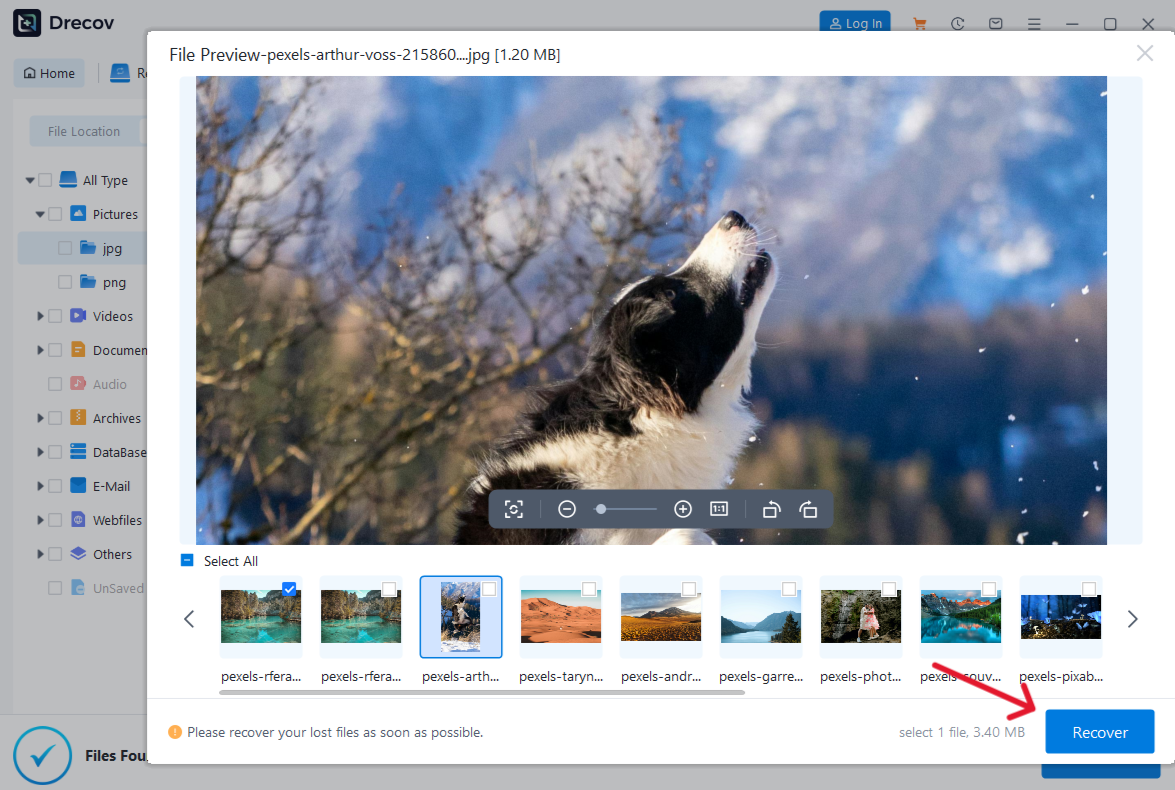
Step 4: Secure Recovery
Select the photos you wish to restore and click “Recover”.
Key Operation Point: Always save the recovered files to a different drive (like an external USB stick) to ensure 100% data integrity during the writing process.
Related Data Management Resources
Managing your Google account goes beyond just photos. If you are cleaning up your digital footprint, you might find these guides helpful:
- Learn how to remove bookmarks from Google Chrome to streamline your browser.
- If you accidentally wiped your browser data, here is how to get your Google Chrome bookmarks back.
- A deeper look into how to recover deleted bookmarks in Chrome for power users.
- The essential guide for everyday users to recover Chrome bookmarks.
Alternative Methods for Mass Deletion
Using Google Takeout
If you have 100GB+ of photos, the web interface might hang. The safest way to “delete” is actually a three-step dance:
- Export: Use Google Takeout to get everything out.
- Verify: Ensure the ZIP files open and your photos are safe on your hard drive.
- Wipe: Use a script or the “Shift-Select” method to delete the cloud versions.
Using Third-Party Tools
There are browser extensions like “Delete All Google Photos” available on the Chrome Web Store. While they automate the scrolling and clicking, be cautious. Only use extensions with high ratings and recent updates, as Google frequently changes its website code, which can break these tools.
Common Problems and Fixes
- Photos Reappearing: This usually happens because another device (like an old tablet) is still turned on and re-syncing the photos back to the cloud. Fix: Log out of Google Photos on all devices except the one you are using to delete.
- “Error Deleting Items”: This occurs if you try to delete more than 500-1,000 photos at once. Fix: Refresh the page and delete in smaller batches.
- Storage Not Decreasing: Remember that the Trash takes up storage space. Fix: You must manually empty the trash to see the “Storage Used” meter go down.
Tips to Manage Photos Better in the Future
After you have mastered how to delete all photos from google photos, don’t let the clutter return.
- Disable “Auto-Backup” for folders like WhatsApp Images or Screenshots.
- Use “Partner Sharing” wisely; sometimes you are inadvertently saving someone else’s entire library to your own.
- Monthly Maintenance: Spend 5 minutes at the end of every month deleting the “junk” photos from that month. It’s much easier than a mass deletion every five years.
Delete All Photos From Google Photos FAQs
1. Can I delete all photos at once in Google Photos?
Yes. On a desktop, select the first photo, hold Shift, select the last photo, and hit Delete. This is the fastest method.
2. Will deleting photos from Google Photos delete them from my phone?
Yes, if “Back up & sync” is turned on. To prevent this, disable sync in the app settings before you start deleting from the web.
3. How do I permanently delete photos?
You must navigate to the Trash/Bin folder and select “Empty Trash.” Otherwise, they will sit there for up to 60 days.
4. Can I recover photos after deleting them?
Within 60 days, you can find them in the Trash. After that, you’ll need a tool like PandaOffice Drecov to scan your physical device for remaining data fragments.
5. Is there a faster way to delete thousands of photos?
For massive libraries, the “Shift-Click” method on a desktop browser is the most reliable. Third-party scripts exist but carry security risks.
Conclusion
Learning how to delete all photos from google photos is a vital skill for anyone living a digital-first life. Whether you are doing it for privacy, storage, or a fresh start, the process requires a careful balance of bulk actions and safety checks. Always remember to back up your data via Google Takeout before performing a mass wipe.
If the worst happens and you lose a memory you didn’t intend to delete, don’t panic. Tools like PandaOffice Drecov offer a high-tech safety net for google photos recovery, ensuring that “permanent” doesn’t always have to mean “gone forever.”





