







Almost everyone using the internet has experienced that painful moment when an important browser tab suddenly disappears. Maybe you accidentally clicked the close button, restarted your computer too quickly, closed the wrong Chrome window, or lost dozens of research tabs during a browser crash. One second the information is there, and the next it feels like it vanished into thin air. Fortunately, Google Chrome includes several powerful features that make reopening closed tabs surprisingly easy.
This complete guide explains how to open closed tabs on Chrome using different methods, including keyboard shortcuts, history restoration, recently closed sessions, mobile recovery, synchronization features, extensions, troubleshooting fixes, and advanced tab management strategies.
Why People Accidentally Close Chrome Tabs
Modern browsing habits involve constant multitasking. Many users keep work dashboards, emails, streaming sites, research articles, shopping pages, and social media tabs open simultaneously. With dozens of active tabs, accidental closures happen constantly.
Common causes include:
- Misclicking the X button: In a rush to switch windows, the cursor often slips.
- Browser crashes: Hardware overloads or software bugs can force Chrome to shut down.
- System restarts: Windows updates or power surges can terminate a session instantly.
- Keyboard shortcut mistakes: Accidentally pressing Ctrl + W instead of Ctrl + Q or other keys.
- Memory overload: If your RAM is full, the browser might struggle to keep pages active.
Luckily, Chrome offers several ways to recover lost tabs quickly.
Fastest Way to Reopen Closed Tabs
The easiest method uses a keyboard shortcut. If you just closed something seconds ago, this is your best friend.
Chrome Reopen Closed Tab Shortcut
- Windows and Linux: Ctrl + Shift + T
- Mac: Command + Shift + T
This shortcut instantly restores the most recently closed tab. Pressing it repeatedly restores multiple tabs in reverse order. Think of it like an “undo” button for browser tabs. If you accidentally closed a window with ten tabs, pressing this once will usually bring back the entire window.
How Chrome Stores Recently Closed Tabs
Chrome temporarily keeps session information after tabs close. This includes website URLs, tab order, browser windows, and session data. As long as browsing history is not deleted immediately, Chrome can usually recover recently closed pages. It manages this through a local cache that tracks your “Short-term History.”
Reopen Closed Window in Chrome
Sometimes users accidentally close an entire Chrome window instead of a single tab. The same shortcut still works.
- Open a new, fresh Chrome window.
- Press Ctrl + Shift + T.
- Chrome may restore all tabs, the window layout, and the previous browsing session.
This is incredibly useful during multitasking disasters where you lose hours of work in one click.
Using Chrome History to Restore Tabs
If keyboard shortcuts fail—perhaps because you closed the tabs a long time ago or restarted the browser multiple times—Chrome History becomes the next solution.
How to Open Chrome History
- Shortcut: Press Ctrl + H.
- Direct URL: Visit
chrome://history.
Chrome displays recently visited websites, closed pages, and browsing activity organized by date and time. Users can reopen lost tabs manually from this list by simply clicking on the entry. If you are looking for a tab from yesterday, the search bar in the History menu is the most efficient tool.
Reopen Tabs from Recently Closed Menu
Chrome includes a built-in “Recently Closed” section within its main menu. This is a visual way to see what you lost without opening a full history page.
Steps to Use the Menu
- Step 1: Right-click an empty area on the tab bar at the top of the browser.
- Step 2: Select Reopen Closed Tab.
- Step 3: Alternatively, click the three-dot menu in the top right corner, hover over History, and you will see a list of “Recently closed” items.
Some Chrome versions also show recently closed windows and groups, allowing you to restore a collective set of tabs at once.
How to Restore Tabs After Chrome Crash
Unexpected crashes sometimes close every open tab. Fortunately, Chrome often detects crashes automatically.
Chrome Session Restore
After reopening Chrome following a crash, you may see a notification in the top right corner that says: “Chrome didn’t shut down correctly. Restore pages?”
- Click: Restore.
If the message disappears too quickly, don’t panic. Navigate to History > Recently Closed, and you should see an entry like “8 Tabs” or “Window.” Clicking this will bring everything back to its previous state.
PandaOffice Drecov Data Recovery Software: Advanced Tab & File Recovery
While built-in browser features handle most “accidental clicks,” what happens if your browser profile is corrupted, your hard drive fails, or you accidentally delete your entire Chrome user data folder? In these professional-level scenarios, standard shortcuts won’t help. This is where PandaOffice Drecov data recovery software comes into play.
When Chrome closes, it writes data to your local disk in a folder called “Default” or “Profile 1.” If this data is lost due to a system crash or accidental deletion, PandaOffice Drecov data recovery software can scan your storage media to find and reconstruct these lost configuration files.
⚠ Warning: Install it on a drive different from the one where your data was lost to prevent overwriting.
Steps to Recover Chrome Data Files with PandaOffice Drecov
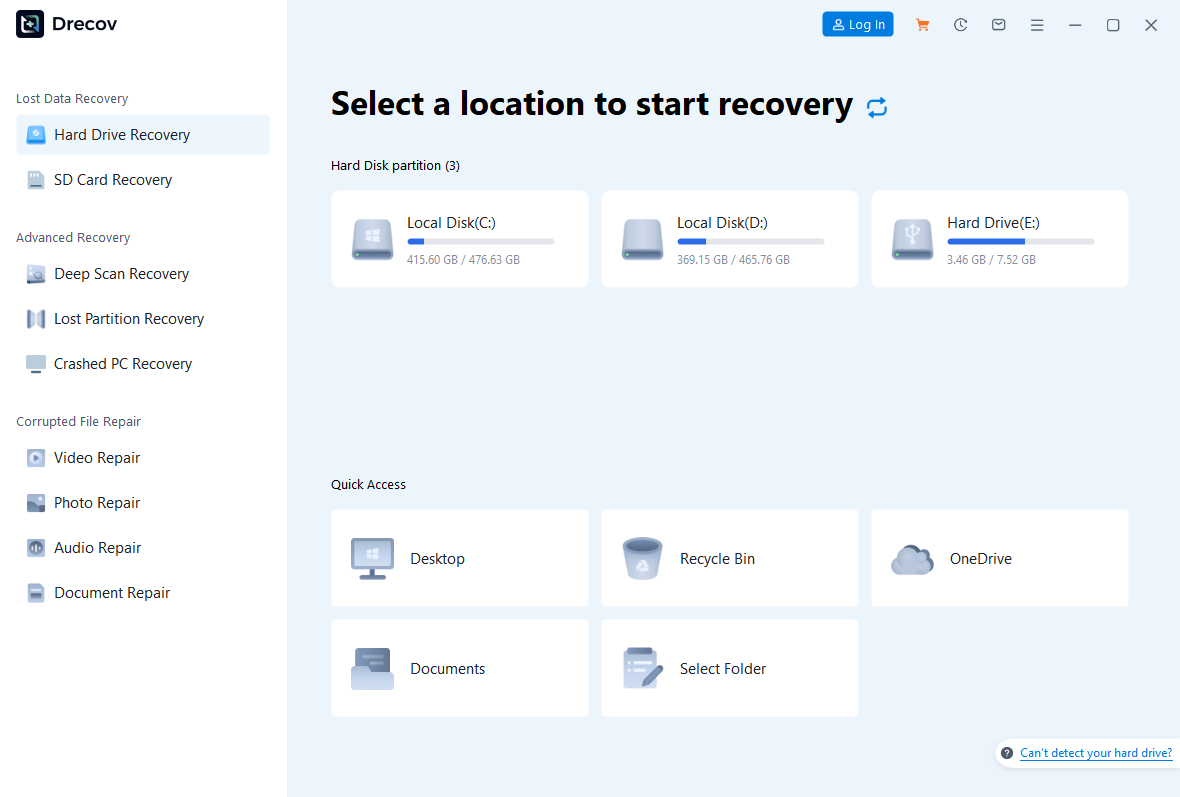
Step 1: Select the Location
Launch the tool and select the partition where your Chrome user profile was located. Usually, this is C:\Users\[YourName]\AppData\Local\Google\Chrome\User Data. You can also just select the entire C drive for a comprehensive scan.
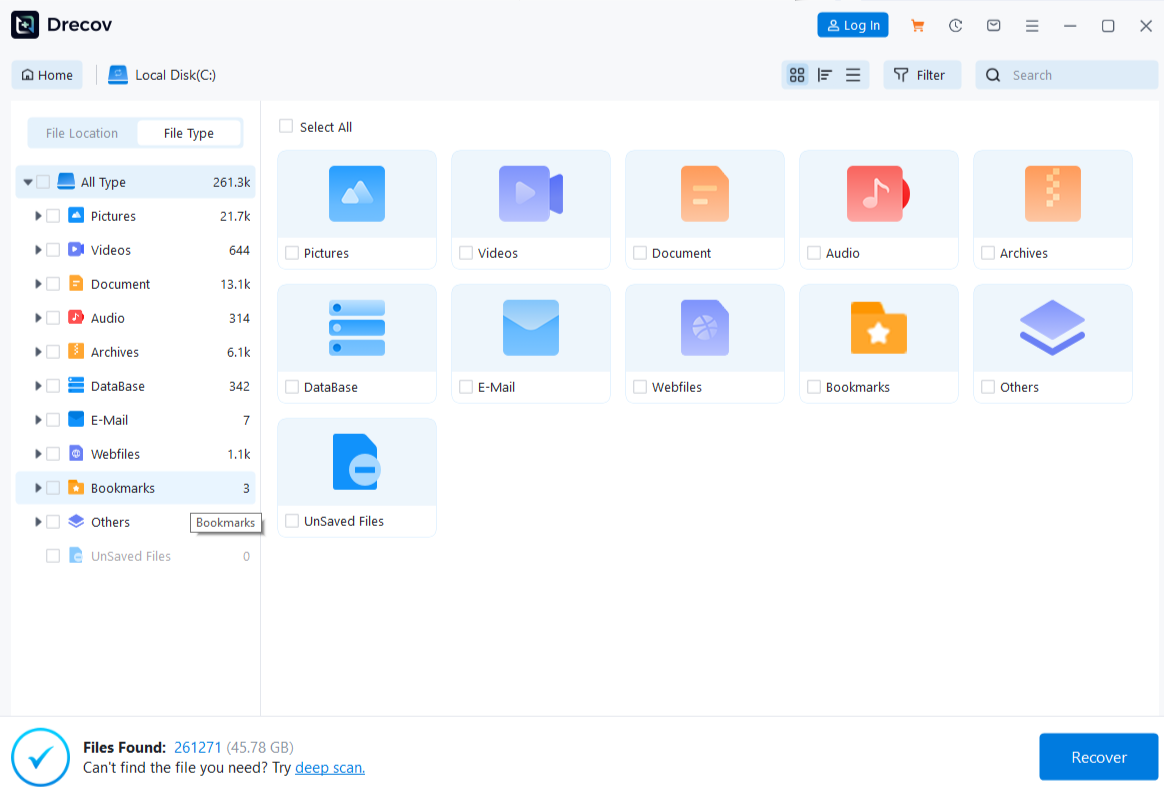
Step 2: Deep Scan for Database Files
Click the “Scan” button. PandaOffice Drecov will perform a deep analysis of the file system. It looks for “History,” “Current Session,” and “Last Session” files which are essentially SQLite databases containing your tab information.
Step 3: Preview and Recover
Once the scan is complete, use the filter feature to search for “Chrome” or look through the folder structure. Highlight the files you need and click Recover.
Warning Prompt: Never save the recovered files directly back into the original Chrome folder until you have verified them. Save them to an external USB or a separate folder first to ensure data integrity.
By recovering these specific session files, you can manually replace corrupted files in your Chrome directory and effectively open closed tabs on Chrome that were thought to be gone forever.
If you are a power user with hundreds of tabs, you should treat your Chrome profile like any other important data. Using PandaOffice Drecov data recovery software is a great “plan B,” but regular backups of your User Data folder are also recommended. For more specialized digital tasks, you might also be interested in:
- How to download videos from browsers like Firefox
- How to optimize your AI experience with ChatGPT
- Fast ways to format USB drives for data storage
Reopen Closed Tabs on Android
Chrome mobile users can also recover tabs, though the interface is slightly different.
Steps for Android
- Step 1: Open the Chrome app on your smartphone.
- Step 2: Tap the three-dot menu in the top right corner.
- Step 3: Select Recent Tabs.
- Step 4: Previously closed pages appear here under the “Recently closed” heading. Tap any link to reopen it.
This works for many recent browsing sessions and even shows tabs open on other devices if you are signed in.
Reopen Closed Tabs on iPhone and iPad
Chrome on iOS supports similar recovery options, making it easy to jump back into your work.
Steps for iOS
- Step 1: Open the Chrome app.
- Step 2: Tap the three-dot menu icon (often at the bottom or top right).
- Step 3: Choose Recent Tabs.
- Step 4: Review the list of pages you recently navigated away from and tap the one you wish to restore.
Sync Chrome Tabs Across Devices
Chrome synchronization is an incredibly useful feature for tab recovery. Using a Google account allows Chrome to sync your tabs, history, bookmarks, passwords, and even open windows across all your hardware.
How to Enable Chrome Sync
- Step 1: Open Chrome Settings.
- Step 3: Click on “You and Google” and sign into your Google account.
- Step 3: Enable Sync everything or specifically ensure Open Tabs is toggled on.
Now browsing activity synchronizes across devices. If your laptop dies, you can open closed tabs on Chrome by picking up your phone, going to “Recent Tabs,” and seeing the “Tabs from other devices” section. This creates a massive safety net for lost information.
Using Chrome Tab Search
Modern Chrome versions include a Tab Search feature located at the very top of the window (the small downward arrow).
How to Access Tab Search
Click the small dropdown arrow near the tabs area (or press Ctrl + Shift + A). This tool allows you to:
- Search currently open tabs.
- View a dedicated list of Recently Closed tabs.
- Restore browsing sessions with a single click.
This is especially useful for people managing large numbers of tabs who don’t want to dig through the full history page.
Chrome Extensions for Tab Recovery
Several Chrome extensions improve session management beyond what the default browser offers. You can find these in the Chrome Web Store.
Popular Extension Categories
- Session Savers: Tools like “Session Buddy” automatically save your open tabs at set intervals.
- Tab Managers: Help you categorize tabs into folders so they don’t get lost in the first place.
- Workspace Organizers: Allow you to switch between different “modes” (e.g., Work vs. Personal) without closing tabs.
Best Uses for Tab Management Extensions
Extensions help users save browsing sessions for weeks, organize complex projects, and restore windows automatically after a crash. Heavy multitaskers, like developers or researchers, often rely on these tools daily to keep their digital workspace clean and recoverable.
Prevent Losing Tabs in the Future
While knowing how to open closed tabs on Chrome is a vital skill, prevention saves even more time.
Smart Prevention Tips
| Tip | Benefit |
| Bookmark important pages | Permanent access regardless of session history. |
| Enable sync | Cross-device recovery and cloud backup. |
| Use tab groups | Better organization and accidental closure protection. |
| Set Chrome to “Continue where you left off” | Automatically restores tabs every time you open Chrome. |
| Avoid force shutdowns | Prevents database corruption within the Chrome profile. |
Good browsing habits reduce recovery headaches significantly. One of the best settings to change is found in Settings > On startup > Continue where you left off. This ensures that even if you close the browser, your tabs are waiting for you next time.
Chrome Tab Groups for Better Organization
Chrome Tab Groups help organize related pages together. When you group tabs, you can collapse them to save space or move them as a single unit.
Example Groups
- Work: Office tasks, Jira, and Email.
- Research: Academic papers and Wikipedia.
- Shopping: Product comparisons and Amazon.
- Entertainment: YouTube, Netflix, and music.
Organized tabs are less likely to be closed accidentally because you are interacting with a “Group” rather than a sea of tiny, unidentifiable icons.
Why Chrome Tabs Disappear Sometimes
Several issues may cause tabs to vanish unexpectedly. Understanding the cause helps prevent future problems.
- Memory Overload: If your computer runs out of RAM, Chrome might “discard” tabs. They stay in the bar but must reload when clicked.
- Corrupted Profiles: If your local user file is damaged, Chrome might reset to a blank state.
- Extension Conflicts: Some “cleaner” extensions might automatically close inactive tabs to save speed.
- Automatic Updates: Windows or Chrome might restart during the night to apply security patches.
Troubleshooting Tab Recovery Problems
Sometimes Chrome fails to restore tabs properly. If the Ctrl + Shift + T shortcut doesn’t work, try these steps:
- Restart Chrome: A simple restart often fixes temporary glitches in the session manager.
- Update Chrome: Outdated browsers may behave unpredictably. You can update Chrome via the Official Google Chrome Support site.
- Disable Problematic Extensions: Faulty extensions sometimes interfere with session restoration. Try disabling tab managers or “memory savers” to see if the default behavior returns.
- Check Incognito Mode: Remember that Chrome never saves history or closed tabs from Incognito windows. If you close an Incognito tab, it is gone forever for privacy reasons.
Using Bookmarks as Backup Protection
Bookmarks remain the safest long-term protection against lost tabs. While a session might expire or a history log might be cleared, a bookmark is a permanent entry in your database.
Bookmark Shortcuts
- Bookmark one page: Ctrl + D
- Bookmark all open tabs: Ctrl + Shift + D
The latter is a “pro tip” for researchers. Before closing a massive window, press Ctrl + Shift + D to save every single open tab into a dated folder. This acts as a manual restore point that you can access from any device.
Benefits of Mastering Chrome Tab Recovery
Knowing how to open closed tabs on Chrome helps save time, reduce stress, and improve productivity. Students can recover lost citations, remote workers can restore crashed meetings, and researchers can protect days of progress.
As internet browsing becomes increasingly complex and multitasking-heavy, mastering these techniques is an essential skill for modern computer users. Whether you are using a simple keyboard shortcut or employing the deep-scanning power of PandaOffice Drecov data recovery software, your data is rarely truly gone.
Conclusion
Accidentally closing tabs in Chrome can feel frustrating, especially when important work, research, or entertainment disappears unexpectedly. Fortunately, Chrome includes powerful recovery tools that make reopening closed tabs fast and simple. Whether you use keyboard shortcuts like Ctrl + Shift + T, browse Chrome History, restore recently closed windows, enable synchronization, or use tab management extensions, there are multiple reliable ways to recover lost browsing sessions.
Understanding how to open closed tabs on Chrome and manages recently closed tabs helps users avoid unnecessary stress and lost productivity. Small habits like enabling sync, bookmarking important pages, organizing tab groups, and using session management tools can dramatically improve browsing efficiency while reducing the risk of losing valuable information. Always remember that even in the event of a severe system failure, professional tools are available to help you reconstruct your digital life. Stay calm, use the shortcuts, and keep browsing with confidence.






