







Welcome to this comprehensive guide on digital recovery. If you have ever experienced that sinking feeling when a thumb drive suddenly appears empty or prompts a “format disk” error, you are not alone. Data loss is a common hurdle in our digital lives, but with the right usb flash data recovery software, those “lost” files are often just hiding.
In this article, we will explore the mechanics of how data is stored, why it disappears, and provide a step-by-step roadmap to getting it back using professional and open-source tools.
Understanding the Basics of USB Data Loss and Recovery
Before diving into the “how-to,” we must understand the “why.” USB flash drives use NAND flash memory, a non-volatile storage technology. Unlike traditional hard drives with spinning platters, flash drives have no moving parts. However, they are susceptible to logical corruption and physical wear.
When you delete a file, the operating system doesn’t actually erase the data immediately. Instead, it marks the space occupied by that file as “available” in the File Allocation Table (FAT) or Master File Table (NTFS). As long as you do not write new data to the drive, the original bits remain intact. This is the golden window where usb flash data recovery software performs its magic.
Common Reasons for USB Data Corruption
- Improper Ejection: Pulling a drive out while the OS is still writing to the “map” (file system) can lead to a RAW drive state.
- Electronic Surge: Static electricity or unstable power ports can fry the controller chip.
- Limited Write Cycles: Every flash cell has a lifespan. Over time, these cells wear out, leading to read/write errors.
- Virus Attacks: Malware can hide partitions or encrypt headers, making files invisible to File Explorer.
The Science of “Ghost” Files: Why Data Recovery is Possible
Have you ever wondered why deleting a 10GB movie takes only a fraction of a second, while copying that same file takes several minutes? The answer lies in how operating systems like Windows and macOS manage storage.
Think of your USB flash drive as a massive library. When you save a file, the system does two things:
- It writes the actual data (the “text” of the book) onto the NAND flash memory chips.
- It records the file’s name and location in a File Allocation Table or Master File Table (the library’s “index card catalog”).
When you click “Delete,” the computer doesn’t go into the stacks and shred the pages of the book. Instead, it simply walks over to the index card catalog and puts a “Discard” stamp on the card. To the computer, that space is now marked as unallocated—meaning it is free to be overwritten whenever new data comes along.
As long as you haven’t written a “new book” over those specific “pages,” the original data remains physically present on the drive. This is exactly what usb flash data recovery software exploits. It ignores the corrupted or empty index catalog and scans the “library shelves” directly to reconstruct the original files based on their unique binary signatures. This is why the #1 rule of data recovery is to stop using the drive immediately; every new file you save is a potential “new book” that could overwrite your lost treasure.
Part One: Preparing for a Successful Recovery Operation
Success in data recovery is 50% tool selection and 50% preparation. If you rush the process, you risk overwriting the very data you are trying to save.
Crucial Pre-Recovery Steps
- Stop All Write Operations: The moment you realize data is missing, unplug the drive. Do not save new documents to it, and do not “fix” it using Windows CHKDSK, as this can sometimes overwrite file fragments.
- Verify Hardware Connectivity: Sometimes the issue isn’t the data, but the port. Before assuming the drive is dead, try a different port or a different computer.
- Check Disk Management: Press
Win + Xand select Disk Management. If your USB shows up as “Removable” with a drive letter, even if it says “RAW,” software recovery is highly likely to succeed.
For a deeper dive into hardware-related issues, you might find our USB ports not working troubleshooting guide helpful in determining if the problem lies with your PC.
Part Two: Professional Recovery with PandaOffice Drecov
When you need a reliable, high-success-rate solution without a steep learning curve, PandaOffice Drecov is the industry standard. It is designed to handle complex scenarios like formatted partitions, lost drive letters, and deleted folders with an intuitive graphical interface.
⚠ Warning: Install the software on your local C: drive or a different external disk. Never install recovery software onto the USB drive you are attempting to rescue.
How to Recover Files Using PandaOffice Drecov
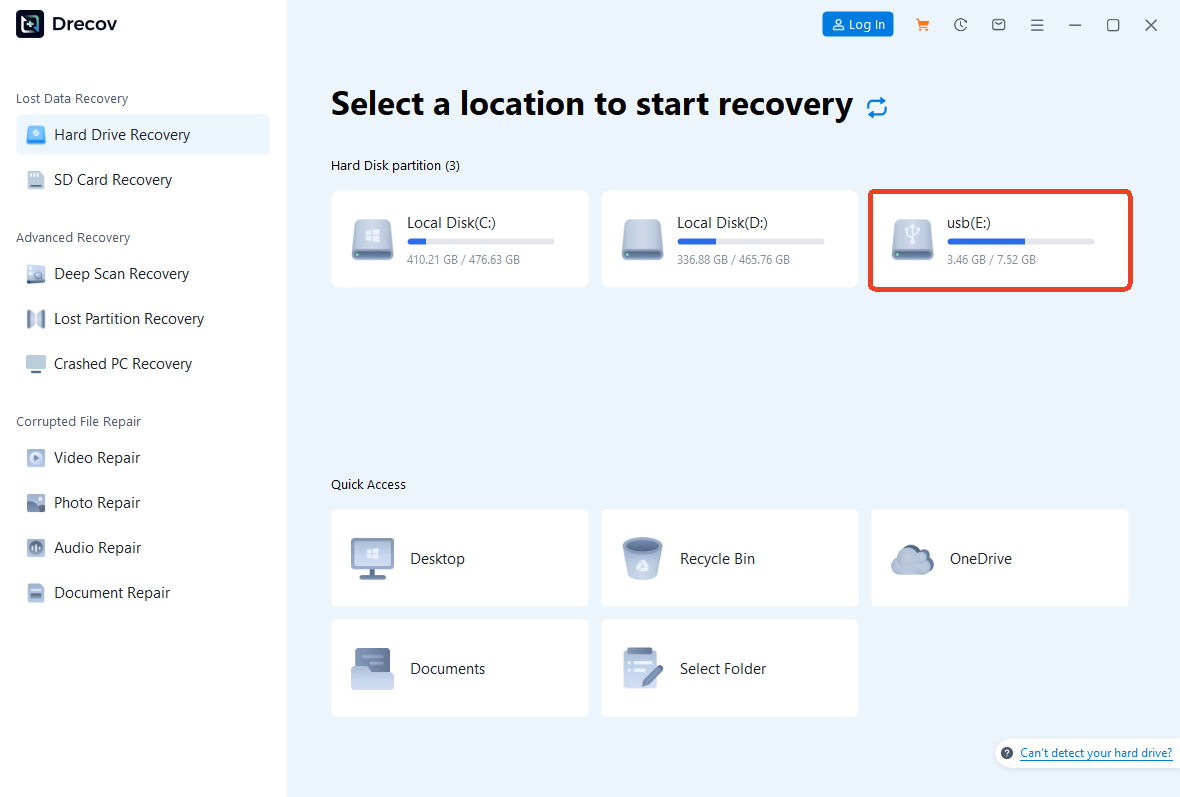
Step 1: Connect and Select the Target Device
Plug your USB flash drive into a high-speed USB 3.0/3.1 port for the best scanning speeds. Launch Drecov, and on the main interface, you will see a list of available drives. Identify your USB drive by its size and name.
Step 2: Initiate the Scan
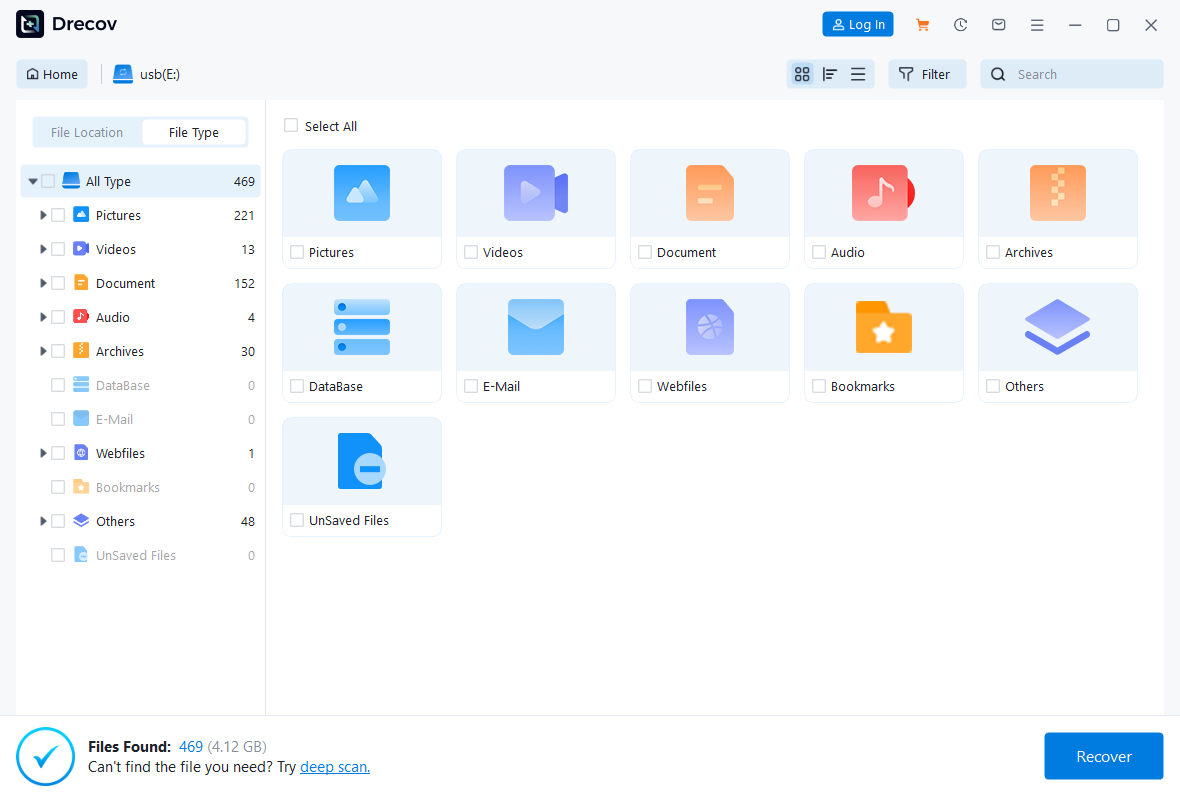
Click the “Scan” button. PandaOffice Drecov will automatically perform two types of scans:
- Quick Scan: Targets recently deleted files by scanning the file directory.
- Deep Scan: This is the “heavy lifter.” It scans the drive sector by sector, looking for file signatures (headers) even if the file system is completely destroyed.
Step 3: Filter and Preview Results
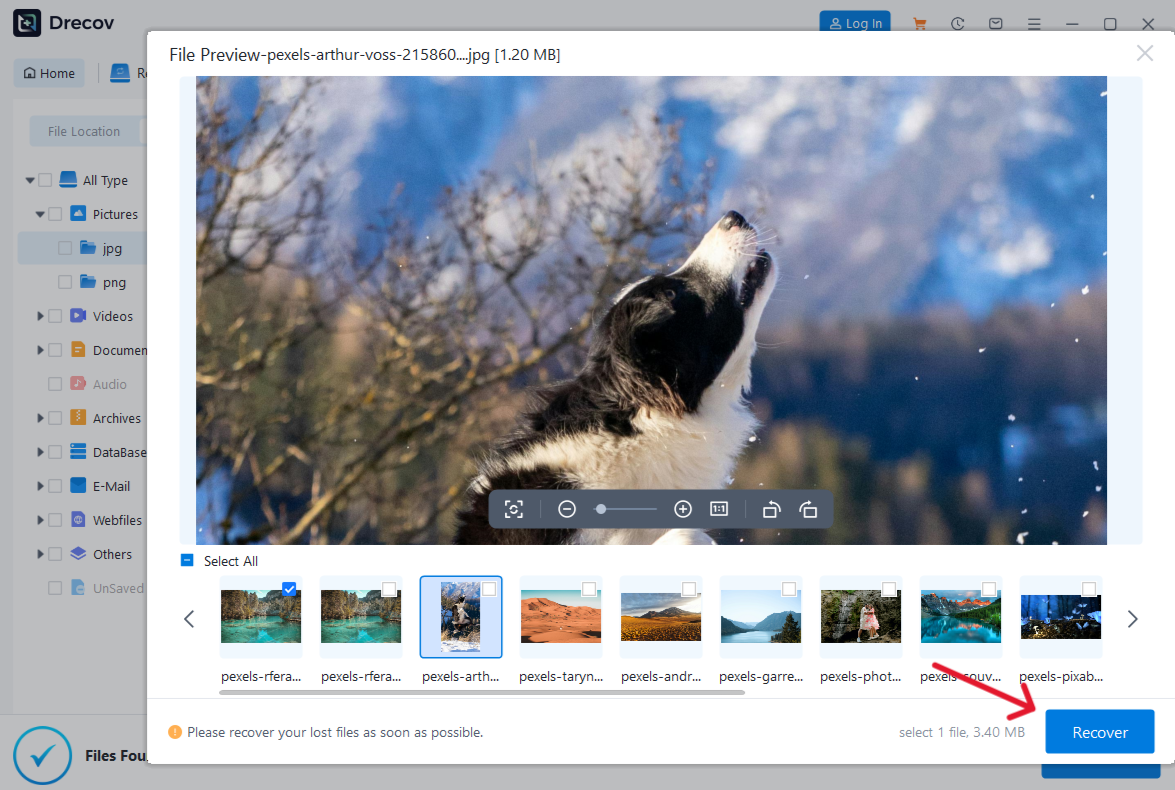
As the scan progresses, files will begin to populate the list. You can use the sidebar to filter by file type (e.g., Photos, Documents, Videos). Drecov provides a Preview feature; double-click a file to see if it is intact before you commit to recovering it.
Step 4: Select a Recovery Destination
Check the boxes next to the files you wish to save. Click “Recover”. A prompt will ask where to save the data.
Warning: Choose a destination on your computer’s hard drive or a different cloud-mapped folder. Saving back to the source USB drive will cause permanent data overwriting.
Part Three: Open-Source Alternatives for Technical Users
If you prefer a free, open-source approach and are comfortable with a text-based interface, PhotoRec (distributed with TestDisk) is a powerful usb flash data recovery software alternative. It ignores the file system entirely and goes after the underlying data.
Using PhotoRec for Deep Signature Recovery
Step 1: Launch the Tool
Download the TestDisk/PhotoRec archive from CGSecurity. Extract the folder and right-click photorec_win.exe, then select Run as Administrator.
Step 2: Select the Media
Use the arrow keys to select your USB drive from the list. Press Enter to proceed.
Step 3: Choose the Partition
If the drive is corrupted, you may see a “No Partition” option or the original partition. Generally, selecting the main partition is the best start.
Step 4: File System Settings
PhotoRec will ask for the file system type. For almost all USB drives used on Windows or Mac, select [Other] (which covers FAT, NTFS, and exFAT).
Step 5: Select the Search Scope
You can choose to scan only the [Free] space (to find deleted files) or the [Whole] partition. If the drive was formatted, choose [Whole].
Step 6: Define Destination and Execute
Navigate to a folder on your PC where the files should be “carved.” Press C when you are in the correct directory. The software will begin the recovery process, creating folders named recup_dir.1, recup_dir.2, etc.
Part Four: Advanced Windows Command-Line Recovery
For Windows 10 (version 2004 and later) and Windows 11 users, Microsoft provides its own command-line usb flash data recovery software called Windows File Recovery (WinFR).
Step-by-Step WinFR Execution
- Install the Tool: Get “Windows File Recovery” from the Microsoft Store.
- Open as Admin: Type
cmdin the start menu, right-click, and run as administrator. - Command Syntax: Use the following structure:
winfr source-drive: destination-drive: [/mode] [/switches]For a typical USB recovery (where USB is drive E: and you want to save to D:), use Extensive mode:winfr E: D:\RecoveryFolder /extensive /n *.jpg /n *.docx
This command specifically looks for JPEG images and Word documents on the E: drive and restores them to the D: drive.
Part Five: Technical Deep Dive – Where Does the Data Go?
Experienced users might wonder about the forensic trail a USB leaves behind. When a USB is connected, Windows records the event in the Registry. If you are troubleshooting a drive that won’t mount, you can check this path:
HKEY_LOCAL_MACHINE\SYSTEM\CurrentControlSet\Enum\USBSTOR
This key contains the hardware ID and serial number of every USB device ever connected to the system. If your software isn’t detecting the drive, sometimes deleting the specific sub-key here and replugging the drive forces Windows to reinstall the driver correctly.
Best Practices to Prevent Future Data Loss
- The 3-2-1 Rule: Keep 3 copies of your data, on 2 different media types, with 1 copy off-site (cloud).
- Always Eject Safely: Use the “Safely Remove Hardware” icon in the system tray. This ensures all cached “write” operations are completed.
- Monitor Drive Health: Use tools that read S.M.A.R.T. data to check for “retired blocks” on your flash drive.
Conclusion
Recovering data from a USB flash drive doesn’t have to be a nightmare. Whether you choose the streamlined efficiency of PandaOffice Drecov, the raw power of PhotoRec, or the native Windows tools, the key is to act quickly and avoid writing new data to the affected device.
Now that you have learned how to use usb flash data recovery software, you might want to ensure your USB is optimized for future use. If you were forced to format your drive during this process, check out our guide on how to recover deleted files from a USB drive for more specific file-type recovery tips.
If your recovery was part of a larger system fix, you might also need to reinstall Windows 10 from a USB to ensure your PC is running at peak performance.






