







To repair Thunderbird safely, first determine whether the application will not start, one folder appears empty, or messages are missing from the mail account itself. Those problems need different actions. Before reinstalling, compacting, or creating a new profile, copy your current Thunderbird profile to another healthy drive. Then test the least invasive fix: Troubleshoot Mode for an app-wide failure, Repair Folder for a damaged folder index, or the provider’s webmail for a sync question. A reinstall is not a substitute for finding the mail data.
Repair Thunderbird: Match the Fix to the Symptom
Thunderbird includes the application, a local profile, message stores and indexes, extensions, account settings, and a connection to a mail server. A fault in one layer can imitate a fault in another. If all folders disappear after an update, do not immediately delete the profile. An empty Inbox alongside messages in webmail may indicate a local view, index, or synchronization issue. If neither Thunderbird nor webmail has the mail, a server-side deletion or retention problem needs attention beyond the desktop app.
Write down when the change began and whether it affects every account, one account, or one folder. Note any exact error message. Check whether Thunderbird opens in the background with a blank window, crashes immediately, or opens normally but fails to show expected messages. The distinction helps you test one cause at a time. Avoid repeated account removal and re-addition; synchronization can make it harder to understand what was originally stored only on the PC.
A quick server comparison is useful for IMAP accounts. Sign in through the provider’s official webmail and check Inbox, Archive, Trash, and search. Do not assume all accounts are IMAP, though. POP and Local Folders may hold mail that exists only in the Thunderbird profile. For those, a server view cannot replace a profile backup.
Before You Repair Thunderbird, Copy the Active Profile
If Thunderbird opens, choose the menu, Help, then Troubleshooting Information. Under Application Basics, use Open Folder beside Profile Folder. Leave that Explorer window open, close Thunderbird fully, and copy the whole profile folder to another healthy physical drive. Mozilla’s profile-location guidance also documents how to find the Windows profile at %APPDATA%\Thunderbird\Profiles\ when the app will not open. Do not delete or rename the original while making the copy.
Check that the copied folder contains more than a shortcut or empty shell. It should have files and subfolders such as account settings and mail storage, although exact contents differ by configuration. Record its size and the Windows account used. On a shared PC, another user’s profile might look similar but not hold your messages. If the source drive clicks, repeatedly disconnects, or returns severe read errors, stop copying attempts and seek advice about imaging or professional recovery instead of pushing it through another scan.
The companion Thunderbird mail backup guide covers a longer-term plan for Local Folders and profile copies. Here the copy is a safety checkpoint before repair. Store it away from a sync folder that could mirror accidental deletions. Do not compact or clean up mail storage merely to make the backup smaller.
When Thunderbird will not open, use Troubleshoot Mode
Close any stuck Thunderbird process if you can do so without interrupting an active profile copy. Hold Shift while starting Thunderbird on Windows, or, if the application is already open, choose Menu > Help > Troubleshoot Mode and accept the restart. Continue in Troubleshoot Mode without choosing permanent changes at first. Mozilla describes this mode as temporarily disabling several customizations and extensions so you can see whether they caused the problem. Your mail data is not intentionally removed by entering the mode.
If Thunderbird now opens, test the exact action that previously failed. Open the affected folder, search for a known message, and wait for the account to settle. Then return to normal mode and disable extensions one at a time through Add-ons and Themes. Test after each change. A theme or hardware-acceleration issue is possible, but do not change every setting together; otherwise you will not know which one mattered. Keep the profile backup until the app works across a normal restart.
If the failure continues in Troubleshoot Mode, extensions are less likely to be the cause. Check whether Windows has enough free space, whether security software is blocking the profile, and whether another process holds it open. Record the error before reinstalling. An app reinstall typically replaces program files, while the profile may remain, but it is not safe to assume the correct profile will be selected afterward. Use your copied profile to compare contents if a new empty window appears.
When one folder looks empty, repair its index
First compare that folder with webmail and with any other Thunderbird folder. If messages exist on the server but one local folder list is blank, the index may be stale or damaged. After copying the profile, right-click the affected folder in Thunderbird, choose Properties, then select Repair Folder. Wait for the index to rebuild and reopen the folder. This is a targeted action; do not run it on every folder simply because one view is wrong.
Check several message subjects and open message bodies, not just the folder count. An index can show a title without a complete local message. If the folder remains empty, confirm you selected the correct account and folder, then check whether the server retains the mail. Mozilla’s support material on interrupted compacting describes how an empty index may make mail temporarily invisible and why Repair Folder can rebuild it. It does not promise to recreate messages whose underlying store was deleted.
Compacting is a separate operation that rewrites storage to reclaim space from deleted messages. It is not the first fix for a missing folder and may add risk if the disk is unstable or the profile is being touched by other software. Preserve a working copy before any compact or storage cleanup. If a mail server has deleted a message, rebuilding a local index cannot undo that server action.
When mail is missing, locate the account and copies
Search all folders and accounts for a distinctive sender, phrase, or attachment name. Look in Archive, Trash, Junk, and Local Folders. In webmail, search the same time period using the same account. A changed folder subscription, filter, or view can make messages seem absent. If webmail has the item, use the account’s supported synchronization or export path rather than replacing local mailbox files by hand.
For POP or Local Folders, compare the active profile with your backup and any old computer. A mailbox file can exist in a previous profile even when Thunderbird starts under a new empty profile. Do not paste isolated files into the live profile while Thunderbird is running. Verify the old profile’s identity and make another copy before attempting a restore. The profile manager may allow you to point Thunderbird at an existing intact profile; use Mozilla’s documented profile procedure rather than guessing at random folder names.
If a single email was deleted on the server, inspect the provider’s Trash or admin retention options. Drecov cannot reach into a remote mailbox to reverse server deletion. For broader email-deletion options, see the deleted-email recovery overview, but keep the Thunderbird profile separate from the server account in your notes.
Recover a deleted local profile only when it is truly gone
A missing local profile, mailbox store, exported message, or saved attachment on stable Windows storage is the point where PandaOffice Drecov may help. It uses a read-only recovery workflow with Quick Scan, Deep Scan when needed, filters, preview, and recovery to a different healthy device. Its Lost Partition Recovery mode may search for files from a missing partition on a readable disk. It does not repair Thunderbird itself, resynchronize an account, decrypt unknown credentials, or guarantee files already overwritten or released by SSD TRIM. Check your profile copy, backups, old PC, and provider first.
⚠ Warning: Install it on a drive different from the one where your data was lost to prevent overwriting.
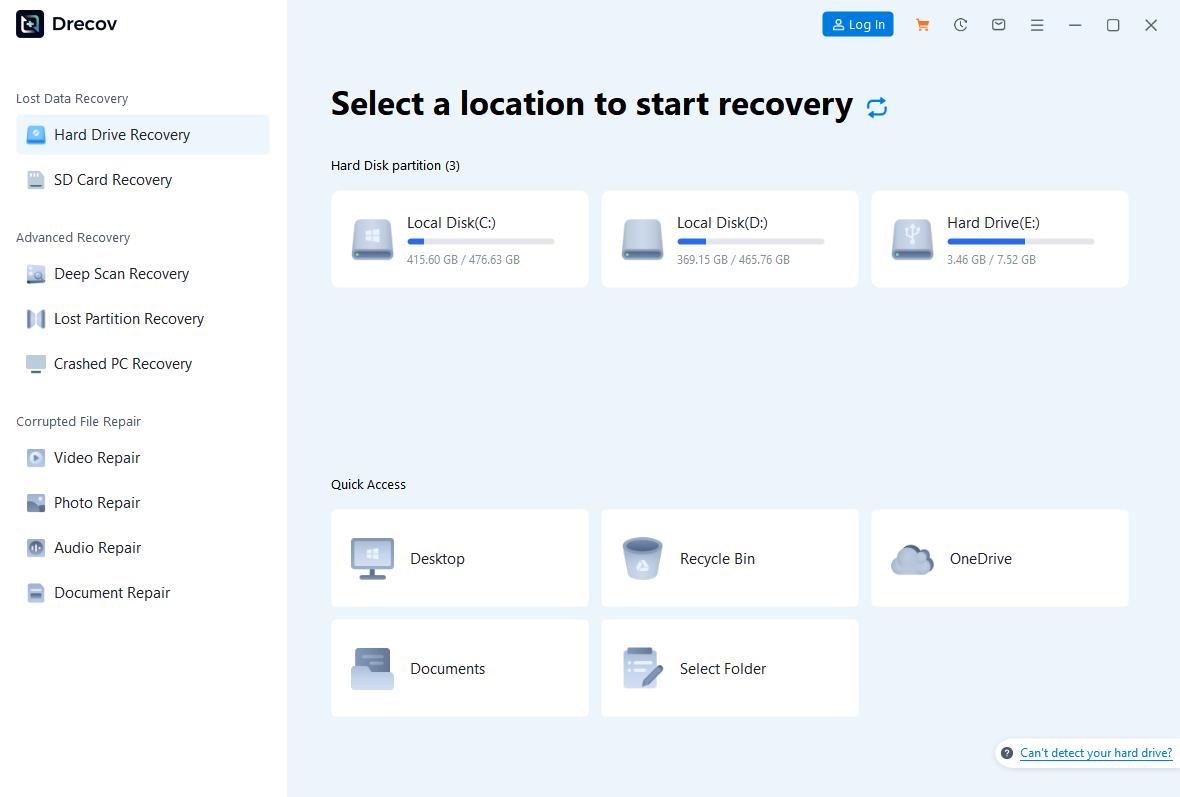
Step 1: Select the drive that held the profile
Stop writing to the affected Windows volume as much as possible. Prepare a separate healthy physical drive for results. Do not install Drecov on the partition where the Thunderbird profile was lost. Open Drecov and select that original Windows disk or partition, using the known profile location to guide your search. If the disk itself is unstable, stop and seek imaging or professional help instead of continuing software scans.
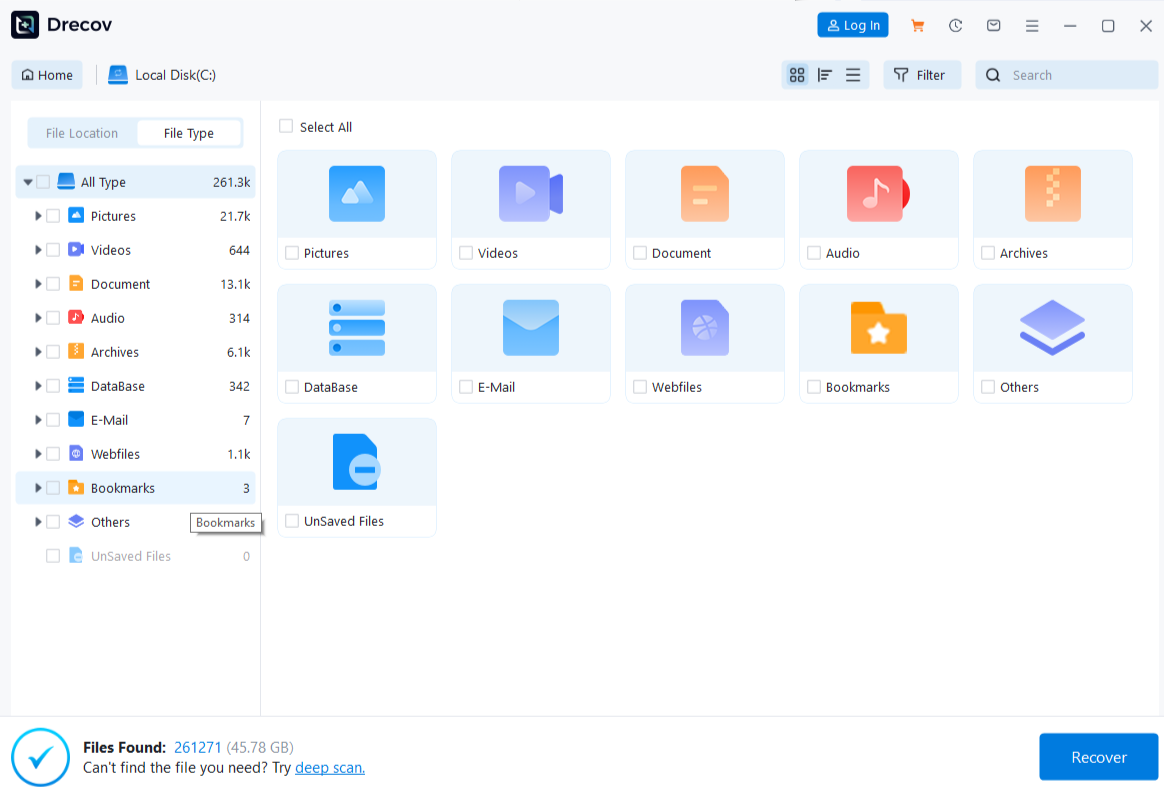
Step 2: Start Quick Scan and inspect profile paths
Run Quick Scan. Browse for Thunderbird\Profiles, the former profile folder, mailbox stores, address books, exported messages, and saved attachments that matter. A familiar folder name alone does not prove the whole profile survived. Compare dates and sizes with your earlier inventory or any backup.
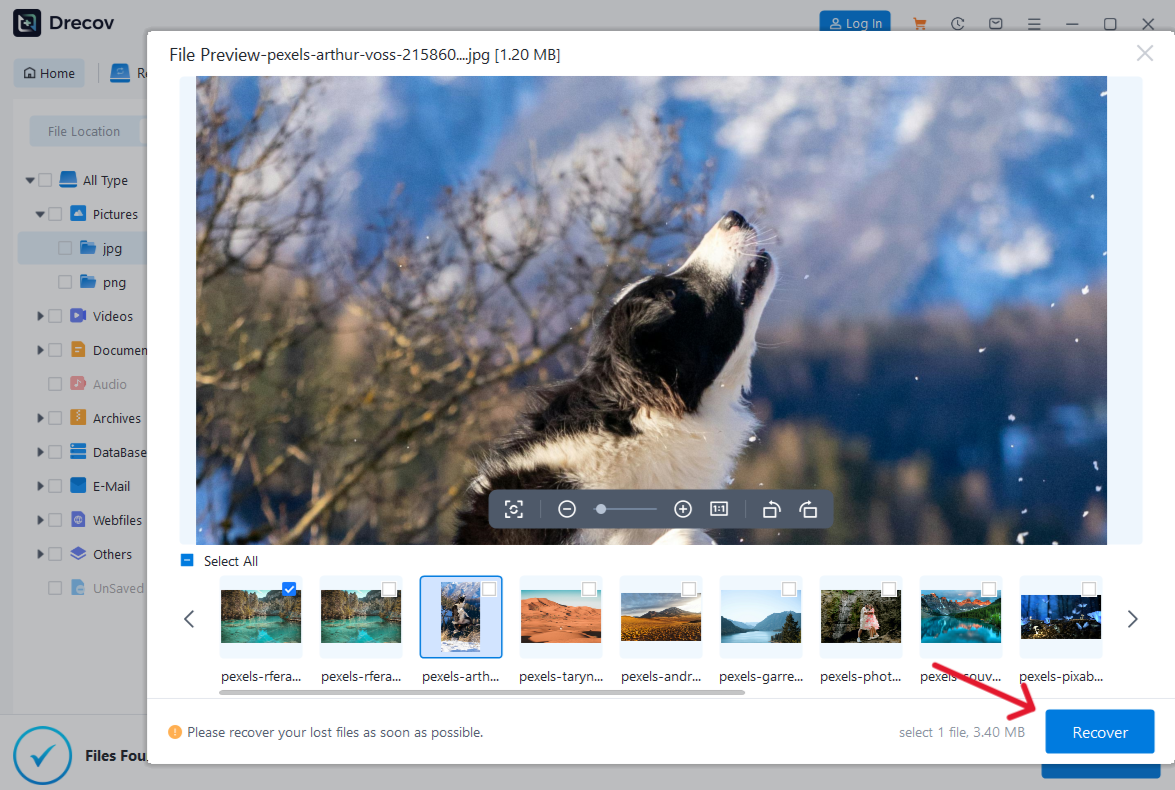
Step 3: Search deeper and preview candidates
If important local files remain missing and the storage stays stable, run Deep Scan. Filter by previous path, file type, or name where available. Preview representative supported documents and attachments; a mailbox container may not preview as ordinary email. Keep related candidate files together for later testing rather than assuming one recovered index file is enough.
Step 4: Restore elsewhere and test a copy
Recover candidates to the prepared healthy device, never to the source. If they are not where expected, check Drecov Folder or Recovery Folder at the destination. Work with a copy of the recovered profile. Open Thunderbird using a documented profile procedure and verify account identities, several old messages, attachments, Local Folders, and address books. Do not overwrite the surviving active profile until that test confirms the recovered one is useful.
⚠ Warning: Install it on a drive different from the one where your data was lost to prevent overwriting.
FAQs
Will reinstalling Thunderbird remove my emails?
Program files and profile data are separate, but mistakes can still select or overwrite the wrong profile. Copy the current profile first and confirm its location before reinstalling anything.
What does Repair Folder actually repair?
It rebuilds the folder’s local index. This helps when messages exist but the folder list is wrong. It cannot recreate messages removed from the underlying store or mail server.
Is Troubleshoot Mode safe for mail?
Mozilla describes it as a temporary diagnostic mode that disables selected customizations. Start without permanent changes, then test the original symptom. Keep the profile backup for any later repair.
Why is webmail full while Thunderbird looks empty?
The local view, folder subscription, sync state, or selected account may differ. Check one known message and the correct account before modifying profile files.
Can Drecov recover mail that exists only on the server?
No. It searches suitable Windows-accessible local storage. Use the provider’s trash, backup, or administrator process for mail never stored locally.
Conclusion
Repair Thunderbird by matching the fix to the symptom: Troubleshoot Mode for an app-wide problem, Repair Folder for a suspect local index, and account or webmail checks when messages are missing. Preserve the active profile before any structural change. If a local profile or attachment was truly deleted from stable Windows storage and no intact copy exists, Drecov can search the original volume and save candidates to another drive. Verify recovered mail in a test profile before replacing anything that still works.
⚠ Warning: Install it on a drive different from the one where your data was lost to prevent overwriting.