







“Volume information for this disk cannot be found” usually appears after you open a disk’s Properties in Device Manager, choose Volumes, and click Populate. It means that view did not return usable volume details; it does not prove the disk is blank. First compare the disk’s model and capacity in Device Manager with its entry in Disk Management. If valuable files might still be on it, do not initialize, format, create a volume, or run a repair command merely to make the message disappear. Whether the disk stays detected matters more than the wording of this one dialog.
“Volume Information for This Disk Cannot Be Found”: What It Means
When “volume information for this disk cannot be found” appears, avoid treating the disk as empty. Device Manager lists devices and their drivers. A disk appearing under Disk drives shows that Windows has detected some hardware identity. It does not establish that the controller can read the partition table, that a volume is mounted, or that the files are intact. The Volumes tab asks Windows to populate details for that disk. The failure message therefore describes a failed information request, not a complete diagnosis of the hardware or file system.
Record exactly which physical disk you selected. Note its manufacturer or model, capacity, connection type, and any warning icon or code under the General tab. A stale hidden-device entry can remain after the storage is unplugged, so select the currently connected entry rather than assuming the first matching model is live. If this is a new disk that has never held data, the investigation may end differently from an old disk containing the only family photographs or work files.
Reports on Microsoft Q&A show the same text on quite different devices, including an external drive absent from Disk Management and a newly installed internal SSD. Those examples illustrate why the message is not evidence for one universal fix. Do not follow an unrelated forum instruction to change firmware, reinstall a driver, or initialize storage until your own disk’s state supports that action.
Missing Volume Information: Compare Four Windows Views
Keep the device connected if it is stable. Open Device Manager, Disk Management, Settings > System > Storage > Advanced storage settings > Disks & volumes, and File Explorer. Windows labels may vary slightly by version. In each view, look for the same physical device, then note its reported size, any partition, any drive letter, and whether files can be opened. Microsoft’s Disk Management documentation explains how to open that tool and what volume actions it provides. You are only observing for now, not using its initialize or format controls.
| What you see | What it suggests | Safe next question |
|---|---|---|
| Correct capacity, readable files in Explorer | The volume is accessible despite the Populate error | Can you copy and open important files elsewhere? |
| Correct capacity in Disk Management, but no letter | A volume may exist without an Explorer path | Is the partition healthy and correctly identified? |
| Correct capacity with RAW or unallocated status | Windows cannot present the old volume normally | Are backups complete before any structural change? |
| Device Manager entry only; no live disk elsewhere | Device identity is not translating into usable storage | Does another known-good connection change detection? |
| Wrong capacity or repeated disconnection | Hardware or connection instability is plausible | Should direct tests stop in favor of specialist imaging? |
A table can narrow the branch, not certify the cause. A device visible in Storage settings but not in Explorer still needs its volume state checked. Conversely, one temporary blank Disk Management window can reflect a delayed refresh. Wait briefly, use Action > Rescan Disks once if the interface allows it, and compare again. Do not repeatedly cycle power on a failing drive just to get a different display.
“Volume Information for This Disk Cannot Be Found”: Copy Accessible Files
A volume that opens in Explorer has given you the most useful evidence: real files are presently readable. Copy irreplaceable folders to another healthy physical device. Open a sample of documents, several full-size photographs, and part of a larger video from the destination. Compare file counts and sizes for critical folders. A successful copy dialog alone cannot show that every file is complete.
After preserving the data, you can investigate a narrow Device Manager or driver-display issue without gambling the only copy. Check the device’s Events tab for recent changes and note any error code in General. Microsoft documents specific Device Manager codes separately; a Populate failure without a code should not be treated as Code 28 or Code 31 by assumption. If the disk is external, try one direct port and a known-good cable or enclosure connection when practical. A drive that disconnects during the copy needs a different path from a stable drive with an empty Volumes tab.
For a newly purchased empty disk, confirm that no prior files are expected before considering setup actions. For a previously used disk, “Not initialized” is a state to investigate, not permission to click Initialize. That click writes metadata and can complicate recovery. A broader explanation of unrecognized file systems is relevant only if the volume actually appears as RAW or Windows reports that specific condition.
If Disk Management sees a disk but not your old volume
Healthy partition with no drive letter
Verify its size and file-system label against what you remember. After data protection, a stable existing partition with no letter may be assigned an unused letter in Disk Management through Change Drive Letter and Paths. Do not alter the Windows system volume or a partition used by an application. If the option is unavailable, Windows may not consider that volume mountable; forcing a partition change is not the same as adding a letter. Reopen Explorer after the change and confirm that the expected folders, not merely a new icon, appear.
RAW, unallocated, or “Not initialized” on a used disk
Leave the structure untouched while files matter. RAW says Windows cannot use the volume in its current state; unallocated indicates no presented partition in that region. Neither status proves every old file has been overwritten. First check independent backups and any complete copy made earlier. If the physical disk is stable and has a plausible size, a recovery scan may locate missing files before you decide whether to rebuild or format the source. The post-transfer missing-drive guide explains a narrower USB case; use it when the problem followed a file transfer rather than assuming every disk shares that cause.
CHKDSK repairs file-system structures and is not a harmless data-search command. It may not apply to an unallocated region at all. Likewise, DiskPart clean, partition creation, and formatting can overwrite information that a recovery tool needs. Only after securing and verifying the required files should you consider such changes, and only if you understand the exact disk being modified.
If the device appears only intermittently
Unplug other removable drives so you can identify the suspect device. For an external disk, check one direct port and one known-good compatible cable. Watch whether Device Manager shows the same model and whether Disk Management reports a stable capacity. If the disk drops out repeatedly, makes abnormal clicking sounds, becomes unusually hot, or changes apparent size, stop repeated Populate attempts and full scans. Further software checks cannot repair an electrical fault, failing controller, or damaged mechanism.
For important data, a professional assessment or controlled image is safer than trying different repair switches. Do not open a sealed hard drive, freeze it, or keep reconnecting it until it responds. If another computer reliably recognizes the disk, that comparison points toward a host-side port, enclosure, power, or driver path, but it still does not prove the stored files are safe. Preserve readable data promptly and investigate the host after the copy is verified.
An internal SSD requires a different physical check from a USB drive. Confirm its detection in firmware and its correct seating only if you are comfortable working inside the computer and the system is powered off. Avoid changing storage-controller or RAID settings casually. A mode change can make Windows unbootable even when the SSD itself is healthy. Record the current firmware setting before any authorized change.
Recover missing files from a stable recognized disk
When a previously used disk remains visible with a plausible capacity but its files or partition are missing, PandaOffice Drecov is a Windows data-recovery option. Its read-only recovery workflow provides Quick Scan, Deep Scan when needed, filters, preview, and a choice of another healthy destination. Lost Partition Recovery can search for data associated with a missing partition on a readable device. It does not force an absent disk to appear, repair a controller, rebuild the partition table, or guarantee files whose storage has been overwritten. Check a backup first; recovery software is the conditional path when that copy is missing or incomplete.
⚠ Warning: Install it on a drive different from the one where your data was lost to prevent overwriting.
Step 1: Select the source that matched your evidence
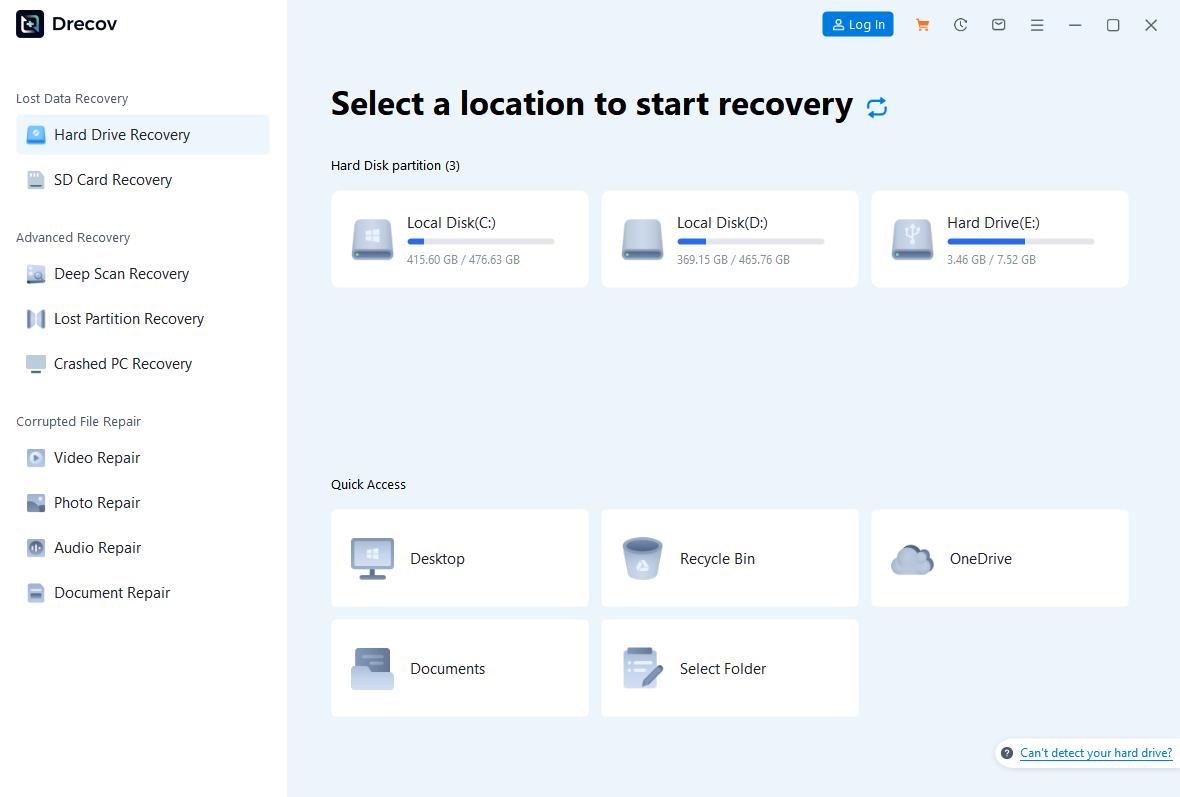
Prepare a separate healthy physical drive with space for the output. Install Drecov away from the affected source. Open Drecov and select the original disk or visible partition by model and capacity, not by a drive letter you are unsure about. If a former partition has vanished but the disk itself remains stable and correctly recognized, choose the appropriate Lost Partition Recovery mode. Do not initialize the disk to make it selectable.
Step 2: Run Quick Scan and inspect likely locations
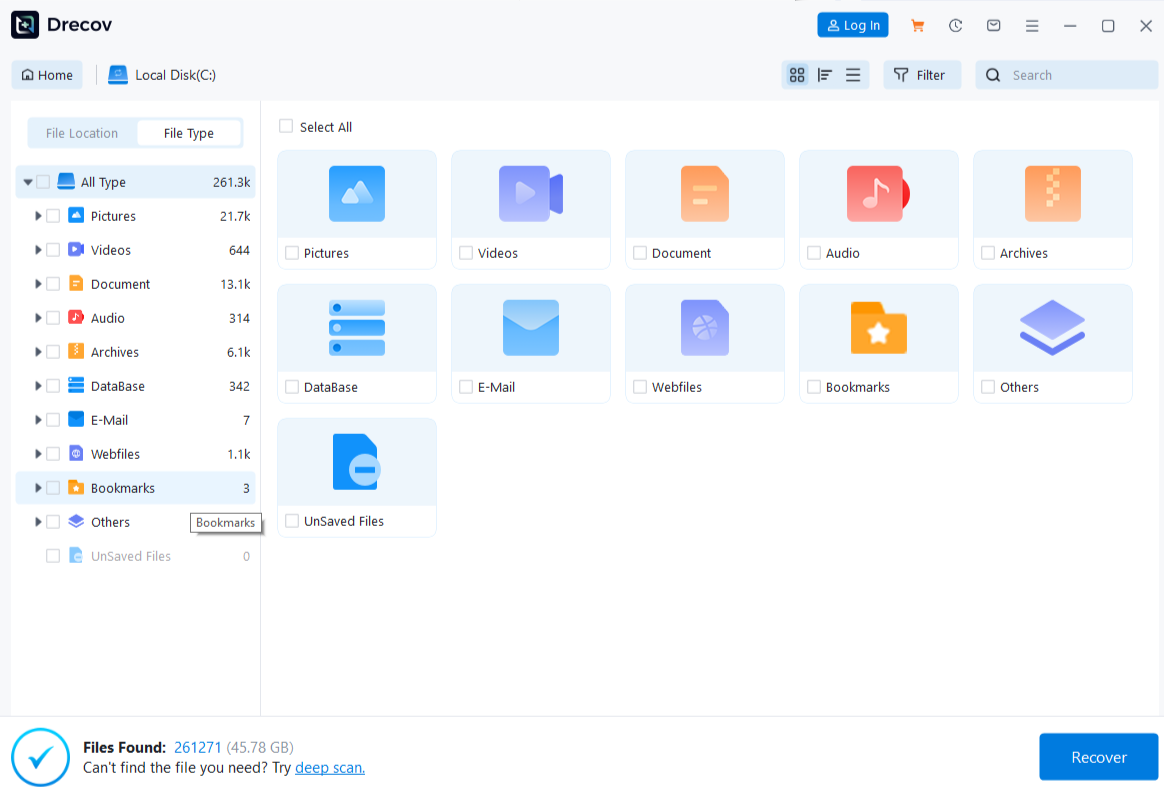
Start Quick Scan. Look for the former user folders, work projects, photographs, or other files that establish whether you selected the right source. Use names and paths as clues, not proof that every file is complete. If the device disconnects or begins returning serious read errors, stop rather than repeating a scan. A physical problem needs assessment before more direct reads.
Step 3: Deep Scan only when the medium stays stable
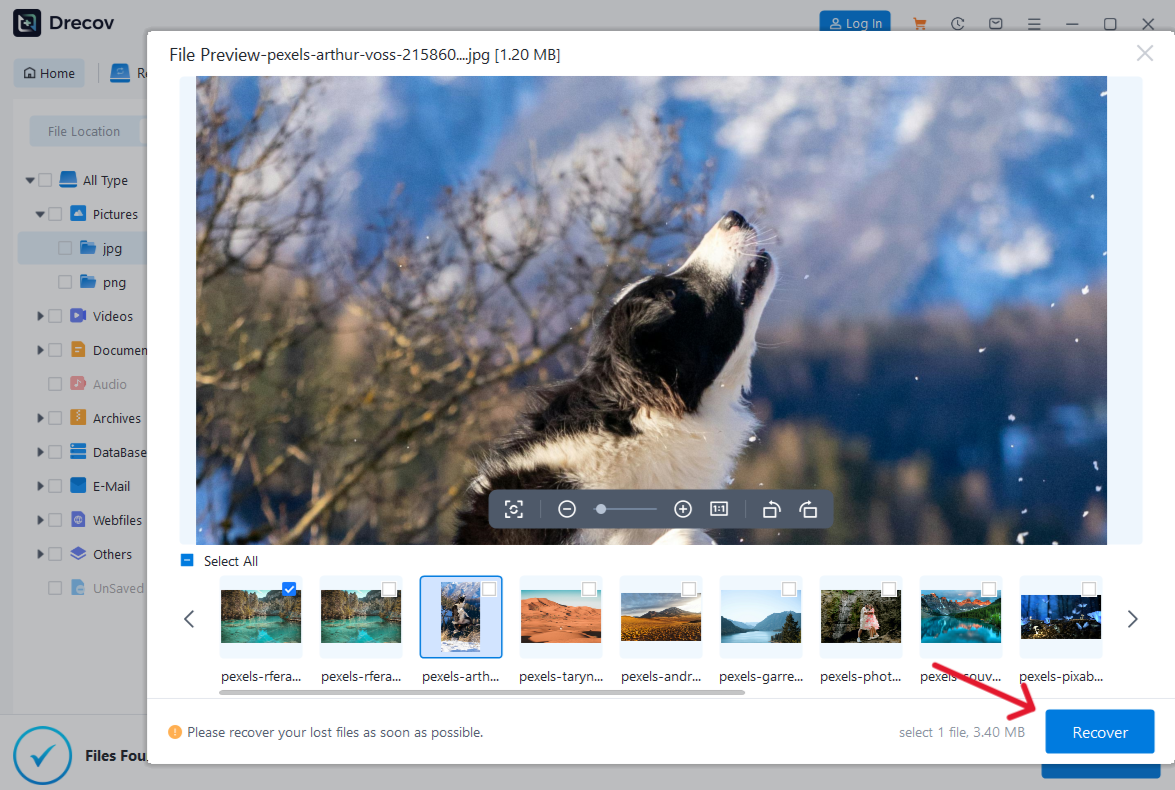
If Quick Scan does not locate the needed material and the disk still behaves consistently, run Deep Scan. Filter by file type or search for known names and paths. Preview representative supported files. A visible thumbnail cannot establish that an entire video, multi-page document, or archive is sound. Compare the candidates with any unaffected copy to identify the correct version.
Step 4: Save elsewhere and test the result
Recover selected files to the prepared healthy drive, never the source. If you do not find the output where expected, inspect Drecov Folder or Recovery Folder at the selected destination. Open and sample important files in their normal applications. Only after that verification should you consider a drive-letter change, file-system repair, or reinitialization. A recovered file and a repaired disk are different outcomes; make sure you achieved the one you actually needed.
⚠ Warning: Install it on a drive different from the one where your data was lost to prevent overwriting.
FAQs
Does this message mean my disk is empty?
No. It means Device Manager’s Populate request did not provide the volume details. Disk Management, Storage settings, and actual file access offer better evidence about the disk’s current state.
Should I click Initialize to make the Volumes tab work?
Not on a used disk with files you need. Initialization changes disk metadata. Protect or recover the data first and confirm that you selected the correct physical device.
Why can Device Manager list the disk when Explorer cannot?
Device detection and mounted-volume access are separate stages. The connection may identify hardware even when no usable partition or drive letter is available.
Can updating a driver recover files?
A relevant driver can restore access when the host path was the problem, but it does not undelete data or repair physical media. Preserve accessible files before a change, and use the manufacturer’s supported driver for the correct model.
Is a software scan suitable for a drive that keeps disconnecting?
No. Stop repeated direct scans. A specialist can evaluate imaging or hardware recovery, especially when the missing files exist nowhere else.
Conclusion
If “volume information for this disk cannot be found” persists, compare the device identity and capacity across Windows views. The message alone does not prove data loss. The message “volume information for this disk cannot be found” is a clue about one Windows information view, not a verdict on the data. Compare the physical disk’s identity, its Disk Management state, and whether files actually open. Copy accessible files before making changes; stop direct tests on an unstable device. When a stable recognized disk has lost files or a partition and no complete backup exists, Drecov can search that original location and recover candidates to another drive. Verify those files before attempting any repair or setup action on the source.
⚠ Warning: Install it on a drive different from the one where your data was lost to prevent overwriting.