







Introduction to Trashed Email Recovery
Understanding Trashed Emails
Trashed emails are messages that have been deleted from the inbox but remain in the trash or deleted folder temporarily. Many users face the issue of how to retrieve trashed emails after accidental deletion, system sync issues, or email client errors.
Recovering these emails is possible with the right approach and tools. Understanding how to get back trashed emails helps prevent data loss and ensures that important information, attachments, or communications are safely restored.
⚠️ Warning: Avoid creating or deleting new emails after noticing missing messages to prevent overwriting recoverable emails.
Why Recovering Trashed Emails Is Important
Emails contain sensitive or critical information, including:
- Work-related documents and correspondence
- Personal communication and attachments
- Subscription confirmations, receipts, and billing records
Failing to recover lost messages can result in missed deadlines, miscommunication, or lost legal documents. Recover trashed emails procedures ensure timely and safe restoration.
Common Reasons Emails End Up in Trash
Accidental Deletion
Users often delete emails by mistake. Even if emails are not immediately visible in the inbox, they remain recoverable from the trash folder. Knowing how to recover trashed emails quickly is essential for avoiding permanent loss.
Email Filters and Rules
Automatic rules in email clients may move messages to the trash. For example, emails from unknown senders may be deleted automatically. This scenario often prompts users to ask how do I retrieve trashed emails.
Sync or Software Errors
Sometimes, emails disappear due to sync problems, application crashes, or database corruption. Recovering trashed emails requires either built-in email recovery tools or specialized software.
Methods to Recover Trashed Emails
Method 1: Restore Directly from the Trash Folder
Test Environment
| Component | Configuration |
|---|---|
| Email Client | Any supporting Trash folder |
| Scenario | Accidental deletion within last 30 days |
Steps:
- Open the email client.
- Navigate to the Trash folder.
- Select emails to recover.
- Move them back to the Inbox or desired folder.
- Verify restoration of all messages.
This method is effective for recent deletions without any additional tools.
Method 2: Restore from Email Server
Test Environment
| Component | Configuration |
|---|---|
| Email Account | IMAP-supported email services |
| Scenario | Emails still exist on the server |
Steps:
- Log in to the email account via web interface.
- Navigate to the Trash or Deleted Items folder.
- Select messages to restore.
- Move them back to the Inbox.
- Sync the email client to update local folders.
IMAP servers typically retain trashed emails for 30–60 days, allowing safe recovery.
Method 3: Recover from Local Email Archive
Test Environment
| Component | Configuration |
|---|---|
| Email Client | Any client supporting local archives |
| Scenario | Trash emptied or server-side emails deleted |
Steps:
- Locate archived email storage (e.g., .mbox or local backup files).
- Open or import these files in the email client.
- Recover the messages to Inbox or custom folder.
- Verify that all attachments and metadata are intact.
This method is useful for retrieving trashed emails after long-term deletion.
Method 4: Restore from Backup
Test Environment
| Component | Configuration |
|---|---|
| Backup System | Local or cloud backup solution |
| Scenario | Trash emptied or local archives corrupted |
Steps:
- Access the backup containing email data.
- Locate relevant email database or folder.
- Restore to a safe location.
- Import restored emails into the client.
- Confirm that all required emails are present.
Backup systems ensure timely recovery for users asking how to recover trashed emails.
Method 5: Using PandaOffice Drecov for Advanced Email Recovery
Test Environment
| Component | Configuration |
|---|---|
| Software | PandaOffice Drecov |
| Scenario | Emails missing from Trash and server, or corrupted databases |
Steps:
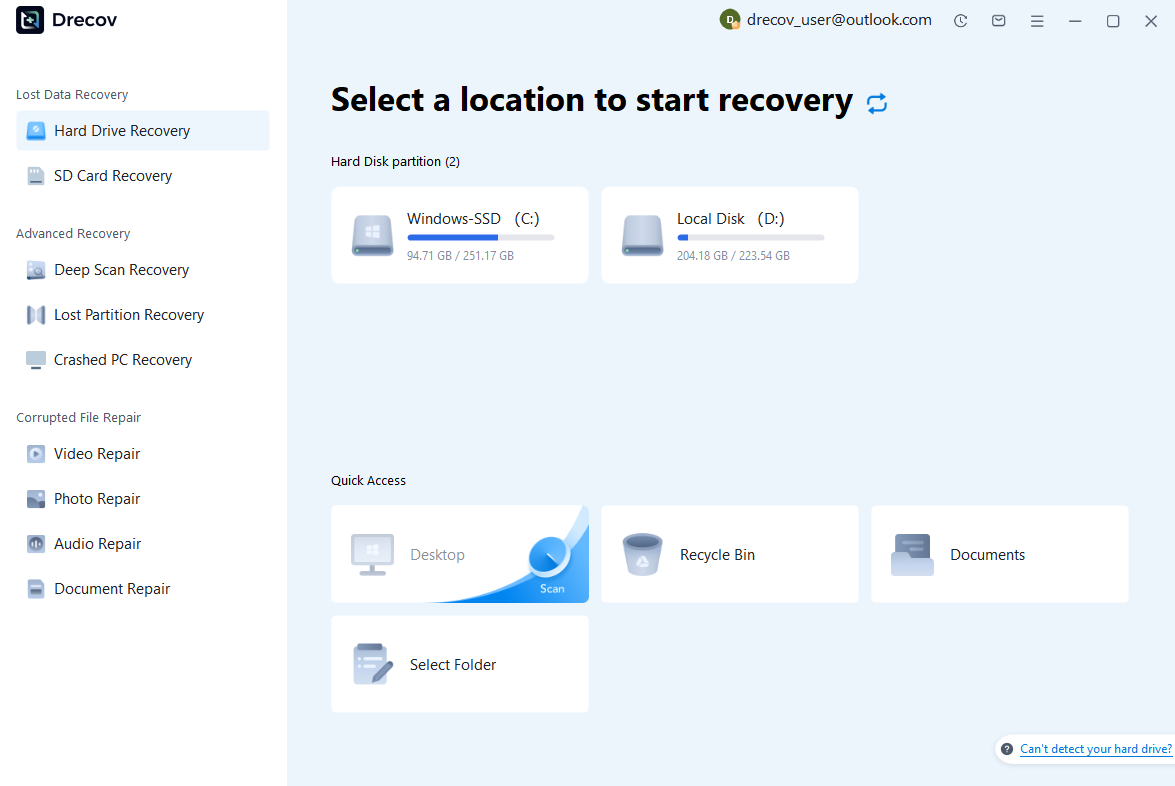
Step 1: Scan the Storage Device (SD Card / Hard Drive / USB)
Connect your device (SD card, HDD/SSD, or USB drive) to your computer and launch PandaOffice Drecov. Select the target device and start the scan. The software will perform a quick scan and deep scan to detect lost or deleted data.
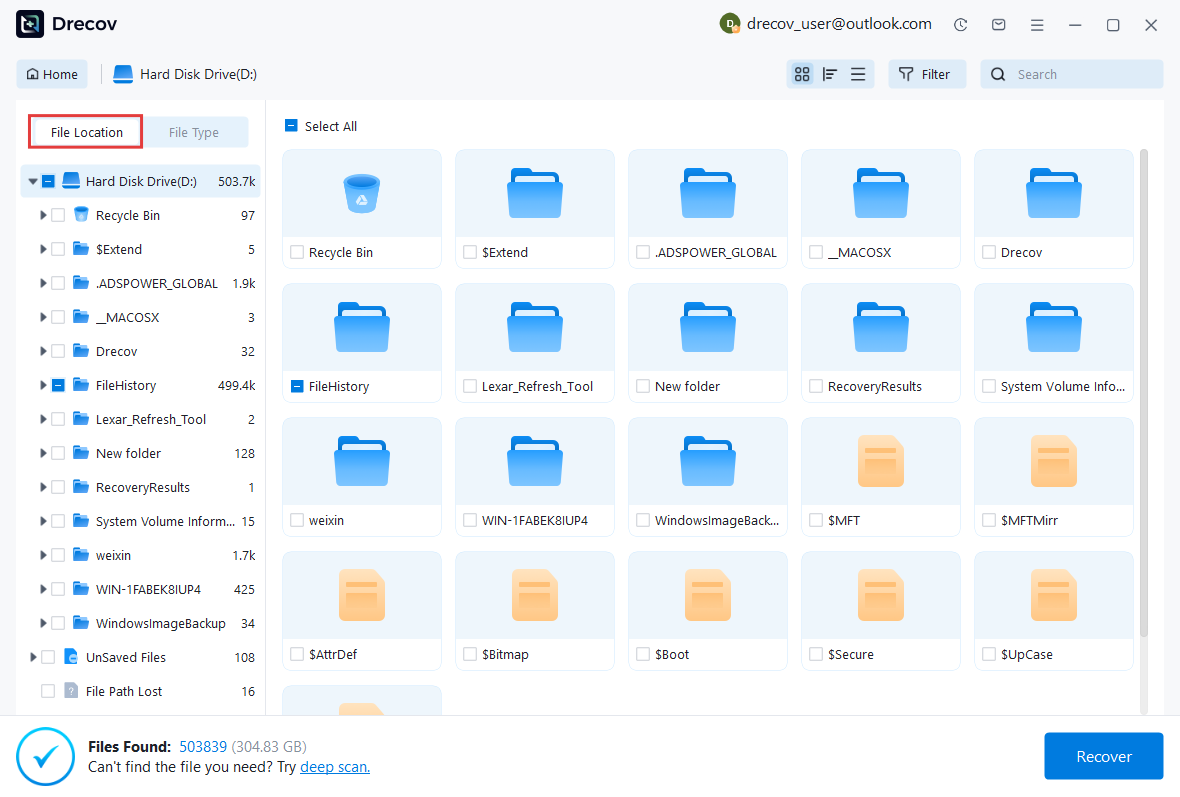
Step 2: Locate and Preview Lost Files
After scanning, browse the detected files and use the preview feature to check recoverable data. You can preview documents (Word, Excel, PDF), photos, and videos to ensure file integrity before recovery.
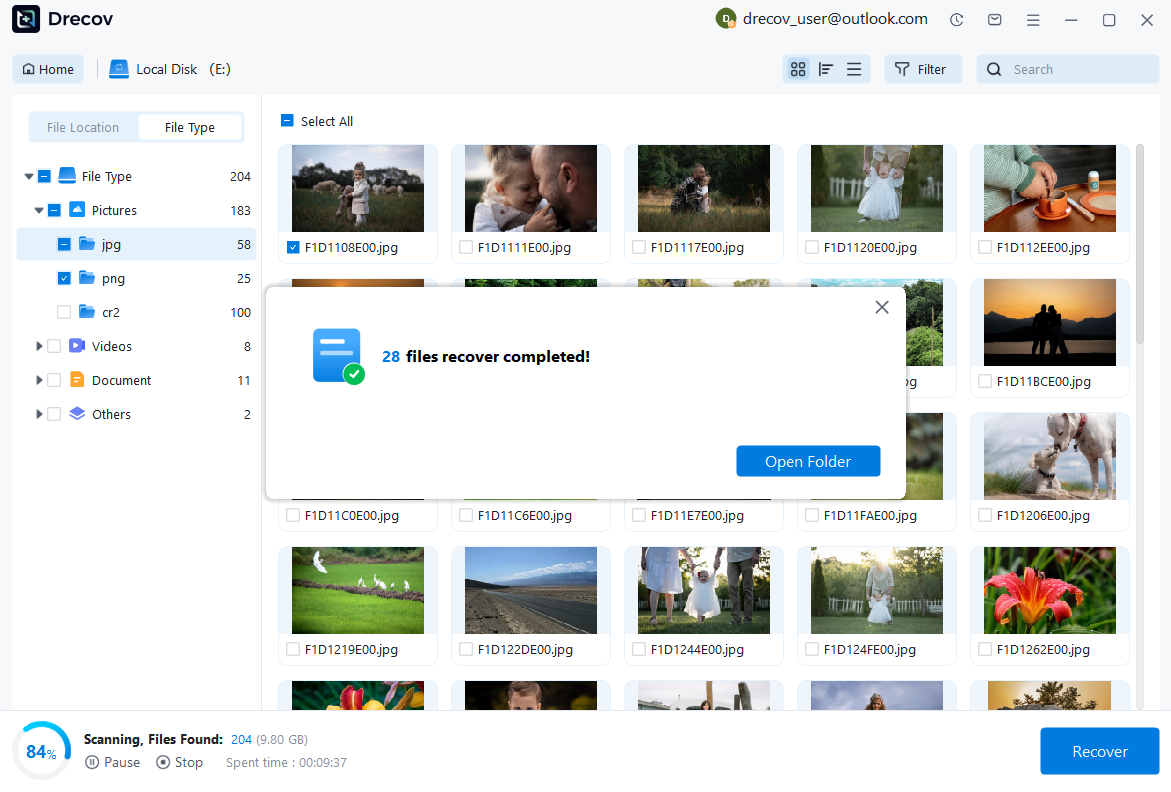
Step 3: Recover and Save to a New Location
Select the files you want to restore and click recover. Save all recovered data to a different drive or location (not the original device) to avoid overwriting lost data.
Why Choose PandaOffice Drecov Recovery Software?
PandaOffice Drecov offers a fast, secure, and user-friendly solution for recovering lost files across multiple scenarios. Whether you need email recovery, ZIP File Recovery, format data recovery, or help to recover deleted drafts Outlook, the software provides reliable recovery performance for both personal and business users.
PandaOffice Drecov supports recovery from formatted hard drives, SSDs, USB drives, SD cards, and external storage devices. Its advanced scanning engine can locate deleted archives, damaged ZIP files, lost Outlook drafts, and accidentally removed documents with high accuracy. For users searching for how to find deleted messages in Teams, PandaOffice Drecov can also help recover exported chat files, attachments, and related local cache data when available.
Key advantages include:
- Deep scan technology for complex data loss situations
- Support for emails, archives, videos, photos, and office documents
- Recovery from accidental deletion, formatting, corruption, and system crashes
- Easy preview before restoring files
- Compatible with Windows and multiple storage devices
Unlike complicated enterprise recovery tools, PandaOffice Drecov keeps the recovery process simple. Users can scan, preview, and restore files in just a few steps without technical expertise.
Whether you are dealing with lost Outlook drafts, corrupted ZIP archives, formatted drives, or missing communication data, PandaOffice Drecov provides an efficient and practical recovery experience designed to minimize downtime and protect important files.
Disk imaging ensures that even partially corrupted drives can be preserved. This is often the safest approach before attempting any aggressive repair operations for fix bad sectors on hard drive situations.
⚠️ Warning: Avoid saving recovered emails to the same folder as lost emails to prevent overwriting.
Method 6: Contact Email Provider Support
When server-side retention is available:
- Contact your email provider with account details and approximate deletion time.
- Request restoration of trashed emails from server backups.
- Follow provider instructions to sync recovered emails to your client.
Advanced Methods for Retrieving Trashed Emails
When Basic Recovery Methods Fail
In some cases, standard ways of restoring trashed emails—such as checking the trash folder or server recovery—do not work. This usually happens when emails have been permanently deleted, overwritten, or removed due to sync conflicts across multiple devices.
Users often start searching for how to retrieve trashed emails when:
- The trash folder has been emptied
- Emails are missing from both inbox and server
- Email database files are corrupted
- Sync errors removed messages across devices
At this stage, more advanced recovery techniques are required.
Deep-Level Email Recovery Techniques
Recovering from Email Database Files
Test Environment
| Component | Configuration |
|---|---|
| Email Client | Outlook / Thunderbird / Generic IMAP client |
| Storage | Local email database files |
| Scenario | Missing emails after deletion and sync failure |
Steps:
- Locate email database files stored locally.
- Use recovery tools to scan database structure.
- Extract recoverable email fragments.
- Rebuild mailbox structure where possible.
- Import recovered emails back into the client.
This method is effective for users trying how to get back trashed emails after system-level failures.
Restoring Emails Using System-Level Backups
Test Environment
| Component | Configuration |
|---|---|
| Backup Type | Cloud or local system backup |
| Scenario | Emails deleted beyond trash retention period |
Steps:
- Access system backup dashboard or software.
- Select backup point before deletion occurred.
- Locate email application data.
- Restore email folders selectively.
- Sync restored data with email client.
System backups are one of the most reliable ways of retrieving trashed emails, especially in enterprise environments.
Recovering from Corrupted Email Sync
Test Environment
| Component | Configuration |
|---|---|
| Email Service | IMAP / Exchange / Gmail |
| Scenario | Sync conflict causing missing emails |
Steps:
- Disable email sync on all devices.
- Log into webmail interface.
- Check Trash, Spam, and Archive folders.
- Restore missing emails manually.
- Re-enable sync and verify consistency.
⚠️ Warning: Do not re-enable sync before confirming email restoration to avoid overwriting data.
Mobile-Based Trashed Email Recovery
Recovering Emails on Mobile Devices
Mobile email apps often contribute to accidental deletion due to swipe gestures or automatic cleanup settings. Many users search for how to recover trashed emails after deleting messages on mobile.
Test Environment
| Component | Configuration |
|---|---|
| Device | iOS / Android |
| Email App | Gmail / Outlook Mobile |
| Scenario | Accidental deletion on mobile |
Steps:
- Open the email app.
- Navigate to Trash or Bin folder.
- Select emails for recovery.
- Tap “Move to Inbox” or “Restore.”
- Confirm sync across devices.
This method is the fastest way of recovering trashed emails on mobile devices.
Recovering Emails from App Cache
Test Environment
| Component | Configuration |
|---|---|
| Device | Android / iOS |
| Scenario | Emails missing due to app cache corruption |
Steps:
- Clear email app cache (not data).
- Restart the email application.
- Allow full resynchronization.
- Check restored email folders.
- Verify missing emails have returned.
Cache recovery is useful when users experience partial email disappearance.
Professional Recovery Using PandaOffice Drecov
Advanced Email Data Reconstruction
When emails are permanently deleted or database corruption occurs, professional tools like PandaOffice Drecov can help restore lost content by scanning storage at a deeper level.
Test Environment
| Component | Configuration |
|---|---|
| Software | PandaOffice Drecov |
| Scenario | Permanently deleted emails not found in Trash or server |
Steps:
- Install PandaOffice Drecov on a separate system drive.
- Select email storage location or database file.
- Run deep scan mode for email recovery.
- Preview recoverable emails, attachments, and metadata.
- Export recovered emails to email client or safe folder.
⚠️ Warning: Do not install recovery software on the same drive where data loss occurred to avoid overwriting.
Preventing Future Email Loss
Best Practices for Email Protection
Preventing email loss is more effective than attempting recovery. Users who frequently search how do I retrieve trashed emails can reduce risk with proper habits.
Recommended practices:
- Regularly back up email data
- Enable email archiving features
- Avoid bulk deletion without verification
- Use cloud-based email services with retention policies
- Sync email across multiple devices carefully
Setting Up Email Backup Systems
Test Environment
| Component | Configuration |
|---|---|
| Backup Type | Cloud / Local storage |
| Scenario | Preventing future email loss |
Steps:
- Enable automatic email backup.
- Choose backup frequency (daily or weekly).
- Store backups in secure cloud or external drive.
- Test restore function periodically.
- Monitor backup logs for errors.
Common Questions About Trashed Email Recovery
How long do trashed emails stay recoverable?
Most email providers keep trashed emails for 30 days, though this varies by service.
Can permanently deleted emails be recovered?
Yes, but only through backups or advanced recovery tools if data has not been overwritten.
Why are emails missing after sync?
Sync conflicts or server mismatches can cause emails to disappear temporarily or permanently.
Is recovery software safe to use?
Yes, reputable tools like PandaOffice Drecov are safe when installed correctly and used responsibly.
Conclusion
Recovering deleted emails is often possible if the right steps are taken quickly. Whether dealing with accidental deletion, sync errors, or system failures, trashed emails can usually be restored through built-in recovery features, backups, or professional tools.
Simple solutions like checking the trash folder or server are often enough for users searching how to retrieve trashed emails. More complex cases may require database recovery or tools like PandaOffice Drecov for deep scanning and reconstruction.
By combining preventive strategies with effective recovery methods, users can ensure that important messages are never permanently lost and that retrieving trashed emails becomes a manageable and reliable process.





