







A reliable Thunderbird backup mail set needs more than messages visible in the Inbox. Local Folders, POP mail, address books, filters, account settings, calendars, saved searches, and profile preferences can live only on the PC. Identify those local-only items, close Thunderbird completely, copy the entire active profile to another healthy device, and verify the copy before migration or Windows repair.
Map Where Thunderbird Mail Really Lives
Thunderbird displays accounts in one interface, but their data may come from different places. An IMAP Inbox normally mirrors a server mailbox. POP messages may be downloaded and removed from the server. Local Folders are stored in the profile. A backup plan must follow the storage location, not the folder name shown in the sidebar.
Separate IMAP from local-only content
Sign in to each provider’s webmail without changing account settings. Compare folders, date ranges, and message counts with Thunderbird. Messages present online can usually synchronize again after account setup. Messages visible only in Local Folders, custom archives, or a POP account require a local backup.
Inventory more than messages
List address books, calendars, message filters, tags, identities, signatures, certificates, dictionaries, extensions, and saved searches. Note which passwords are stored in a separate password manager. A copied profile may contain sign-in data, so protect the backup with the same care as the live account.
Find the active profile from Thunderbird
Open Help, Troubleshooting Information, and choose Open Folder beside Profile Folder. This route avoids guessing among similarly named folders. Record the path and profile name. If multiple profiles exist, open the Profile Manager or repeat the check for each one that matters.
| Data type | Likely location | Backup decision |
|---|---|---|
| IMAP server folders | Mail server plus local cache | Verify webmail and still copy the profile for settings and offline data |
| POP mail | Often local profile storage | Treat as irreplaceable unless the server copy is confirmed |
| Local Folders and local archives | Thunderbird profile | Copy the complete profile and test restoration |
| Address books and filters | Profile databases and settings | Include the profile; create exports for critical contacts |
| Attachments saved separately | User-selected Windows folders | Back up those folders outside the Thunderbird profile |
| Cloud calendar or contacts | Remote service plus profile configuration | Confirm server access and record account details |
Create a Consistent Full-Profile Copy
Mozilla’s official Thunderbird profile documentation explains that messages, passwords, and preferences are stored separately from the application program. Copying the profile while Thunderbird writes to it can produce inconsistent database and mailbox files.
Close Thunderbird and confirm its process ended
Exit Thunderbird normally. Wait for disk activity to settle, then open Task Manager and confirm no Thunderbird process remains. Do not copy during message compaction, folder repair, indexing, or a large synchronization. Those operations can leave pairs of files at different moments.
Copy the profile to another physical device
Copy the entire profile folder, not a handful of visible mailbox files. Preserve hidden items, subfolders, filenames, and timestamps. Store the backup on a healthy external disk or another verified system. A second partition on the same drive does not protect against that drive’s failure.
Keep the profile selector information
Record the Thunderbird version, Windows account, profile path, account types, and extension list. Save a screenshot of the account pane without exposing passwords. If you copy the parent Profiles folder, also retain the profile-selection configuration where appropriate. This context makes restoration much easier than an unlabeled random directory.
Add a dated manifest
Create a text file beside the backup. Include the backup date, source PC, profile name, webmail verification results, Local Folders that exist only locally, and separately backed-up attachment paths. Do not place passwords in an unencrypted manifest.
Add Portable Exports for Critical Items
A full profile is the best representation of Thunderbird state, while targeted exports make essential data easier to inspect or move. Use both when the mail is important. Exports are supplements, not replacements for a complete profile.
Export address books
Open Address Book and export important books in a suitable format such as CSV or LDIF. Keep one format that preserves the fields you need. Open the export with a compatible viewer and verify names, email addresses, and non-Latin characters.
Preserve local mail folders
Local mail may use mailbox files and matching index files. The profile copy should preserve both. Avoid opening and editing these files with a text editor. If you use an export extension, document its source and output format, then test several exported messages and attachments.
Back up attachments saved outside Thunderbird
An attachment downloaded to Documents or a project folder is no longer protected merely because the email remains. Add those Windows folders to the backup plan. The site’s restorable external-drive backup method explains why a checked destination and sample restore matter.
Test the Backup Without Endangering the Live Profile
A backup becomes trustworthy only after a restoration test. Do not replace the working profile for the experiment. Use a separate Windows account, test PC, virtual machine, or an isolated Thunderbird profile with networking disabled at first.
Restore to a separate profile
Install a compatible Thunderbird release through the official channel. Start it once, close it, and locate the new profile. Preserve the empty profile. Copy the backed-up profile into a controlled location and use Thunderbird’s profile selection tools to point to that copy rather than overwriting the live production folder.
Inspect local data before going online
With networking disabled, check Local Folders, POP archives, address books, filters, tags, and saved searches. Open messages from old and recent periods. Test several attachments. This step proves that the backup contains local content rather than relying on the server to refill the display.
Reconnect accounts carefully
Enable networking only after local inspection. Confirm server names, account identity, and synchronization direction. Avoid bulk deletions until the restored profile has synchronized and folder subscriptions are correct. A mistaken server-side deletion can propagate to every IMAP client.
Record the test result
Update the manifest with the tested Thunderbird version, profile path, folders checked, attachments opened, and any extension that failed. Keep the successful test copy separate from the only backup. Repeat this exercise after major account or folder changes.
Use Drecov When a Thunderbird Profile Was Lost
Drecov is not a mail synchronization or Thunderbird repair tool. It is relevant when local mailbox files, profile databases, exported messages, or separately saved attachments were deleted or became logically inaccessible on stable Windows storage. First inspect the external backup, provider webmail, cloud version history, Recycle Bin, and any old PC. The site’s local email archive recovery guidance helps identify which content may exist only on disk.
⚠ Warning: Install it on a drive different from the one where your data was lost to prevent overwriting.
For a deleted Windows mail profile, PandaOffice Drecov can search the PC or stable source media, including HDDs, SSDs, external disks, USB storage, SD cards, and memory cards. Its read-only recovery mode keeps retrieval separate from mailbox repair. Quick Scan provides the first results; Deep Scan can look further when the source remains stable. Names, former paths, dates, types, and preview support the search for email data, documents, archives, photos, video, and audio before recovery to another healthy location.
Lost Partition Recovery can search when the profile partition disappears. Drecov cannot reconnect an email account, repair a Thunderbird database, decrypt unknown credentials, or guarantee overwritten and TRIM-cleared data. Stop scanning a source that clicks, disconnects, freezes the PC, or produces severe read errors.
Recover Missing Thunderbird Profile Data With Drecov
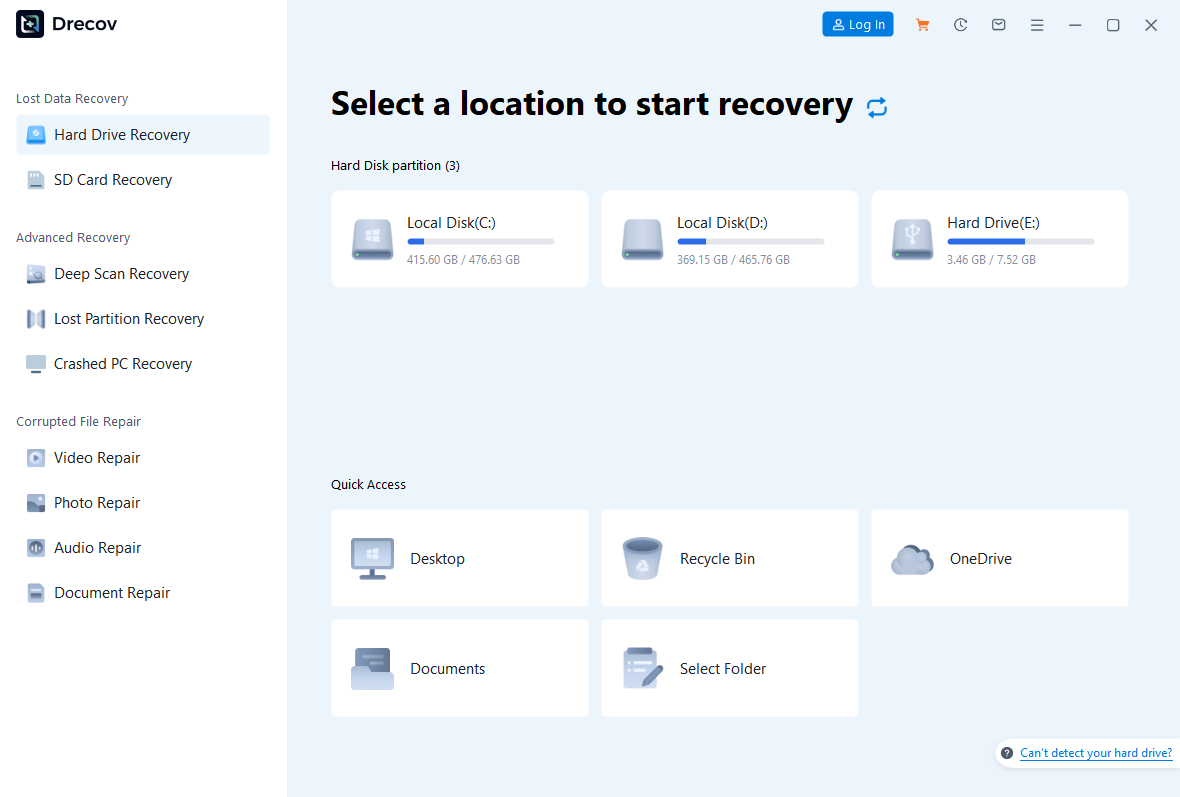
Step 1: Open Drecov and select the former profile location
Reserve a reliable destination drive before recovery. Keep the Drecov installation away from the partition that stored the missing profile. Once opened, point the program at the former Windows user directory, mail volume, or stable backup device. If the entire volume is gone, use Lost Partition Recovery without first initializing or formatting it.
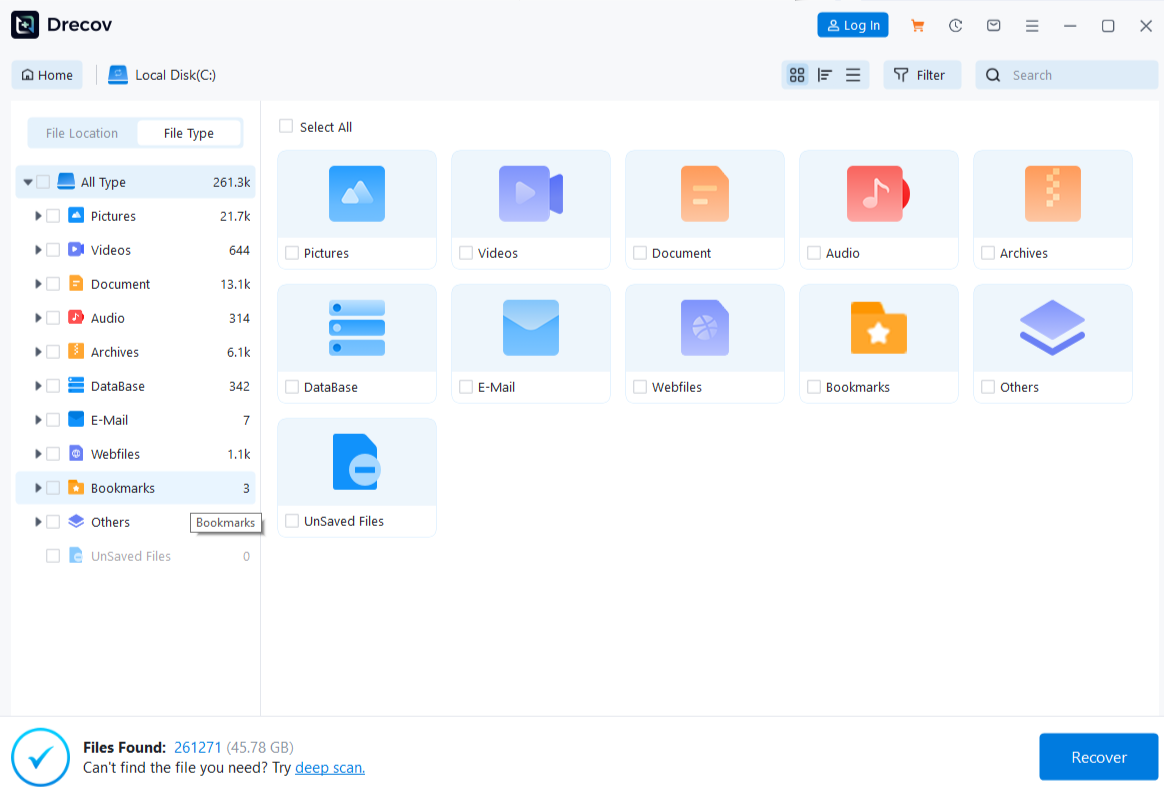
Step 2: Run Quick Scan and follow the profile path
Start Quick Scan. Browse the former Thunderbird and Profiles paths. Filter by mailbox, database, address-book, message, archive, and attachment evidence. Use the profile name and loss date. Preserve groups of related files rather than selecting a single large mailbox without its surrounding profile context.
Step 3: Run Deep Scan only while the device remains stable
Use Deep Scan when Quick Scan misses necessary local mail and the source stays consistently readable. Stop if the drive disconnects, stalls severely, or reports new I/O errors. A deeper logical search cannot stabilize failing hardware.
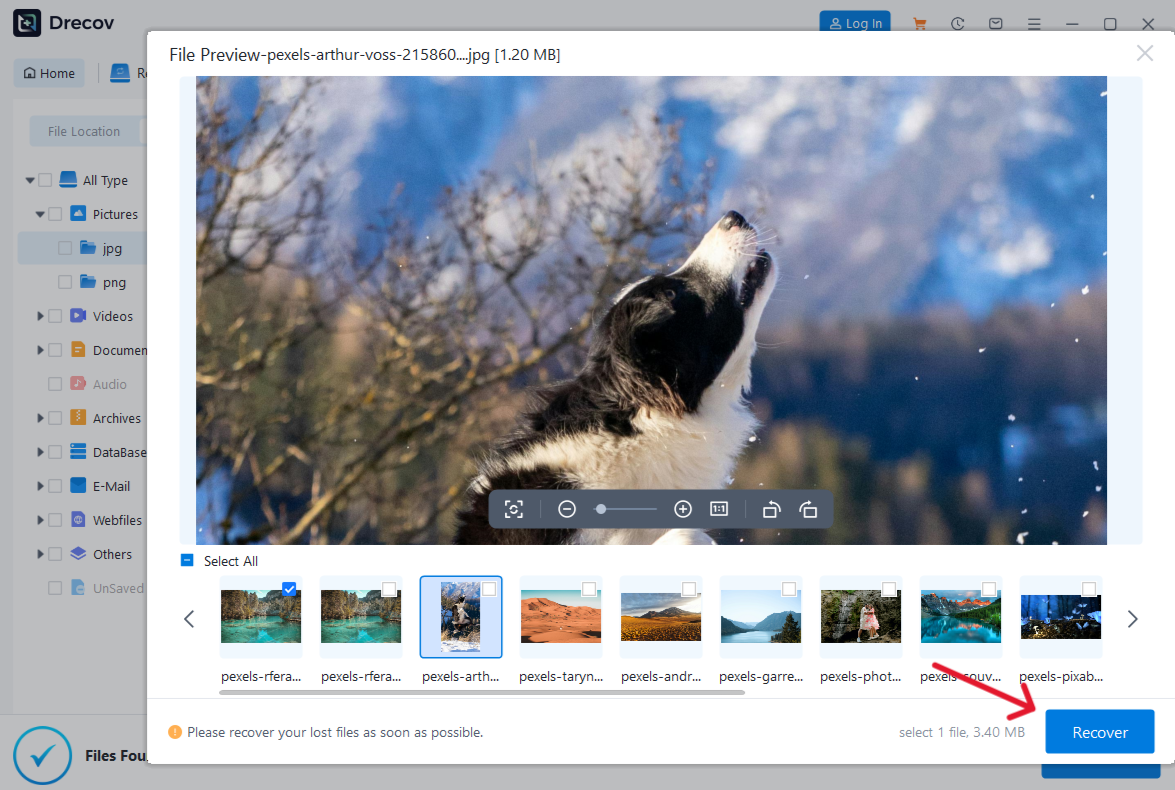
Step 4: Filter, preview, and recover to the other disk
Combine name, former path, date, file type, and size. Preview representative supported messages, documents, archives, or attachments where possible. Preview does not prove that every message in a mailbox database is intact. Recover selected profile groups to the healthy output disk, never to the source.
Step 5: Locate and verify data in an isolated profile
Inspect Drecov Folder or Recovery Folder when results are not visible at the chosen destination. Preserve recovered originals. Build a test profile from duplicates and keep networking disabled during the first inspection. Open old and recent mail, attachments, contacts, and Local Folders. Only after verification should you compact folders, repair databases, reinstall Windows, or format the source.
If the provider deleted server mail independently of the local profile, compare the situation with the site’s deleted email recovery routes. Server recovery and local profile recovery are separate jobs.
Conclusion
A useful Thunderbird backup mail plan begins by separating server-backed IMAP folders from POP mail, Local Folders, and other local-only data. Close Thunderbird, copy the entire active profile to another physical device, add portable exports, and restore into an isolated test profile. If local mailbox or profile files are genuinely deleted from stable Windows storage, Drecov can search their former location and recover related candidates elsewhere. Verify messages, attachments, contacts, and folder history before changing the old profile or source disk.
⚠ Warning: Install it on a drive different from the one where your data was lost to prevent overwriting.






