







Few things are as frustrating as being in the middle of a critical project, only to have a pop-up window halt your progress with the dreaded message: your system has run out of application memory. This error is more than just a nuisance; it often leads to frozen windows, forced application closures, and the terrifying prospect of losing unsaved work. In the professional world of data recovery and system optimization, we view this error as a “resource exhaustion” event that requires both immediate triage and long-term prevention.
Understanding why your system has run out of application memory is the first step toward reclaiming your computer’s performance. While it sounds like a hardware limitation, it is frequently a software management issue. In this comprehensive guide, we will explore the technical nuances of memory management, provide actionable fixes for various operating systems, and—most importantly—teach you how to recover your vital files if a memory-related crash leads to data loss.
The Anatomy of Memory Exhaustion
To fix the issue where your system has run out of application memory, we must first distinguish between physical RAM and virtual memory. Your RAM (Random Access Memory) is the high-speed “short-term memory” your computer uses to store data for active tasks. However, modern operating systems like macOS and Windows also use “Swap Storage” or “Virtual Memory,” which utilizes space on your SSD or hard drive to supplement physical RAM.
When you see the notification that your system has run out of application memory, it typically means that both your physical RAM is at capacity and your boot drive is too full to create additional swap files. This creates a bottleneck where the CPU has nowhere to place the data it needs to process. Consequently, the system must “Force Quit” applications to stay alive.
Out of Memory Error But I Have Plenty of RAM
One of the most common complaints I hear from users is, “Why am I seeing an out of memory error but i have plenty of ram?” It seems counterintuitive. If you have 32GB or 64GB of RAM, why would the system complain?
There are several technical reasons for this phenomenon:
- Memory Leaks: This occurs when a program requests memory but fails to give it back to the operating system after the task is finished. Over time, that one app can swell to consume tens of gigabytes.
- Lack of Disk Space: Even with 64GB of RAM, macOS and Windows require several gigabytes of free disk space to manage memory addresses. If your SSD is 99% full, the system cannot create the “paging file” or “swap file” needed to manage the RAM you do have.
- Kernel Tasks and Extensions: Sometimes, low-level system drivers or third-party extensions (like antivirus or specialized hardware drivers) malfunction, hogging resources that aren’t visible in the standard user-app list.
If you are experiencing an out of memory error but i have plenty of ram, your first move should always be to check your disk overhead. Ensure you have at least 15-20% of your total disk capacity free.
How to Find Which App Is Using All Memory
Before you can resolve the your system has run out of application memory error, you must identify the culprit. You don’t want to close your important work if a background update service is the real hog. Here is how to find which app is using all memory on the two major platforms:
On macOS (Activity Monitor)
- Step 1: Press
Command + Spaceto open Spotlight, type “Activity Monitor,” and hit Enter. - Step 2: Click on the Memory tab at the top of the window.
- Step 3: Look at the Memory Pressure graph at the bottom. If it’s green, you’re fine; if it’s yellow or red, you’re in the danger zone.
- Step 4: Sort the list by the Memory column (descending order). This will put the most resource-heavy apps at the top.
- Step 5: If you see an app using an astronomical amount (e.g., a web browser using 15GB), select it and click the “X” at the top left to Force Quit.
On Windows (Task Manager)
- Step 1: Press
Ctrl + Shift + Escto launch the Task Manager directly. - Step 2: If the view is simplified, click “More details” at the bottom.
- Step 3: Navigate to the Processes tab and click the Memory column header to sort by usage.
- Step 4: Right-click the offending process and select End Task.
Learning how to find which app is using all memory allows you to perform “surgical” shutdowns rather than rebooting and losing all your progress.
Recover Unsaved Files After System Ran Out of Application Memory
The most devastating consequence of when your system has run out of application memory is the sudden crash. When an app like Microsoft Word, Excel, or Adobe Premiere Pro is forced to quit, you may lose hours of unsaved progress. However, modern software often has safety nets.
To recover unsaved files after system ran out of application memory, follow these steps:
Step 1: Utilize AutoRecover Features
Most productivity suites have a built-in “heartbeat” save.
- Microsoft Office: Open the application again. Usually, a “Document Recovery” pane will appear on the left.
- Adobe Creative Cloud: Photoshop and Premiere Pro often prompt you to open a recovered version of your project upon the next launch.
Step 2: Check Temporary Folders
If the AutoRecover didn’t trigger, you might need to hunt for the temp files.
- On Windows, navigate to
%AppData%\Roaming\Microsoft\Word\or a similar path for your specific app. - On macOS, use the Terminal and type
open $TMPDIRto browse temporary storage caches.
Step 3: Check the “Recovered Items” in Trash
On macOS, after a memory crash, the system sometimes moves unsaved temporary data to a folder named “Recovered items” inside the Trash. Open your Trash and look for folders with this name.
When you successfully recover unsaved files after system ran out of application memory, immediately save them to an external drive or cloud storage to prevent further loss during the troubleshooting process.
Recover Deleted Temp Files After Memory Crash
Sometimes, a memory crash is so severe that it corrupts the temporary file directory or triggers a system cleanup that deletes your “safety net” files. If you find that your temp folders are empty, you need to recover deleted temp files after memory crash using professional-grade tools.
Temp files are often stored in specific sectors of your drive. When they are “deleted,” the system simply marks that space as available for new data. Therefore, time is of the essence. To recover deleted temp files after memory crash, you must stop using the computer immediately to prevent overwriting those sectors.
For more technical guidance on file systems, you can refer to the .
Introducing PandaOffice Drecov Data Recovery Software
When manual methods fail and your files seem gone forever due to the your system has run out of application memory error, it is time to use a specialist tool. PandaOffice Drecov data recovery software is a powerful utility designed to scan your storage at a granular level, finding file fragments that the operating system no longer recognizes.
Whether you need to recover deleted temp files after memory crash or restore a corrupted database, PandaOffice Drecov data recovery software provides a user-friendly interface that masks complex forensic algorithms.
⚠ Warning: Do not install the software on the same drive where you lost the data. Use a USB flash drive or a secondary partition to avoid overwriting your lost files.
Step-by-Step Guide to Using PandaOffice Drecov
Step 1: Select the Location to Scan
Launch PandaOffice Drecov data recovery software. You will see a list of available drives. Select the drive (usually C: or Macintosh HD) where the system crash occurred.

Step 2: Perform a Deep Scan
Click the “Scan” button. The software will first perform a Quick Scan, followed automatically by a Deep Scan. The Deep Scan is essential to recover deleted temp files after memory crash because it looks for file signatures rather than just file directory entries.
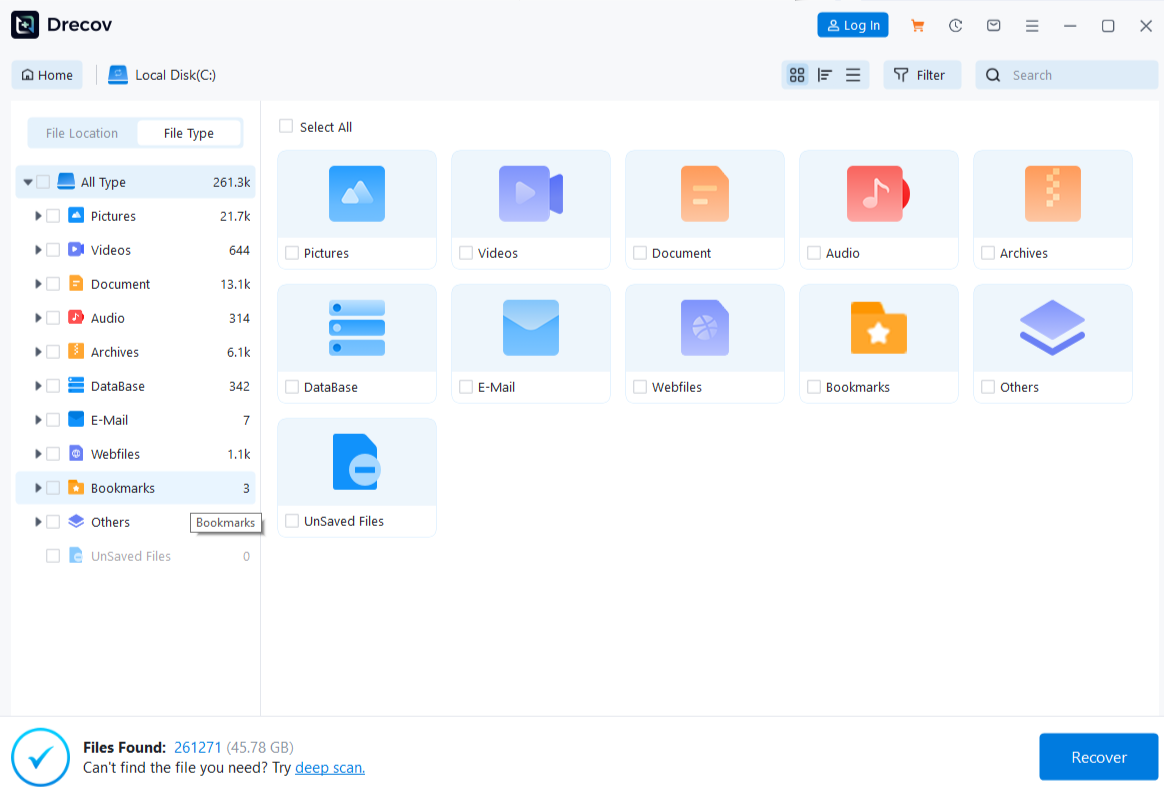
Step 3: Filter and Preview
Use the search bar to look for specific extensions (like .tmp, .docx, or .psd). PandaOffice Drecov allows you to preview files before recovering them. If the preview looks intact, the file is recoverable.

Step 4: Execute Recovery
Select the files you need and click “Recover.” Choose a destination on an external drive. Once the process is complete, verify the files open correctly.
Useful Resources for Further Reading
- To learn more about optimizing your system, check out Apple’s Official Support on Activity Monitor.
- For Windows users, the Windows Memory Management guide offers deep technical insights.
Internal Links for Continued Support
- Need to fix specific document issues? Learn how to recover overwritten Excel files to save your spreadsheets.
- Dealing with compressed archives? Here is how to unzip files and recover lost data efficiently.
- Accidentally emptied your bin during a cleanup? Follow these 5 fast fixes for Recycle Bin recovery to get your files back.
Advanced Technical Fixes for Memory Management
If you have already identified the apps and recovered your data, but your system has run out of application memory keeps recurring, you need to look under the hood.
Adjusting Virtual Memory (Windows 10/11)
If you are seeing the out of memory error but i have plenty of ram, your paging file might be set too small.
- Go to Settings > System > About > Advanced system settings.
- Under the Advanced tab, click Settings in the Performance section.
- Go to the Advanced tab and click Change under Virtual Memory.
- Uncheck “Automatically manage paging file size.”
- Select your drive and set a Custom size. A good rule of thumb is setting the initial size to 1.5x your RAM and the maximum to 3x your RAM.
Clearing NVRAM/PRAM (Intel-based Macs)
Sometimes the memory controller on a Mac gets “confused.”
- Shut down your Mac.
- Press the power button, then immediately hold
Option + Command + P + R. - Hold for 20 seconds, then release. This resets the deep system settings that handle memory allocation.
The Role of Web Browsers
Google Chrome and Microsoft Edge are notorious for memory usage. They use a “sandbox” architecture where every tab is a separate process. If you have 50 tabs open, you are essentially running 50 mini-apps. Use extensions like “The Great Suspender” (for Chrome) or built-in “Sleeping Tabs” (for Edge) to mitigate the risk that your system has run out of application memory.
Final Tip: Always keep at least 20GB of free space on your boot drive. This is the single most effective way to prevent the message your system has run out of application memory from ever appearing again. Stay proactive, keep your software updated, and always maintain a secondary backup of your most important work.
Conclusion
Encountering the error where your system has run out of application memory is a clear signal that your digital workspace needs maintenance. Whether it is a memory leak in a poorly coded app or a lack of physical storage for swap files, the solutions are manageable for users of all technical levels.
By learning how to find which app is using all memory, you can prevent future crashes. And if the worst happens, tools like PandaOffice Drecov data recovery software ensure that a system error doesn’t become a permanent data loss disaster.






