







DBAN (Darik’s Boot and Nuke) is one of the most widely used disk wiping utilities for permanently erasing data from storage devices. It is commonly used before selling, donating, or disposing of a computer to ensure that personal and business information cannot be accessed by others.
While DBAN is highly effective at destroying data, many users accidentally wipe the wrong drive or realize too late that important files were still stored on the disk. This often leads to one critical question: can data be recovered after DBAN?
The answer depends on several factors, including the wiping method selected, the number of overwrite passes completed, and whether the process finished successfully. In some situations, partial recovery may still be possible. In others, the erased data may be permanently lost.
This guide explains how a dban hard drive is erased, what affects recovery success, and which methods may help retrieve files after a DBAN wipe.
How DBAN Erases Data on a Hard Drive
What Is DBAN and How Does It Work?
DBAN is a bootable utility that removes information by overwriting storage sectors with new patterns of data. Unlike deleting files or formatting a partition, DBAN targets the actual sectors where information is stored.
When a dban drive is processed, the software writes over existing data using one of several available erasure standards. Depending on the selected option, the software may overwrite the entire disk one time or multiple times.
Common wiping methods include:
- Quick Erase
- DoD Short
- DoD 5220.22-M
- RCMP TSSIT OPS-II
- Gutmann Method
The purpose of these methods is to make original files unrecoverable through conventional recovery techniques.
Why People Use DBAN
Users often choose DBAN because it provides a higher level of security than normal deletion methods.
Typical use cases include:
- Selling a used computer
- Recycling old hard drives
- Disposing of company equipment
- Removing confidential business information
- Protecting personal privacy
Because the software is specifically designed for secure erasure, recovering files afterward becomes significantly more difficult than recovering deleted data from a formatted drive.
Can Data Be Recovered After DBAN?
Many users search online asking, can data be recovered after dban. The answer is not always straightforward.
Recovery may be possible when:
- The wipe process was interrupted.
- The wrong disk was selected but the process did not finish.
- Hardware errors prevented certain sectors from being overwritten.
- Only part of the drive was erased.
- Recovery attempts begin immediately after the incident.
Recovery is usually impossible when:
- The wipe completed successfully.
- Multiple overwrite passes were used.
- The Gutmann method was selected.
- New data has been written to the disk after wiping.
⚠️ Warning: If you realize a mistake was made during a DBAN wipe, stop using the drive immediately. Additional write operations can reduce recovery possibilities.
Factors That Influence Recovery After a DBAN Hard Drive Wipe
The Number of Overwrite Passes Used
One of the most important recovery factors is the number of overwrite passes performed.
A single overwrite already makes recovery difficult. However, when multiple passes are completed, the chances of successful recovery decrease dramatically.
Generally speaking:
| Wiping Method | Recovery Possibility |
|---|---|
| Quick Erase | Low |
| Single Pass | Very Low |
| Three Passes | Extremely Low |
| Seven Passes | Nearly Impossible |
| Gutmann | Practically Impossible |
The more times data is overwritten, the less likely any original information remains accessible.
Whether the Wipe Was Completed
A fully completed wipe is far more destructive than an interrupted process.
Unexpected events such as:
- Power failures
- System crashes
- Hardware malfunctions
- Accidental shutdowns
may leave portions of a dban hard drive untouched. In these situations, recovery software may still detect recoverable sectors.
Drive Type and Storage Technology
The type of storage device also affects recovery outcomes.
Traditional HDDs store information magnetically. Some partially overwritten sectors may remain accessible under certain circumstances.
SSDs use flash memory and often rely on TRIM commands and wear-leveling technology. These features make recovery significantly more difficult after a wipe operation.
As a result, recovering files from an SSD that has undergone a complete DBAN process is generally less successful than recovering data from a mechanical hard drive.
Time Elapsed After the Wipe
The sooner recovery efforts begin, the better the chances of success.
Continuing to use the disk may overwrite any remaining recoverable information.
⚠️ Warning: Never install recovery software onto the affected drive. Install it on another storage device instead.
How to Determine Whether Recovery Is Possible
Review the DBAN Completion Report
After wiping a disk, DBAN typically generates a summary report.
The report may contain information such as:
- Wipe method used
- Verification results
- Completion percentage
- Error messages
- Total overwrite passes
If the report indicates that the process ended unexpectedly, some data may still exist on the disk.
Check Disk Structure and Partitions
Connecting the affected drive to another computer can help determine whether any partitions remain accessible.
Useful signs include:
- Unallocated space
- Missing partitions
- Corrupted volume tables
- Partially accessible folders
These indicators may suggest that the wiping process was incomplete.
Inspect the Drive for Physical Errors
Bad sectors and hardware problems sometimes prevent DBAN from overwriting every area of a disk.
Running diagnostic tools can help identify:
- Unreadable sectors
- Hardware failures
- Controller issues
- Surface damage
If some sectors were skipped during the wiping process, fragments of recoverable information may still exist.
Assess the Importance of the Lost Data
Before attempting recovery, consider the value of the missing files.
For example:
- Business documents
- Legal records
- Financial databases
- Family photographs
- Research projects
may justify investing additional time or professional recovery services.
Methods to Recover Data After a DBAN Drive Wipe
Recover Files Using PandaOffice Drecov
Test Environment
- Operating System: Windows 11 Pro
- Storage Device: 2TB Seagate HDD
- Wiping Method: Quick Erase
- Recovery Scenario: DBAN process interrupted at approximately 45%
- Connection Type: SATA to USB Adapter
When a wipe operation does not finish successfully, some sectors may still contain traces of original files. In this situation, a professional recovery application may help identify and extract recoverable information.
PandaOffice Drecov is designed to scan storage devices for deleted, lost, and inaccessible files. Although no software can reverse a fully completed multi-pass wipe, it may recover data when the DBAN process was interrupted or when certain sectors were never overwritten.
Steps to Recover Files
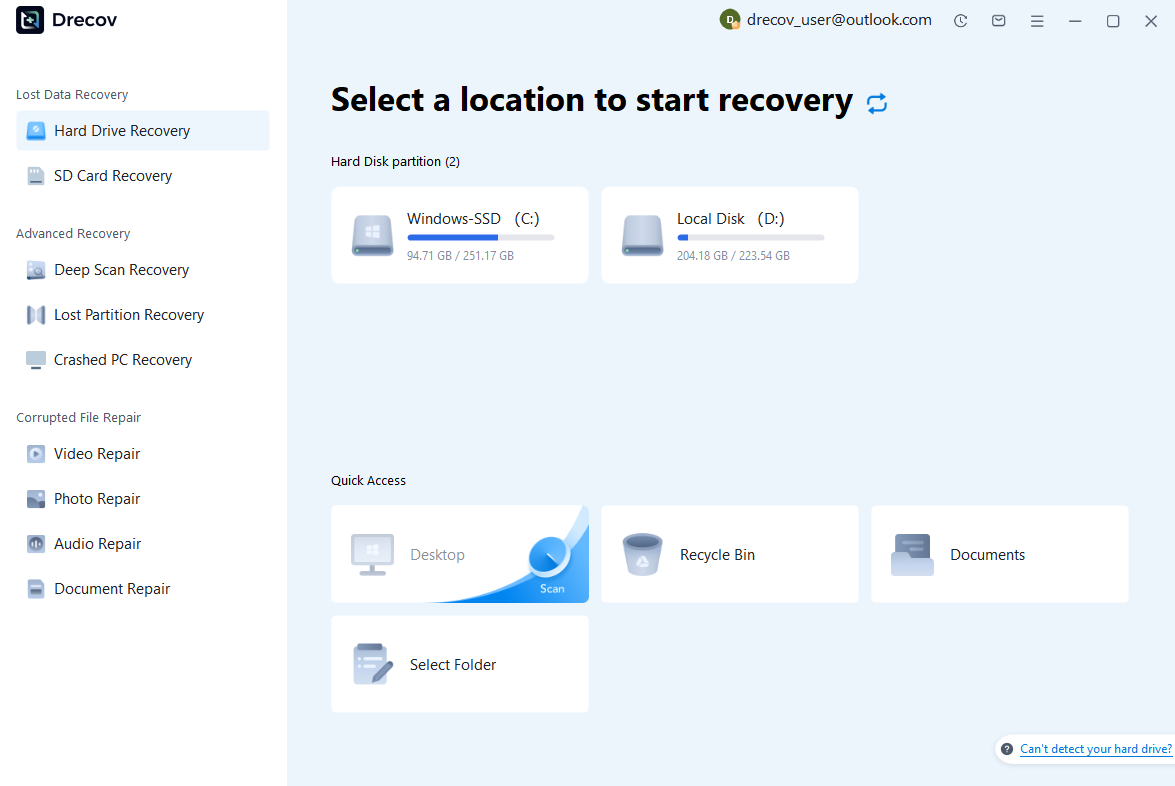
Step 1: Connect the Drive / USB)
Connect your device (SD card, HDD/SSD, or USB drive) to your computer and launch PandaOffice Drecov. Select the target device and start the scan. The software will perform a quick scan and deep scan to detect lost or deleted data.
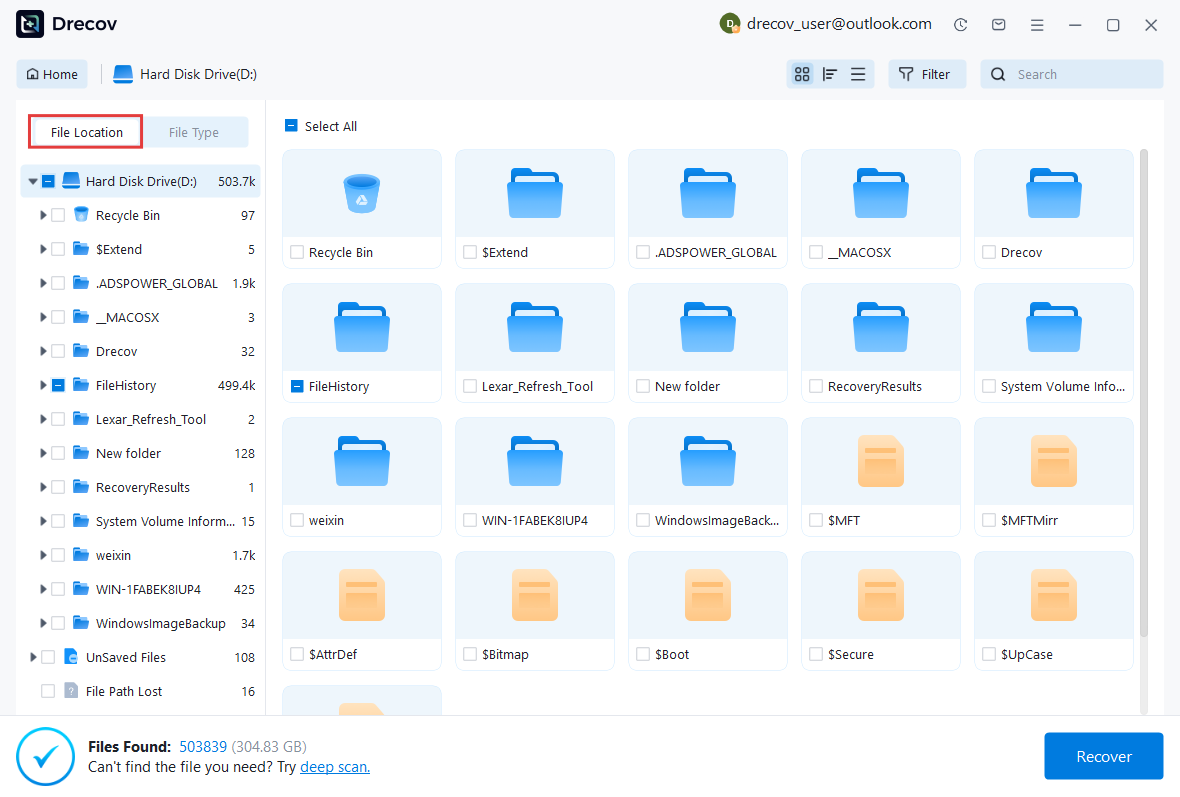
Step 2: Locate and Preview Lost Files
After scanning, browse the detected files and use the preview feature to check recoverable data. You can preview documents (Word, Excel, PDF), photos, and videos to ensure file integrity before recovery.
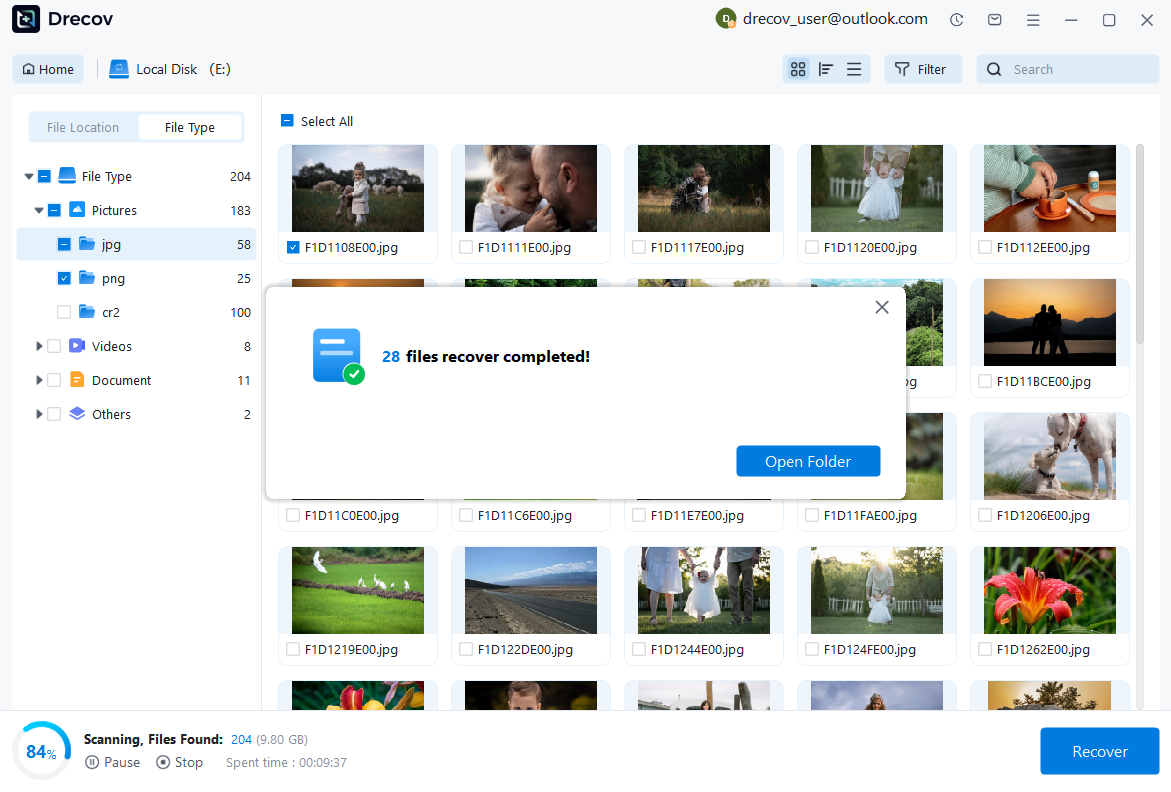
Step 3: Recover and Save to a New Location
Select the files you want to restore and click recover. Save all recovered data to a different drive or location (not the original device) to avoid overwriting lost data.
Why Choose PandaOffice Drecov Recovery Software?
PandaOffice Drecov offers a fast, secure, and user-friendly solution for recovering lost files across multiple scenarios. Whether you need email recovery, ZIP File Recovery, format data recovery, or help to recover deleted drafts Outlook, the software provides reliable recovery performance for both personal and business users.
PandaOffice Drecov supports recovery from formatted hard drives, SSDs, USB drives, SD cards, and external storage devices. Its advanced scanning engine can locate deleted archives, damaged ZIP files, lost Outlook drafts, and accidentally removed documents with high accuracy. For users searching for how to find deleted messages in Teams, PandaOffice Drecov can also help recover exported chat files, attachments, and related local cache data when available.
After recovery, test the file again. If the audio stream was damaged because of storage issues, a recovered version may play normally.
This method is particularly useful when only a few files exhibit audio problems while VLC works correctly with all other media.
This method can help users recover files from floppy disk storage after accidental deletion, formatting, or logical corruption.
Advantages
- Supports deep disk scanning
- Compatible with various file systems
- Allows file preview before recovery
- Suitable for incomplete wipe scenarios
Limitations
- Cannot restore sectors that have been fully overwritten.
- Recovery success depends on how much of the original data remains intact.
⚠️ Warning: Save recovered files to a different drive to avoid overwriting additional recoverable sectors.
Restore Data from an Existing Backup
Test Environment
- Operating System: Windows 10 Pro
- Backup Solution: Windows File History
- Storage Device: External 4TB HDD
- Recovery Scenario: Complete DBAN wipe
If a backup exists, restoring files is often the easiest and most reliable solution.
Potential backup sources include:
- Windows File History
- System Image Backup
- NAS Storage
- Cloud Backup Services
- External Hard Drives
Restoration Steps
- Locate the most recent backup copy.
- Verify that the backup files are accessible.
- Connect a healthy storage device.
- Launch the backup software.
- Restore required files and folders.
- Confirm that recovered files open correctly.
Advantages
- Fast recovery process
- High success rate
- Preserves original folder structure
- No risk of further disk damage
Limitations
- Requires a previously created backup.
- Recently modified files may not be included.
Rebuild Lost Partitions After an Incomplete DBAN Wipe
Test Environment
- Operating System: Windows 11 Pro
- Storage Device: 1TB Western Digital HDD
- Wiping Method: Quick Erase
- Recovery Scenario: DBAN stopped unexpectedly due to power loss
- Connection Type: Direct SATA Connection
In some cases, the wiping process may damage or remove partition information while leaving portions of file data untouched. When this occurs, rebuilding lost partitions may help restore access to previously stored files.
Partition reconstruction works by scanning the drive for remnants of partition tables, boot sectors, and file system metadata. If enough information remains, the original volume structure may be rebuilt.
Steps to Rebuild Lost Partitions
- Connect the affected drive to a working computer.
- Launch a partition recovery utility.
- Perform a full disk scan.
- Search for lost or deleted partitions.
- Review detected partition entries.
- Restore the correct partition structure.
- Mount the recovered volume.
- Copy important files immediately.
Advantages
- May restore original folder organization.
- Useful when partition information is damaged.
- Can recover large numbers of files at once.
Limitations
- Ineffective if the entire drive has been overwritten.
- Results vary depending on the condition of the file system.
Many users dealing with a partially erased dban drive have successfully recovered important documents after rebuilding damaged partitions.
Recover Data from a Previous Disk Image
Test Environment
- Operating System: Windows 10 Pro
- Storage Device: 2TB HDD
- Backup Method: Monthly System Image Backup
- Recovery Scenario: Complete DBAN wipe
- Storage Location: NAS Server
Disk images are one of the most valuable safeguards against accidental data loss. A disk image contains a sector-level copy of an entire drive, including operating system files, applications, settings, and personal data.
If a disk image was created before the wipe occurred, recovering data becomes significantly easier.
Steps to Restore a Disk Image
- Locate the most recent disk image.
- Verify the image integrity.
- Connect a replacement storage device.
- Launch the imaging software.
- Select the desired image version.
- Start the restoration process.
- Verify that all files are accessible after restoration.
Advantages
- Restores entire systems quickly.
- Preserves operating system configurations.
- Maintains folder structures and permissions.
- High success rate when backups are current.
Limitations
- Requires a previously created image.
- Changes made after the image date may be lost.
Organizations that regularly create disk images rarely need to worry about whether can data be recovered after dban, because their backup copies remain safely stored elsewhere.
Contact Professional Data Recovery Specialists
Test Environment
- Storage Device: Enterprise HDD
- Capacity: 8TB
- Wiping Method: Interrupted DoD Short
- Recovery Scenario: Critical business database loss
- Data Importance: High
When valuable data is involved, professional recovery services may be worth considering.
Specialized recovery laboratories use advanced tools that operate at the firmware and sector levels. While no recovery provider can guarantee results after a completed multi-pass wipe, experts may occasionally retrieve data from disks affected by interrupted wipes, hardware failures, or incomplete overwriting.
Professional services are often used when the lost data includes:
- Business records
- Financial databases
- Legal documents
- Scientific research
- Historical archives
When Professional Recovery Makes Sense
- The files are irreplaceable.
- Recovery software cannot detect any data.
- The drive has physical damage.
- Business operations depend on the lost information.
Advantages
- Access to advanced recovery equipment.
- Expertise with damaged storage devices.
- Higher success rates in complex cases.
Limitations
- Can be expensive.
- Recovery is not guaranteed.
- Turnaround times vary.
⚠️ Warning: Avoid opening a hard drive yourself. Internal contamination can permanently damage the storage media.
How to Prevent Data Loss Before Using DBAN
Create Multiple Backups
The best protection against accidental erasure is maintaining several backup copies.
A recommended backup strategy includes:
- One local backup
- One external backup
- One cloud backup
Following the 3-2-1 backup principle dramatically reduces recovery risks.
Verify the Correct Drive Before Wiping
Many accidental wipe incidents occur because users select the wrong disk.
Before starting DBAN:
- Confirm drive capacity.
- Verify model numbers.
- Disconnect unnecessary storage devices.
- Double-check partition layouts.
Spending a few extra minutes verifying the target disk can prevent a major disaster.
Create a Disk Image First
Before wiping any storage device, consider creating a complete disk image.
Benefits include:
- Full system restoration capability
- Protection against mistakes
- Easy access to archived data
- Faster disaster recovery
Test Backup Accessibility
Creating a backup is not enough. The backup must also be usable.
Before erasing a drive:
- Open several backup files.
- Verify folder structures.
- Confirm file integrity.
- Test the restoration process.
This ensures the backup can actually be used if needed.
⚠️ Warning: Never assume a backup is valid until you have tested it.
Frequently Asked Questions About DBAN Recovery
Can Data Be Recovered After DBAN Completed Successfully?
If DBAN completed a full overwrite operation successfully, recovery becomes extremely difficult.
Single-pass wipes occasionally leave limited opportunities for advanced forensic analysis, but multiple-pass methods generally eliminate practical recovery possibilities.
The likelihood of recovery decreases significantly as overwrite passes increase.
Can Data Be Recovered After DBAN on an SSD?
Recovery from SSDs is often more difficult than recovery from traditional hard drives.
Modern SSDs use technologies such as:
- Wear leveling
- Garbage collection
- TRIM commands
These features may remove data more thoroughly than conventional HDD storage systems.
As a result, successful recovery from a fully wiped SSD is uncommon.
Does Formatting Provide the Same Protection as DBAN?
No.
Formatting primarily removes file system information and directory entries. In many cases, deleted files can still be recovered after formatting.
DBAN actively overwrites storage sectors, making recovery far more difficult.
What Happens If DBAN Stops Halfway Through?
An interrupted wipe often creates the best opportunity for recovery.
Some sectors may be overwritten while others remain untouched. Recovery software may still detect files stored in unaffected areas.
The sooner recovery begins, the better the chances of success.
Can a DBAN Hard Drive Be Reused?
Yes.
After the wipe process completes, the drive can typically be repartitioned, formatted, and used again.
However, all previous data will likely be gone.
How Long Does a DBAN Wipe Take?
The duration depends on:
- Drive capacity
- Drive speed
- Wiping algorithm
- Number of overwrite passes
A single-pass wipe may take a few hours, while more secure methods can require significantly longer.
Is DBAN Suitable for SSDs?
DBAN was originally designed for magnetic hard drives.
Many storage manufacturers recommend using built-in Secure Erase functions for SSDs instead of relying on traditional overwriting methods.
Should I Continue Using the Drive After Discovering the Mistake?
No.
Continuing to use the drive can overwrite any remaining recoverable sectors.
Immediately disconnect the drive and begin recovery efforts if the data is important.
Final Thoughts on Recovering Data from a DBAN Drive
Accidentally erasing a drive with DBAN can be alarming, especially when important files are involved. Fortunately, the answer to can data be recovered after dban is not always a simple yes or no.
Recovery success depends on factors such as the wipe method, overwrite passes, storage technology, and whether the process completed successfully. Interrupted wipes, damaged sectors, and incomplete overwrites may leave opportunities for file recovery, while fully completed multi-pass wipes usually eliminate practical recovery options.
For users facing accidental data loss, the most effective approach is to stop using the affected dban hard drive immediately and evaluate available recovery methods. Solutions such as PandaOffice Drecov, backup restoration, partition reconstruction, disk image recovery, and professional recovery services may help recover valuable information depending on the situation.
Most importantly, maintaining reliable backups and carefully verifying the target dban drive before wiping remain the best defenses against permanent data loss.





