







Understanding Thunderbird Email and Profile Recovery
What Thunderbird Stores Inside a Profile
Mozilla Thunderbird stores far more than individual emails. Every account configuration, message folder, contact list, filter rule, and user preference is saved inside a dedicated profile folder. This profile acts as the central repository for all Thunderbird-related data.
When users perform email recovery for Thunderbird, they are often trying to recover much more than deleted messages. In many situations, the real objective is restoring the complete profile so Thunderbird can function exactly as it did before data loss occurred.
Profile folders commonly contain:
- Email messages
- MBOX mailbox files
- Address books
- Account settings
- Password databases
- Calendar information
- Custom filters and rules
Gaming PCs frequently use large secondary drives for storage. Many users move Thunderbird profiles to D:, E:, or dedicated SSDs to save space on the system drive. While this provides additional storage capacity, it also introduces additional recovery challenges if the drive becomes damaged or inaccessible. According to Mozilla documentation, Thunderbird stores all user data inside profile directories separate from the application itself, making profile recovery possible even when the program is reinstalled.
Why Thunderbird Data Can Disappear from Gaming Drives
Gaming drives experience heavy workloads. Large game installations, frequent updates, and intensive read/write operations can increase the risk of file system issues.
Thunderbird data stored on gaming drives may become inaccessible because of:
- Accidental deletion
- Drive formatting
- Partition loss
- File system corruption
- SSD firmware failures
- Power outages
- Malware attacks
- Improper profile relocation
Sometimes the emails still exist physically on the drive, but Thunderbird can no longer locate the profile. In other situations, the profile folder itself has been deleted.
⚠️ Warning: Stop using the affected drive immediately after discovering data loss. Writing new files to the drive may overwrite recoverable Thunderbird data and significantly reduce recovery success rates.
Understanding the root cause helps determine which recovery method should be attempted first.
Common Causes of Thunderbird Email Loss
Accidental Deletion of Profile Files
Human error remains one of the most common reasons for Thunderbird data loss.
Many users clean gaming drives regularly to free storage space. During these cleanups, Thunderbird folders may be removed accidentally. Because profile folders often contain unfamiliar names such as:
xxxxxxx.default-releaseusers sometimes mistake them for temporary files.
Deleting profile directories can lead to:
- Missing emails
- Empty inboxes
- Lost account settings
- Missing local folders
Fortunately, if the files have not been overwritten, successful thunderbird email recovery is often possible.
In some cases, deleted profile folders may still exist inside the Windows Recycle Bin. Checking there should always be the first recovery step.
Drive Formatting or Partition Changes
Gaming enthusiasts frequently upgrade storage devices.
Common upgrade scenarios include:
- Replacing HDDs with SSDs
- Expanding partitions
- Installing larger NVMe drives
- Cloning operating systems
During these processes, partitions may be reformatted unintentionally.
A quick format removes file system references while leaving much of the underlying data intact. This is why specialized recovery techniques can sometimes restore Thunderbird profiles even after formatting.
However, full formatting combined with heavy subsequent drive usage can make recovery substantially more difficult.
Corrupted Gaming Drive File Systems
A corrupted file system can cause Thunderbird folders to disappear even when the underlying data still exists.
Possible causes include:
- Sudden power loss
- Forced shutdowns
- Driver conflicts
- SSD controller issues
- Windows crashes
When corruption occurs, Thunderbird may launch with:
- Empty folders
- Missing accounts
- New profile creation prompts
Mozilla documentation notes that Thunderbird relies heavily on profile integrity. If critical profile files become damaged, the software may fail to load stored messages properly.
⚠️ Warning: Avoid running disk repair tools before creating a backup image of the affected drive. Some repair operations can modify recoverable data.
Malware and Unexpected System Failures
Malicious software remains a major threat to stored email data.
Certain malware variants specifically target:
- User documents
- Email archives
- Configuration files
Ransomware can encrypt Thunderbird profile folders, preventing access to important messages.
System failures may also contribute to profile corruption. Examples include:
- Motherboard failures
- RAM instability
- Storage controller problems
- Unexpected Windows updates
When Thunderbird data loss follows a hardware failure, recovery should focus on obtaining a safe copy of the affected drive before attempting restoration.
How to Recover Thunderbird Emails and Profiles from Gaming Drives
Method 1: Search for Missing Thunderbird Profile Files Manually
Before using recovery software, manually verify that the profile has not simply been moved or hidden.
Test Environment
- Windows 11 Pro
- Thunderbird 128 ESR
- Secondary NVMe gaming drive (D:)
- Profile manually relocated to D:\Thunderbird
Steps
- Open File Explorer.
- Enable Hidden Items.
- Search for:
profiles.ini- Search for:
*.default-release- Examine Thunderbird profile directories.
- Verify mailbox files are present.
Common locations include:
D:\Thunderbird\
D:\Mail\
D:\Profiles\
You can also launch Thunderbird and navigate to:
Help → Troubleshooting Informationto identify the active profile path. Mozilla’s support documentation explains how profile locations can be accessed through Thunderbird’s troubleshooting information panel.
If the profile still exists, simply reconnect Thunderbird to the folder and restart the application.
This method is quick, safe, and completely free.
Method 2: Restore Thunderbird Data from Existing Backups
If you previously backed up Thunderbird, recovery becomes significantly easier.
Test Environment
- Windows 10
- Thunderbird 115 ESR
- External USB backup drive
- Weekly profile backup archive
Steps
- Close Thunderbird completely.
- Locate your backup profile folder.
- Copy the backup files.
- Navigate to the active Thunderbird profile directory.
- Replace damaged files with backup copies.
- Restart Thunderbird.
Important profile components include:
- prefs.js
- Mail folder
- ImapMail folder
- Address books
- MBOX files
Mozilla recommends backing up entire profile folders rather than individual email files because all account information is stored inside the profile structure.
After restoration, Thunderbird should load all accounts, messages, and settings from the backup.
⚠️ Warning: Always create a copy of the current profile before overwriting existing files with backup data.
Method 3: Use PandaOffice Drecov for Thunderbird Recovery
Test Environment
- Windows 11
- 2TB NVMe SSD
- Deleted Thunderbird profile
- Quick-formatted gaming partition
Steps
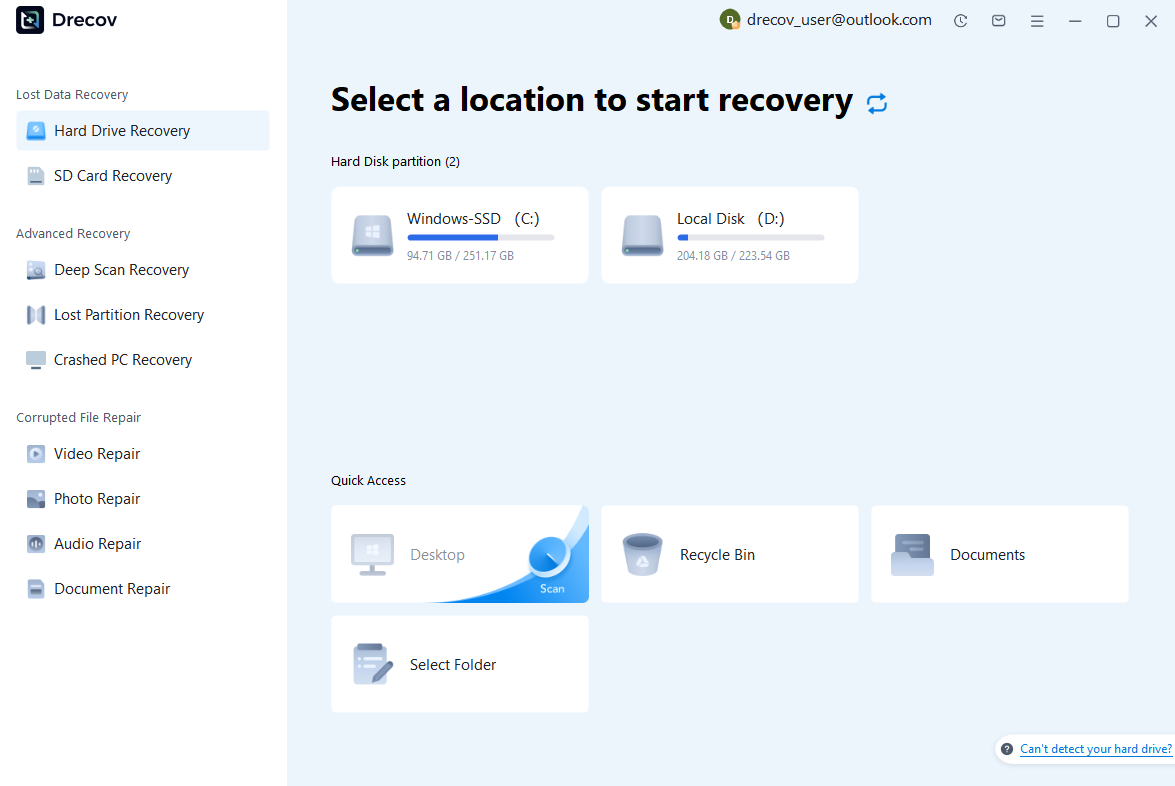
Step 1: Connect the Drive / USB)
Connect your device (SD card, HDD/SSD, or USB drive) to your computer and launch PandaOffice Drecov. Select the target device and start the scan. The software will perform a quick scan and deep scan to detect lost or deleted data.
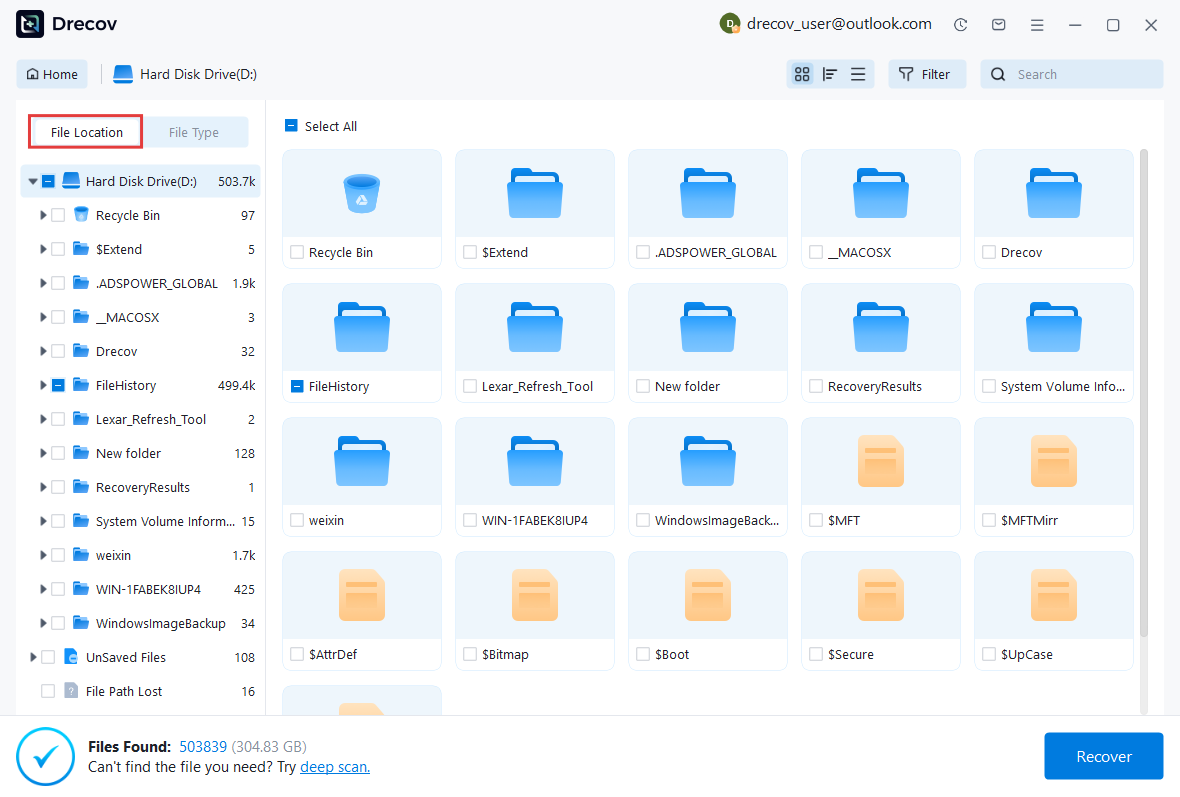
Step 2: Locate and Preview Lost Files
After scanning, browse the detected files and use the preview feature to check recoverable data. You can preview documents (Word, Excel, PDF), photos, and videos to ensure file integrity before recovery.
Step 3: Recover and Save to a New Location
Select the files you want to restore and click recover. Save all recovered data to a different drive or location (not the original device) to avoid overwriting lost data.

Why Choose PandaOffice Drecov Recovery Software?
PandaOffice Drecov offers a fast, secure, and user-friendly solution for recovering lost files across multiple scenarios. Whether you need email recovery, ZIP File Recovery, format data recovery, or help to recover deleted drafts Outlook, the software provides reliable recovery performance for both personal and business users.
PandaOffice Drecov supports recovery from formatted hard drives, SSDs, USB drives, SD cards, and external storage devices. Its advanced scanning engine can locate deleted archives, damaged ZIP files, lost Outlook drafts, and accidentally removed documents with high accuracy. For users searching for how to find deleted messages in Teams, PandaOffice Drecov can also help recover exported chat files, attachments, and related local cache data when available.
After recovery, test the file again. If the audio stream was damaged because of storage issues, a recovered version may play normally.
This method is particularly useful when only a few files exhibit audio problems while VLC works correctly with all other media.
This method can help users recover files from floppy disk storage after accidental deletion, formatting, or logical corruption.
If valuable files are stored on a problematic drive, tools such as PandaOffice Drecov can help recover documents, photos, videos, and other data before proceeding with more aggressive troubleshooting steps.
This approach minimizes risk and ensures that important information remains protected throughout the repair process.
PandaOffice Drecov can help locate deleted Thunderbird profiles, mailbox files, and related email data that are no longer visible in Windows Explorer. It is particularly useful when dealing with accidental deletion, formatting, partition loss, or file system corruption.
After the recovery process is complete, copy the restored profile folder to the appropriate Thunderbird profile location and restart Thunderbird. If the recovered profile contains intact configuration files and mailbox data, Thunderbird should load emails, folders, and account settings normally.
Advanced Thunderbird Email Recovery Techniques
Recovering MBOX Mailbox Files Directly
Sometimes Thunderbird profiles cannot be restored completely, but individual mailbox files still remain on the gaming drive. In these situations, recovering MBOX files can help restore important messages.
Thunderbird stores email folders in MBOX format. Unlike modern email databases, an MBOX file contains multiple messages within a single file. If these files are recovered successfully, thousands of emails may be restored at once.
Test Environment
- Windows 11 Pro
- Thunderbird 128 ESR
- Formatted SSD gaming drive
- Missing Inbox and Sent folders
Steps
- Scan the affected drive for MBOX files.
- Look for files without extensions.
- Identify mailbox names such as:
- Inbox
- Sent
- Drafts
- Archive
- Recover the files to another storage location.
- Open Thunderbird.
- Import recovered mailbox files into Local Folders.
Typical mailbox locations include:
Mail\
Local Folders\
ImapMail\
After importing the files, Thunderbird will often rebuild message indexes automatically.
This approach is particularly useful when only certain folders are missing while the rest of the profile remains functional.
For users seeking thunderbird email recovery, recovering mailbox files individually may be faster than restoring an entire profile structure.
Rebuilding a Damaged Thunderbird Profile
A profile may become corrupted even when all email files still exist on the drive. In this situation, creating a new profile and reconnecting mailbox data can restore access to messages.
Test Environment
- Windows 10
- Corrupted Thunderbird profile
- Existing mailbox files available
- Secondary SSD storage
Steps
- Close Thunderbird completely.
- Launch the Profile Manager.
- Create a new Thunderbird profile.
- Configure a temporary account.
- Locate recovered mailbox files.
- Copy mailbox data into the new profile.
- Restart Thunderbird.
A newly created profile often resolves problems involving:
- Broken configuration files
- Damaged account settings
- Corrupted index databases
- Missing profile references
If Thunderbird repeatedly opens with empty folders despite recovered data being available, rebuilding the profile may be the most effective solution.
Many administrators use this technique during advanced thunderbird email recovery projects because it minimizes configuration-related issues while preserving email content.
⚠️ Warning: Never copy recovered files directly into an active profile without creating a backup first. Incorrect replacements may cause additional profile corruption.
Recovering Thunderbird Emails After Drive Formatting
Formatting is one of the most common causes of email loss on gaming drives. Fortunately, a quick format usually removes file system references rather than immediately erasing all underlying data.
Recovery success depends heavily on what happened after the format occurred.
Test Environment
- Windows 11
- Quick-formatted NVMe SSD
- Thunderbird profile previously stored on D:
- No new data written after formatting
Recovery Procedure
- Stop using the formatted drive immediately.
- Avoid installing programs onto the affected partition.
- Perform a deep scan of the drive.
- Search for profile directories.
- Recover mailbox and configuration files.
- Restore recovered data to a separate device.
- Reconnect Thunderbird to the recovered profile.
If the drive has experienced extensive overwriting after formatting, complete recovery may not be possible. However, partial restoration of mailbox data is often achievable.
The sooner recovery begins, the higher the likelihood of success.
For many users performing email recovery for Thunderbird, formatted-drive recovery represents the most challenging scenario because overwritten sectors cannot typically be restored.
Best Practices to Improve Recovery Success Rates
Stop Using the Affected Drive Immediately
One of the biggest mistakes users make after losing Thunderbird emails is continuing to use the drive.
Every new file written to storage may overwrite recoverable mailbox data.
Examples include:
- Installing games
- Downloading updates
- Saving screenshots
- Recording gameplay videos
- Installing recovery software on the affected drive
Even a small amount of new activity can reduce recovery success significantly.
Whenever Thunderbird data loss is discovered:
- Shut down unnecessary applications.
- Avoid copying files.
- Disconnect the drive if possible.
- Begin recovery procedures promptly.
The earlier recovery starts, the better the results tend to be.
This principle applies to every type of thunderbird email recovery, whether dealing with deleted profiles, corrupted partitions, or formatted drives.
Create Regular Thunderbird Profile Backups
The most reliable recovery strategy is preventing permanent data loss before it occurs.
Thunderbird profiles contain everything necessary to rebuild an email environment. Regular backups eliminate much of the uncertainty associated with recovery operations.
Recommended backup frequency:
| User Type | Suggested Backup Schedule |
|---|---|
| Home User | Weekly |
| Student | Weekly |
| Gamer | Weekly |
| Small Business | Daily |
| Enterprise User | Daily |
Backup destinations may include:
- External SSDs
- NAS devices
- Cloud storage
- Secondary internal drives
A complete profile backup typically requires only a few minutes but can save countless hours during a recovery emergency.
Maintaining multiple backup generations further improves protection against accidental deletion and ransomware attacks.
FAQ
Can permanently deleted Thunderbird emails be recovered?
Yes, in many cases permanently deleted Thunderbird emails can still be recovered if the storage sectors containing the data have not been overwritten.
Successful recovery depends on factors such as:
- Drive condition
- Time elapsed since deletion
- Amount of new data written
- File system integrity
Quick action significantly improves recovery chances.
Where are Thunderbird profiles usually stored?
Default Thunderbird profile locations commonly include:
Windows
C:\Users\Username\AppData\Roaming\Thunderbird\Profiles\
macOS
~/Library/Thunderbird/Profiles/
Linux
~/.thunderbird/
Some users relocate profiles to gaming drives or external storage devices to conserve system disk space.
When troubleshooting thunderbird email recovery, identifying the profile location is often the first step.
What is a Thunderbird email recovery tool?
A thunderbird email recovery tool is software designed to locate deleted, lost, or inaccessible Thunderbird email files.
These tools may help recover:
- Profile folders
- MBOX mailbox files
- Deleted messages
- Formatted-drive data
- Corrupted partition content
Recovery tools are most useful when no usable backup exists.
However, results vary depending on the condition of the storage device and the extent of data overwriting.
What is the difference between standard and advanced Thunderbird email recovery?
Standard recovery typically involves:
- Restoring backups
- Recovering deleted profile folders
- Reconnecting existing mailbox files
Advanced thunderbird email recovery usually includes:
- Deep scanning formatted drives
- Rebuilding damaged profiles
- Recovering raw mailbox structures
- Extracting messages from partially corrupted storage
Advanced methods are generally required when severe file system damage or partition loss has occurred.
How can I prevent Thunderbird email loss in the future?
The most effective preventive measures include:
- Backing up profiles regularly
- Using reliable SSDs
- Maintaining antivirus protection
- Avoiding forced shutdowns
- Monitoring drive health
- Creating system restore points
Combining these practices dramatically reduces the risk of future email loss.
⚠️ Warning: Never store your only Thunderbird profile copy on a single gaming drive without backups.
Final Thoughts
Losing important Thunderbird emails can be frustrating, especially when profiles are stored on gaming drives that experience heavy daily use. Whether the problem stems from accidental deletion, formatting, partition changes, malware, or file system corruption, recovery is often possible when the correct approach is used.
The recovery process should begin with simple checks, including locating existing profile folders and restoring available backups. If those options are unavailable, deeper recovery techniques such as mailbox restoration, profile rebuilding, and specialized scanning methods may help retrieve lost information.
For users facing severe data-loss situations, a dedicated thunderbird email recovery tool can assist in locating deleted profiles and mailbox files that Windows no longer displays. Meanwhile, maintaining regular backups remains the most reliable protection against future incidents.
By following the methods outlined in this guide, users can greatly improve their chances of successful email recovery for Thunderbird while minimizing the risk of permanent message loss. Whether you need basic thunderbird email recovery or more complex advanced thunderbird email recovery procedures, acting quickly and avoiding unnecessary drive activity will always provide the best opportunity for restoring valuable email data.





