







If your computer won’t wake up from sleep, first look for signs that it still has power: a charging light, fan, keyboard backlight, or image on an external monitor. Press a key, move the mouse, or open the laptop lid, then wait briefly. A dark screen does not prove the whole PC is off. Save work through any display that still functions before forcing a restart. If there is no sign of power, check the charger and outlet rather than changing Windows settings you cannot reach.
The useful question is not simply “Why is it asleep?” A laptop with a dead battery, a desktop sending video to the wrong monitor, and Windows stuck during a power-state transition can all look black. Their remedies differ. Make one observation at a time and note what changes. That approach protects unsaved work and prevents a display problem from turning into an unnecessary reset or reinstall.
Which part failed to return?
Start with the power indicator and peripherals. Does the keyboard light turn on? Can you hear a fan? Does a connected monitor show a cursor or sign-in screen? If a display works but the built-in panel stays dark, focus on display output, cable, panel, or graphics behavior. If both screens stay blank while lights remain on, Windows or a driver may have stalled in the transition. No lights at all calls for a power check first.
On a laptop, connect its proper charger to a known working outlet. Give it time to charge. Watch for unusual heat, a swollen battery, a burning smell, or damaged power equipment. Disconnect safely and seek qualified help if any of those appear. Do not keep trying the power button on an electrically unsafe device. A software scanner has no role until a stable storage source and a genuine file-loss problem exist.
For a desktop, confirm that the monitor is on and set to the correct input. Check a dock or external screen separately if one is attached. A loose display cable can make an awake computer look frozen. If you can reach Windows from another display, save current documents and check whether the original monitor reappears after a normal restart. Do not assume a storage failure merely because the display stayed black.
Try the lowest-risk wake actions first
Press a keyboard key or click the mouse, and open the lid if it is a laptop. Microsoft notes that supported wake methods vary by device. Some keyboards or wireless receivers cannot wake a particular PC in every sleep state. If a dock is involved, try the built-in keyboard and display without disconnecting an active storage transfer. Wait for the sign-in screen before pressing more controls.
When lights show that the computer is running but the picture is absent, check the display path rather than repeating random key combinations. On a compatible Windows PC, the graphics-driver reset shortcut Windows + Ctrl + Shift + B may help test an unresponsive screen. It is not a power-on command. If an external display works, use it to save open work and inspect the display settings before doing anything more disruptive.
A single forced restart may become necessary if the machine stays unresponsive and you cannot access work from any screen. First allow any visible update or installation to finish. A power cut during a write can leave a document or system operation incomplete. If you must hold the power button, do it once, then record whether the next boot reaches a logo, sign-in screen, or recovery message. Repeating forced shutdowns is not a troubleshooting plan.
After it starts, test a repeatable sleep cycle
Save your open work and close applications that hold irreplaceable unsaved data. Disconnect nonessential accessories after safely ejecting storage. Put Windows to sleep through Start > Power > Sleep, not only by closing a lid or pressing a case button. Wake it with the built-in keyboard or power button as documented for the device. Note whether the problem appears only with the dock, one monitor, one input device, or after a longer sleep period.
If it wakes normally without the dock, reconnect one accessory at a time. A monitor or USB receiver can change the apparent outcome without the main computer failing. If the fault occurs only after a specific driver or update, use the device manufacturer’s current support information for that model. Do not install a random driver package merely because a web page lists it. Keep a restore route and a backup before changing firmware.
Windows offers power and sleep settings under Settings > System > Power & battery on current Windows 11 devices. Check when the screen turns off and when the PC enters sleep. Those are separate timers. If your issue is really that the screen goes dark too soon, adjust the screen timer; if the PC sleeps unexpectedly, inspect the sleep timer. Compare battery and plugged-in settings on a laptop.
Use evidence from Windows, not a guess about the last wake
If you can reproduce the behavior, open Command Prompt and run powercfg /lastwake. Microsoft describes it as a report about what woke the system from its last sleep transition. An empty or unhelpful result does not prove that no wake event occurred. powercfg /devicequery wake_armed lists devices configured to wake the computer, but it does not mean each of them caused this incident. Treat these as reports, not fixes.
Check Reliability Monitor for a critical event or driver failure at the same time as the failed wake. The timing matters more than a generic warning elsewhere in the log. If Windows reports an unexpected shutdown, that confirms the previous session ended abruptly; it does not identify the failed component. A recurring graphics error, a specific driver name, or a failure only on battery gives a more useful next test than a single Event ID 41 entry.
Microsoft’s sleep and hibernate guidance describes normal wake methods and the difference between those power states. If the computer instead turns off and immediately restarts, the related shutdown diagnosis owns that neighboring problem. Stay with wake-from-sleep tests only if the PC actually entered sleep and then failed to return.
Protect files only if the incident caused a real loss
A failed wake does not by itself delete files. After Windows becomes usable, open the document or project you were working on, then check that application’s autosave or recovery view. Look at File History, cloud version history, or another backup if the last edit is absent. Unsaved content that never reached the disk may not be recoverable by scanning storage. Distinguish a missing saved file from changes that never left memory.
PandaOffice Drecov is Windows data recovery software for a different branch: a saved local file was deleted or became inaccessible on stable storage after the incident. Its read-only recovery mode, Quick Scan, Deep Scan, file filters, preview, and output to another healthy device can help inspect remaining candidates. Lost Partition Recovery applies when a former partition is missing. Drecov does not wake a sleeping PC, repair its display, restore RAM-only unsaved changes, or fix physical damage.
If a previously saved file truly disappeared, stop adding data to its original drive and check backups first. Prepare a separate healthy recovery destination, and do not install software on the affected partition. A drive that clicks, repeatedly drops offline, or produces severe read errors needs a controlled image or professional assessment instead of repeated scans. Only continue when the original device remains stable and readable.
⚠ Warning: Install it on a drive different from the one where your data was lost to prevent overwriting.
Step 1: Open Drecov at the original saved location
Launch Drecov in a working Windows environment and select the volume where the file was last saved. For a document in the user’s Documents folder, that may be the Windows data volume; for a project on an external USB drive, select that device. Match model and capacity rather than a remembered drive letter. Do not scan the separate drive prepared to receive the output.
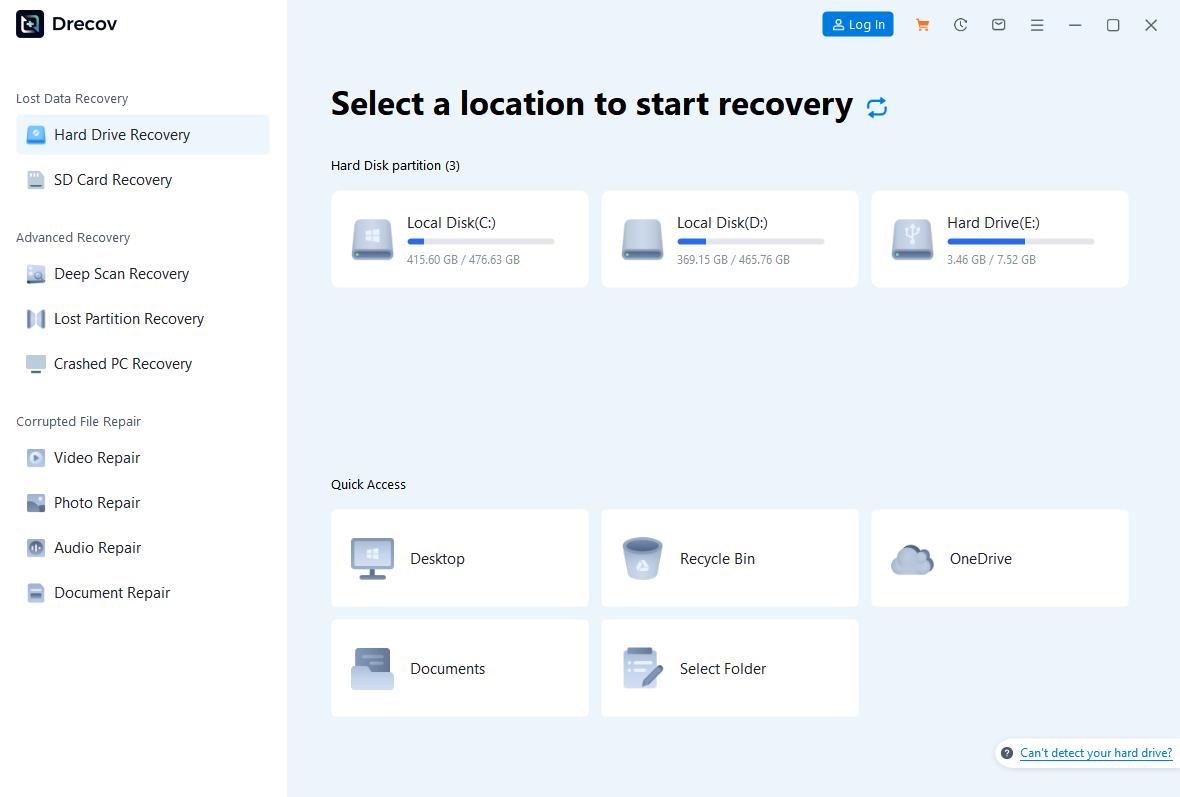
Step 2: Review Quick Scan before broadening the search
Start Quick Scan and inspect the former folder, filename, date, and file type. Compare found versions with autosave or cloud copies. If the needed file appears, preview a representative supported item. A preview can show that a sample opens, not that every page or linked project resource remains intact.

Step 3: Use Deep Scan only on stable storage
If Quick Scan misses the saved file and the source stays stable, run Deep Scan. Filter by available name, path, type, or date clues. Results may include duplicates or reconstructed items without old names. Do not keep scanning a device that starts disconnecting or reports escalating errors.
Step 4: Save elsewhere and confirm the work
Recover chosen files to the other healthy drive. Never save them back to the source. If output seems absent, inspect the destination and any Drecov Folder or Recovery Folder there. Open the recovered project in its application and check the sections that matter, not only the icon or thumbnail. The file recovery overview covers other local-loss cases, while the Drecov homepage shows current recovery modes.

⚠ Warning: Install it on a drive different from the one where your data was lost to prevent overwriting.
FAQs
Why are the lights on but the screen stays black?
The PC may be awake while its display output or graphics driver has not returned. Check the monitor input, external screen, and built-in display separately. Save work through a functioning screen before forcing a restart.
Can a mouse always wake a Windows PC?
No. Wake behavior depends on the device, connection, and supported power state. Try the built-in keyboard, lid, or documented power button. A wireless receiver may not be active in every sleep state.
Will a forced restart erase my files?
Saved files usually remain, but open unsaved changes can be lost, and an interrupted write can leave an incomplete file. Use a forced restart only when safer wake and display checks fail. After reboot, inspect the application recovery list.
Should I reset Windows if sleep fails repeatedly?
Not as the first test. Compare the issue with and without peripherals, check power settings and relevant drivers, and protect data before broader system changes. If the machine also shows abnormal hardware behavior, investigate that before reinstalling Windows.
Conclusion
A computer that will not wake from sleep needs a power, display, and Windows-state check before a forced restart. Look for signs of life, test one wake method, and compare the next sleep cycle under controlled conditions. Protect current work whenever you can still reach it. Drecov matters only if a previously saved local file is genuinely missing on stable storage; it can search that source and save results to another drive. It cannot bring back content that was never saved from memory or fix a faulty display.
⚠ Warning: Install it on a drive different from the one where your data was lost to prevent overwriting.