







“I deleted a file in my Downloads folder, emptied the Recycle Bin, then downloaded another file with the same name. Is the original gone forever, or can file recovery software still save the day?”
That sounds like a nightmare, but it is also a very real kind of Reddit help post. A representative original post that mirrors this exact panic scenario is here: Reddit help post about deleted Downloads file recovery. The user deleted a file, emptied the Recycle Bin, then downloaded a file with the same name and wondered whether the old version could still be saved. The top replies explained something many people do not realize: deletion is not always destruction, but modern SSD behavior can change the outcome dramatically.
In this guide, we will first introduce the most practical tools, then explain each recovery method step by step. We will begin with safe checks, move into beginner-friendly file recovery software, then continue into official open-source tools for deeper recovery.
The Main File Recovery Software and Recovery Tools You Should Know First
Today, people do not only lose photos or Word documents. They also lose browser bookmark exports, saved web pages (.html), downloaded invoices (.pdf), CSV exports from web dashboards, ZIP downloads from cloud storage, USB folders full of website assets, browser session files, and project files stored in Downloads by mistake.
As a result, many users search for file recovery software after a single accidental deletion, a mistaken cleanup, or a browser export gone missing. Before we jump into recovery, let’s briefly introduce the tools in the order most users should understand them.
1. Built-In Windows Recovery Features
Before using any third-party file recovery software, you should always check Windows itself. Built-in options include the Recycle Bin, Previous Versions, File History, OneDrive sync history, and Browser download history. These options are the safest because they preserve file names, folder structure, and timestamps.
2. PandaOffice Drecov
PandaOffice Drecov is the easiest place to start when built-in recovery does not help. This file recovery software is designed for normal users who need a guided process for deleted files, emptied Recycle Bin recovery, USB file recovery, and browser download recovery. Its biggest advantage is usability; it helps users avoid mistakes during a stressful recovery attempt.
3. PhotoRec
PhotoRec, from the official TestDisk / CGSecurity project, is a powerful open-source file recovery software option. Despite its name, it recovers much more than photos, including PDF, HTML, DOCX, XLSX, and ZIP files. It is excellent when deleted files no longer have clean file system records.
4. TestDisk
TestDisk focuses on storage structure problems rather than simple file deletion. Use it when a USB drive looks empty, Windows says the drive must be formatted, or a partition becomes RAW. This is more advanced than ordinary file recovery software, but it can rescue situations where normal scanning fails.
5. Browser Profile Recovery
Sometimes the lost “file” is not a normal file at all. Instead, it is browser-related data such as bookmarks, session tabs, or cached page resources. In those cases, targeted recovery of browser profile files can work faster than broad file recovery software scanning.
Section 1: The Science Behind File Recovery Software
Before you use file recovery software, it helps to understand one key principle: Deleting a file usually removes the file’s map entry before it removes the file’s actual data.
Imagine your hard drive as a library:
- The file is the book.
- The file system is the catalog.
- Deleting the file often removes the catalog card first.
- The book may still sit on the shelf until a new book replaces it.
That is exactly why file recovery software can work. There are two core recovery principles that these tools use:
Metadata-Based Recovery
This is the cleanest kind of recovery. The file recovery software reads file system records (like the MFT in NTFS) and restores the original file name, folder path, file size, and date modified. If these records still exist, recovery is usually neat and easy.
Signature-Based Recovery
If the file system record is gone, file recovery software can scan raw sectors for file signatures. For example, PDF files often begin with %PDF, and JPEG files often begin with FF D8 FF. This method is powerful, but it often loses the original file names and folder structure.
Why SSD Recovery Can Be Harder Than HDD Recovery
Many users assume deleted files remain recoverable forever. However, modern SSDs often use TRIM behavior, which can make deleted blocks unreadable to file recovery software very quickly. In the Reddit example above, the most experienced replies pointed out that SSD + TRIM can make the old file effectively unrecoverable even without obvious overwriting. That is why the first rule is always: Stop using the affected drive immediately.
Section 2: Key Considerations Before You Run Any File Recovery Software
Before you start any method, keep these rules in mind to maximize your success rate:
- Do not save new files to the affected drive.
- Do not install recovery tools on the affected drive if possible.
- Do not recover files back to the same drive (this causes overwriting).
- Prefer preview before recovery when available.
- Start with safe methods, then move into deeper file recovery software scans.
- If the drive is failing physically (making clicking noises), stop and consider professional help.
Method 1: Check Built-In Windows and Browser Recovery First
This is the safest method, so it should always come first. It is best for recently deleted files and browser-specific data.
How to Recover Deleted Files Without Third-Party File Recovery Software
- Step 1: Open the Recycle Bin. Search by file name or extension (e.g.,
.html,.pdf). If found, right-click and select Restore.

- Step 2: Check the original folder manually. Look for renamed duplicates in
C:\Users\<YourUserName>\Downloadslikereport (1).pdf. - Step 3: Open browser download history. Use the shortcut keys Ctrl + J in Chrome, Edge, or Firefox. If the entry exists, you might be able to re-download it.
- Step 4: Check Previous Versions. Right-click the parent folder, select Properties, then the Previous Versions tab. If a version exists, open it and copy the files out.
- Step 5: Check OneDrive or Cloud Sync. If the deleted file lived in a synced location, check the cloud’s online Recycle Bin.
Method 2: Use PandaOffice Drecov
This method is the most practical next step for most users. PandaOffice Drecov excels at recovering emptied Recycle Bin files and lost browser exports with a simple, guided interface.
⚠ Warning: Install it on a drive different from the one where your data was lost to prevent overwriting.
How to Recover Files with PandaOffice Drecov
- Step 1: Launch the software. Select the exact location where the file was lost, such as Downloads or the Recycle Bin.

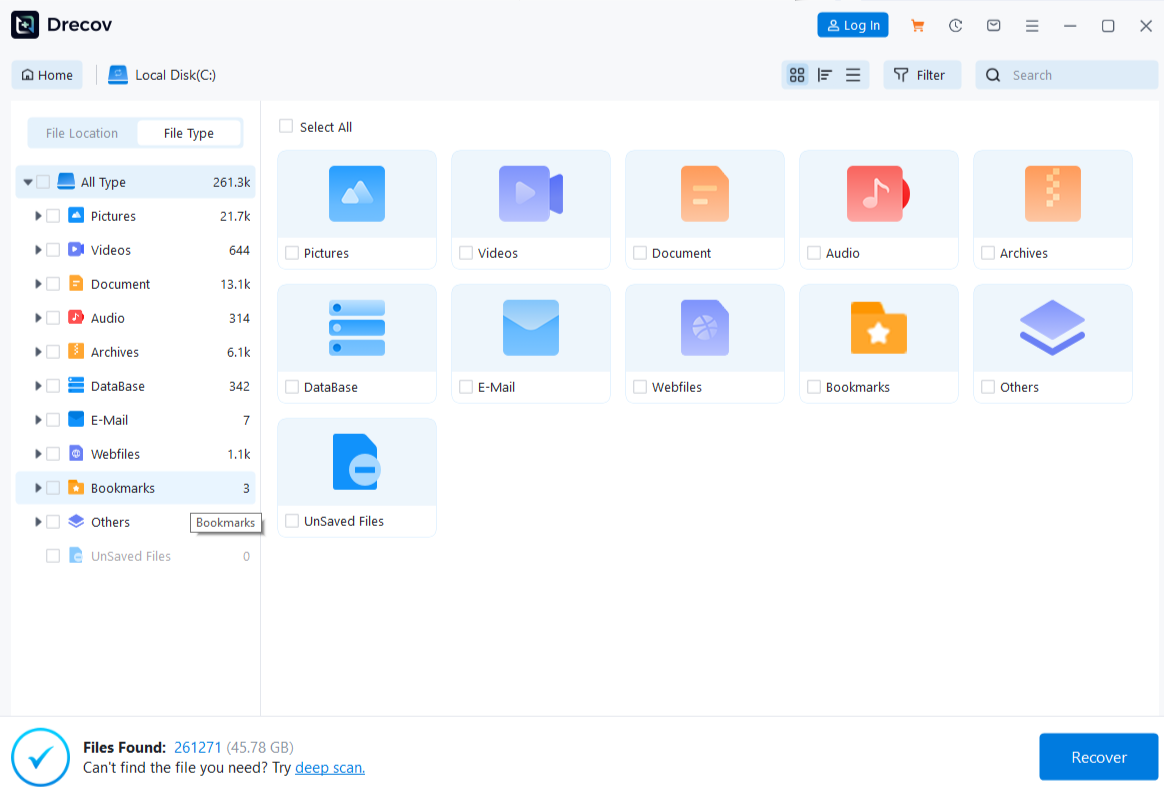
- Step 2: Start a Quick Scan. This is ideal for recent deletions or recently deleted browser exports.
- Step 3: Filter results. Use the filter sidebar to select Documents, HTML/Web files, or Archives. Enter the file extension like
.csvor.zipin the search bar.
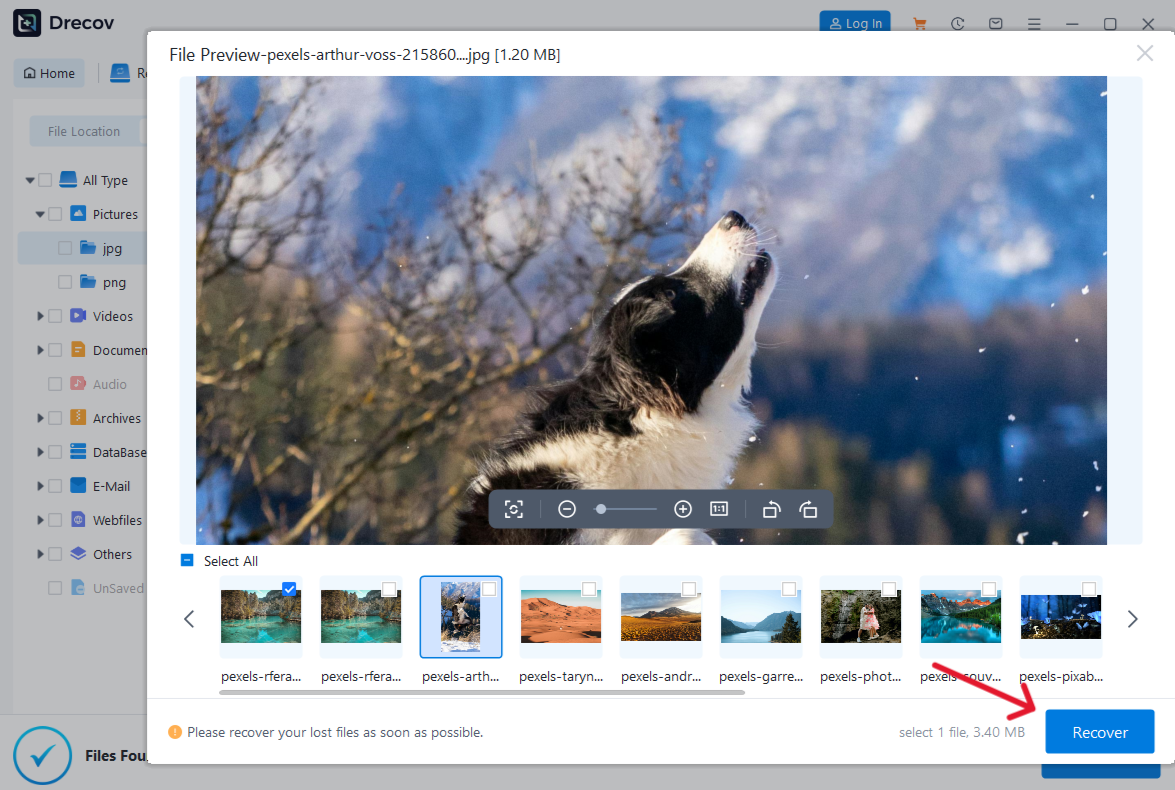
- Step 4: Use the Preview feature. Before restoring, click the file to see if the content is intact. This is a major advantage of this file recovery software.
- Step 5: Run a Deep Scan if needed. If the Quick Scan fails, the Deep Scan will search raw sectors for file signatures.
- Step 6: Select and Recover. Select your target files and click Recover. Save the recovered files to an external drive or a different partition.
Warning: Never restore files to the same drive you are scanning. This can permanently destroy other files you are trying to save!
Recommended Internal Guides
After completing the recovery methods above, readers who need more targeted help can continue with these internal resources:
- Recover deleted files on OneDrive – comprehensive guide
- How to recover deleted files from a USB drive
- Complete guide to Windows 10 and 11 file recovery
Method 3: Use PhotoRec
If beginner-friendly file recovery software does not find the file, use PhotoRec. It is powerful but lacks original file names.
How to Recover Files with PhotoRec
- Step 1: Download the package. Get the official TestDisk / PhotoRec package from the CGSecurity website.
- Step 2: Extract to a healthy drive. Do not run it from the drive you are trying to recover.
- Step 3: Launch QPhotoRec. On Windows, run
qphotorec_win.exefor a graphical interface. - Step 4: Select the Disk and Partition. Choose the physical disk (e.g., your SSD) and the specific partition (e.g., NTFS).
- Step 5: Filter File Formats. Click File Formats and uncheck everything except what you need (like
html,pdf,zip). - Step 6: Choose Scan Scope. Select Free to scan only unallocated space where deleted files live.
- Step 7: Start the scan. Choose an output folder on a different drive and wait.
- Step 8: Review results. Look through the
recup_dirfolders. You will need to identify files by content since names are usually lost.
Method 4: Use TestDisk for RAW, Empty, or “Needs Formatting” Drives
When the entire drive becomes inaccessible, standard file recovery software scans might fail. TestDisk is the tool for repairing the partition table itself.
How to Recover Data with TestDisk
- Step 1: Launch TestDisk. Run
testdisk_win.exe. - Step 2: Create a Log. Select Create to keep track of the session.
- Step 3: Select the Disk. Choose the drive that is appearing as RAW or empty.
- Step 4: Partition Table. Usually, select Intel/PC or EFI GPT as detected by the tool.
- Step 5: Analyse. Select Analyse and then Quick Search.
- Step 6: Preview Files. If a partition is found, press P to list files. You can copy them to another drive from this screen.
- Step 7: Write changes (Advanced). Only use the Write command if you are certain the partition structure found is correct and you want to fix the drive layout.
Method 5: Recover Deleted Browser and Web Data from Profile Folders
Sometimes the “file” isn’t a standalone document but a piece of the browser’s database.
Common Browser Profile Paths in Windows
- Chrome/Edge:
C:\Users\<YourUserName>\AppData\Local\Google\Chrome\User Data\Default - Firefox:
C:\Users\<YourUserName>\AppData\Roaming\Mozilla\Firefox\Profiles\
How to Recover Browser-Related Data
- Step 1: Close the browser. Use Ctrl + Shift + Esc to ensure all browser processes are dead.
- Step 2: Navigate to the path. Use Windows + R and type
%LOCALAPPDATA%to find the folders. - Step 3: Look for backup files. Often, browsers keep
Bookmarks.bakfiles. Renaming these can restore lost links. - Step 4: Use File Recovery Software on the Profile Folder. Instead of scanning the whole drive, point PandaOffice Drecov specifically at these AppData paths to find deleted session or history files.
Method Comparison: Which File Recovery Software Should You Choose?
| Method | Difficulty | Best For | Advantages |
| Windows Recovery | Very Easy | Recent deletions | Safest; preserves names. |
| PandaOffice Drecov | Easy | Deleted files, USBs | Beginner-friendly, preview mode. |
| PhotoRec | Moderate | Deep signature scan | Powerful; open-source. |
| TestDisk | Advanced | RAW drives, partitions | Fixes drive structure. |
| Browser Profiles | Moderate | Bookmarks, sessions | Highly targeted for web data. |
Preventive Measures: How to Avoid Needing File Recovery Software Again
The best file recovery software is the one you never have to open. To protect your data in the future, follow this checklist:
- Enable File History in Windows Settings for your main user folders.
- Move files out of Downloads immediately. Treat the Downloads folder as a temporary transit zone, not a storage cabinet.
- Use Cloud Sync (OneDrive, Google Drive, or Dropbox) which offers a 30-day “Version History” for every file.
- Export browser bookmarks monthly and save them to a dedicated “Backups” folder.
- Always label USB drives so you don’t accidentally format the wrong one.
- Create a “Web Exports” folder specifically for your
.html,.csv, and.pdfdownloads to keep them separate from temporary clutter.
File Recovery FAQs:
What is the best file recovery software for deleted files on Windows?
For most users, PandaOffice Drecov is the strongest starting point because it combines ease of use with powerful scanning features.
Can file recovery software recover deleted browser downloads?
Yes. As long as the data hasn’t been overwritten by new downloads, tools like PandaOffice Drecov or PhotoRec can find them.
Does file recovery software work on SSDs?
It can, but success is lower due to TRIM. You must act much faster on an SSD than on an old-fashioned HDD.
How do I recover deleted HTML files or saved web pages?
Start with a targeted scan using file recovery software filtered for the .html extension. If the metadata is gone, use the signature-based scan in PhotoRec.
Conclusion
When files disappear, the worst thing you can do is panic and keep using the drive. The smartest recovery order is simple: Check built-in recovery first, use PandaOffice Drecov for a user-friendly experience.
In short, file recovery software is not magic, but it is a highly effective safety net. If you act quickly, respect the “no-overwrite” rule, and choose the right method for your specific situation, you can recover your deleted files and web data with much better odds than you might think.





