







We’ve all been there. It’s 11:00 PM, you’re trying to sync a crucial presentation for tomorrow’s meeting, and suddenly, a bright red “X” appears on your taskbar. Your OneDrive is full. Or perhaps worse: you realize that the folder you just “cleaned up” on your laptop has vanished from your colleague’s shared drive because you didn’t realize they were linked.
I recently helped a freelance photographer, Sarah, who accidentally synced her entire 2TB raw photo archive to a 256GB Surface Pro. Her computer froze, her internet slowed to a crawl, and she was terrified that deleting the files from her PC would erase her life’s work from the cloud.
Knowing how to delete files from OneDrive isn’t just about clicking a button; it’s about managing your digital life without losing your mind—or your data. In this guide, we’ll break down every method to clear space, the subtle science of how data actually “dies,” and how to get it back if you make a mistake.
Part 1: Why Clean Up? Common Scenarios for Clearing Space
Before we dive into the “how,” let’s look at the “why.” Understanding your scenario helps you choose the right method.
- The “Storage Full” Ghost: OneDrive’s free tier is notoriously slim. Once you hit that 5GB limit, emails stop arriving in your Outlook inbox because they share the same storage quota.
- Privacy Concerns: You might have synced sensitive documents (like tax returns or passwords) to a work computer and need them gone—permanently.
- The Duplicate Dilemma: Sometimes, OneDrive creates “Conflict Copies” of files. Learning how to delete files from OneDrive effectively helps you prune these duplicates to keep your version history clean.
- The Hardware Swap: You’re selling your laptop and want to ensure your cloud-linked files aren’t accessible to the next owner.
Part 2: The Architect’s Guide — How to Delete Files from OneDrive with Precision
As a technical expert, I categorize the process of how to delete files from OneDrive into three distinct layers: the GUI user, the command-line power user, and the system administrator. Choosing the right layer ensures you don’t just “hide” a file, but manage its lifecycle correctly.
1. The File Explorer Masterclass (GUI Method)
Most users interact with OneDrive through the Windows File Explorer. However, there are nuances to the icons you see next to your filenames.
- The Blue Cloud Icon: This file exists only online. Deleting it here removes it from the cloud.
- The Green Checkmark: This file is stored locally. Deleting it removes it from your SSD and the cloud.
Pro-Tip: Precision Shortcuts Instead of dragging files to the bin, use these for efficiency:
Shift + Delete: This is the “Nuclear Option.” It bypasses the Windows Recycle Bin and sends a direct instruction to the OneDrive API to move the item to the Online Second-Stage Recycle Bin.Ctrl + D: The standard deletion that moves files to the local bin first.
2. The Command Line Approach (For Power Users)
Sometimes the interface lags, or you have thousands of small cache files to clear. You can execute how to delete files from OneDrive via PowerShell or Command Prompt (CMD).
Using PowerShell:
- Press
Win + Xand select Terminal (Admin). - To delete all
.tmpfiles in your OneDrive, type:Get-ChildItem -Path "$env:OneDrive\*.tmp" -Recurse | Remove-Item -ForceThis command bypasses the GUI overhead and clears space in seconds.
3. The Registry & System Path Precision
If you want to prevent OneDrive from ever syncing a specific folder again (effectively “deleting” the sync relationship), you need to know the paths.
- Default Root Path:
%UserProfile%\OneDrive - Registry Key for Account Control:
HKEY_CURRENT_USER\Software\Microsoft\OneDriveWithin this key, theUserFolderstring value defines exactly where your data lives. If you are troubleshooting a deletion that won’t “stick,” checking the permissions on this registry path is the first step a pro takes.
Part 3: The Science of “Gone” — Data Recovery and Protection
Understanding how to delete files from OneDrive requires understanding what happens to the bits and bytes. It is never as simple as “vanished.”
The Life Cycle of a Deleted Byte
When you delete a file, Windows doesn’t immediately scrub the physical magnetic or flash storage. Instead, the file system marks the space as “Unallocated.” Imagine a library where the librarian doesn’t burn a book when it’s “deleted”—they simply remove the entry from the index card and tell people, “You can write your own stories on these pages now.” As long as no one has written a new “story” over those pages, the original content is 100% recoverable.
The “TRIM” Factor (Warning for SSD Users): Most modern laptops use SSDs. Windows sends a TRIM command to an SSD after a deletion, which tells the drive to clean up those “unallocated” cells during idle time. This is why time is your greatest enemy. If you’ve accidentally deleted a critical folder, you must stop using the computer immediately to prevent the TRIM command or new data from overwriting your lost files. over it. This is why speed is vital—the more you use your computer after an accidental deletion, the higher the chance your “ghost” file gets overwritten.
Introducing PandaOffice Drecov: Your Safety Net
If you’ve emptied your Recycle Bin and realized you made a massive mistake, don’t panic. Professional-grade tools like PandaOffice Drecov can scan the sectors of your hard drive to find those “unindexed” files before they disappear forever.This makes it an indispensable tool for a wide range of data loss scenarios, including:
- Accidental Desktop Deletions: Instantly retrieving files wiped from your local workspace.
- Disk Formatting Errors: Salvaging files from drives that have been completely wiped or reformatted.
- External Media Rescue: Recovering lost data from formatted or corrupted SD cards and USB flash drives.
- Sync Conflict Resolution: Reversing data loss caused by synchronization errors between your PC and the OneDrive cloud.
- Browser Metadata Recovery: Restoring lost Chrome bookmarks and other essential application data.
The Three-Step Recovery Process
- Step 1: Target and Scan
Launch PandaOffice Drecov. From the main dashboard, select the specific drive where your OneDrive folder was located (usually the C: drive). Click Scan. The software will perform a Deep Scan to look for file headers that match your deleted items.

- Step 2: Filter and Preview
You don’t have to dig through millions of files. Use the filter sidebar to sort by “Deleted Files” or search for specific file extensions like .docx or .jpg. Drecov allows you to Preview the file—if you can see the image or read the text in the preview window, the file is 100% recoverable.
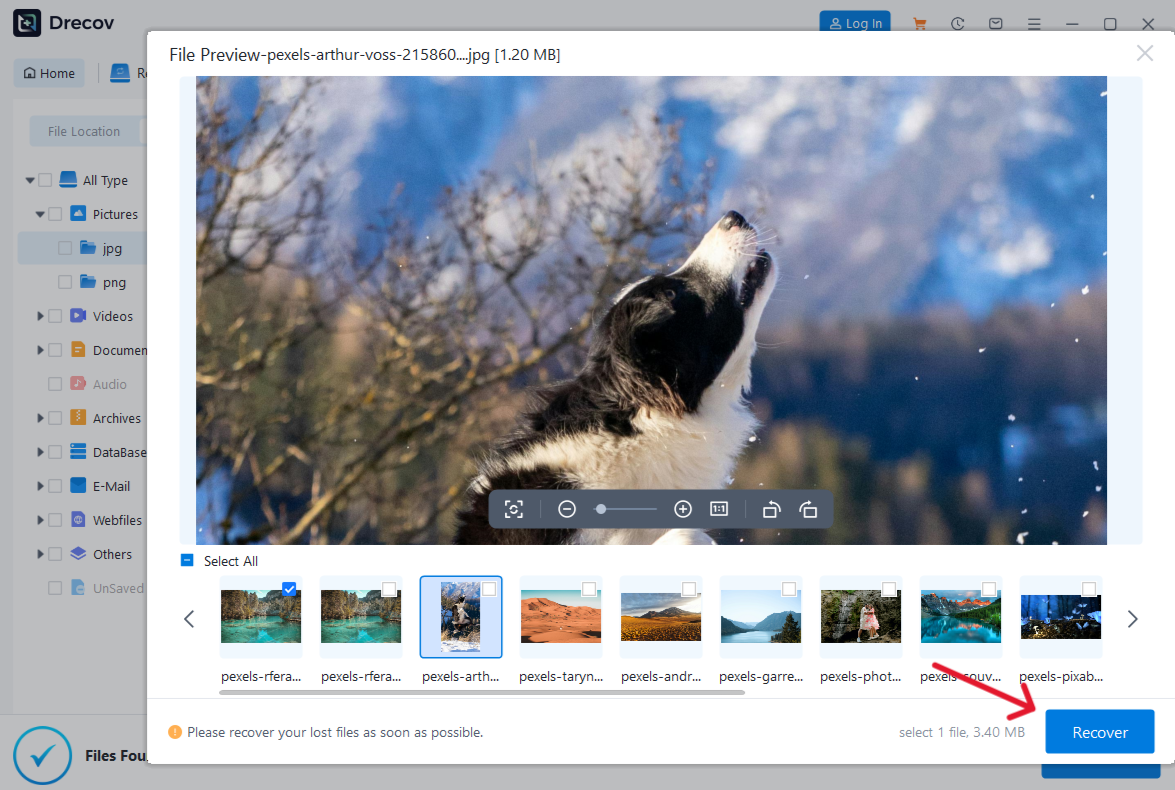
- Step 3: Secure Restoration
Select the checkboxes for the files you need. Click Recover.
Crucial Warning: Always save the recovered files to a different drive (like a USB thumb drive). Saving them back to the same drive can overwrite the very data you are trying to save!
FAQ: Clearing Up the Confusion
Q: Does deleting files from OneDrive delete them from my phone?
A: Yes. OneDrive is a synchronization service, not a one-way backup. If the devices are signed into the same account, the deletion will sync across all of them.
Q: How long do files stay in the OneDrive Online Recycle Bin?
A: For personal accounts, they stay for 30 days. For school or work accounts, it’s usually 93 days, unless your administrator has changed the settings.
Q: Can I delete OneDrive files from my PC but keep them online?
A: You cannot “delete” them, but you can use the “Free up space” option mentioned in Method 1. Alternatively, go to OneDrive Settings > Account > Choose folders and uncheck the folders you don’t want on your PC.
Q: What is the shortcut to permanently delete a file?
A: Use Shift + Delete. This bypasses the local Recycle Bin.
Q: If I delete a file from the “Shared with Me” section, does it delete for everyone?
A: No. If you are not the owner, removing a file from your “Shared” view only removes your access. However, if you have “Edit” permissions and delete it from the synced folder on your PC, it will delete the file for the owner and everyone else. Use caution!
Q: Can I automate how to delete files from OneDrive after a certain time?
A: Yes. You can use Windows Storage Sense. Go to Settings > System > Storage > Storage Sense. You can set it to automatically make OneDrive files “online-only” if you haven’t opened them in 30 days, effectively managing space without manual deletion.
Q: Why do files I deleted keep reappearing?
A: This usually indicates a “Sync Loop.” This happens when another device (like a tablet or a second laptop) has that file open or is trying to upload it while your main PC is trying to delete it. To fix this, sign out of OneDrive on all devices, delete the file via , and sign back in.
Conclusion
Mastering how to delete files from OneDrive is a fundamental skill in the cloud-first world of 2026. Whether you are using the “Free up space” feature to save your hard drive or the web portal for a total cleanup, remember that sync is a two-way street.
Always double-check your Recycle Bin before emptying it, and keep a tool like PandaOffice Drecov in your digital toolkit just in case “the ghost in the machine” decides to take something you weren’t ready to let go of.






