







Overview of Outlook Contacts and Recovery Options
Understanding Outlook Contacts and Their Role
Contacts in Microsoft Outlook are essential for storing email addresses, phone numbers, and business details. Whether for personal use or professional communication, losing contacts can interrupt workflows and cause significant inconvenience. Many users rely heavily on Outlook’s contact management system, making recovery solutions extremely important.
When contacts are deleted, they are not always permanently erased immediately. Outlook includes several built-in recovery layers that make it possible to recover deleted contacts in Outlook under the right conditions. Knowing where do deleted contacts go in Outlook helps users act quickly and choose the correct recovery method.
In most cases, deleted contacts are temporarily stored in the Deleted Items folder or hidden recovery storage. If these options fail, backups or advanced recovery tools can help restore lost data.
This guide explains practical ways to recover a deleted contact in Outlook, from simple restoration steps to more advanced solutions. By following the methods below, you can effectively restore deleted contacts in Outlook and prevent permanent loss.
Why Contacts Get Deleted in Outlook
Common Causes of Lost or Missing Contacts
Before attempting recovery, it’s important to understand why contacts disappear. This helps determine the most effective solution and prevents repeated issues.
The most common reasons include:
- Accidental deletion during mailbox cleanup
- Synchronization errors between devices or servers
- Auto-archive settings moving contacts out of view
- Corrupted PST or OST files causing data loss
- Account removal or reconfiguration issues
In some cases, contacts are not actually deleted but misplaced due to filters or folder changes. This is why many users first try to find deleted contacts in Outlook before assuming permanent loss.
Understanding these causes makes it easier to choose the right approach when learning how to recover deleted contacts in Outlook.
⚠️ Warning: Avoid adding new contacts immediately after deletion, as this may overwrite recoverable data.
Methods to Recover Deleted Contacts in Outlook
Method 1: Restore Contacts from the Deleted Items Folder
Test Environment: Outlook 365 on Windows 11 with Microsoft 365 account
The first and simplest way to recover deleted contact in Outlook is by checking the Deleted Items folder. When contacts are deleted, they are usually moved there temporarily.
Steps to follow:
- Open Outlook and go to the Deleted Items folder.
- Search for the deleted contact.
- Right-click the contact.
- Select Move > Other Folder.
- Choose the Contacts folder and confirm.
This method works well for users who want a quick way to recover a deleted contact in Outlook without using additional tools.
⚠️ Warning: Deleted Items may be cleared automatically depending on account settings.
Method 2: Recover Contacts from Recoverable Items Folder
Test Environment: Outlook 2019 with Exchange Server
If the contact is not found in Deleted Items, it may still exist in Outlook’s hidden recovery storage. This feature allows users to recover deleted contacts in Outlook even after permanent deletion.
Steps to follow:
- Open the Deleted Items folder.
- Click Recover items recently removed from this folder.
- A new window will display recoverable contacts.
- Select the contact you want to restore.
- Click Restore Selected Items.
This method is especially useful in corporate environments where Exchange accounts are used.
⚠️ Warning: This feature is not available for POP accounts and depends on server retention settings.
Method 3: Use PandaOffice Drecov to Recover Contacts
Test Environment: Windows 10 with damaged PST file
When built-in Outlook methods fail, a professional recovery solution is required. PandaOffice Drecov can deeply scan Outlook data files and retrieve permanently deleted contacts.
Steps to follow:
- Install and launch PandaOffice Drecov.
- Select the drive where your Outlook data file is stored.
- Start a deep scan to locate lost data.
- Preview recoverable contacts.
- Select and restore the needed contacts.
This method is ideal for users who need to recover deleted contacts in Outlook after file corruption or permanent deletion.
Compared to manual recovery, this solution provides deeper scanning and higher recovery success rates.
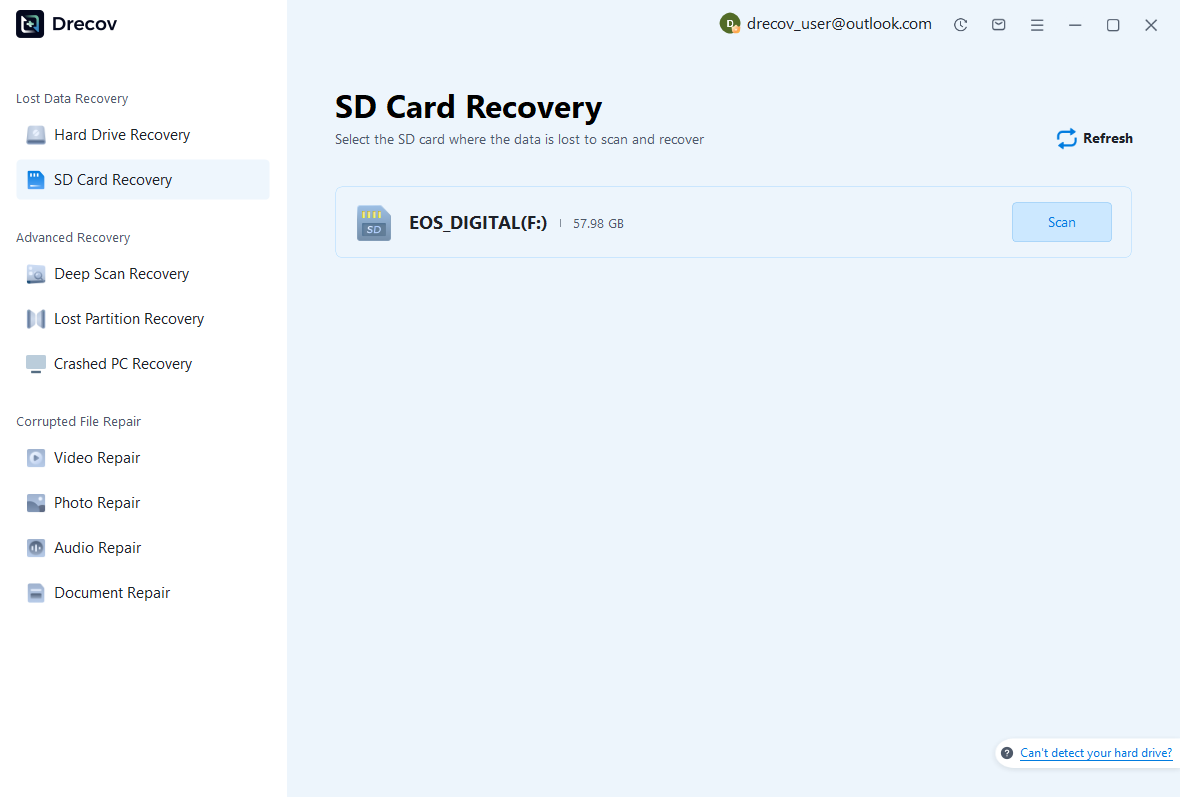


Why Choose PandaOffice Drecov Data Recovery Software?
When it comes to reliable data recovery, PandaOffice Drecov stands out as a powerful, all-in-one solution designed to handle a wide range of data loss scenarios. Whether you’re trying to perform TikTok deleted video recovery, restore files after formatting, or recover important documents, Drecov delivers fast and dependable results.
One of its biggest advantages is versatility. From format data recovery to lost partition recovery, the software can scan deeply and accurately locate files that other tools often miss. Even if your drive has been accidentally formatted or a partition has disappeared, Drecov uses advanced algorithms to reconstruct and retrieve your data with high success rates.
Drecov also supports specialized recovery needs. If you’ve lost important documents, its PDF recovery tool ensures that files retain their original structure and quality. For media users, the audio recovery feature helps restore music, recordings, and other sound files without corruption, making it ideal for both personal and professional use.
Ease of use is another key benefit. The intuitive interface allows beginners to recover files in just a few clicks, while still offering advanced options for more experienced users. Plus, it supports a wide range of storage devices, including HDDs, SSDs, USB drives, and memory cards.
In short, PandaOffice Drecov combines powerful recovery capabilities with user-friendly design, making it a trusted choice for anyone facing data loss.
Method 4: Restore Contacts from Outlook Backup File
Test Environment: Outlook 2016 with PST backup
If you have a backup of your Outlook data, restoring contacts from it is one of the safest methods. It allows you to restore deleted contacts in Outlook without relying on system recovery limits.
Steps to follow:
- Locate your backup PST file.
- Open Outlook and go to File > Open & Export.
- Select Open Outlook Data File.
- Navigate to the Contacts folder in the backup.
- Copy contacts back to your main account.
This method works best when backups are recent and intact.
Method 5: Check the Archive Folder for Missing Contacts
Test Environment: Outlook with AutoArchive enabled
Sometimes contacts are not deleted but moved to the Archive folder automatically. This can make it seem like they are lost.
Steps to follow:
- Open Outlook and locate the Archive folder.
- Browse through stored contacts.
- Find the missing contact.
- Move it back to the main Contacts folder.
This is a simple yet often overlooked solution for users trying to find deleted contacts in Outlook.
Method 6: Recover Contacts After Emptying Deleted Items
Test Environment: Outlook 365 on Windows 11 with Exchange account (retention enabled)
Even after the Deleted Items folder is emptied, Outlook may still retain contacts in a hidden storage layer. This allows users to recover deleted contacts in Outlook within a limited time frame.
Steps to follow:
- Open Outlook and go to the Deleted Items folder.
- Click Recover items recently removed from this folder.
- A recovery window will appear with deleted contacts.
- Select the contact you want to restore.
- Click Restore Selected Items.
This method is highly effective for users wondering how to recover deleted contacts in Outlook after clearing their trash.
⚠️ Warning: Recovery depends on server retention policies. Once expired, recovery is no longer possible.
Method 7: Repair Outlook Data File to Retrieve Contacts
Test Environment: Outlook 2019, corrupted PST file due to system crash
Contacts may become inaccessible due to file corruption rather than deletion. Repairing the Outlook data file can help you recover deleted contact in Outlook in such cases.
Steps to follow:
- Close Outlook completely.
- Locate the ScanPST.exe tool on your system.
- Open the tool and select your PST file.
- Click Start to scan for errors.
- Choose Repair if issues are found.
- Restart Outlook and check your Contacts folder.
This method is effective when contacts disappear unexpectedly without user action.
⚠️ Warning: Always back up your PST file before performing repairs.
Method 8: Recover Contacts Using Outlook Web App
Test Environment: Microsoft 365 account via browser (Outlook Web App)
If you cannot locate contacts in the desktop version, they may still exist in the web version of Outlook. This is useful for resolving sync-related issues.
Steps to follow:
- Log in to Outlook Web App via your browser.
- Navigate to the People (Contacts) section.
- Check Deleted or Archive folders.
- Locate the missing contact.
- Restore or move it back to your main contacts list.
This approach is helpful when users are unsure where do deleted contacts go in Outlook across different platforms.
Method 9: Re-add Outlook Account to Fix Missing Contacts
Test Environment: Outlook 365 with Exchange Online (multi-device sync issue)
Synchronization issues may cause contacts to appear missing even though they are still stored on the server. Re-adding your account can refresh the connection.
Steps to follow:
- Open Outlook and go to File > Account Settings.
- Remove your email account.
- Restart Outlook.
- Add the account again.
- Allow full synchronization to complete.
After syncing, check if your contacts have reappeared. This method often resolves issues related to how to recover deleted contact in Outlook caused by sync errors.
⚠️ Warning: Ensure you have a backup before removing your account.
Method 10: Restore Contacts from Previous System Version
Test Environment: Windows 10 with File History enabled
If your system has backup features enabled, you can restore a previous version of your Outlook data file to retrieve lost contacts.
Steps to follow:
- Navigate to the folder containing your PST file.
- Right-click the file and select Restore previous versions.
- Choose a version before the contacts were deleted.
- Restore the file.
- Open it in Outlook and copy the contacts back.
This method is ideal for users looking to restore deleted contacts in Outlook when other recovery options are unavailable.
FAQ: Recover Deleted Contacts in Outlook
How to recover deleted contacts in Outlook quickly?
The fastest way is to check the Deleted Items folder. If the contact is there, you can restore it immediately without additional tools.
Can I recover deleted contacts in Outlook after emptying Deleted Items?
Yes, you can use the Recoverable Items feature if your account supports it. However, this depends on your email server’s retention policy.
Where do deleted contacts go in Outlook?
Deleted contacts typically move to the Deleted Items folder first. After removal, they may remain in the Recoverable Items folder for a limited time.
Is it possible to recover permanently deleted contacts without backup?
Yes, in some cases. Recovery tools or server-side retention features may help, but success is not guaranteed.
Conclusion: Key Takeaways on Outlook Contact Recovery
Final Thoughts on Managing and Restoring Contacts
Losing important contacts can disrupt communication, but Outlook offers multiple recovery options depending on the situation. From simple restoration methods to advanced recovery techniques, users have several ways to recover deleted contacts in Outlook effectively.
To summarize:
- Start with basic recovery options like Deleted Items
- Use advanced methods when necessary
- Maintain regular backups for safety
- Act quickly to increase recovery success
By understanding these techniques, you can confidently handle situations involving lost contacts and ensure your data remains secure and accessible.





