







A USB flash drive is one of the most convenient storage devices for daily life and work. However, the moment it suddenly becomes unreadable, asks to be formatted, disappears from File Explorer, or shows empty folders, panic sets in quickly. The good news is that in many cases, you can still recover USB drive data safely—if you use the right method in the right order.
This guide explains how to recover USB drive data using beginner-friendly and advanced methods, starting with the safest solutions first and moving toward more technical recovery options. Whether your files were deleted by mistake, hidden by malware, lost after formatting, or trapped on a corrupted USB drive, this article will help you understand what to do next. More importantly, you’ll learn how to avoid common mistakes that can permanently overwrite recoverable data.
Why USB Drive Data Gets Lost in the First Place
Before you try to recover USB drive data, it helps to understand what may have happened. Different causes require different recovery strategies. Here are the most common reasons:
- Accidental deletion of important files or folders.
- Accidental formatting of the entire drive partition.
- File system corruption leading to a RAW drive or the error: “You need to format the disk before you can use it.”
- Unsafe ejection or sudden power interruption during a write process.
- Bad sectors on the NAND flash storage chip.
- Virus or shortcut malware hiding files from view.
- Partition loss or a missing drive letter in Windows.
- Physical damage to the USB connector or memory controller.
Important Warning Before You Recover USB Drive Data
If you want the highest success rate, stop using the USB drive immediately. Every second the drive is powered on and interacting with the OS, background processes might be writing data. To ensure you can recover USB drive files successfully, you must follow these rules:
- Do not save new files to the USB drive.
- Do not run repeated format attempts.
- Do not copy files onto the drive to “test” if it works.
- Do not use “repair” tools like CHKDSK blindly before extracting data.
- Do not repartition the drive unless data is already safely moved elsewhere.
Every write operation can reduce the chance to recover USB drive files successfully by overwriting the space where your old data still technically resides.
Recover USB Drive First: The Safe Recovery Order You Should Follow
To keep recovery safe and efficient, use this logical order, moving from the lowest risk to the highest complexity:
- Check whether the files are only hidden: Use view settings or attributes.
- Look for deleted files in backups: Check cloud storage or local PC copies.
- Use professional recovery software: This is the recommended early step for most users.
- Fix drive letter or USB detection issues: Use Disk Management.
- Repair logical file system errors: Only after recovery is attempted.
- Use command-line repair tools: Use these carefully as they modify the file system.
- Escalate to professional lab recovery: Required for physical damage or “No Media” errors.
This order matters because many users try to “repair” the drive first, but structural repairs can make it much harder to recover USB drive data later.
Best Way to Recover USB Drive Files Safely
If your USB drive is recognized by Windows but files are missing, deleted, inaccessible, or the drive asks to be formatted, the safest and most practical option is to use a professional recovery tool before attempting any manual repair.
Use PandaOffice Drecov to Recover USB Drive Data
PandaOffice Drecov is a dedicated, high-performance data recovery product designed to handle complex logical failures. It helps users recover USB drive files from scenarios such as:
- Deleted files (Shift + Delete or emptied Recycle Bin).
- Formatted USB flash drives (Quick Format).
- Corrupted or RAW USB drives.
- Lost or deleted partitions.
- Virus-hidden data.
- Unreadable or inaccessible USB devices (when still detectable by the system).
It is especially suitable for non-technical users because the workflow is visual, guided, and avoids the risks associated with manual command-line repairs.
Why Use PandaOffice Drecov First?
Because recovery software focuses on extracting data to a safe location (like your computer’s hard drive) before making any changes to the original USB drive. That is usually the smartest move to prevent permanent data loss.
⚠ Warning: Install it on a drive different from the one where your data was lost to prevent overwriting.
How to Recover USB Drive Data with PandaOffice Drecov
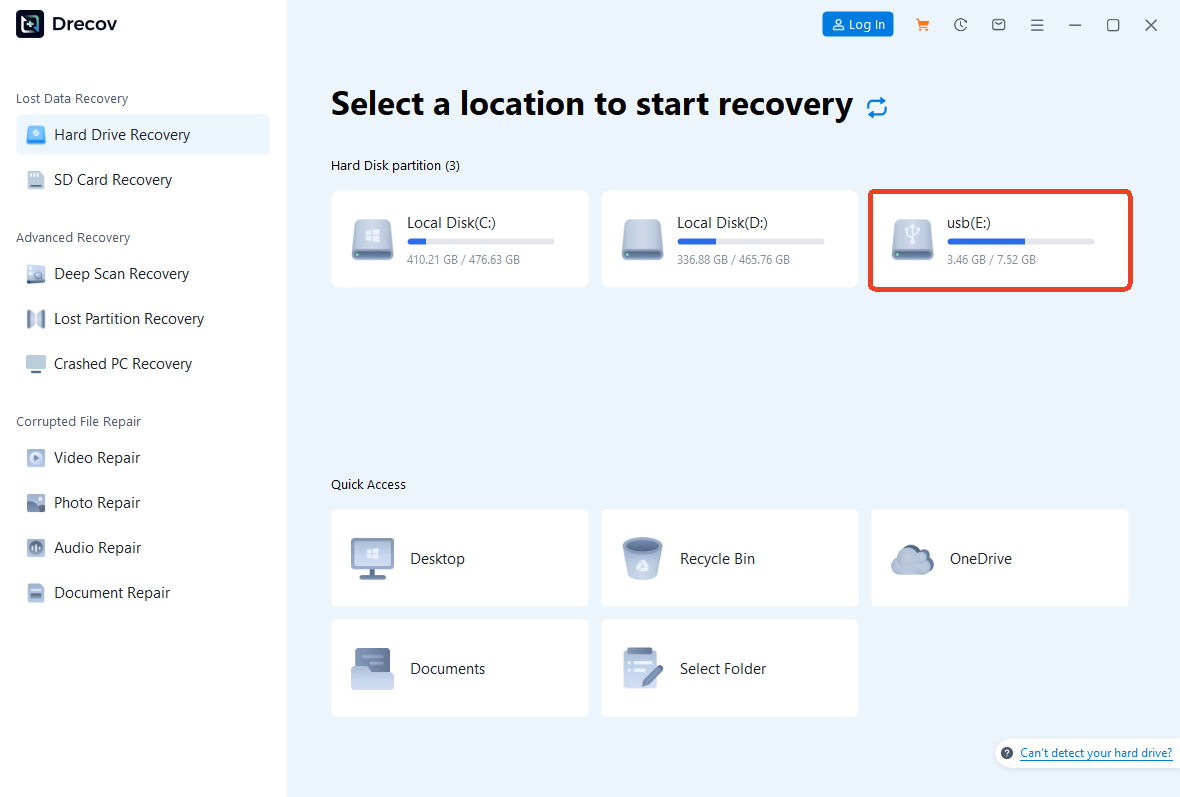
Step 1: Insert the USB drive and launch PandaOffice Drecov
Connect the USB flash drive to a working port (preferably a direct port on the PC motherboard) and open the software. Wait for the drive list to populate.
Step 2: Select the affected USB drive
Choose the correct USB drive from the available storage devices. Check the details carefully:
- Capacity: Ensure it matches your drive (e.g., 32GB, 64GB, or 128GB).
- Drive Letter: Such as E: or F:.
- Device Label: If the drive still has its original name.
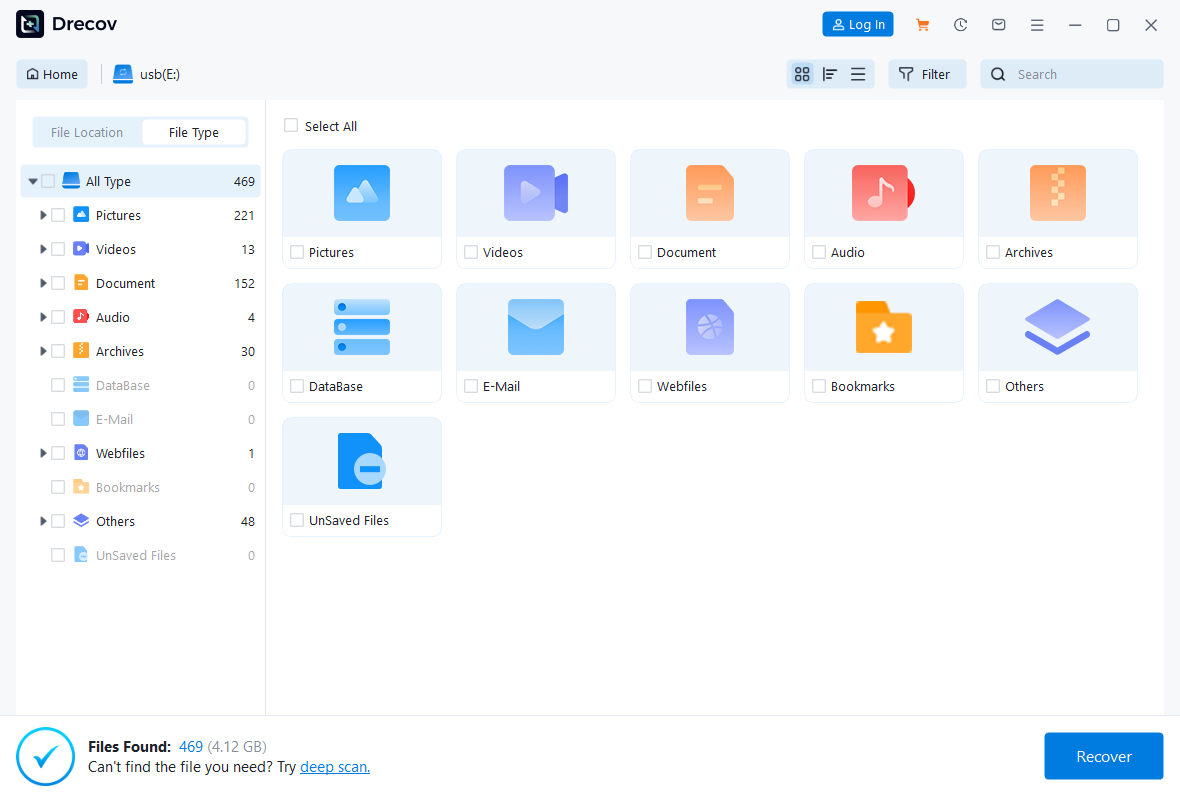
Step 3: Start a scan
Begin with the scan process. While a quick scan is faster for recently deleted files, a Deep Scan is better for formatted or corrupted USB drives as it searches the drive sector-by-sector for file signatures.

Step 4: Preview recoverable files
Once the scan completes, browse the results. You can filter by:
- File Type: Photos (.jpg, .png), videos (.mp4, .mov), documents (.docx, .pdf), archives (.zip).
- Original Path: Locate files in their original folder structure.
- Search: Use the search bar to find specific file names or extensions.
Step 5: Select files and recover them to another location
Select the checkboxes for the files you want. Click the Recover button and save them to:
- Your computer’s internal hard drive.
- An external hard drive or cloud storage.
- A different USB device.
Warning: Do not recover files back to the same USB drive you are scanning. This can overwrite other recoverable data that you haven’t saved yet.
How to Recover USB Drive Hidden Files After Virus or Shortcut Malware
Sometimes you haven’t truly deleted the files; instead, malware changes file attributes to Hidden and System, making the USB drive look empty while the space remains occupied. This is a very common reason users search for recover USB drive solutions.
Signs Your USB Files Are Hidden, Not Deleted
- USB drive shows used space in Properties, but folders look empty in File Explorer.
- You see shortcut files (.lnk) instead of real folders.
- Antivirus previously detected malware on the drive.
Use the ATTRIB Command to Recover USB Drive Hidden Files
Microsoft provides the attrib command to modify these properties. You can find more details in the Microsoft ATTRIB command documentation.
Step 1: Identify your drive letter
Open File Explorer and note the drive letter assigned to your USB (e.g., G:).
Step 2: Open Command Prompt as Administrator
- Press Windows + S.
- Type cmd.
- Right-click Command Prompt and select Run as administrator.
Step 3: Type the exact command
Replace E: with your specific USB drive letter:
attrib -h -r -s /s /d E:\*.*
- -h removes the Hidden attribute.
- -r removes the Read-only attribute.
- -s removes the System attribute.
- /s applies the command to files in all subfolders.
- /d applies the command to folders as well.
Step 4: Press Enter and wait
The cursor will blink while it processes the drive. This may take a few minutes if there are many files.
Step 5: Reopen the USB drive
Check if your original folders have reappeared. If they have, immediately copy them to your PC and run a full malware scan. You can refer to the Windows Security Virus & Threat Protection guide for further instructions.
How to Recover USB Drive Deleted Files Without Software Backups
If you deleted files from a USB drive and they are not in the Recycle Bin (removable drives usually bypass the bin), you still may be able to recover USB drive content because the data remains on the chip until new data overwrites it.
Method 1: Use PandaOffice Drecov for Accidental Deletion
This is the most reliable method for “Shift + Deleted” files.
- Stop using the drive.
- Scan with Drecov: Focus on the “Deleted Files” category in the results.
- Filter and Recover: Look for the specific file extensions you lost.
Method 2: Check Windows File History or Backups
If you copied the original files from your PC and use Windows Backup features, you may be able to restore them from your computer’s local history. Refer to the Windows File History backup and restore guide for setup details.
- Step 1: Open the folder on your PC where the files were originally located.
- Step 2: Right-click the folder and select Restore previous versions.
- Step 3: Select a version from a date before the deletion occurred and click Restore.
How to Recover USB Drive After Accidental Formatting
Accidental formatting is a major reason people need to recover USB drive data. Is it possible? Usually, yes, provided you performed a Quick Format rather than a Full Format.
Can Formatted USB Drives Be Recovered?
A Quick Format only erases the “address book” (File System) of the drive, leaving the actual data bits intact. A Full Format (available in Windows 10/11) overwrites the entire drive with zeros, making recovery virtually impossible.
- Step 1: Do not format again. If Windows keeps prompting you to format, click Cancel.
- Step 2: Run a Deep Scan in PandaOffice Drecov. Since the file system structure is gone, a deep scan will look for file signatures.
- Step 3: Sort by File Type. Note that the original folder names might be lost; files might appear as “Recovered File 001.jpg.” Use the preview feature to identify them.
- Step 4: Recover to a different drive.
How to Recover USB Drive When It Says “You Need to Format the Disk Before You Can Use It”
This error usually indicates that the File System Metadata is damaged, often due to pulling the drive out while it was writing. Windows can see the hardware but can’t understand the “map” of the files, so it labels it as RAW.
The Safe Recovery Workflow
- Click Cancel: Never click “Format disk” when this prompt appears.
- Use PandaOffice Drecov: The software can bypass the corrupted file system and read the data directly from the storage sectors.
- Recover first: Extract all critical documents to your local PC.
- Repair later: Once the data is safe, you can then proceed to format the drive to make it usable again.
How to Recover USB Drive Not Showing Up in File Explorer
If the drive doesn’t appear in This PC, it doesn’t necessarily mean the hardware is dead. It might just be a logical conflict.
Open Disk Management the Correct Way
As per the Microsoft Disk Management in Windows guide, follow these steps:
- Press Windows + X and select Disk Management.
- Locate your USB drive (usually labeled as Removable).
Scenario A: Missing Drive Letter
If the drive shows “Healthy” but has no letter (e.g., E:):
- Step 1: Right-click the volume.
- Step 2: Select Change Drive Letter and Paths…
- Step 3: Click Add and assign a free letter.
Scenario B: Drive Shows as RAW
If it says RAW, follow the “Safe Recovery Workflow” mentioned in the previous section using PandaOffice Drecov.
Scenario C: Drive Shows “No Media”
If Disk Management lists the drive but says “No Media” with 0MB capacity, the flash controller is likely failing. Software cannot recover USB drive data in this state; you may need a hardware specialist.
How to Repair a Corrupted USB Drive After You Recover USB Drive Data
Once your files are safe and verified, you can attempt to fix the drive using the CHKDSK utility. You can read the official Microsoft CHKDSK command documentation for a full list of parameters.
Step 1: Open CMD as Administrator.
Step 2: Type the command
chkdsk E: /f(Replace E: with your drive letter).- The /f parameter fixes logical errors on the disk.
- If you suspect bad sectors, use
chkdsk E: /f /r, but be aware this stresses the drive.
Step 3: Press Enter.
Windows will attempt to re-align the file system. If it works, your drive is now healthy and ready for reuse.
Advanced Method: Recover USB Drive Data with DiskPart Checks
If the drive is extremely stubborn, you can use DiskPart to inspect the low-level status. Caution: DiskPart is a powerful tool; one wrong command like clean will wipe your drive instantly.
- Open Command Prompt (Admin).
- Type
diskpartand press Enter. - Type
list diskto see all connected drives. - Type
select disk X(Replace X with your USB’s number). - Type
detail diskto check if the drive is set to Read-only or if the partition is marked as active.
If DiskPart shows the disk as “Online” but the volume is missing, it confirms that your best bet to recover USB drive data is using signature-based recovery software.
Common Mistakes That Reduce Your Chances to Recover USB Drive Data
To ensure the best results, avoid these pitfalls:
- Impatience: Pulling the drive out during a scan.
- Overwriting: Saving new data to the drive you are trying to recover.
- Blind Trust: Assuming CHKDSK will “fix” everything—it often deletes corrupted file fragments that could have been recovered by software.
- Wrong Tools: Using untrusted “free” tools that might contain malware or further corrupt the partition table.
Internal Resources for Further Reading
After you have completed the initial recovery, you might find these specific guides helpful:
- How to repair corrupted USB flash drive without losing data
- USB ports not working: Ultimate troubleshooting guide
- How to recover deleted files from USB drive
FAQ: Frequently Asked Questions
Can I recover USB drive data after a format?
Yes, provided it was a Quick Format. Use PandaOffice Drecov to perform a Deep Scan to find your files.
What if my USB drive is physically bent?
Do not plug it in. Plugging in a bent drive can cause an electrical short that destroys the memory chip. Consult a professional lab.
How long does it take to recover USB drive files?
A Quick Scan takes seconds, while a Deep Scan on a 128GB drive might take 30 to 60 minutes depending on the USB speed (2.0 vs 3.0).
Why does my USB show 0 bytes?
This usually means the file system is RAW or the partition table is damaged. The data is likely still there, but Windows can’t measure it.
Conclusion
If you need to recover USB drive files quickly and safely, the most effective strategy is a “Data-First” approach. By using PandaOffice Drecov before attempting risky command-line repairs, you ensure that your precious photos and documents are extracted while the drive is still functional.






