







If you’re like most people, your Chrome browser probably has dozens—maybe hundreds—of bookmarks accumulated over time. While bookmarks can be lifesavers for quickly accessing your favorite websites, they can also become cluttered, outdated, or simply unnecessary. If you’ve been thinking about starting fresh, you may be asking: how to delete all bookmarks on Chrome? Fortunately, Chrome offers several ways to clean up your bookmarks efficiently, whether you want to delete a few at a time or completely wipe your collection.
Managing bookmarks effectively isn’t just about decluttering—it’s about improving browser performance and keeping your browsing experience organized. Too many bookmarks can slow down search results within your bookmark manager, make it harder to find the sites you truly need, and create visual clutter on the bookmarks bar. Luckily, Chrome provides tools and options to manage bookmarks quickly and safely. Furthermore, understanding the underlying data structure of these bookmarks can help you if you ever need to perform a recovery after an accidental deletion.
In this article, we’ll cover step-by-step instructions for how to delete all bookmarks on Chrome across all devices, including Windows, Mac, Android, and iOS. We’ll also explore alternative methods, safety tips, and advanced data recovery solutions if things go wrong.
What Are Chrome Bookmarks and Why They Matter
Bookmarks are saved links to web pages that you want to revisit easily. They act like digital sticky notes that store addresses for later use. While they’re convenient, over time, they can accumulate and create disorganization. In the technical sense, Google Chrome stores these bookmarks in a specific JSON file located within your local user profile directory. When you learn how to delete all bookmarks on Chrome, you are essentially modifying this local database.
Why bookmarks matter:
- Quick access: Open your favorite sites in one click.
- Organization: Categorize links into folders for faster retrieval.
- Reference: Keep track of important resources, articles, and guides.
However, when bookmarks are no longer useful, deleting them is the best way to maintain an organized browser. For more information on how Google manages your data, you can visit the official Google Chrome Help Center.
Reasons to Delete All Bookmarks
There are several reasons why you might want to remove all bookmarks in Chrome:
- Start Fresh: Sometimes, it’s easier to remove all existing bookmarks than to sort them individually.
- Browser Performance: A large number of bookmarks can slow down Chrome’s bookmark search functionality and increase memory usage during synchronization.
- Privacy: Shared devices or public computers may require cleaning bookmarks for privacy reasons to ensure no sensitive browsing history is left behind.
- Error Correction: Duplicate, broken, or outdated bookmarks can cause frustration and clutter your interface.
Deleting all bookmarks can feel drastic, but it’s often the fastest way to regain control over your browser. However, before you proceed with learning how to delete all bookmarks on Chrome, you must be aware that once they are deleted and the browser syncs, they are gone from all devices unless you have a backup.
How to Delete All Bookmarks on Chrome for Windows
Deleting bookmarks on a Windows PC is straightforward. Chrome has a dedicated Bookmark Manager that allows for bulk deletion. This is the most efficient way to handle thousands of entries simultaneously.
Step-by-Step Guide
- Step 1: Open Chrome on your Windows PC.
- Step 2: Click the three-dot menu in the top-right corner of the window.
- Step 3: Navigate to Bookmarks > Bookmark Manager or simply press the hotkey Ctrl+Shift+O.
- Step 4: In the Bookmark Manager, click any bookmark or folder in the list to focus the window.
- Step 5: Press Ctrl+A to select all bookmarks and folders in the current view.
- Step 6: Right-click on any highlighted item and select Delete, or simply press the Delete key on your keyboard.
Warning: This action is immediate. If you have “Sync” enabled, these bookmarks will also be deleted from your phone and tablet within seconds.
How to Delete All Bookmarks on Chrome for Mac
Mac users can follow a very similar process to their Windows counterparts, using macOS-specific shortcuts to manage their data.
- Step 1: Launch the Chrome application from your Applications folder or Dock.
- Step 2: Click Bookmarks in the top menu bar, then select Bookmark Manager.
- Step 3: Use the shortcut Command+A to select every bookmark in the folder.
- Step 4: Right-click (or Control-click) and choose Delete, or press the Delete key.
All selected bookmarks are removed immediately, helping you declutter your browser efficiently. Since macOS handles file paths differently, if you ever need to find the physical backup file, it is usually located at ~/Library/Application Support/Google/Chrome/Default/Bookmarks.
Delete All Bookmarks from Chrome on Android
Android devices have a slightly different process, as bookmarks are managed within the mobile interface which doesn’t support the “Select All” keyboard shortcut.
- Step 1: Open the Chrome app on your Android smartphone or tablet.
- Step 2: Tap the three-dot menu in the top-right corner.
- Step 3: Select Bookmarks from the dropdown list.
- Step 4: Tap the specific folder (e.g., “Mobile bookmarks”) you want to clear.
- Step 5: Long-press a single bookmark to enable the selection mode (checkmarks will appear).
- Step 6: Manually tap the other bookmarks you wish to remove, then tap the Trash icon at the top.
Tip: Unfortunately, Android Chrome doesn’t offer a one-click option to delete all bookmarks at once. If you have hundreds, it is much faster to use the desktop method mentioned above while synced to the same Google account.
Delete All Bookmarks from Chrome on iPhone and iPad
iOS devices also require batch deletion, as the Chrome app for iOS follows Apple’s design language, which emphasizes manual selection for data security.
- Step 1: Open the Chrome app on your iPhone or iPad.
- Step 2: Tap the three-dot menu (bottom right or top right depending on version) and go to Bookmarks.
- Step 3: Tap Edit at the bottom of the bookmarks screen.
- Step 4: Select the bookmarks or folders you want to remove by tapping the circles next to them.
- Step 5: Tap Delete at the bottom.
- Step 6: Repeat as needed to remove all bookmarks from various folders.
What to Do If You Accidentally Deleted Everything?
While learning how to delete all bookmarks on Chrome, accidents are bound to happen. You might realize five minutes after a mass deletion that you forgot to save an important work link or a banking portal. Because Chrome syncs almost instantly, the “Undo” notification often disappears before you can click it. This is where professional data recovery knowledge becomes essential.
When you delete a bookmark, Chrome updates its Bookmarks and Bookmarks.bak files. If you act quickly, you can sometimes rename the .bak file to restore your links. But if the browser has already overwritten those files, you need a more powerful solution to scan your hard drive for deleted file fragments.
Using PandaOffice Drecov data recovery software for Chrome Restoration
When manual methods fail, PandaOffice Drecov data recovery software is a premier choice for retrieving lost browser data. This tool is specifically designed to handle deep scans of storage media to locate files that the operating system has marked as deleted but hasn’t yet overwritten. Whether your bookmarks were lost due to a sync error, a browser crash, or an accidental “Delete All” command, this software provides a path to recovery.
⚠ Warning: Install it on a drive different from the one where your data was lost to prevent overwriting.
Step-by-Step Recovery Guide with PandaOffice Drecov
- Step 1: Select the Location. Launch the program and select the C: drive (or your primary system partition). This is where Chrome stores the local
User Datafolder.

- Step 2: Run the Scan. Click “Scan.” The software will perform a Quick Scan followed by a Deep Scan to identify fragmented JSON files and deleted bookmark databases.

- Step 3: Filter and Preview. Use the file type filter to search for files named
Bookmarksor search for the.bakextension. PandaOffice Drecov allows you to preview the file’s metadata to ensure it’s the right one.
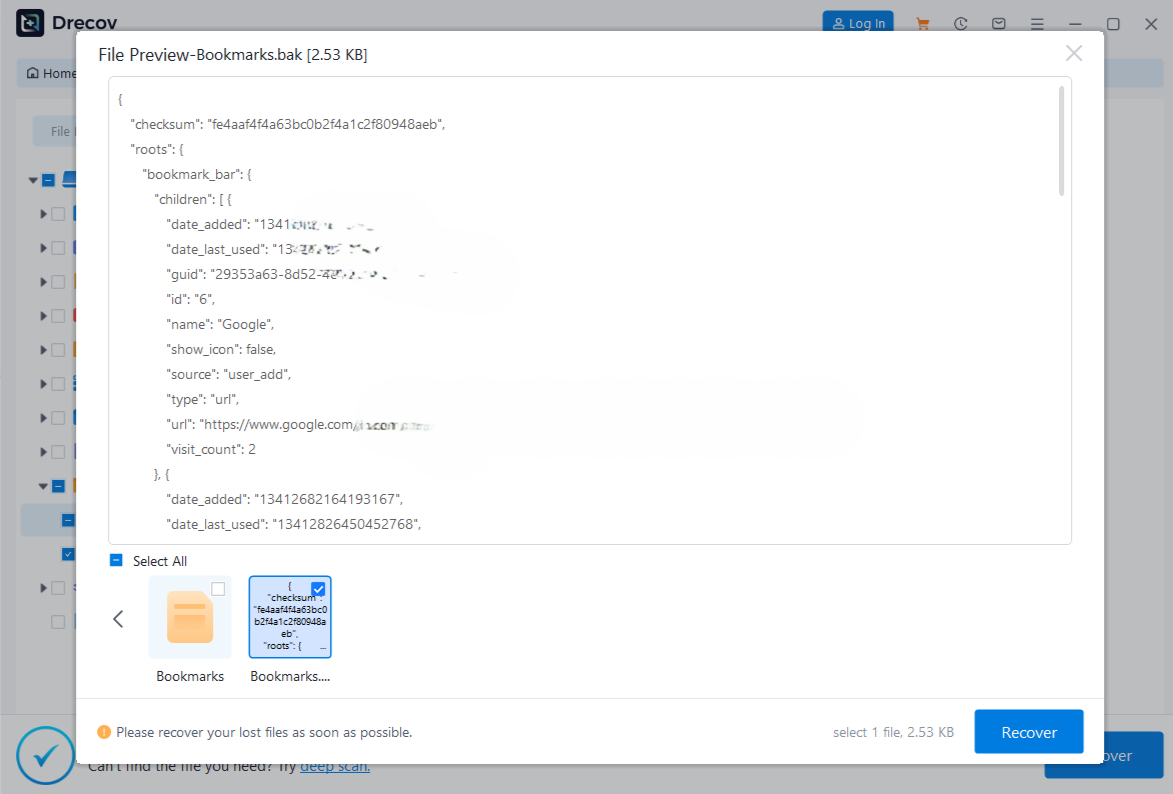
- Step 4: Recover. Select the found bookmark files and click “Recover.” Save them to an external USB drive or a different partition.
- Step 5: Restore to Chrome. Copy the recovered
Bookmarksfile back into the Chrome profile path:%LOCALAPPDATA%\Google\Chrome\User Data\Default\.
Warning Prompt: Always close Google Chrome completely before attempting to replace bookmark files in the system directory, otherwise, the browser may overwrite your recovered file upon closing.
Advanced Recovery and Digital Management
Understanding how to manage your digital footprint is vital in the modern age. If you found the recovery process interesting, you might want to explore more advanced topics in the realm of AI and data management.
For instance, check out this AI data recovery complete guide to AI-powered recovery tools to see how machine learning is making it easier to find lost files.
Furthermore, data loss isn’t limited to browsers. If you’ve ever accidentally cleared your inbox while trying to declutter, you should learn how to recover a deleted draft in Outlook. Similarly, for mobile users who might have deleted more than just bookmarks, here is a guide on how to find recently deleted apps on iPhone and Android.
Using the Chrome Bookmark Manager for Bulk Management
The Bookmark Manager is a powerful tool for organizing and deleting bookmarks without needing external software. Beyond just knowing how to delete all bookmarks on Chrome, you should know these hidden features:
- Search Functionality: Use the search bar at the top of the Bookmark Manager to find specific keywords or duplicate links.
- Column Sorting: While Chrome doesn’t natively sort by date added, you can use the “Organize” menu to sort by name.
- Drag and Drop: You can move entire blocks of selected bookmarks into a “To Be Deleted” folder for easier final processing.
- Export Before You Destroy: Always click the three dots in the Manager and select Export Bookmarks to save an HTML backup.
By using Bookmark Manager efficiently, you can prevent accidental loss of important links and maintain a lean browser.
Exporting Bookmarks Before Deleting: A Safety Protocol
It’s an industry-standard best practice to back up bookmarks before deleting all of them. This ensures you can restore them if you realize later that you needed a specific URL.
Steps to Export Bookmarks
- Open Chrome and go to Bookmark Manager (Ctrl+Shift+O).
- Click the three-dot menu (icon) located at the very top right of the blue bar inside the manager page.
- Select Export bookmarks.
- Save the file (usually named something like
bookmarks_date.html) to a secure location like a cloud drive or a secondary hard drive.
You can import this file later by selecting Import bookmarks from the same menu. This is the single most effective way to avoid needing PandaOffice Drecov data recovery software in the future.
Using Extensions to Delete Bookmarks
For users with thousands of bookmarks, manual selection can be tedious even with “Select All.” Browser extensions can automate the process and provide advanced filtering.
Recommended extensions:
- Bookmarks clean up: This is a fantastic tool that identifies duplicate bookmarks, broken links (404 errors), and empty folders. It allows you to delete them in bulk with high precision.
- SuperSorter: This extension keeps your bookmarks sorted automatically and can be configured to delete duplicates on a schedule.
- One Click Delete: A specialized tool designed for those who frequently need to wipe their session data and bookmarks for privacy or testing purposes.
Precise Path Info: When using extensions, remember that they require permissions to “Read and change your bookmarks.” Always use highly-rated extensions from the Chrome Web Store.
Deleting Bookmarks Synced Across Devices
One of the most common points of confusion regarding how to delete all bookmarks on Chrome is the “Sync” feature. If you have a Google account, your bookmarks are likely stored in the cloud.
Steps to ensure synced deletion:
- Log into your primary desktop Chrome browser.
- Ensure Sync is turned ON in your Google Profile settings.
- Perform the deletion using the Bookmark Manager method described earlier.
- Wait a few minutes. Chrome will send a “Delete” command to Google’s servers.
- Check your Android or iPhone; the bookmarks should disappear automatically as the device polls the server for updates.
This is useful for keeping your browser consistent across all platforms, but it also means a mistake on one device can lead to data loss on all others.
Troubleshooting Bookmark Deletion
Sometimes, you might try to delete bookmarks, but they keep reappearing. This “ghost bookmark” phenomenon is usually caused by sync conflicts.
Common causes and solutions:
- Chrome Sync Conflicts: If two devices are trying to sync at the same time, the server might think the deletion was an error and restore the bookmarks from the second device. Solution: Sign out of Chrome on all devices except one, delete the bookmarks, and then sign back in.
- Corrupt Bookmark Files: If the
Bookmarksfile in your Windows directory is marked “Read Only,” Chrome cannot save the deletion. Path:C:\Users\[Username]\AppData\Local\Google\Chrome\User Data\Default. Right-click the file and ensure “Read-only” is unchecked. - Extensions Interfering: Some security extensions “protect” your browser settings. Solution: Disable all extensions before performing a mass deletion.
Best Practices for Bookmark Management
To avoid having to learn how to delete all bookmarks on Chrome every six months, follow these maintenance tips:
- The “One-In, One-Out” Rule: For every new bookmark you add, try to delete an old, unused one.
- Use Folders Wisely: Create a “Temporary” folder for links you only need for a week. Clear this folder every Sunday.
- Periodic Audits: Every three months, open your Bookmark Manager and remove links that no longer resolve or are no longer relevant to your interests.
- Cloud Sync Awareness: Be mindful of which account you are signed into. Syncing work bookmarks with a personal account can lead to a cluttered mess that is difficult to untangle.
Proper management prevents the need for drastic measures and ensures a smooth, productive workflow.
Pros and Cons of Deleting All Bookmarks
| Pros | Cons |
| Cleaner browser interface | Risk of losing critical links |
| Improved search performance | Time-consuming to rebuild a collection |
| Enhanced privacy on shared PCs | Potential “Sync” errors across devices |
| Faster syncing between devices | Cannot be undone without a backup file |
Evaluate your needs carefully. If you have important data, consider using a recovery-minded approach by keeping a backup or having PandaOffice Drecov data recovery software ready on your system just in case.
Frequently Asked Questions
1. Can I recover deleted bookmarks in Chrome?
Yes. You can either restore from an exported HTML backup or use the Bookmarks.bak file in your local directory. If those are gone, you should use PandaOffice Drecov data recovery software to scan your drive for the deleted database file.
2. Can I delete all bookmarks on Chrome mobile at once?
Currently, the mobile apps (Android and iOS) do not feature a “Select All” button. The most efficient way to delete all mobile bookmarks is to sync your mobile device with a desktop Chrome browser and use the Ctrl+A method in the desktop Bookmark Manager.
3. Will deleting bookmarks affect my Google account?
Deleting bookmarks only affects the bookmarks stored in your Google Chrome profile. It does not affect your emails, Google Drive files, or other account data. However, it will remove them from all devices where you are signed in with Sync enabled.
4. How do I find the Chrome Bookmarks file on Windows 11?
The precise path is C:\Users\[YourUsername]\AppData\Local\Google\Chrome\User Data\Default. Note that the “Default” folder might be named “Profile 1” or “Profile 2” if you use multiple Chrome personalities.
5. Is there a way to “Archive” bookmarks instead of deleting them?
Yes. Instead of deleting, you can use the Export Bookmarks feature to save them as an HTML file on your computer, then delete them from the browser. This clears your UI while keeping the links accessible in a single file.
Conclusion
Learning how to delete all bookmarks on Chrome is a vital skill for anyone looking to optimize their digital workspace. Whether you are using Windows, Mac, or a mobile device, the process is generally simple, though it requires attention to detail—especially regarding Google Sync. While the built-in Bookmark Manager is powerful enough for most tasks, the use of extensions can help those with massive link libraries.
Most importantly, always remember the importance of data safety. Before you perform a mass wipe, export your data. If you’ve already made a mistake and deleted bookmarks without a backup, don’t panic. Professional tools like PandaOffice Drecov data recovery software are specifically built to help you navigate these digital emergencies. By following the structured steps provided in this guide, you can enjoy a clean, fast, and organized Chrome experience while resting easy knowing your data is recoverable.






