







Stop writing to the affected drive before trying to clear error 0x800701E3. The safest first job is to decide whether the failure belongs to the connection, the logical file system, or unstable hardware. A stable drive may be recoverable with software; a clicking, disappearing, or capacity-changing drive should not be subjected to repeated scans.
What Error 0x800701E3 Actually Tells You
Windows raises 0x800701E3 when an input/output request cannot be completed reliably; the wording does not identify the failed component. Keep the source unchanged until that distinction is supported by a second observation. Save readable data before any test that writes metadata or reads the whole surface.
A loose USB cable, underpowered hub, failing enclosure bridge, controller problem, damaged file system, or deteriorating medium can produce similar copy failures. A repeatable control is more useful than another repair command at this stage. Escalate when the device cannot remain connected long enough for a controlled read.
Record the exact operation, drive model, capacity, connection path, and whether the error follows one file or every read from the device. Save readable data before any test that writes metadata or reads the whole surface. Use model, capacity, sound, temperature, and connection behavior as one evidence set.
A Five-Minute Test That Does Not Change the Disk
One known-good cable and one direct motherboard port are useful controls for an external drive, provided the device shows no physical instability. Escalate when the device cannot remain connected long enough for a controlled read. Retire an unreliable drive even when a temporary reconnection appears to work.
A correct model and stable capacity in Disk Management support further read-only checks, but they do not prove that every sector is healthy. Use model, capacity, sound, temperature, and connection behavior as one evidence set. Keep the source unchanged until that distinction is supported by a second observation.
Clicking, repeated spin-up, overheating, disappearing from the bus, severe read errors, or changing capacity are stop signals rather than reasons to scan again. Retire an unreliable drive even when a temporary reconnection appears to work. A repeatable control is more useful than another repair command at this stage.
Read Stability Before You Choose Software
SMART attributes can add context, yet a simple green health label cannot certify the surface or rule out intermittent electronics. Keep the source unchanged until that distinction is supported by a second observation. Save readable data before any test that writes metadata or reads the whole surface.
Copy irreplaceable readable files first; do not begin with benchmarks, surface tests, antivirus sweeps, or an attempt to fill the disk. A repeatable control is more useful than another repair command at this stage. Escalate when the device cannot remain connected long enough for a controlled read.
CHKDSK changes file-system structures and can discard damaged references, so recovery or imaging comes before repair when files matter. Save readable data before any test that writes metadata or reads the whole surface. Use model, capacity, sound, temperature, and connection behavior as one evidence set.
Protect Data Before CHKDSK, Initialization, or Format
Initialization, partition creation, and formatting write new metadata and cannot diagnose whether the original data remains recoverable. Escalate when the device cannot remain connected long enough for a controlled read. Retire an unreliable drive even when a temporary reconnection appears to work.
An image is preferable to repeated direct scans when the source is marginal but sufficiently stable for controlled sequential reading. Use model, capacity, sound, temperature, and connection behavior as one evidence set. Keep the source unchanged until that distinction is supported by a second observation.
Drecov is appropriate only when Windows recognizes a stable source and the loss is logical; it cannot repair heads, motors, NAND, or a USB bridge. Retire an unreliable drive even when a temporary reconnection appears to work. A repeatable control is more useful than another repair command at this stage.
⚠ Warning: Install it on a drive different from the one where your data was lost to prevent overwriting.
Recover From a Stable Recognized Drive With Drecov
Quick Scan should be assessed before Deep Scan, because a deeper pass reads more of the source and cannot restore overwritten content. Keep the source unchanged until that distinction is supported by a second observation. Save readable data before any test that writes metadata or reads the whole surface.
Recovered files belong on another healthy physical device, followed by opening representative documents, photos, videos, and archives. A repeatable control is more useful than another repair command at this stage. Escalate when the device cannot remain connected long enough for a controlled read.
A drive that triggered a fatal hardware error should not return to backup duty merely because one copy succeeds after reconnection. Save readable data before any test that writes metadata or reads the whole surface. Use model, capacity, sound, temperature, and connection behavior as one evidence set.
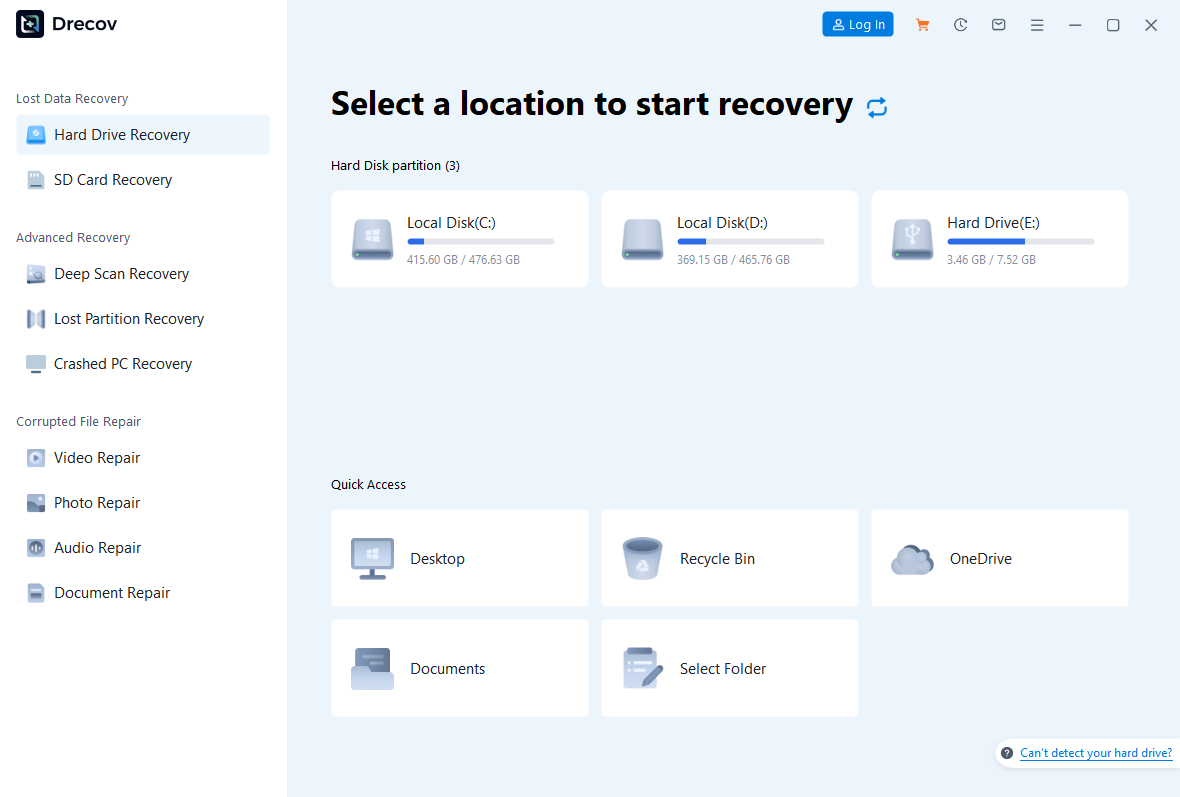
Step 1: Select the original location
Open Drecov and select the original loss location or the matching recovery mode. Install and run it from a healthy Windows volume, not from the affected source. Stop immediately if the device clicks, disconnects, changes capacity, or develops severe read errors.
Step 2: Run Quick Scan and assess the result
Start Quick Scan, then inspect former folders and relevant file categories. Search or filter by name, type, date, size, or location. Do not select everything merely because the scan lists it.
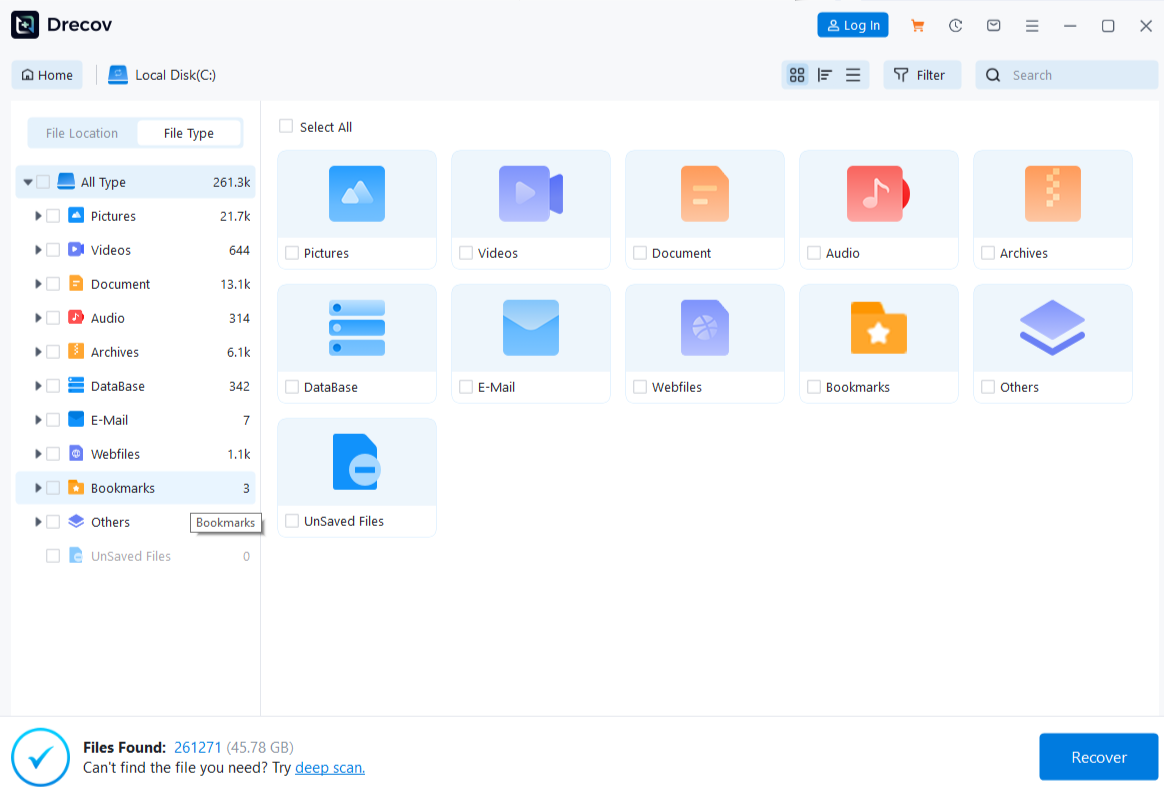
Step 3: Use Deep Scan only on a stable source
If Quick Scan does not locate the files and the device remains stable, run Deep Scan. This longer read can find additional logical remnants, but it cannot restore fully overwritten data or repair physical hardware.
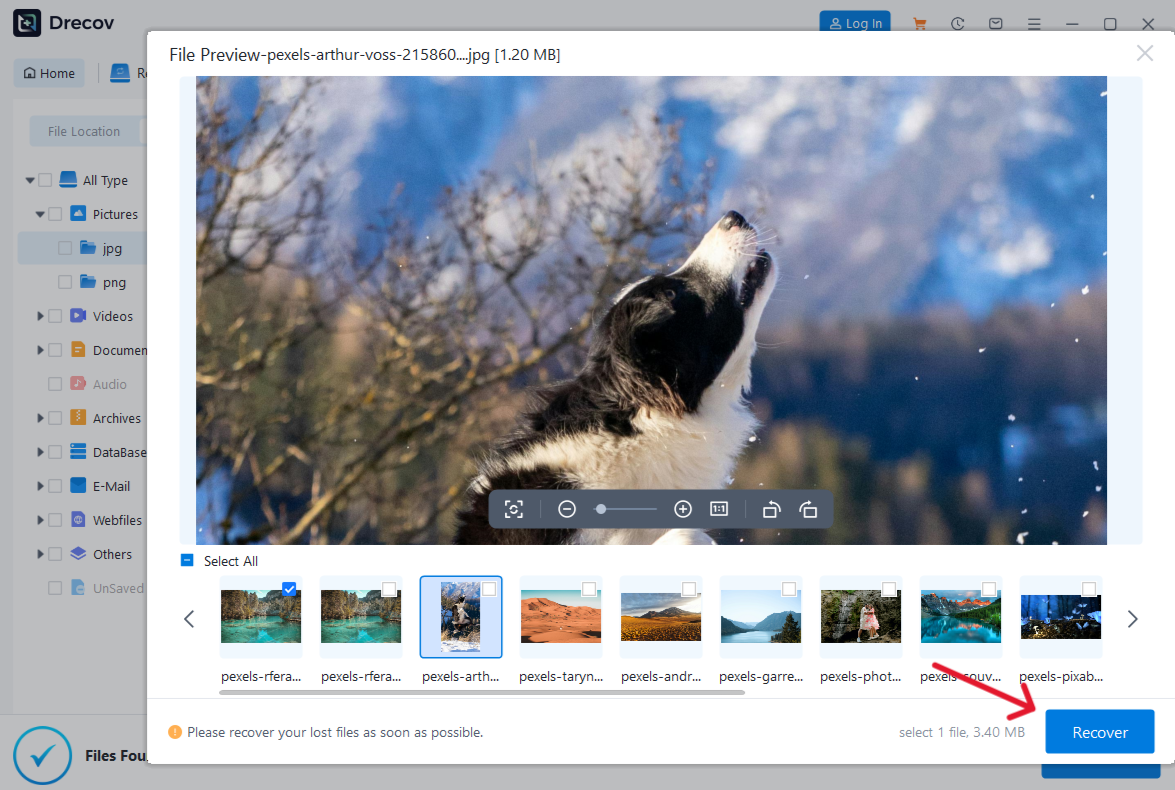
Step 4: Preview representative files
Preview several supported files from different folders and types. A readable preview is useful evidence, but it does not prove that every page, frame, archive member, or linked object is intact.
Step 5: Recover elsewhere and verify
Recover only the selected files to another healthy physical device, never to the source. Check the Drecov folder or Recovery folder if output is not where expected, then open representative results before repairing or retiring the original drive.
⚠ Warning: Install it on a drive different from the one where your data was lost to prevent overwriting.
When Imaging or a Laboratory Is Safer
1. Verification & Hardware Risk
Verify replacements via restart/reconnect tests, log reviews, and backup restores. Retire unreliable drives even if temporary reconnections work, and escalate if stable connectivity fails. Always bypass hubs during recovery. Cable swaps fix connection issues, but not media degradation; replace drives with recurring errors.
2. Isolating Failures
Single-file copy errors indicate unreadable regions, not application faults. Test with small known files from the same drive and cross-check external copies without writing data back.
3. RAW Volumes & Initialization Warnings
Cancel Windows initialization prompts—they mean layout metadata is missing, not that media is healthy. Accepting writes new signatures that risk overwriting data. Treat RAW volumes similarly: image or clone the drive first before attempting file-system repairs or reformatting.
4. Safe Recovery Practices
Never install software or download files onto the affected volume. Run recovery software from a healthy system and output to a separate drive. Use sector-by-sector imaging rather than standard file copies, and stop immediately if hardware deteriorates.
5. Compliance & Validation
Document chain of custody, permissions, and encryption keys for compliance. Verify recovered files by opening samples and checking integrity—never rely solely on directory names. Preserving data always supersedes completing a repair checklist.
Decision checkpoint
| Decision checkpoint | What the evidence changes | Verification |
|---|---|---|
| Stable, correct capacity, no unusual sound | One cable/port control, then recovery if files are missing | Repeated read plus recovered-file preview |
| Disconnects, clicks, heats, or changes capacity | Stop direct scans; image only if safely possible or use a specialist | Image log or laboratory intake record |
| Data safe and only logical errors remain | Repair or reformat the original after recovery | Full copy, reconnect, event log, and backup test |
Related guidance: I/O device error diagnosis, external-drive repair decisions, external hard-drive data recovery.
Microsoft hardware-error documentation is the primary reference for the platform behavior discussed here.
Questions that change the plan
What should never be the first response?
Formatting writes new structures and may erase evidence needed for recovery.
How is completion proved?
A repeatable result on a stable device, verified recovered files, and no new hardware warnings are required.
Can a different cable prove the drive is healthy?
No. A known-good cable can isolate one connection fault, but it does not test every sector or the electronics under sustained load. Copy important data, review logs, and test the replacement path before trusting the drive again.
Should CHKDSK run after the error?
Only after important data is recovered or safely imaged. CHKDSK changes file-system structures. It may improve mountability, but that repair can remove damaged references that a recovery tool or specialist would otherwise examine.
Does a successful Drecov preview guarantee recovery?
A preview confirms that one supported sample can be decoded from the scan result. It cannot certify every file, every frame, or the physical source. Recover selected data elsewhere and open a representative set before modifying the drive.
Keep the original evidence, logs, and protected copies until the result survives ordinary use. A safe resolution is not a quieter error message; it is a verified outcome with no unnecessary write to the source.
⚠ Warning: Install it on a drive different from the one where your data was lost to prevent overwriting.






