







What term is used to describe a logical drive? In a general storage discussion, volume is often the intended answer. In precise MBR terminology, a logical drive sits inside an extended partition. Those meanings are related, but they are not interchangeable in every context. For a quiz, check the supplied definition and answer choices. For a real computer, identify the storage layer before changing anything.
what term is used to describe a logical drive: safe diagnosis
Everyday language describes the storage you open: a drive containing documents, pictures, or applications. Technical descriptions may instead describe how space is divided on a disk. A teacher, an operating system, and a partition utility can therefore emphasize different properties while discussing the same files. Recognizing that difference is more useful than memorizing one word without its context.
General usage: the area Windows presents for files
When someone points to a usable storage area and calls it a logical drive, “volume” commonly captures the intended idea. The important contrast is with the hardware itself. You interact with an organized file-storage area, not directly with every sector of a physical device. Its label and access path help you find it, but neither is the device’s identity.
Specific usage: an MBR layout term
Microsoft’s basic and dynamic disk documentation distinguishes partitions, logical drives, and formatted volumes. On a basic MBR disk, logical drives are contained within an extended partition. GPT does not require that arrangement. Consequently, “logical drive” in an old partitioning lesson can mean something narrower than “a volume visible in Windows.”
A question that mentions an extended partition is signaling this narrower definition. A question contrasting a physical storage device with an operating-system storage unit may expect the broader answer. Without those clues, do not claim that every examination or application uses identical terminology.
Separate the hardware, the storage area, and its address
Consider a laptop with one internal SSD and a connected USB drive. File Explorer might show several letters, even though only two physical storage devices are involved. A single device can contain multiple storage areas. Conversely, the name you see in a file dialog tells you little about which hardware will fail if a device stops working.
A compact map of the layers
| Layer | What it describes | What it does not prove |
|---|---|---|
| Physical disk | The storage device containing data | That it contains only one accessible volume |
| Partition or layout entry | A division of the device’s address space | That its files are readable |
| Volume | A storage area organized for operating-system access | That it is a separate backup device |
| Drive letter or mount point | A path used to reach storage | A permanent hardware identity |
| Folder | An organizational location within accessible storage | A separate disk or partition |
This map explains why copying a folder from C: to D: is not automatically an independent backup. Both letters may belong to the same SSD. The copy can help with an accidental file edit, but it does not isolate you from that SSD’s physical failure. Check the actual layout before relying on it.
Do not confuse file systems with partition styles
NTFS and exFAT describe ways of organizing files. GPT and MBR describe partition layouts. They answer different questions. A Windows volume does not become an MBR logical drive simply because it uses NTFS. For the separate layout-selection question, use the explanation of GPT and MBR partition styles, rather than treating the terms as competing file formats.
Read your own layout without editing it
Open Disk Management through Windows search and use it for observation only. Match the graphical disk entries with their capacities, then note the volumes associated with each device. Compare that information with File Explorer. You are establishing relationships, not testing a repair. Dismiss prompts to initialize an unfamiliar disk while you determine what it contains.
Make a small identification note
For the drive that matters, record its label, capacity, current letter, and the disk entry beneath it. Add the physical device description when available. This combination is safer than writing down a letter alone. Connecting another device or entering a recovery environment can change the letter you expect to see.
Do not remove a working internal disk merely to identify it. The aim is to compare information already available. A screenshot can help you remember the arrangement, but it is not a backup of the files or partition structures. Keep it separate from any decision to resize, delete, or format a volume.
Distinguish free space from missing storage
Free space inside a working volume is available to its file system. Unallocated space is not the same observation. When a previously used area suddenly appears unallocated, creating a new volume is not a harmless way to reveal the old files. Stop and investigate the change. A new layout can write metadata where recovery needs the existing information.
Three practical decisions the terminology helps you make
Choosing a backup destination
Select a separate healthy device when you need protection from source-device failure. Confirm which hardware holds the destination instead of trusting a different letter. The discussion of an external-drive backup you can restore develops that planning task. Here, the key lesson is that logical separation and physical separation are different protections.
Responding to a missing letter
A missing letter does not establish that the files were deleted. The device may be disconnected, locked, or represented differently. Inspect its state and check existing copies before choosing recovery software. Do not format merely to make a new letter appear. Formatting answers a preparation question, not a missing-file question.
Deleting an unwanted storage area
A folder, a volume, and a disk are different deletion targets. Confusing them can remove far more than intended. Before any partition removal, verify the affected device and its backup. Follow a dedicated partition-deletion safety procedure; this terminology explanation is not authorization to alter your layout.
If the missing volume also contains missing files
Learning the terminology does not require a scan. Recovery becomes relevant only when needed files are genuinely lost or inaccessible. Stop writing to the affected device and check backups first. Repeated disconnections, severe read errors, or physical damage call for professional assessment or specialist imaging, not repeated direct scans.
What Drecov can contribute to this specific problem
PandaOffice Drecov is Windows data recovery software for PCs, HDDs, SSDs, external drives, USB devices, and memory cards. It supports common document, photo, video, audio, email, and archive recovery workflows. Its read-only recovery mode keeps the search separate from source repairs. Quick Scan and Deep Scan locate candidates; filtering and supported previews help identify the missing volume’s contents.
⚠ Warning: Install it on a drive different from the one where your data was lost to prevent overwriting.
It helps diagnose what term is used to describe a logical drive without changing the source data. Lost Partition Recovery is relevant when the original partition is missing. It does not mean Drecov rebuilds the partition table or repairs damaged hardware. Overwritten files may be unrecoverable, and SSD TRIM can sharply limit results. Prepare a different healthy device with enough space. Do not install the software on the partition containing the lost files.
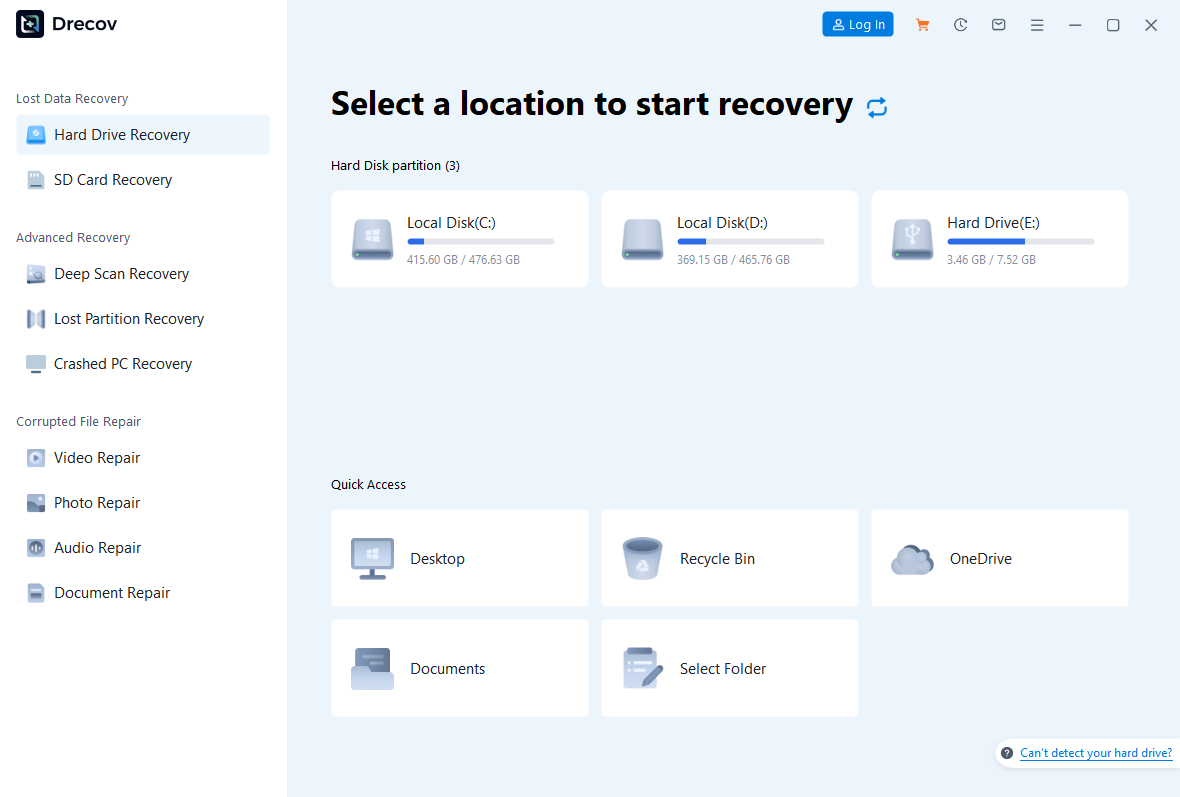
Step 1: Open Drecov and identify the original source
This check is especially useful for what term is used to describe a logical drive. Select the device or original location that held the missing files. Use the capacity and device notes from your earlier inspection. When the partition itself is absent, use the relevant Lost Partition Recovery workflow rather than creating a replacement volume. Do not select the new backup destination as the source.
Step 2: Review the initial Quick Scan results
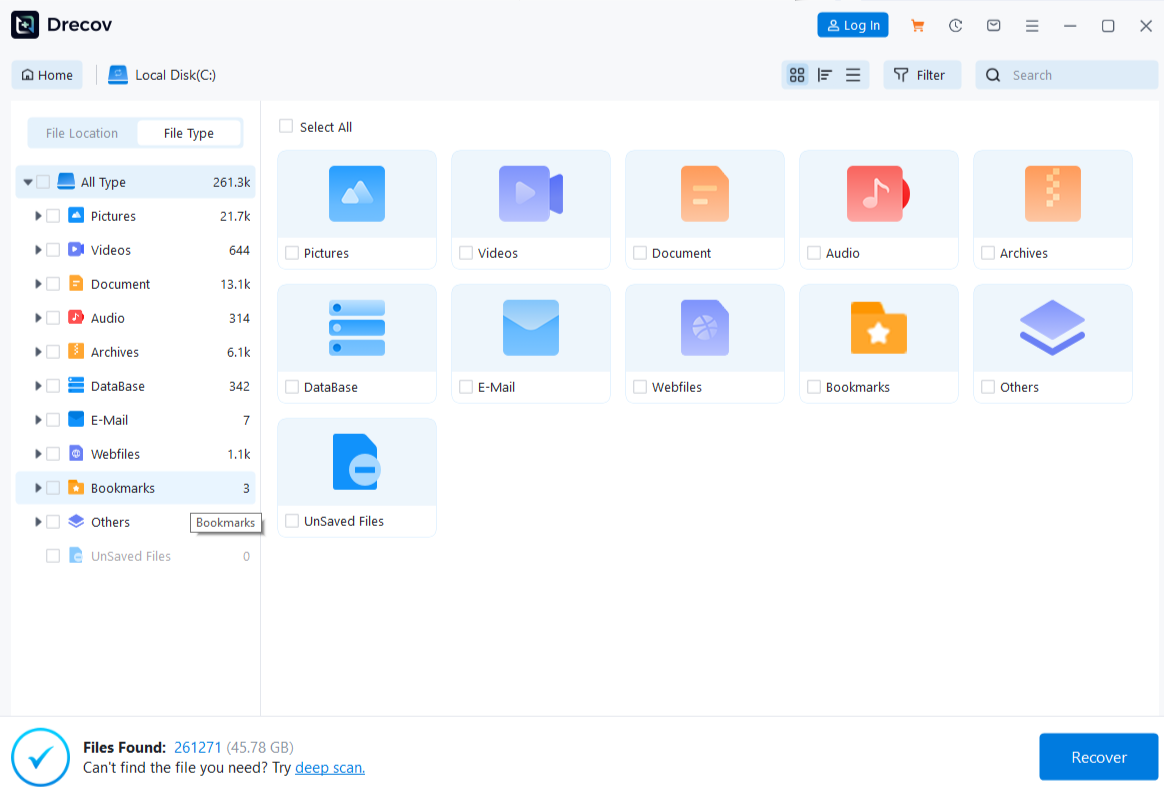
Run Quick Scan where available in the selected workflow. Look for familiar folder names and a representative document from the missing area. The presence of a recognizable filename is encouraging but does not prove that its contents are intact. Keep source and destination identities separate throughout.
Step 3: Extend the search only while the device stays stable
When the initial search misses your documents, consider Deep Scan on the identified source device. Proceed only while it remains reliably readable. Stop if the device disconnects or develops serious read errors. Repeating a scan cannot repair unstable electronics, and continued access may reduce the chance of a useful specialist recovery.

Step 4: Locate and preview relevant candidates
Filter or browse by available file type, filename, and original location. Compare several files with what you remember from the volume. Preview supported examples, recognizing that a preview cannot certify every page or frame. An unsupported preview alone is not proof that the recovered file will be unusable.
Step 5: Save files onto different hardware
Recover into a clearly named folder on the healthy destination device. A second letter on the same source disk is not the safe destination described here. Keep competing versions separate instead of overwriting equal filenames before comparison.
⚠ Warning: Install it on a drive different from the one where your data was lost to prevent overwriting.
Step 6: Open the results before changing the layout
If the chosen destination appears empty, inspect its Drecov Folder or Recovery Folder for the exported volume contents. Open important documents and sample media in their normal applications. Verify the needed content, not just the file count. Only afterward consider repair, partition changes, or formatting, with an appropriate plan for the original fault.
What term is used to describe a logical drive FAQs
Is every partition a logical drive?
No. Precise MBR terminology distinguishes primary partitions from logical drives inside an extended partition. Broader informal usage should not erase that distinction.
Does D: always mean a second disk?
No. It is an access letter. Check which physical device contains that volume before choosing it as a backup or recovery destination.
Can a volume exist without an obvious drive letter?
Yes. A letter is not the definition of a volume. Avoid changing system or recovery areas merely because they are not shown like an ordinary documents drive.
Does GPT need an extended partition?
No. The extended-partition arrangement belongs to the MBR model discussed above. Do not create one simply to match an older lesson.
Will creating a new volume restore a deleted one?
No. New volume creation is a modifying operation, not file recovery. Preserve needed data before making replacement storage structures.
Conclusion
“Volume” often answers the general logical-drive question; an MBR lesson requires the narrower definition. Identify the physical device, storage area, and access path separately. When real files are missing, Drecov can support recovery from stable media to another device. Terminology should help prevent the wrong change, not encourage unnecessary repairs.
⚠ Warning: Install it on a drive different from the one where your data was lost to prevent overwriting.





