







When your PC couldn’t start properly, do not keep selecting Restart without learning what happens next. One controlled restart is reasonable. A repeating Automatic Repair loop needs a different response: note the error code, check whether the Windows drive is stable, protect files that lack a backup, and then choose the least destructive recovery option that matches the evidence.
your PC couldn’t start properly: safe diagnosis
The blue recovery screen often offers Restart and Advanced options. Restart merely tries the same boot path again. Advanced options opens Windows Recovery Environment, commonly called WinRE, where Startup Repair, Startup Settings, System Restore, Uninstall Updates, Command Prompt, and reset choices may be available. Their names sound similar, but they change different parts of the system.
Photograph the full message and any code, such as 0xc0000001, 0xc0000225, or a named driver. Record what happened just before the failure: an update, a power interruption, a storage change, a driver installation, or no obvious event. That small timeline is more useful than running a long list of unrelated commands.
| What happens | What it suggests | Safer next move |
|---|---|---|
| The PC starts after one restart | Temporary update or shutdown interruption | Back up current files and review recent reliability events |
| Safe Mode opens | A startup app, service, update, or driver may be involved | Copy files, then reverse the most recent change |
| Windows volume is readable in WinRE | Boot problem with accessible storage | Protect files before boot repair or reset |
| The disk disappears or disconnects | Connection, controller, or physical instability | Stop repeated attempts and consider imaging or professional recovery |
| BitLocker asks for a key | The encrypted volume is locked in WinRE | Locate the recovery key rather than formatting the volume |
Decide whether the disk is safe enough for DIY work
A Windows startup error is not automatically a failing drive. Still, storage condition changes the entire plan. A logically damaged but stable SSD or hard drive usually remains detected with the expected capacity and can list folders consistently. An unstable device may vanish between starts, show the wrong size, freeze directory listings, produce serious read errors, or make abnormal mechanical sounds.
Do not run repeated scans, CHKDSK, reset, or reinstall operations against unstable media. Power down and check one known-good connection if that can be done safely. When valuable files exist only on that disk, a sector-level image or a professional recovery service is safer than hours of repair attempts. Software cannot repair physical damage.
SSD behavior also deserves caution. Continued Windows use, reset, and reinstall activity writes new data, while TRIM may reduce the prospects of recovering deleted content. The exact outcome varies, so avoid guarantees. The practical rule is simple: reduce writes until the important data is safe.
Try reversible Windows recovery options first
Disconnect nonessential USB storage, docks, and memory cards before another test. Leave the keyboard, mouse, display, and required system disk connected. An old external boot entry can send firmware to the wrong device, while a failing accessory can delay startup. If the PC then reaches Windows, reconnect devices one at a time.
Use Startup Settings when Safe Mode is available
From Advanced options, choose Startup Settings and restart into Safe Mode. Safe Mode loads a reduced set of drivers and services. If it works, copy important user files first. Then uninstall or roll back the recent driver, update, security package, or startup utility most closely tied to the failure. Change one item at a time and keep notes.
Remove the latest update only when timing supports it
Uninstall Updates can remove the latest quality or feature update from WinRE. It makes sense when the problem began immediately after Windows updated. It is less useful when the disk is unstable, firmware settings changed, or the failure began after installing hardware. Keep the diagnosis tied to the timeline.
Use System Restore without confusing it with file backup
System Restore can roll system files, drivers, registry settings, and installed applications back to a restore point. It is not a substitute for a personal-file backup. Read the affected-programs list before continuing, and protect unique files first when the disk contains the only copy.
Give Startup Repair one controlled attempt
Startup Repair can address certain damaged startup components automatically. Microsoft documents how to access and use Startup Repair in Windows. Run it once after confirming the correct Windows installation. If it fails, read its result or log rather than launching an endless loop.
Protect local files before reset, repair commands, or reinstall
Reset this PC and a clean installation are not first-line diagnostic tools. “Keep my files” is less destructive than “Remove everything,” but it still removes applications and changes Windows. A failed reset can leave the machine in a worse state. Command-line boot repairs, partition changes, formatting, and CHKDSK also write to the source. Confirm a usable backup or recover files before those steps.
If the Windows volume is stable and local files are missing or inaccessible, Drecov can support the data-protection stage. It is Windows data recovery software for PCs, hard drives, SSDs, external drives, USB drives, SD cards, and memory cards. It can locate photos, videos, documents, e-mail data, audio, and archives through read-only recovery, Quick Scan, Deep Scan, filtering, preview, and recovery to another healthy location.
⚠ Warning: Install it on a drive different from the one where your data was lost to prevent overwriting.
Lost Partition Recovery applies when a former partition is missing, while Crashed PC Recovery supports the relevant unbootable-PC workflow. These modes recover files; they do not fix the Windows bootloader, rebuild hardware, decrypt a BitLocker volume without its key, or recover content that has been fully overwritten.
Recover files from a stable PC that will not start
Prepare another healthy drive with enough free capacity. Do not install recovery software on the partition that contains the missing files. If the source starts disconnecting, reports escalating read errors, or becomes unusually slow, stop direct scanning and switch to imaging or specialist help.
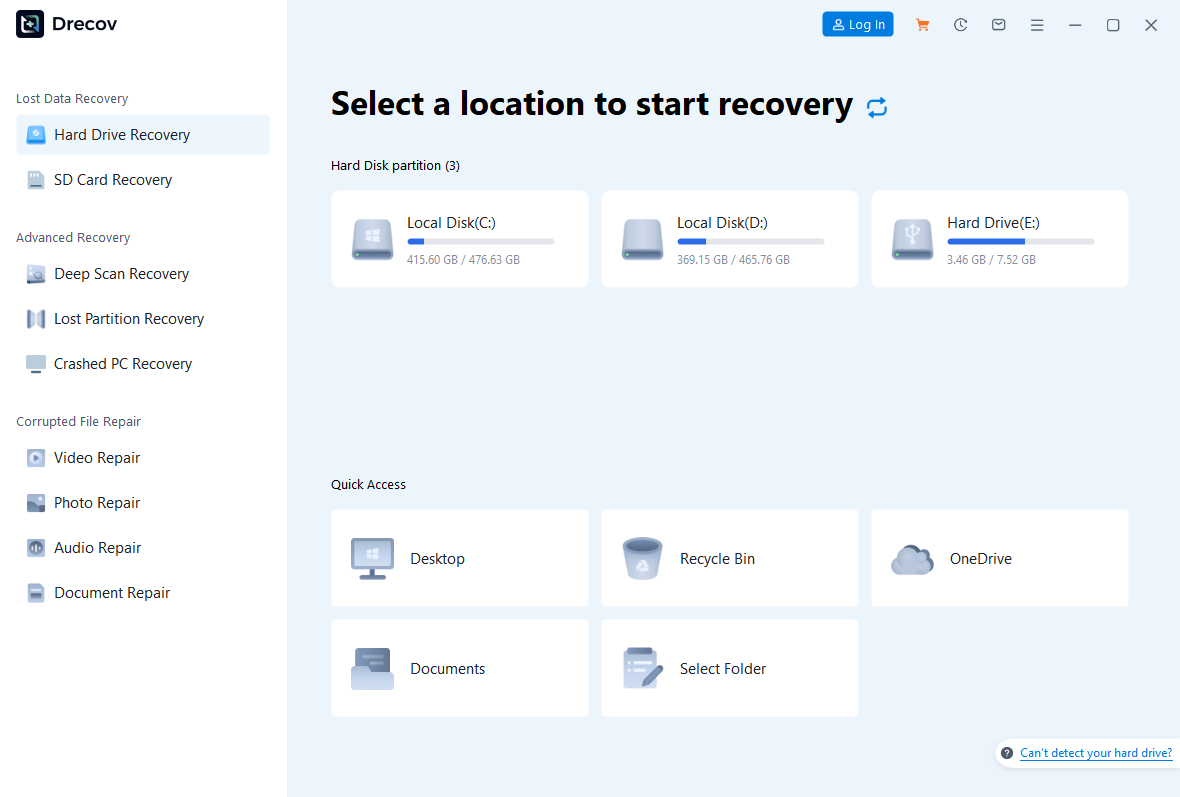
Step 1: Open Drecov and select the original Windows location
Start Drecov in a working Windows environment and select the original user-data partition or the recovery mode that matches the loss. Confirm the disk by model and capacity instead of assuming that its drive letter stayed the same. Choose Lost Partition Recovery only when the former partition is absent, and use Crashed PC Recovery for its supported startup-loss scenario.
Step 2: Run Quick Scan and inspect the user profile
Begin with Quick Scan. Look under the former Users profile and prioritize Desktop, Documents, Pictures, project folders, and other unique data. Filter by type, path, file name, date, and expected size so replaceable Windows files do not hide the important results.
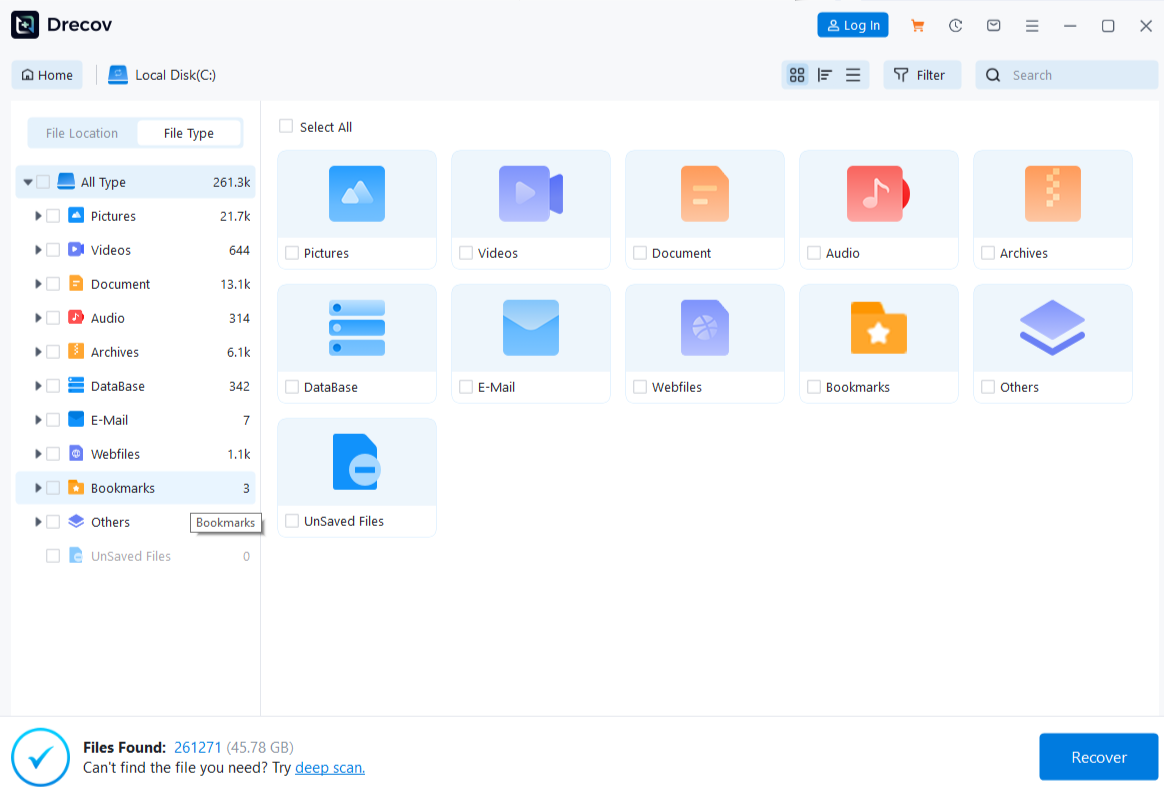
Step 3: Use Deep Scan only while the source remains stable
Continue with Deep Scan if Quick Scan misses required folders and the disk still behaves normally. A deep result may not preserve every original name or path. Compare dates, sizes, types, and previews. Stop the scan if new instability appears.
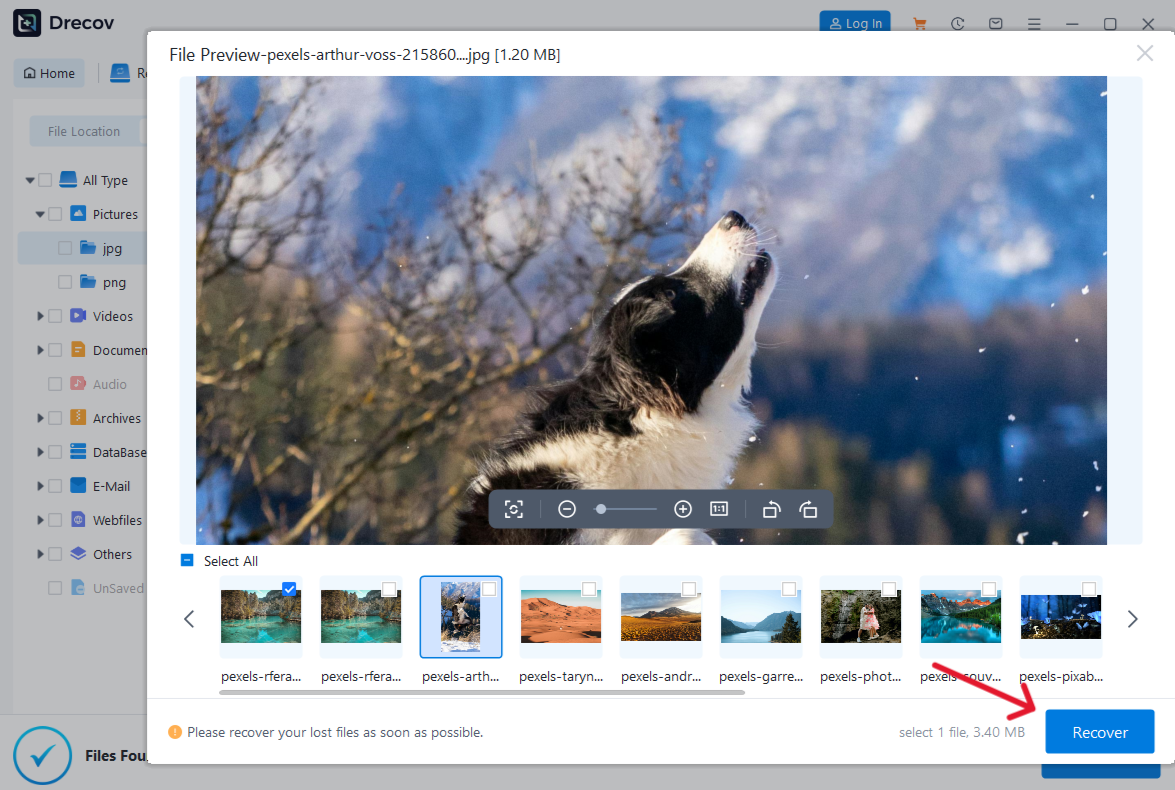
Step 4: Preview representative files
Preview several supported documents, photos, and videos before selecting the full set. A preview shows that the displayed sample can be decoded. It cannot promise that every page, frame, archive member, database record, or linked asset is intact.
Step 5: Recover to the separate healthy drive
Save selected files to the prepared destination, never back to the source. Writing recovered data to the damaged Windows volume can overwrite other recoverable content. If the output is not where expected, check “Drecov Folder” or “Recovery Folder.”
⚠ Warning: Install it on a drive different from the one where your data was lost to prevent overwriting.
Step 6: Open and verify the recovered set
Open a sample of every important format directly from the destination. Check document pages, video duration, archive extraction, photo dimensions, and the newest project versions. Keep the original disk unchanged until the recovery has been verified. Related pages on recovering files from a PC that will not boot, Startup Repair failure, and a missing Windows Boot Manager cover adjacent situations without replacing this decision path.
Choose reset or reinstall only after verification
Once the files are safe, return to the evidence. A driver-related Safe Mode success points toward rollback or clean driver installation. An update-timed failure supports uninstalling that update. A verified boot-configuration problem may need targeted BCD or EFI work. Reset makes more sense when Windows components are broadly damaged and reversible methods have failed.
Before resetting, confirm which option is selected, where application installers and license information are stored, and whether encryption keys are available. After reinstalling, do not erase the recovery destination. Verify the repaired system over several starts, then copy back only known-good data.
FAQ
Does “Your PC couldn’t start properly” mean the drive is dead?
No. Updates, drivers, boot files, power loss, and firmware settings can cause the same screen. A missing, clicking, or repeatedly disconnecting drive is a stronger hardware warning.
How many times should I press Restart?
One controlled restart is reasonable after a temporary interruption. If the same screen returns, use Advanced options and diagnose the cause instead of repeating the loop.
Will Startup Repair delete personal files?
It is designed to repair startup components, not erase personal files. Nevertheless, any write to an unprotected or unstable disk carries risk, so important data should be backed up first.
Can Drecov make Windows boot again?
No. Drecov recovers files from supported storage. Windows recovery tools or technical repair address the operating system after the files are safe.
Should recovered files go back to the Windows disk?
No. Recover to another healthy device and verify the files there. Returning them to the source too early can overwrite data that is still recoverable.
Conclusion
When your PC couldn’t start properly, let the screen, recent changes, and disk condition decide the next move. Try reversible WinRE options first, but protect unbacked local files before reset, command-line boot repair, or reinstall. Drecov can recover files from a stable Windows storage source to another healthy drive; it cannot repair an unstable device or Windows itself. Verify the recovered set, then apply the specific system fix supported by the evidence.
⚠ Warning: Install it on a drive different from the one where your data was lost to prevent overwriting.





